
Newsletter 16-37

Issue 16-37, September 25, 2016


+————————————CONTENTS—————————————-+

  1. MESSAGE FROM THE CHAIR: WHERE DO MY REGISTRATION FEES GO?
  2. IMPORTANT UPDATES TO NSF GRANT PROGRAMS
  3. DPS 48/EPSC 11 EARLY CAREER PRESENTER’S REVIEW
  4. TRICK-OR-TREAT AND TELESCOPES
  5. UPCOMING MEETINGS AND WORKSHOPS
  6. JOBS, POSITIONS, OPPORTUNITIES

+——————————————————————————————–+


1———1———1———1———1———1———1———1———1———1

MESSAGE FROM THE CHAIR: WHERE DO MY REGISTRATION FEES GO? 


With the Pasadena DPS/EPSC meeting forthcoming in just a month now,

I thought that I might throw out some numbers with respect to where your

money goes when you register for a DPS meeting.  The Full Member, early

registration this year was $588.  It was $478 for the previous Pasadena DPS,

in 2010.  That’s a bit above inflation (which would have sent it at $536), but

not too far off.  However registration at the 2006 Pasadena meeting was just

$225!  What happened between 2006 and 2010? 


We grew.  It used to be that a DPS meeting was small enough that a volunteer

Local Organizing Committee (LOC) Chair could run the whole meeting.  The

LOC Chair used to negotiate contracts with venues, hotels, and such.  As the

DPS attendance has grown, the LOC Chair job became too big.  It is just too

much to ask for a scientist to volunteer a year of their time to keep registration

costs down. 


Since then we have professionalized DPS meeting planning.  Our parent

organization, the American Astronomical Society (AAS), now has a team of

people whose job it is to run meetings.  They take care of us here at the DPS

as well as the AAS Summer and Winter meetings.  This professionalization

comes at a price, of course:  just under a quarter of the total meeting allocation

($144,000, or $156 per person) goes to the AAS in exchange for running the

meeting (staff time, travel, and overhead).   


I think that this cost is money well spent:  I want meeting professionals

bearing the brunt of the burden for planning the DPS meeting, and I want

our scientists doing as much science as they can with their time.  We get

significant value from the AAS’ organizational skills, too, including a huge

increase in the amount of sponsorships to over $95,000 this year that we

receive from our generous sponsors but also due in large part to the diligence

of Debbie Kovalsky, the Sponsorship Coordinator up at the AAS. 


The single biggest meeting expense that we have is food.  You wouldn’t

believe how much planetary scientists eat!  We have budgeted over $192,000

($207 per person) this year for catering alone — itself almost as much as the

entire 2006 meeting cost us ($199,390).  Catering is where meeting spaces

make their money; technically the facility rental was just $35,000 for the

Pasadena Convention Center, provided we spent enough on food. 


The rest of our estimated $650,000 meeting budget this year derives from

‘small’ charges:  $25,000 for internet; $62,500 for A/V; $35,000 for the

exhibition setup contractor.  Security, program books, credit card processing

fees.  It all adds up. 


As the vast majority of our revenue comes from your registration fees, the

DPS Committee will be making a minor change to our fees policy moving

forward.  We have started adding in an on-site registration surcharge as

insurance.  The idea is to offset the possibility that all of you NASA folks

who don’t get travel approval until 2 days before the meeting end up having

to cancel your plans due to a government shutdown (at least 5% probability

I think).   


Thanks to Kelly Clark, the AAS CFO, for her help providing the budget

numbers for this Fall’s meeting and for inspiring this Message.  I look

forward to seeing you all in Pasadena, 


Jason W. Barnes

DPS Chair


2———2———2———2———2———2———2———2———2———2

IMPORTANT UPDATES TO NSF GRANT PROGRAMS


Below, the NSF Division of Astronomical Sciences (AST) provides information 

regarding a number of our individual investigator funding opportunities. 

For all programs, prospective proposers should pay close attention to the changes 

this year in the Grant Proposal Guide, NSF 16-1 

(http://www.nsf.gov/publications/pub_summ.jsp?ods_key=gpg),

which describes all requirements except for those superseded specifically 

in an individual solicitation:


·      AST is beginning a pilot “no-deadline” program for proposals in solar and 

planetary astronomy. Proposals that address topics related to planetary systems

— including exoplanets, our own solar system, and solar physics — should be 

submitted in response to the new “Solar and Planetary Research Grants (SPG) 

solicitation NSF 16-602 (http://nsf.gov/pubs/2016/nsf16602/nsf16602.htm.

These proposals may be submitted at any time.  Previously, these proposals

were submitted to the Astronomy and Astrophysics Research Grants (AAG) 

program (see below).  Although SPG proposals may be submitted any time 

throughout the year, proposals submitted to SPG after November 15, 2016, 

but judged to be more appropriate for the AAG program may be returned 

without review. If you are unsure whether your proposed research fits into 

SPG, please contact one of the program officers listed in the SPG solicitation 

website.

·      The Astronomy & Astrophysics Research Grants program (AAG) considers 

proposals in support of observational, theoretical, laboratory, and archival data 

studies in all other areas of astronomy and astrophysics. Proposals submitted by

November 15, 2016 (5 PM local time of the submitting institution) will be

considered for funding in FY2017.  Please see the solicitation NSF 16-574 

(http://www.nsf.gov/pubs/2016/nsf16574/nsf16574.htm ).

·      Proposals for the Advanced Technologies and Instrumentation (ATI) program

are due by November 1, 2016, also at 5 PM local time of the submitting institution. 

See http://www.nsf.gov/funding/pgm_summ.jsp?pims_id=5660 .

·      The Partnerships in Astronomy and Astrophysics Research and Education (PAARE) 

      program is not accepting new proposals this year.  For a description of the PAARE 

      program, please see http://www.nsf.gov/funding/pgm_summ.jsp?pims_id=501046 .

·      NSF will not issue a second solicitation for the Theoretical and Computational 

      Astrophysics Networks (TCAN) program.  Given the realized budgets so far this 

decade, any funding for TCAN would come from a matching reduction in AAG

funding, which would be contrary to the 2010 decadal survey recommendation. 

Prospective TCAN proposers should instead propose to the AAG or SPG programs

described above.  They may wish to designate their proposal as being responsive to the 

NSF emphasis area of Computational and Data-Enabled Science and Engineering 

(CDS&E) if the proposal satisfies one or more of the special CDS&E criteria.  See 

http://nsf.gov/funding/pgm_summ.jsp?pims_id=504813 for a description of CDS&E.


3———3———3———3———3———3———3———3———3———3

DPS 48/EPSC 11 EARLY CAREER PRESENTER’S REVIEW

Are you an early career scientist preparing to present your research 
at the DPS 48/EPSC 11 meeting? Are you nervous? Are you looking for 
advice? Join others like you to receive feedback from seasoned 
presenters! Participants in the Early Career Presenters Review have 
the opportunity to present their DPS 48/EPSC 11 oral or poster 
presentation and receive feedback before presenting during the 
regular meeting. In addition to presenting their research, 
participants have the opportunity to network with their peers and 
future colleagues. The review will be held Sunday, October 16 
from 1-5pm in Conference Building C107. Register at:

https://www.surveymonkey.com/r/dps2016_early_career

The deadline to register is 5:00pm Central Time, October 12, 2016. 
Registration is limited to 20 presenters. Scientists wishing to 
participate by providing feedback to the early career presenters 
should contact Andy Shaner at [email protected].


4———4———4———4———4———4———4———4———4———4

TRICK-OR-TREAT AND TELESCOPES


Based on an activity that DPS member Richard Schmude Jr. has been doing 

for years, with over 5000 children reached, DPS is initiating the program 

Trick-or-Treat and Telescopes. We are encouraging people to put out their 

telescopes during trick-or-treat time on Halloween, in their own lawns or in 

a neighbor’s lawn with better viewing (or more traffic). The following website 

gives advice and connections to resources. 


education/trick-or-treat-and-telescopes 


5———5———5———5———5———5———5———5———5———5

UPCOMING MEETINGS AND WORKSHOPS
 

A) DAP-2017 CALL FOR ABSTRACTS

The Dust, Atmosphere and Plasma environment of the Moon and Small 
Bodies (DAP-2017) workshop will be held at LASP in Boulder, Colorado on 
January 11-13, 2017. The workshop will be a forum to (i) discuss 
current understanding of the surface environment of the Moon, the moons 
of Mars, and comets and asteroids, (ii) share new results from past and 
ongoing missions to airless bodies and comets, and (iii) describe 
expectations for planned upcoming missions to airless bodies and 
comets. The meeting web site is hosted at: 

http://impact.colorado.edu/dap_meeting.html

DAP-2017 is a NASA/SSERVI follow up on two previous NASA/NLSI-SSERVI 
workshops, LDAP-2010 and DAP-2012. Contributions to LDAP-2010 and 
DAP-2012 were published in special issues of Planetary and Space 
Sciences. A similar volume is planned to report the contributions to 
DAP-2017.

The workshop is hosted by M. Horanyi and A. Stern, and supported by 
NASA’s Solar System Exploration Research Virtual Institute (SSERVI): 
Institute for Modeling Plasma, Atmospheres, and Cosmic Dust 
(IMPACT), the Laboratory for Atmospheric and Space Physics (LASP), and 
the Center for Integrated Plasma Studies (CIPS) of the University of 
Colorado.

The DAP-2017 abstract deadline is Sept. 30th, 2016; submit your 
abstract to [email protected]


B) NASA ADVISORY COUNCIL PLANETARY SCIENCE 

     SUBCOMMITTEE (PSS) MEETING

     September 29-30 2016


The meeting will be open to the public up to the capacity of the room.  

The meeting will be available telephonically and by WebEx.  


Any interested person may call the USA toll free conference call 

number 1-877-918-9234, passcode 4532334, on both days, to participate

in this meeting by telephone. A toll number also is available, 

1-630-395-0299, passcode 4532334, on both days. 


The WebEx link is https://nasa.webex.com/

the meeting number on September 29 is 996 721 448, password is PSS@Sep29; 

and the meeting number on September 30 is 999 540 202, password is PSS@Sep30. 


C) BREAKTHROUGH LISTEN WORKSHOP


The Breakthrough Listen Project and the Green Bank Observatory

(GBO) are sponsoring a Breakthrough Listen North American Community

Workshop that will  be held 5-6 October 2016 at the GBO in Green Bank,

West Virginia, USA. This  Workshop will discuss the goals, strategies and

capabilities of the  Breakthrough Listen Project, including commensal and

ancillary science  opportunities, and will broadly explore the search for

extraterrestrial  intelligence in the modern era. 


To attend, please register by 30 September at the Breakthrough Listen

Workshop website:

http://go.nrao.edu/breakthrough_listen 


The Breakthrough Listen Initiative was launched 20 July 2015 at the

Royal Society in London, U.K., with a charge to conduct the most

comprehensive and sensitive search for advanced life in humanity’s

history. Observations are currently being conducted at radio and optical

wavelengths, in part using the Green Bank Telescope from 0.3 – 100 GHz. 


We look forward to seeing you in Green Bank!


D) ARIZONA – JAXA WORKSHOP 2016


The Institute of Space and Astronautical Science (ISAS) of the Japan 

Aerospace Exploration Agency (JAXA) and the Lunar and Planetary 

Laboratory (LPL) of the University of Arizona will hold a workshop 

dedicated to planetary science enabled by missions launched by the 

Epsilon launcher of JAXA on November 15 and 16, 2016, at LPL in 

Tucson, Arizona. 


Given the nature of the workshop described below, participation will be

limited to the first 50 registrants. 


ISAS has defined three mission classes by which space science will be 

pursued systematically. 

(A) ISAS strategic L-class missions to be launched by the H-IIA/III 

       launcher (such as the Martian Moons eXplorer (MMX), the mission 

       under consideration to return samples from Phobos);

(B) ISAS competitive M-class missions to be launched by the Epsilon 

       launcher (the topic of this workshop); and

(C) Participation in large-class missions to be led by foreign agencies.


The focus of this workshop is to exchange ideas on how to make the 

Epsilon class missions fruitful for the world-wide planetary science 

community. The planned cadence of these small missions is a launch 

every other year. Due to resource limitations (launch capability, budget,

technology for a key instrument not available in Japan), however, it is 

not necessarily easy to construct a good planetary mission plan if a team 

is to be limited to domestic members. Before fully internationalizing 

M-class missions, ISAS wants to evaluate whether the Epsilon-class 

planetary missions are attractive to the international communities. 


Three specific mission candidates in different phases will be subject to 

discussion among the participants of the workshop. The Epsilon-class 

missions to be discussed are:


SLIM is a small-scale technology demonstration mission of precise 

(100m-level) landing on the lunar surface. It has been selected already

and is planned for launch in FY2019. The severe limitation in resources 

allows only a multi-band camera to be onboard for scientific observations. 


In APPROACH (Advanced Penetrator PRObes Applied for a Challenge 

of Hard-landing), two miniaturized penetrators would be dropped to the 

lunar surface at 100-300 m/s for technology demonstration as well as for 

three months of seismic and heat flow observations.


The DESTINY+ (Demonstration and Experiment of Space Technology 

for INterplanetary voYage, Phaethon fLyby with reusable probe) mission 

would fly by asteroid 3200 Phaethon, the parent body of the Geminid 

meteor shower. During the cruising phase, physical and chemical properties 

of background dust (interplanetary and interstellar dust particles) and 

meteoroid dust in the dust stream will be measured in-situ. In-situ dust 

measurements will also be made near Phaethon. 


To register, or to see more details of the workshop plans and objectives, 

please see the workshop website at 

https://jaxaworkshop2016.lpl.arizona.edu/


E) ICES IN THE SOLAR SYSTEM WORKSHOP

23-27 January 2017 at the European Space Astronomy Center (ESA/ESAC), 
near Madrid, Spain. Even if you have done a pre-registration to this 
workshop, you need officially register at: 

http://www.cosmos.esa.int/web/ices-in-the-solar-system/home
 
The topics will include: 

* Experimental research and associated modeling (preparation of 
ice analogs and experimental weathering in the lab, analysis and 
modeling techniques to infer optical, thermal, mechanical, 
electrical, thermodynamical, structural and compositional 
properties.

* Mission data revealing ices and their properties, composition, 
geological context and history in the Outer Solar System (Rings, 
icy moons, KBOs and Kuiper Belt), Asteroid Belt, Mars (polar 
caps, ground ice) or well within the snow line (Mercury, Moon).

* The astrobiological potential of ices and their role and transport 
during the Solar System evolution- including the connection to the 
interstellar medium, proto-solar nebulae, icy giants and 
planetesimals formation. 

Abstract submission deadline: November 15th 
Session program available: November 29th

Note that there may be the possibility to include your contribution 
into a special workshop publication issue.

Sponsorship for students, in the form of lump sum payment, 
will be available, upon review of the submitted abstract 
by the Science Organizing Committee. See details at:

http://www.cosmos.esa.int/web/ices-in-the-solar-system/students_support


F) ASTROMETRY AND ASTROPHYSICS IN THE GAIA SKY

IAU Symposium 330
24-28 April 2017
Nice, France

http://iaus330.sciencesconf.org/

The first release of the Gaia data has been made publicly available 
on September 14, 2016. Besides a catalogue of 1.1 billion source 
positions and broad-band G-magnitudes, this DR1 also includes the 
positions, G-magnitudes, parallaxes, proper motions for 2 million 
stars in common between the Tycho-2 Catalogue and Gaia (TGAS). Light 
curves for 3194 Cepheids and RR Lyrae are also part of the release 
as well as a special astrometric solution for 2152 ICRF quasars.

The goal of this IAU symposium is to ensure the world-wide sharing of
the Gaia mission results that will cover the following topics:
astrometry and reference frames, Milky Way galaxy and stellar physics
and the Solar system bodies. 

The next close deadlines are:

November 1st: IAU grant application
December 4: Abstract submission

Registration to the symposium is open. Space is limited.

More details are available at the conference website: 

http://iaus330.sciencesconf.org/

Alejandra Recio-Blanco, Anthony Brown and Timo Prusti (for the SOC)
Patrick de Laverny (for the LOC)

Contact: [email protected]


G) VEXAG MEETING #14 – Call FOR PRESENTATIONS 

    AND REGISTRATION
    
Venus Exploration Analysis Group (VEXAG) Meeting #14 will be held 
on Tuesday-Thursday, November 29 – December 1, 2016 at NASA 
Headquarters, James E. Webb Memorial Auditorium, 300 E Street SW, 
Washington, DC.

Current plans are:
November 29, 2016 (Tuesday) – NASA and Mission reports 
                              Poster/Social Event (PM)
November 30, 2016 (Wednesday) – Venus Science and Technology reports
December 1, 2016 (Thursday) – VEXAG activities (adjourn at mid-day)

Presentations on all aspects of Venus science and technology are 
solicited. Presentations on upcoming Venus mission opportunities 
and high-temperature operations are of particular interest. Please 
email your title, a short summary, preference for oral or poster 
presentation to Bob Grimm [email protected], and Tommy 
Thompson, [email protected], by October 28th. Posting of the 
full program is anticipated in early November.

If you’ll be attending in person and haven’t done so already, please 
enter your name on the Meeting Registration/Intent to Attend Form 
on the VEXAG Web-Site:

https://www.hou.usra.edu/meeting_portal/registration/index.cfm?mtg=vexag2016


6———6———6———6———6———6———6———6———6———6

JOBS, POSITIONS, OPPORTUNITIES


A) ASSISTANT PROFESSOR OF ASTRONOMY

     University of Maryland

     College Park, Maryland


content/assistant-professor-astronomy-0


B) 2017 EXPLORATION POSTDOCTORAL FELLOWSHIP

     IN EARTH AND SPACE SCIENCE

     School of Earth and Space Exploration

     Arizona State University

     Tempe, Arizona


content/2017-exploration-postdoctoral-fellowship-earth-and-space-science


C) ASSISTANT OR ASSOCIATE PROFESSOR – 

     EXPERIMENTAL SPACE PHYSICS
     University of Iowa

The Department of Physics and Astronomy (http://www.physics.uiowa.edu/)
at the University of Iowa seeks a space physics experimentalist with a 
record of involvement in spaceflight hardware.

Interested applicants should apply at:

http://jobs.uiowa.edu/ 

and refer to requisition #69613. The Department and the College of
Liberal Arts and Sciences are strongly committed to diversity; the
strategic plans of the University and College reflect this commitment. 
All qualified applicants are encouraged to apply and will receive 
consideration for employment free from discrimination on the basis of 
race, creed, color, national origin, age, sex, pregnancy, sexual 
orientation, gender identity, genetic information, religion, 
associational preference, status as a qualified individual with a 
disability, or status as a protected veteran. The University of Iowa 
is an equal opportunity/affirmative action employer.


D) RESEARCH POSITION AT THE SWEDISH INSTITUTE 

     OF SPACE PHYSICS

The Solar System Physics and Space Technology research programme at 
the Swedish Institute of Space Physics (IRF) invites applications 
for a temporary research position in Space Physics, related to the 
ESA Rosetta mission to comet 67P Churyumov-Gerasimenko. Applications 
are invited both for a 2-year post-doc position and for shorter 
periods for senior guest scientists.

The advertised position is a research position for studies of the 
cometary plasma environment and its interaction with the solar wind 
primarily using ion data from the Ion Composition Analyzer on board 
Rosetta but also using data from the other instruments that form the 
Rosetta Plasma Consortium (RPC).

Previous experience of working with plasma and/or particle data from 
space missions is required. The position, placed in Kiruna, is 
funded by the Swedish Research Council. Post-doc candidates should 
have completed a PhD during 2013 or later. Candidates planning to 
obtain their PhD degree no later than January 2017 can also apply. 
A post-doc candidate should not currently be an active researcher 
at IRF.

Closing date is 7 October 2016.
Ref: 2.2.1-235/16

More information: 

http://www.irf.se/Topical/Vacancies/?group=P3&vacid=22


———————————+ 

Send submissions to:

Anne Verbiscer, DPS Secretary ([email protected]


To unsubscribe visit http://aas.org/unsubscribe or email [email protected].

To change your address email [email protected].


Newsletter 16-35

Issue 16-35, September 18, 2016


+————————————CONTENTS—————————————-+

  1. DPS LOGO SHIRTS AT LANDS’ END
  2. REMINDERS FOR UPCOMING DPS 48/EPSC 11 DEADLINES
  3. JWST EVENTS AT DPS 48/EPSC 11
  4. NASA SCIENCE MISSION DIRECTORATE SEEKING VOLUNTEER REVIEWERS
  5. DAP-2017 CALL FOR ABSTRACTS
  6. MID-CYCLE OBSERVATIONS WITH HST
  7. AGU-JPGU JOINT MEETING MAY 20-25, 2017
  8. JOBS, POSITIONS, OPPORTUNITIES

+——————————————————————————————–+


1———1———1———1———1———1———1———1———1———1

DPS LOGO SHIRTS AT LANDS’ END 

For those of you who want to sport pride in your professional society at this fall’s 

meeting, you can now order Lands’ End apparel festooned with the DPS logo.  

To do so, login or register at business.landsend.com and use the logo #1479609 

and the customer #4348569.  They usually turn orders around in 2 weeks or so, 

so there’s still time to have orders delivered before you leave for Pasadena!


2———2———2———2———2———2———2———2———2———2

REMINDERS FOR UPCOMING DPS 48/EPSC 11 DEADLINES


Pasadena, CA, 16-21 October 2016 at the Pasadena Convention Center

https://aas.org/meetings/dps48


* Important date


– 21 September: Open Mic Submissions Deadline


The DPS is grateful to our Meeting Sponsors:


ESA

Europlanet

NASA

The Johns Hopkins Applied Physics Laboratory 

AURA

Nature Astronomy

Southwest Research Institute
Ball Aerospace

Nature Geoscience

Planetary Science Institute

The Planetary Society

Space Science Institute

The University of Arizona Press

Universities Space Research Association (USRA)

VORTICES


3———3———3———3———3———3———3———3———3———3

JWST EVENTS AT DPS 48/EPSC 11


The James Webb Space Telescope (JWST) is scheduled to launch in October 2018, 

and the first proposal deadlines are quickly approaching over the next 18 months. 

The project and STScI are working on a series of workshops and events to help

 prepare the community with proposal tools, capabilities, opportunities, and deadlines.


At the DPS 48/EPSC 11 Meeting, the JWST will host two events as follows:


Sunday, October 16 from 1:00pm-4:00pm there will be a JWST Early Release 

Science (ERS) Program Workshop in C106 at the Pasadena Convention Center.  

This workshop will help prepare the community for ERS proposals with proposal

preparation demonstration and community discussion.  ERS proposals will be due 

in the Spring 2017! The workshop will be available to individuals unable to attend 

the meeting via WebEx and connection details will be posted soon here:

https://jwst.stsci.edu/science-planning/science-corner/planetary-systems-and-the-origin


On Tuesday, October 18  from 12:00pm-1:30pm JWST will hold a Townhall event 

“Observing the Solar System with the JWST”  in C107 at the Pasadena Convention 

Center.  Lunch will be provided to the first 50 participants (Registration for the event 

is not required) – sponsored by Ball Aerospace.  A special presentation will be given 

by Will Grundy (Lowell Observatory) as well as status and updates for solar system 

observations.


STScI has already begun a series of webinars which have been recorded and are 

available here along with a future schedule:

https://confluence.stsci.edu/display/JWSTLC/JWST+Community+Webinars.

To receive future announcements and reminders, please send a blank email to 

[email protected].  

Subscribers will receive an email back with a link to click to confirm their intent 

to join.  If you have any questions, please feel free to contact Stefanie Milam 

(Stefanie.n.milam  nasa.gov).

___________________________________________________________________________

Mission Concept Briefing on the Far-IR Surveyor


Latest updates on the mission concept for the Far-IR Survey will be presented 

at the upcoming DPS 48/EPSC 11 Meeting on Monday, October 17 from 

12:30pm-2:00pm in Ballroom F at the Pasadena Convention Center.  


NASA initiated a community-based process to identify Mission Concepts for 

candidate large missions to follow the James Webb Space Telescope (JWST) 

and the Wide-Field Infrared Survey Telescope (WFIRST). The Science and 

Technology Definition Team (STDT) has been organized for the Far-IR Surveyor

(http://asd.gsfc.nasa.gov/firs/) and has a charter to deliver a competitive mission 

concept for the next Astrophysics decadal survey.

Members of the Solar System Community are encouraged to participate in this 

meeting to hear about the anticipated mission architecture, key science goals, and 

future activities to help define a competitive mission concept for the next 

generation space observatory. 


4———4———4———4———4———4———4———4———4———4

NASA’S SCIENCE MISSION DIRECTORATE IS SEEKING 

VOLUNTEER REVIEWERS


NASA’s Science Mission Directorate is seeking subject matter experts to 

serve as mail-in and/or panel meeting reviewers of proposals to ROSES 

and other solicitations. Just follow the links below to the volunteer review 

forms and click the boxes to indicate the topics in which you consider yourself 

to be a subject matter. If your skills match our needs for this review we will 

contact you to discuss scheduling. 


We are currently seeking reviewers for:


Concepts for Ocean worlds Life Detection Technology

Earth Science Applications: Ecological Forecasting

Mars Data Analysis

Planetary Science and Technology Through Analog Research

Solar System Exploration Research Virtual Institute (SSERVI)


The names of the programs above should contain links to those individual 

review forms, but the landing page all of these forms may be found at:

http://science.nasa.gov/researchers/volunteer-review-panels/


5———5———5———5———5———5———5———5———5———5

DAP-2017 CALL FOR ABSTRACTS

The Dust, Atmosphere and Plasma environment of the Moon and Small 
Bodies (DAP-2017) workshop will be held at LASP in Boulder, Colorado on 
January 11-13, 2017. The workshop will be a forum to (i) discuss 
current understanding of the surface environment of the Moon, the moons 
of Mars, and comets and asteroids, (ii) share new results from past and 
ongoing missions to airless bodies and comets, and (iii) describe 
expectations for planned upcoming missions to airless bodies and 
comets. The meeting web site is hosted at: 

http://impact.colorado.edu/dap_meeting.html

DAP-2017 is a NASA/SSERVI follow up on two previous NASA/NLSI-SSERVI 
workshops, LDAP-2010 and DAP-2012. Contributions to LDAP-2010 and 
DAP-2012 were published in special issues of Planetary and Space 
Sciences. A similar volume is planned to report the contributions to 
DAP-2017.

The workshop is hosted by M. Horanyi and A. Stern, and supported by 
NASA’s Solar System Exploration Research Virtual Institute (SSERVI): 
Institute for Modeling Plasma, Atmospheres, and Cosmic Dust 
(IMPACT), the Laboratory for Atmospheric and Space Physics (LASP), and 
the Center for Integrated Plasma Studies (CIPS) of the University of 
Colorado.

The DAP-2017 abstract deadline is Sept. 30th, 2016; submit your 
abstract to [email protected]


6———6———6———6———6———6———6———6———6———6

MID-CYCLE OBSERVATIONS WITH HST 

Proposers are reminded of the upcoming deadline for Mid-Cycle GO 
proposals. Mid-Cycle GO proposals MUST meet the following prime 
criteria: 

1. Proposers must provide an explanation of why the proposal could not 
have been submitted in response to the standard annual Call for 
Proposals: for example, the target source may have been identified 
subsequent to the most recent proposal deadline. 

2. Proposers must provide a clear description of the scientific urgency 
of these observations and why they should be executed in the present 
cycle. 

Mid-Cycle GO proposals will also have the following characteristics: 

· Proposals are limited to requesting no more than 10 orbits; 

· Observations should have minimal constraints to maximize scheduling 
flexibility; 

· Observations taken for accepted programs will have a proprietary 
period of no more than 3 months; 

· Proposals may request only HST time – joint proposals are not 
permitted; 

· Proposers may apply for all available instruments. Proposals must be 
compliant with the technical restrictions described in the Cycle 24 Call 
for Proposals. 

PROPOSAL SUBMISSION AND REVIEW 

Proposals should be submitted via the Astronomer’s Proposal Tool (APT) 
as type GO, using the Mid-Cycle template for the pdf attachment. 
Proposals may be submitted by 23:59 pm on September 30, 2016; valid 
proposals submitted after that deadline will be held over for the second 
mid-cycle Cycle 24 review in February 2017. The proposals will be 
distributed for review by members of the community, with the results 
released by mid-November. There are no restrictions on re-submitting 
unsuccessful proposals in response to the Cycle 25 Call, which has a 
deadline of April 7, 2017. 

Full details are found at: 
http://www.stsci.edu/hst/proposing/mid-cycle-submission [1]. 

Links: 
—— 
[1] http://www.stsci.edu/hst/proposing/mid-cycle-submission 
[2] https://proper.stsci.edu/proper/subscriptions/optout/odtb_1ht


7———7———7———7———7———7———7———7———7———7

AGU-JPGU JOINT MEETING MAY 20-25, 2017
 

The first joint meeting of the Japan Geoscience Union and the American 

Geophysical Union will be held from May 20-25, 2017 in Chiba, Japan 

(http://www.jpgu.org/index-e/). The meeting covers frontier research in all 

areas of Space and Planetary Science, Solid Earth, Atmosphere and 

Hydrosphere Science, Biogeoscience, and Human Geoscience.  The program 

committee, consisting of members from both Unions, welcomes you to submit 

your session proposals at http://www.jpgu.org/meeting_e2017/.


The call is open from Sept. 1 – Oct. 13, 2016 5 PM JST.  

Abstract submission will be open from Jan. 6-Feb. 16, 2017.


8———8———8———8———8———8———8———8———8———8

JOBS, POSITIONS, OPPORTUNITIES


A) FACULTY POSITION IN PLANETARY 

     MINERALOGY/PETROLOGY/GEOCHEMISTRY

     Department of Earth and Planetary Sciences

     University of Tennessee

     Knoxville, Tennessee


content/faculty-position-planetary-mineralogypetrologygeochemistry


B) CO-INVESTIGATOR NEEDED FOR NEO FOLLOW-UP PROJECT

http://www.tenagraobservatories.com

Must have good telescope skills and experience, especially hands on 
with sub 1.0-m telescopes of all kinds and a variety of CCD cameras, 
extensive experience in astrometry of MPs (especially NEOs). Must be 
able to stand in for PI, manage data analyst and programmer as well as 
manage 3 telescopes, two on-site in S. Arizona and one remote in the 
Sierra Nevada in California. Must live local to S. Arizona and have 
own car. Experience in programing, especially Visual Basic and FORTRAN, 
a definite plus. This is a VERY hands-on position requiring learning 
Tenagra Observatories’ NEO nightly triage and tools for morning 
analysis output from moving body detection system as well as trouble 
shooting 3 telescopes. Candidates must have a high level of 
independence and creative solutions from hardware to software. Some 
overseas travel necessary.

Position begins 1/1/17 and ends 12/31/20.

Contact: Michael Schwartz, [email protected]


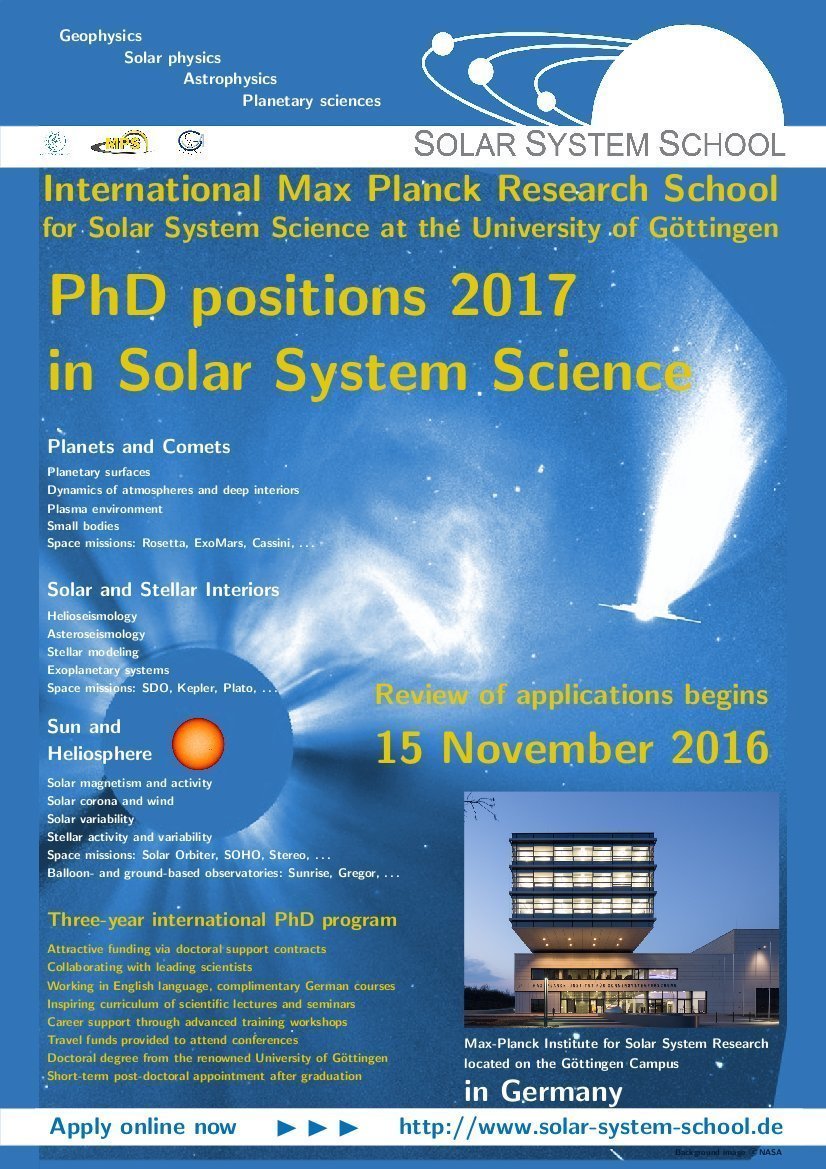
C) CALL FOR APPLICATIONS: IMPRS PHD POSITIONS 

     IN SOLAR SYSTEM SCIENCE IN GÖTTINGEN, GERMANY

     DEADLINE NOVEMBER 15, 2016

Dear colleague,

The International Max Planck Research School for Solar System Science
at the University of Göttingen ( http://www.solar-system-school.de )
invites applications for several PhD positions.

I would be grateful if you could distribute the announcement below to
your institute’s mailing list and specifically bring it to the attention
of students.

If you wish, you can also download and post the announcement as well as
our poster from

https://www.mps.mpg.de/phd/applynow

Files:
https://www.mps.mpg.de/phd/solar-system-school-call-2016.pdf
https://www.mps.mpg.de/phd/solar-system-school-poster-2016.pdf
https://www.mps.mpg.de/phd/solar-system-school-poster-imprs-2016.jpg

or share the facebook post at https://www.facebook.com/MPSGoettingen

Thank you very much for your consideration,
Sonja Schuh


D) TENURE TRACK W2/W3 PROFESSORSHIP IN EXPERIMENTAL 

     PLANETOLOGY, UNIVERSITY OF BAYREUTH


The University of Bayreuth is a research-oriented university with 

internationally competitive and interdisciplinary profile fields in 

research and teaching. At the Bavarian Research Institute of 

Experimental Geochemistry & Geophysics (Bayerisches Geoinstitut) of 

the University of Bayreuth applications are invited for a tenure 

track W2/W3 professorship in Experimental Planetology.


The position will be initially filled at the associate professor level 

(W2) but can be converted to a full professorship (W3) upon successful 

demonstration of excellence in research and teaching. The Bayerisches 

Geoinstitut is seeking an outstanding scientist with broad experience 

in experimental methods to investigate aspects of planetary formation, 

evolution and tectonic processes. Candidates are sought from the fields 

of experimental petrology, geochemistry and geophysics whose research 

interests embrace the study of the origin, composition, structure and 

dynamics of planets and, in particular, planetary interiors. 


Please send your cover letter, CV, a publications list, a list of

courses taught, your certificates, and a description of your research 

to the Dean of the Faculty of Biology, Chemistry and Earth Sciences by 

26.10.2016. Please also submit an identical copy of your application 

as a single PDF file (up to 30 MB) to [email protected].


E) GEORGE MASON UNIVERSITY ASSISTANT/ASSOCIATE 

     PROFESSOR, EXTRASOLAR PLANETS


The George Mason University (htt://www.gmu.edu/) Department of Physics 

and Astronomy invites candidates a tenure-track faculty position in 

Extrasolar Planets. George Mason University has a strong institutional 

commitment to the achievement of excellence and diversity among its 

faculty and staff, and strongly encourages candidates to apply who 

will enrich Mason’s academic and culturally inclusive environment. 


Responsibilities: 

The successful candidate is expected to carry out a vigorous and 

externally funded research program; teach courses at the undergraduate 

and graduate levels; and provide service activities. 


Qualifications: 

Applicants must have completed a Ph.D. in physics, astronomy, or a 

closely related field, prior to the first day of this appointment. 

Well-qualified candidates will have postdoctoral research experience 

and show promise for developing an independent and externally funded 

research program. Consideration for expertise in observational and 

theoretical studies of extrasolar planets including detection, 

characterization and formation and evolution. 


For a complete listing of duties and qualifications, and to apply for 

position F9967z, go to: 


http://jobs.gmu.edu/ 


George Mason University is an EO/AA employer. All qualified applicants 

will receive consideration for employment without regard to race, 

color, religion, sex, gender identity, sexual orientation, national 

origin, disability, or protected veteran status.


———————————+ 

Send submissions to:

Anne Verbiscer, DPS Secretary ([email protected]


To unsubscribe visit http://aas.org/unsubscribe or email [email protected].

To change your address email [email protected].


Newsletter 16-34

Issue 16-34, September 9, 2016


+————————————CONTENTS—————————————-+

  1. DPS/EPSC WOMEN IN PLANETARY SCIENCE DISCUSSION HOUR 2016
  2. REMINDERS FOR UPCOMING DPS 48/EPSC 11 DEADLINES
  3. REQUEST FOR PLANETARY SCIENCE CONCEPTS FOR CUBESATS/SMALLSATS
  4. CALL FOR PROPOSALS FOR THE NASA INFRARED TELESCOPE FACILITY
  5. A WORKSHOP FOR EARLY–CAREER ASTRONOMERS WHO WANT TO DO BETTER OUTREACH
  6. ASTEROID REDIRECT MISSION VIRTUAL INDUSTRY DAY
  7. JOBS, POSITIONS, OPPORTUNITIES

+——————————————————————————————–+


1———1———1———1———1———1———1———1———1———1

DPS/EPSC WOMEN IN PLANETARY SCIENCE DISCUSSION HOUR 2016


Join us on Tuesday, Oct. 18th from 12:00-1:30 pm for the annual DPS/EPSC 

Women in Planetary Science event in room C106 of the Pasadena Convention 

Center (conference venue).  The discussion this year will focus on “Being an 

Ally” and related planetary science demographic information.  All are welcome!


Due to the generosity of the DPS committee we will be able to provide boxed l

unches this year.  Pre-registration at http://bit.ly/DPS_WIPS_2016 is required 

due to space limitations. 


Lunch orders must be placed by SEPTEMBER 15TH.  


Contact [email protected] with questions.  


2———2———2———2———2———2———2———2———2———2

REMINDERS FOR UPCOMING DPS 48/EPSC 11 DEADLINES


Pasadena, CA, 16-21 October 2016 at the Pasadena Convention Center

https://aas.org/meetings/dps48


* Important dates


– 14 September: Hotel Reservations Deadline

– 15 September: Women in Planetary Science Lunch Order Deadline

– 16 September: Dependent Care Grant Application Deadline

– 16 September: Late Registration Deadline

– 21 September: Open Mic Submissions Deadline


The DPS is grateful to our Meeting Sponsors:


ESA

Europlanet

NASA

The Johns Hopkins Applied Physics Laboratory 

AURA

Nature Astronomy

Southwest Research Institute
Ball Aerospace

Nature Geoscience

Planetary Science Institute

The Planetary Society

Space Science Institute

The University of Arizona Press

Universities Space Research Association (USRA)

VORTICES


3———3———3———3———3———3———3———3———3———3

REQUEST FOR PLANETARY SCIENCE CONCEPTS FOR CUBESATS/SMALLSATS


As Mike Seablom discussed during the August OPAG meeting, the NASA 

Space Mission Directorate, SMD, and STMD are surveying mission concepts 

for small satellites. If you have planetary science concepts that you could 

provide, that would greatly help him respond to OMB and OSTP (which 

could be good for us!). The concepts could include daughter-craft, swarms, 

formations, or stand-alone SmallSats/CubeSats.


For the survey, we want ideas at a fairly high level that are shared with the 

community and therefore should not be proprietary. These concepts do not 

have to be at the detailed level, so it is not in conflict with the SmallSat 

solicitation call that just came out, which will not be shared publicly.


To submit a concept, please use the format in the PowerPoint file provided

After completion, send the file to Patricia Beauchamp at

[email protected] no later than September 30, 2016. 

She will collect all the material and forward it to Mike.


A copy of this notice is also available on the OPAG website at

http://www.lpi.usra.edu/opag/request-cubesats-smallsats/.


4———4———4———4———4———4———4———4———4———4

CALL FOR PROPOSALS FOR THE NASA INFRARED TELESCOPE FACILITY


DEADLINE: Monday 03 October 2016


NASA Infrared Telescope Facility Observing Proposals. The due date for the 

2017A semester (February 1, 2017 to July 31, 2017) is Monday, October 3, 2016. 

See our online submission form, which is available for proposal submission from 

12:00AM on September 01, 2016 until 5:00PM on October 03, 2016 HST. 


Available instruments include: (1) SpeX, a 0.7 – 5.3 micron cross-dispersed 

medium-resolution spectrograph (up to R=2,500) and imager; (2) MORIS, a 

512×512 pixel Andor CCD camera (60″x60″ field-of-view) mounted at the 

side-facing window of the SpeX cryostat that can be used simultaneously with 

SpeX; (3) iSHELL, a 1.1 – 5.3 micron cross-dispersed echelle spectrograph 

(up to R=70,000) and imager. Information on available instruments and 

performance can be found at:http://irtfweb.ifa.hawaii.edu/Facility.


PI-led visitor instruments (available on a collaborative basis with the instrument 

team) include: TEXES (5-20 micron high-resolution spectrograph; contact 

Matt Richter at [email protected] for more information), BASS 

(3-14 micron spectrometer; contact Ray Russell at [email protected])

and CELESTE (5-25 micron echelle spectrometer; contact Don Jennings at 

[email protected]).


Remote observing is available with SpeX, MORIS, and iSHELL. Requests 

for remote observing must be made in the proposal application – later requests 

will be considered if requested at least one month ahead of time. If you wish 

to observe from your home institution, you must comply with the requirements 

for video conferencing and instrument operation provided on the 

Remote Observers Information page. Observers are strongly encouraged to

contact Miranda Hawarden-Ogata ([email protected]) to set up a test 

of the video link and user interface at least one month prior to their observing 

run. We cannot guarantee a successful remote observing connection on short 

notice since we have no control of hardware and software compatibility on 

the user’s side. It is the responsibility of the PI to provide up to date observing

contact information.


To keep our bibliography up to date, and to ensure future funding of the 

IRTF, we ask that you send us citations to your latest IRTF publications. 

You can check your publications using our website bibliography page for 

refereed papers:

http://irtfweb.ifa.hawaii.edu/research/biblio/publications.html


Please send any missing references to Bobby Bus ([email protected]),

and please continue to include in your paper the acknowledgement to the 

IRTF and the name of the instrument used as described at:

http://irtfweb.ifa.hawaii.edu/research/acknowledge.php


Important Notice: A new policy regarding the public archiving of IRTF 

data has been put in place, effective August 1, 2016. Raw data files taken 

with IRTF facility instruments after August 1, 2016 will be made publicly 

available via an online archive after a proprietary period of 18 months 

from the date of observation. As part of the archive process, the abstract 

field on the proposal form has been increased to 300 words. This abstract 

should now include summaries of both the scientific and technical 

justifications for the observing program, and will be preserved as part 

of the public archive.


5———5———5———5———5———5———5———5———5———5

A WORKSHOP FOR EARLY-CAREER ASTRONOMERS 

WHO WANT TO DO BETTER OUTREACH


(Tuesday and Wednesday, Jan 3 & 4, 2017 at the start of the American 

Astronomical Society Meeting near Dallas, TX)


The American Astronomical Society is sponsoring a skill-building workshop 

— and an ongoing community — to support early-career astronomers (graduate 

students, post-docs, recent faculty) in doing effective outreach to schools, 

families, and the public.  Working with the Astronomical Society of the Pacific 

and other outreach organizations, the AAS Astronomy Ambassadors program 

(now in its fifth year) offers you two days of hands-on training, extensive 

resources and pre-tested activities (plus a like-minded group of peers.)  If you 

are a younger astronomer with an interest in spending a fraction of your time 

helping students or the public become more scientifically literate, this is an 

invitation to join the growing Ambassadors community. 


Among many other topics, we will discuss the opportunity for astronomy 

education represented by the Aug. 21, 2017 “All-American” eclipse of the 

Sun, and what programs, resources, and ideas are already being developed 

to help you do classroom and public outreach for it.


For now, some of the costs are being underwritten by the AAS Council (so 

registration and materials are free; and one night’s lodging can be provided).  

The workshop for the “Astronomy Ambassadors” program will be held on the 

day before and part of the first day of the January 2017 AAS meeting. 

Participants will spend two active days learning techniques, examining 

selected materials, and getting to know both each other and an existing 

community of astronomers who do and support outreach activities.  There will 

be sessions appropriate for those who have done outreach already and for 

those who are just beginners. No experience is required. We especially want 

to encourage participation by members of groups underrepresented in science.


Applications are due by no later than Oct. 17, 2016. 


For more about the program, see: 

http://aas.org/outreach/aas-astronomy-ambassadors-program


For more information about the 2017 workshop, visit: 

https://aas.org/meetings/aas229/aas-astronomy-ambassadors-workshop


To complete an online application, go to: 

https://aas.org/content/aas-astronomy-ambassadors-program-2017-application


6———6———6———6———6———6———6———6———6———6

ASTEROID REDIRECT MISSION VIRTUAL INDUSTRY DAY


On Sept. 14, 2016, NASA will host a live Asteroid Redirect Mission Virtual 

Industry Day at the Goddard Space Flight Center in Greenbelt, Maryland. 

The event is open to the public for virtual participation only, and follows 

the Sept. 6 release of the Asteroid Redirect Mission Umbrella for Partnerships

(ARM-UP) Broad Agency Announcement (BAA), and its two appendices:

The Industry Day will provide an ARM status update, an introduction to the 

BAA and Appendices A and B, and also will include an overview of the mission’s 

progress since the last Asteroid Redirect Mission Community Update in Oct. 2015. 

The virtual event will be streamed live through Adobe Connect, and viewers will 

be able to ask questions throughout the event. 


The stream will be accessible starting at 12 p.m. EDT on Wednesday, Sept. 14: 

http://connect.arc.nasa.gov/arm-update-2016/.


7———7———7———7———7———7———7———7———7———7

JOBS, POSITIONS, OPPORTUNITIES


A) POSTDOCTORAL RESEARCHER IN PLANETARY SCIENCE

      Space Sector Department

      The Johns Hopkins University Applied Physics Laboratory

      Laurel, Maryland


content/postdoctoral-researcher-planetary-science-0


B) TENURE-TRACK ASTRONOMER

     SCIENTIST

     Space Telescope Science Institute (STScI)

     Baltimore, Maryland


The Space Telescope Science Institute (STScI) has immediate openings for 
tenure-track Astronomer (50% research, 50% mission support) and Scientist 
(20% research, 80% mission support) positions. STScI operates the Hubble 
Space Telescope, will be the science operations center for the James Webb 
Space Telescope, and is involved in other observatories, missions and 
mission studies. Candidates must have a Ph.D. or equivalent degree in 
astronomy, planetary science, or a related field. Experience with space- 
or ground-based observations, observatory  systems, instruments, or data 
archives is particularly sought, and theoretical, computational and data 
analysis skills are also valuable. Applications are due Oct. 31, 2016. 
Further details may be found at: 

https://rn11.ultipro.com/SPA1004/JobBoard/listjobs.aspx?__VT=ExtCan 

Job # 16-0223 – Astronomer 
Job # 16-0224 – Scientist


C) TENURE TRACK ASSISTANT PROFESSOR

     Department of Earth, Atmospheric, and Planetary Sciences

     Massachusetts Institute of Technology

     Cambridge, Massachusetts


http://www.lpi.usra.edu/planetary_news/2016/09/05/job-opportunities-tenure-track-assistant-professor-at-mit/


———————————+

Send submissions to:

Anne Verbiscer, DPS Secretary ([email protected]


To unsubscribe visit http://aas.org/unsubscribe or email [email protected].

To change your address email [email protected].


Newsletter 16-33

Issue 16-33, September 5, 2016


+————————————CONTENTS—————————————-+

  1. REMINDERS FOR UPCOMING DPS 48/EPSC 11 DEADLINES
  2. COMPUTATIONAL ADVANCES IN SOLAR SYSTEM STUDIES
  3. MAPSIT ASSESSMENT GROUP
  4. 32nd MEPAG MEEETING 2nd INFORMATION CIRCULAR
  5. BIG DATA CHALLENGES, RESEARCH, AND TECNOLOGIES IN THE EARTH AND PLANETARY SCIENCES
  6.  JOBS, POSITIONS, OPPORTUNITIES

+——————————————————————————————–+


1———1———1———1———1———1———1———1———1———1

REMINDERS FOR UPCOMING DPS 48/EPSC 11 DEADLINES


Pasadena, CA, 16-21 October 2016 at the Pasadena Convention Center

https://aas.org/meetings/dps48


* Important dates


– 14 September: Hotel Reservations Deadline

– 16 September: Dependent Care Grant Application Deadline

– 16 September: Late Registration Deadline

– 21 September: Open Mic Submissions Deadline


The DPS is grateful to our Meeting Sponsors:


ESA

Europlanet

NASA

The Johns Hopkins Applied Physics Laboratory 

AURA

Nature Astronomy

Southwest Research Institute
Ball Aerospace

Nature Geoscience

Space Science Institute

The University of Arizona Press

Universities Space Research Association (USRA)

VORTICES


2———2———2———2———2———2———2———2———2———2

COMPUTATIONAL ADVANCES IN SOLAR SYSTEM STUDIES


Computing in Science & Engineering (CiSE) magazine announces an 

opportunity to contribute to a special issue about  Computational Advances i

n Solar System Studies. Submission deadline is November 1, 2016.


See the call for articles at:

https://www.computer.org/web/computingnow/cscfp4


Computing in Science & Engineering (CiSE) magazine features the 

latest computational science and engineering research in an accessible 

format, along with departments covering news and analysis, computational 

science and engineering in education, and emerging technologies.


See https://www.computer.org/web/peer-review/magazines for

general author guidelines.


Questions? Contact guest editors Lucy McFadden and 

Nargess Memarsadeghi at [email protected]    


3———3———3———3———3———3———3———3———3———3

MAPSIT ASSESSMENT GROUP

MAPSIT, the Mapping and Planetary Spatial Information Team, is a new 
NASA Assessment Group that is seeking steering committee membership, 
including international. We consider all aspects of planetary data, 
from collection, to processing, to incorporation into regional and 
global products and maps, and finally to storage and accessibility. 
We seek to identify and prioritize community needs and to increase 
the utility of our international spacecraft data. We will accept 
nominations (including self-nominations) consisting of one paragraph 
about how your involvement will benefit MAPSIT, plus your CV, sent 
to [email protected] by 30 September 2016. The MAPSIT steering committee 
will decide between these nominations, considering how to retain 
expertise in tools and methods and to maintain balance between 
science, disciplines and institutions. Visit:

http://www.lpi.usra.edu/mapsit/ 

for more information on MAPSIT.


4———4———4———4———4———4———4———4———4———4

32ND MEPAG MEETING 2ND INFORMATION CIRCULAR

Members of the Mars community,

I cordially invite you to participate in the 32nd meeting of the Mars 
Exploration Program Analysis Group (MEPAG), scheduled as a virtual 
meeting on October 6th, 2016, 8:30am-12:30pm PDT.

Adobe Connect information and current draft agenda are posted at:

http://mepag.nasa.gov/meeting/2016-10/meeting32_2nd%20Information%20Circular_v3.pdf
 
Key discussion topics will include:
* Reports from the Mars Exploration Program on budget, current 
  missions, and studies for future Mars missions;
* Updates on Human Exploration and Operations (HEO) activities;
* Report on the planetary science community-wide survey of 
  Participating Scientist programs;
* New membership within the MEPAG Goals and Executive Committee;
* Report from the recent conference on “Biosignature Preservation 
  and Detection in Mars Analog Environments”;
* Upcoming MEPAG activities, including the next face-to-face 
  MEPAG meeting (No. 33) in early 2017.

The meeting is open to all members of the Mars science community 
including our international colleagues. I look forward to your
participation.

Sincerely,
Dr. Jeffrey R. Johnson
MEPAG Chair


5———5———5———5———5———5———5———5———5———5

BIG DATA CHALLENGES, RESEARCH, AND TECHNOLOGIES 

IN THE EARTH AND PLANETARY SCIENCES

http://geo-bigdata.github.io/

Part of IEEE International Big Data Conference 2016, Washington D.C.
Monday, December 5th, 2016

Paper submissions due September 25th, 2016

A new paradigm is needed in order to increase the productivity and 
effectiveness of scientific data analysis for Earth and planetary 
science investigation. This paradigm must recognize that architectural 
and analytical choices are interrelated, and must be carefully 
coordinated in any system that aims to allow efficient, interactive 
scientific exploration and discovery to exploit massive data 
collections, from point of collection to analysis and decision support.

Both observational systems and data centers will be needed as part 
of this new paradigm, which includes the significant increase in size 
and complexity of science data as well as new approaches across the 
entire data lifecycle from capture to management and analysis of 
the data.

This workshop builds off of two successful previous workshops that 
have merged to offer a comprehensive venue for all aspects of Big 
Data in the Earth and Planetary Sciences. We seek computational and 
data science experts to present on their research and discuss Big Data 
roadmaps, architectures, technologies, and methodologies for future 
Earth and planetary science data challenges emerging from both 
instrumentation and data access and analytics.
 

6———6———6———6———6———6———6———6———6———6

JOBS, POSITIONS, OPPORTUNITIES


A) ASSISTANT PROFESSOR OF ASTRONOMY

      Department of Astronomy

      Cornell University

      Ithaca, New York


content/assistant-professor-astronomy


B) POSTDOCTORAL RESEARCHER IN OBSERVATIONAL 

      STUDIES OF EXOPLANETS

     Centre for Space and Habitability

     University of Bern

     Bern, Switzerland


node/1708


C) PH. D. POSITIONS IN SOLAR SYSTEM SCIENCE

     International Max Planck Research School for Solar System Science

     Max Planck Institute for Solar System Research

     Gottingen, Germany


content/phd-positions-solar-system-science-göttingen-germany-deadline-15-november-2016


D) ASSISTANT PROFESSOR OF ASTRONOMY

     AND/OR PLANETARY SCIENCE

     Department of Physics and Astronomy

     Northern Arizona University

     Flagstaff, Arizona


content/assistant-professor-astronomy-andor-planetary-science     


E) LECTURESHIP/ASSISTANT PROFESSOR POSITIONS (3 POSTS)

     Department of Physics

     University of Warwick

     Warwick, United Kingdom


node/1711


———————————+

Send submissions to:

Anne Verbiscer, DPS Secretary ([email protected]


To unsubscribe visit http://aas.org/unsubscribe or email [email protected].

To change your address email [email protected].


Message From The Chair: Students At DPS 48/EPSC 11

As we here at the DPS gear up for this Fall’s joint meeting in Pasadena, we’d like to extend a special invitation to students to attend and participate in the conference. I think that DPS is the most student-friendly annual planetary meeting.  We have a high proportion of abstracts that get oral talks, and a special category of dissertation talk to ensure that every student gets exposure prior to hitting the postdoc market.  We also hold special events specially targeted to students, starting with the Student & Postdoc Reception on Sunday night at 5:00PM before the official Opening Reception.  The Student Reception is your opportunity to relax with your peers, and to make the friendships and start the collaborations that will continue for your entire career.  And all of this without the pressure of needing to present yourself to potential future employers.  

On Tuesday morning we hold the Student Breakfast.  This one should be a no-brainer — a free hot breakfast for all early-career planetary scientists (students and postdocs).  All of the DPS Committee Leadership will attend the breakfast for the explicit purpose of hearing student concerns so that the society can respond to the needs of its most junior members.  Note that we no longer require registration for the Student Breakfast:  just show up at 7:30AM on Tuesday morning because it will be worth getting up early for.  

And finally on Wednesday evening we hold the annual Banquet, your chance to hob-nob with the field’s senior scientists over a social dinner.  To encourage student attendance at the Banquet this year the DPS Committee voted to offer a special student rate of just $55 (instead of the standard $80).  That discount puts the price of the banquet enough under Pasadena’s per diem ($64) for students to attend the banquet and still eat the rest of the day.  No more excuses about not being able to afford the Banquet, then!  We hope that this financial encouragement and the excitement of our second annual Open Mic night to follow will serve to reinvigorate junior member attendance at the Banquet.  

Along with Local Organizing Committee Chair Diana Blaney and the AAS Meetings staff I just returned from a site visit to the Pasadena Convention Center this past Monday. The team has a great meeting planned, and we hope to see all of you students there in Pasadena,  

Jason W. Barnes
DPS Chair

Message From The FRS: Call To Action This Week – Please Contact Your Members Of Congress

This week we are asking each member of the DPS to contact his/her members of Congress to encourage strong support for planetary science. In Fiscal Year 2016 Congress appropriated $1.63B for planetary science and we want to be sure that the FY2017 appropriation is at least at that level. While we hope that Congress can pass appropriations in regular order it is likely that there will be a continuing resolution of some duration passed by the end of this fiscal year. There is a lot of uncertainty there but Congressional support for planetary science has been very strong in recent years; we want to encourage that to continue. Congress is currently in August recess so staff members are less busy with the day-to-day demands of the Hill. When Congress reconvenes in September there will be a lot of activity surrounding current events, getting an FY2017 appropriation together, and the election. So this coming week gives us an opportunity to get out a positive message regarding support for planetary science. 

For details of this call to action please go to 

public-policy/action-alerts 

and if you have any questions please feel free to contact Makenzie Lystrup, and please distribute through social media and other avenues!


28 Aug 2016

Newsletter 16-32

Issue 16-32, August 28, 2016


+————————————CONTENTS—————————————-+

  1. MESSAGE FROM THE FRS: CALL TO ACTION THIS WEEK – PLEASE CONTACT YOUR MEMBERS OF CONGRESS
  2. MESSAGE FROM THE CHAIR: STUDENTS AT DPS 48/EPSC 11
  3. REMINDERS FOR UPCOMING DPS 48/EPSC 11 DEADLINES
  4. ANNOUNCEMENT OF SPECIAL ISSUE OF ADVANCES IN SPACE RESEARCH ON SMALL BODY SCIENCE AND EXPLORATION
  5. JOBS, POSITIONS, OPPORTUNITIES
  6. REGISTRATION OPEN FOR THE ACADEMIES’ SEARCH FOR LIFE WORKSHOP

+——————————————————————————————–+


1———1———1———1———1———1———1———1———1———1

MESSAGE FROM THE FRS: CALL TO ACTION THIS WEEK – 

PLEASE CONTACT YOUR MEMBERS OF CONGRESS


This week we are asking each member of the DPS to contact his/her members 

of Congress to encourage strong support for planetary science. In Fiscal Year 

2016 Congress appropriated $1.63B for planetary science and we want to be 

sure that the FY2017 appropriation is at least at that level. While we hope that 

Congress can pass appropriations in regular order it is likely that there will be 

a continuing resolution of some duration passed by the end of this fiscal year. 

There is a lot of uncertainty there but Congressional support for planetary science 

has been very strong in recent years; we want to encourage that to continue. 

Congress is currently in August recess so staff members are less busy with the 

day-to-day demands of the Hill. When Congress reconvenes in September there 

will be a lot of activity surrounding current events, getting an FY2017 

appropriation together, and the election. So this coming week gives us an 

opportunity to get out a positive message regarding support for planetary science. 


For details of this call to action please go to 

public-policy/action-alerts 

and if you have any questions please feel free to contact Makenzie Lystrup at

[email protected].

And please distribute through social media and other avenues!


2———2———2———2———2———2———2———2———2———2

MESSAGE FROM THE CHAIR: STUDENTS AT DPS 48/EPSC 11


As we here at the DPS gear up for this Fall’s joint meeting in Pasadena, we’d like 

to extend a special invitation to students to attend and participate in the conference.  

I think that DPS is the most student-friendly annual planetary meeting.  We have 

a high proportion of abstracts that get oral talks, and a special category of 

dissertation talk to ensure that every student gets exposure prior to hitting the 

postdoc market.  We also hold special events specially targeted to students, 

starting with the Student & Postdoc Reception on Sunday night at 5:00PM before 

the official Opening Reception.  The Student Reception is your opportunity to 

relax with your peers, and to make the friendships and start the collaborations 

that will continue for your entire career.  And all of this without the pressure of 

needing to present yourself to potential future employers.  


On Tuesday morning we hold the Student Breakfast.  This one should be a 

no-brainer — a free hot breakfast for all early-career planetary scientists 

(students and postdocs).  All of the DPS Committee Leadership will attend the 

breakfast for the explicit purpose of hearing student concerns so that the society 

can respond to the needs of its most junior members.  Note that we no longer 

require registration for the Student Breakfast:  just show up at 7:30AM on 

Tuesday morning because it will be worth getting up early for.  


And finally on Wednesday evening we hold the annual Banquet, your chance 

to hob-nob with the field’s senior scientists over a social dinner.  To encourage 

student attendance at the Banquet this year the DPS Committee voted to offer 

a special student rate of just $55 (instead of the standard $80).  That discount 

puts the price of the banquet enough under Pasadena’s per diem ($64) for 

students to attend the banquet and still eat the rest of the day.  No more excuses 

about not being able to afford the Banquet, then!  We hope that this financial 

encouragement and the excitement of our second annual Open Mic night to 

follow will serve to reinvigorate junior member attendance at the Banquet.  


Along with Local Organizing Committee Chair Diana Blaney and the AAS 

Meetings staff I just returned from a site visit to the Pasadena Convention 

Center this past Monday.  The team has a great meeting planned, and we 

hope to see all of you students there in Pasadena,  


Jason W. Barnes 

DPS Chair


3———3———3———3———3———3———3———3———3———3

REMINDERS FOR UPCOMING DPS 48/EPSC 11 DEADLINES


Pasadena, CA, 16-21 October 2016 at the Pasadena Convention Center

https://aas.org/meetings/dps48


* Important dates


– 14 September 2016: Hotel Reservations Deadline

– 16 September 2016: Dependent Care Grant Application Deadline

– 16 September 2016: Late Registration Deadline


The DPS is grateful to our Meeting Sponsors:


ESA

Europlanet

NASA

The Johns Hopkins Applied Physics Laboratory 

AURA

Nature Astronomy

Southwest Research Institute
Ball Aerospace

Nature Geoscience

Space Science Institute

The University of Arizona Press

Universities Space Research Association (USRA)

VORTICES


4———4———4———4———4———4———4———4———4———4

ANNOUNCEMENT OF A SPECIAL ISSUE OF ADVANCES IN SPACE 

RESEARCH ON SMALL BODY SCIENCE AND EXPLORATION


Papers are invited for a special topical issue of Advances in Space Research 

(ASR) entitled “Past, Present and Future of Small Body Science and 

Exploration” that was proposed within the 41st COSPAR 2016 Scientific 

Assembly.


This special issue is open to all scientists that want to share their results with 

the scientific community about small body science connected to space exploration. 

The year 2016 has seen an incredible burst in the Space mission activities to 

minor bodies, leading to tremendous or surprising results. Huge amount of data 

are/were returned from investigations of a cometary nucleus by Rosetta, Ceres 

by Dawn, and Pluto by New Horizons. While space observatories HST, 

HERSCHEL, WISE, Gaia collect their large datasets on remote, Hayabusa-2

and OSIRIS-REx will be on their ways to primitive asteroids for sample returns 

and future missions are studied for Phobos, activated asteroids, Jupiter Trojans, 

binary asteroid, planetary defense, human exploration, etc. The present special 

issue welcomes contributions that have a Scientific, Technical or Instrumental 

focus and serves as a crossroad of recent results and future prospects of small 

body explorations.


Papers must be submitted electronically to http://ees.elsevier.com/asr. To ensure 

that all manuscripts are correctly identified for inclusion into the special issue, 

authors must select “Special Issue: Small Body Exploration” when they reach 

the “Article Type” step in the submission process.  The deadline for 

submissions is 31 January 2017.


Questions can be directed to Drs. Palomba, Hestroffer or to the Co-Editor 

for Special Issues, Dr. Peggy Ann Shea ([email protected]).


5———5———5———5———5———5———5———5———5———5

JOBS, POSITIONS, OPPORTUNITIES


A) TENURE TRACK ASSISTANT PROFESSOR

      Department of Earth, Atmospheric, and Planetary Sciences

      Massachusetts Institute Of Technology

      Cambridge, Massachusetts


The Department of Earth, Atmospheric, and Planetary Sciences at the 

Massachusetts Institute of Technology invites qualified candidates to 

apply for a tenure track position at the assistant professor level beginning 

July 2017 or thereafter.  Applicants with research interests in Planetary 

Science are encouraged to apply. We seek an outstanding scientist with

interest in and potential for innovation and leadership in teaching at the 

undergraduate and graduate levels and research. The search is in the broad 

area of Planetary Science encompassing our Solar System as well as 

exoplanets, including theory, observation, and instrumentation.  However, 

we are especially interested in individuals whose research complements 

existing MIT expertise. 


Applicants must hold a Ph.D. in Planetary Science or related field by the

start of employment and must demonstrate ability to excel in teaching. A 

complete application must include curriculum vitae, two-page description 

of research and teaching plans and three letters of recommendations.


Applications are being accepted at Academic Jobs Online: 

https://academicjobsonline.org/ajo/jobs/7724  To receive full consideration, 

complete applications must be received by:  December 1, 2016.


Search Contact: Ms. Karen Fosher, HR Administrator, EAPS, 54-924

Massachusetts Institute of Technology, 77 Massachusetts Avenue, 

Cambridge, MA 02139-4307, email: [email protected]


MIT is an equal employment opportunity employer. All qualified applicants 

will receive consideration for employment and will not be discriminated 

against on the basis of race, color, sex, sexual orientation, gender identity, 

religion, disability, age, genetic information, veteran status, ancestry, or 

national or ethnic origin.


6———6———6———6———6———6———6———6———6———6

REGISTRATION OPEN FOR THE ACADEMIES’ SEARCH FOR LIFE WORKSHOP


The Space Studies Board of the National Academies of Sciences, 

Engineering, and Medicine is hosting a workshop and poster session to 

explore the current status of activities to detect extraterrestrial 

life in the solar system and extrasolar planetary systems. The 

workshop will feature presentations from experts on the environmental 

limits of life, habitable environments in the solar system and beyond, 

extraterrestrial biosignatures, and life detection techniques and 

instrumentation.


The workshop will take place at the Beckman Center in Irvine, CA on 

December 5-6, 2016.  To register as a poster presenter or participant 

and learn more about the workshop, please visit: 


http://SearchingForLife.eventbrite.com.  


The deadline for poster abstracts is November 7, 2016.


For those unable to attend in person, the live workshop webcast will 

be available at: 


https://livestream.com/accounts/15221519/events/6098927.


———————————+ 

Send submissions to:

Anne Verbiscer, DPS Secretary ([email protected]


To unsubscribe visit http://aas.org/unsubscribe or email [email protected].

To change your address email [email protected].


Newsletter 16-31

Issue 16-31, August 24, 2016


+————————————CONTENTS—————————————-+

  1. REMINDERS FOR UPCOMING DPS48/EPSC 11 DEADLINES
  2. NEW HORIZONS KUIPER BELT EXTENDED MISSION SCIENCE PLANNING OPPORTUNITY
  3. ANNOUNCEMENT OF UPCOMING ASTEROID REDIRECT MISSION OPPORTUNITIES
  4. JOBS, POSITIONS, OPPORTUNITIES
  5. UPCOMING MEETINGS

+——————————————————————————————–+


1———1———1———1———1———1———1———1———1———1

REMINDERS FOR UPCOMING DPS 48/EPSC 11 DEADLINES


Pasadena, CA, 16-21 October 2016 at the Pasadena Convention Center

https://aas.org/meetings/dps48


* Important dates


– 14 September 2016: Hotel Reservations Deadline

– 16 Septembar 2016: Dependent Care Grant Application Deadline


The DPS is grateful to our Meeting Sponsors:


The Johns Hopkins Applied Physics Laboratory 

AURA

Nature Astronomy

Southwest Research Institute
Ball Aerospace

Nature Geoscience

Space Science Institute

The University of Arizona Press

Universities Space Research Association (USRA)

VORTICES


2———2———2———2———2———2———2———2———2———2

NEW HORIZONS KUIPER BELT EXTENDED MISSION 

SCIENCE PLANNING OPPORTUNITY

The centerpiece of the proposed New Horizons Kuiper Belt Extended 
Mission (NH-KEM) is the very close flyby of the 20-40 km wide KBO 
2014 MU69 on 1 January 2019. NH-KEM will also observe ~20 other KBOs 
at phase angles and/or at resolutions not otherwise possible, 
producing a unique database of KBO phase curves, satellite searches, 
and ring searches.

On July 1 NASA approved the NH-KEM, which included plans to reach 

out to the planetary community for ideas to optimize the scientific return.

The NH Project is holding two KEM WebEx workshops, one from 1-3 pm EDT

on Sep 13 and one from 1-4 pm EDT on Oct 10, to discuss potential community 

involvement in planning the NH-KEM. If you’re interested in participating in 

these workshops, please send an email ASAP to the NH Project Scientist, 

Hal Weaver ([email protected]). He will then provide you with further 

details about these workshops.


3———3———3———3———3———3———3———3———3———3

ANNOUNCEMENT OF UPCOMING ASTEROID REDIRECT MISSION 

OPPORTUNITIES


NASA’s Asteroid Redirect Mission Umbrella for Partnerships (ARM-UP) Broad 

Agency Announcement (BAA) will seek proposals in research areas including 

partner-provided investigations through systems or payloads to be hosted on the 

robotic segment of the ARM; collaboration through the ARM Investigation 

Team to support definition of additional mission investigations; studies to define 

mission partnership opportunities toward NASA’s planned crewed mission to 

the multi-ton asteroid boulder; and opportunities for access and experimentation 

at the asteroid boulder after the crewed mission. 


The full BAA Solicitation, with two appendices, is expected to be issued in 

early September. The ARM-UP BAA will remain open until August 2018, 

with additional opportunities announced as appendices with their own applicable 

requirements and milestones. 


The first two appendices issued under the omnibus solicitation will be released 

at the same time as the umbrella BAA. Synopses of the appendices are available 

on FedBizOpps at:


NASA plans to host a virtual industry forum Sept. 14, 2016 to provide more information. 

Details will be made available on the ARM and on the NSPIRES web pages.


4———4———4———4———4———4———4———4———4———4

JOBS, POSITIONS, OPPORTUNITIES


A) COMETS/ROSETTA INFRARED DATA

     Observatory of Paris

     Meudon, France

     Deadline: September 25, 2016


content/cometsrosetta-infrared-data


B) POSTDOCTORAL POSITION IN EXOPLANETARY SCIENCES

     University of Amsterdam

     Amsterdam, Netherlands

     Deadline: September 1, 2016


node/1705


5———5———5———5———5———5———5———5———5———5

UPCOMING MEETINGS


A) USHERING IN THE NEW AGE OF MICROLENSING FROM SPACE


21st International Microlensing Conference

February 1-3, 2017

Pasadena, CA


½ Day Microlensing Workshop

January 31, 2017

Pasadena, CA


http://nexsci.caltech.edu/conferences/2017/microlensing/


B) USER TRAINING IN JWST DATA ANALYSIS WORKSHOP


November 9-11, 2016

Space Telescope Science Institute

Baltimore, Maryland


https://jwst.stsci.edu/events/events-area/stsci-events-listing-container/user-training-in-jwst-data-analysis-ii?mwc=4


———————————+ 

Send submissions to:

Anne Verbiscer, DPS Secretary ([email protected]


To unsubscribe visit http://aas.org/unsubscribe or email [email protected].

To change your address email [email protected]

Newsletter 16-30

Issue 16-30, August 10, 2016


+————————————CONTENTS—————————————-+

  1. REMINDER: REGISTRATION DEADLINE FOR DPS 48/EPSC 11
  2. OPAG MEETING WEBEX AND TELEPHONE INFORMATION
  3. NATIONAL ACADEMY OF SCIENCES SPACE STUDIES BOARD REVIEW OF NASA’S PLANETARY SCIENCE DIVISION’S RESTRUCTURED RESEARCH AND ANALYSIS PROGRAM
  4. JOBS, POSITIONS, OPPORTUNITIES
  5. UPCOMING MEETINGS

+——————————————————————————————–+


1———1———1———1———1———1———1———1———1———1

REMINDER: REGULAR REGISTRATION DEADLINE FOR DPS 48/EPSC 11


The Regular Registration Deadline is Friday, August 12, 2016.  


Full Registration for Full DPS Members increases from $622 to $719 if you 

register after August 12.


Pasadena, CA, 16-21 October 2016 at the Pasadena Convention Center

https://aas.org/meetings/dps48


* Important dates


12 August 2016 DPS 48/ EPSC 11 Regular Registration Deadline

https://aas.org/meetings/dps48/registration


And also:

– 14 September 2016: Hotel Reservations Deadline

– 16 Septembar 2016: Dependent Care Grant Application Deadline


The DPS is grateful to our Meeting Sponsors:


AURA

Southwest Research Institute
Ball Aerospace

Nature Geoscience

Space Science Institute

The University of Arizona Press

Universities Space Research Association (USRA)

VORTICES


2———2———2———2———2———2———2———2———2———2

OPAG MEETING WEBEX AND TELEPHONE INFORMATION


Outer Planets Assessment Group (OPAG) Meeting


http://www.lpi.usra.edu/opag/


Thursday, August 11, 2016 to Friday, August 12, 2016

8:00 AM Mountain Time (Arizona, GMT-07:00)(same as Pacific time)


Join WebEx meeting

Meeting number: 999 237 745

Meeting password: )P@GN@S@123


Join by phone

Conf number 1-877-971-7311

Participant Code: 5395257


3———3———3———3———3———3———3———3———3———3

NATIONAL ACADEMY OF SCIENCES SPACE STUDIES BOARD                    

REVIEW OF NASA’S PLANETARY SCIENCE DIVISION’S RESTRUCTURED 

RESEARCH AND ANALYSIS PROGRAM


The Space Studies Board has convened an ad hoc committee to examine the 

program elements of NASA’s Planetary Science Division (PSD) Research 

and Analysis (R&A) programs, as they currently exist following restructuring, 

for their consistency with past advice from the Academies. The committee will

hold its second meeting August 16-18, 2016 in Washington, DC. 


Agenda and webex information can be found here :

http://sites.nationalacademies.org/cs/groups/ssbsite/documents/webpage/ssb_173667.pdf


4———4———4———4———4———4———4———4———4———4

JOBS, POSITIONS, OPPORTUNITIES


A) ASSOCIATE PROFESSOR IN PHYSICAL CLIMATE SCIENCE

     University of Oxford

     Oxford, UK

     Deadline: September 28, 2016


node/1698


B) POSTDOCTORAL FELLOWSHIP IN PLANETARY HYDROLOGY

     Lunar and Planetary Institute

     Houston, TX

     Deadline: October 17, 2016


node/1699


C) POSTDOCTORAL SCIENTIST : PLANETARY ATMOSPHERIC 

     CHEMISTRY MODELING

     Columbia University

     New York, NY

     Deadline: October 9, 2016


content/postdoctoral-scientist-planetary-atmospheric-chemistry-modeling


D) PLANETARY ATMOSPHERIC CHEMISTRY POSTDOCTORAL POSITION

     Columbia University

     New York, NY

     Deadline: October 1, 2016


node/1701


5———5———5———5———5———5———5———5———5———5

UPCOMING MEETINGS


A) EUROPA-ENCELADUS PLUMES MEETING


We will be hosting a Europa-Enceladus Plumes Meeting at Caltech all day 
on Saturday 15th October 2016. The purpose of the meeting will be to compare 

Enceladus and Europa plumes and their sources, and in particular to consider 

how our understanding of Enceladus’ activity can be applied to Europan plumes, 
and observations of them by the Europa mission. 

If you would like to present a talk at this meeting, please submit a 
brief (<250 word) abstract to http://goo.gl/forms/9hgFhoySVa7O9nEf2 by 
5pm PST on 15th August 2016. Given the limited time and number of 
people attending, and because we want to have adequate time for 
discussion, we cannot guarantee that everyone who asks will be able to 
talk. If we have to be selective, we will pick talks that most directly 
address the major theme of comparing Enceladus and Europa plumes and 
their sources, and/or how our understanding of Enceladus’ activity can 
be applied to Europan plumes, and observations of them by the Europa 
mission. 

Carly Howett, Matt Hedman, John Spencer and Scott Edgington.


B) THE THIRD WORKSHOP ON EXTREMELY PRECISE RADIAL

     VELOCITIES (EPRV III)


Please save the date for the Third Workshop on Extremely Precise Radial 

Velocities (EPRV III), at the Pennsylvania State University, University 

Park, PA, USA, during the week of August 7-13, 2017.


This workshop is for teams around the world to share techniques for advancing 

precise radial velocity work towards 10 cm/s precision in coming years.  

Building on the success of the first two workshops at Penn State in 2010 

and Yale in 2015, the focus on this workshop will be on the performance 

of the next generation of precise Doppler instruments, including hardware, 

statistical techniques for signal extraction and interpretation, and stellar 

jitter modeling and mitigation.


Please send questions or inquiries to Dr. Jason Wright at [email protected].


———————————+

Send submissions to:

Anne Verbiscer, DPS Secretary ([email protected]


To unsubscribe visit http://aas.org/unsubscribe or email [email protected].

To change your address email [email protected].


Newsletter 16-29

Issue 16-29, August 4, 2016


+————————————CONTENTS—————————————-+

  1. MESSAGE FROM THE CHAIR: DPS 2016 ELECTION RESULTS
  2. REMINDER: REGISTRATION DEADLINE FOR DPS 48/EPSC 11
  3. SHOEMAKER IMPACT CRATERING AWARD

+——————————————————————————————–+


1———1———1———1———1———1———1———1———1———1

MESSAGE FROM THE CHAIR: DPS 2016 ELECTION RESULTS


I know that you, like I, have been obsessively hitting ‘reload’ at fivethirtyeight.com

to see the latest election predictions.  Well, no more!  The results of the DPS 

election are in.

I am pleased to announce that your new vice-chair-elect is Cathy Olkin, and 

that your new Committeemembers-elect are Catherine Neish and Britney Schmidt.  

Please join me in congratulating them for joining the DPS Leadership.

Thanks in equal measure are due to those who were willing to stand for election

but who did not happen to win the day this year. I really like that our Bylaws 

require multiple candidates for each position:  it makes for elections that mean 

something.  But it also means that each year we also pass over excellent people.  

Thanks to those candidates for running.

With our crop of fresh recruits, I am again renewed in my optimism about the 

future of our organization.  We will all be in good hands next year with 

Lucy McFadden as Chair and on into the future.

Jason W. Barnes
DPS Chair


2———2———2———2———2———2———2———2———2———2

REMINDER: REGULAR REGISTRATION DEADLINE FOR DPS 48/EPSC 11


The Regular Registration Deadline is Friday, August 12, 2016.  


Full Registration for Full DPS Members increases from $622 to $719 if you 

register after August 12.


Pasadena, CA, 16-21 October 2016 at the Pasadena Convention Center

https://aas.org/meetings/dps48


* Important dates


12 August 2016 DPS 48/ EPSC 11 Regular Registration Deadline

https://aas.org/meetings/dps48/registration


And also:

– 14 September 2016: Hotel Reservations Deadline

– 16 Septembar 2016: Dependent Care Grant Application Deadline


The DPS is grateful to our Meeting Sponsors:


AURA

Southwest Research Institute
Ball Aerospace

Nature Geoscience

Space Science Institute

The University of Arizona Press

Universities Space Research Association (USRA)

VORTICES


3———3———3———3———3———3———3———3———3———3

SHOEMAKER IMPACT CRATERING AWARD


Applications for the GSA Planetary Geology Division’s Eugene M. Shoemaker 

Impact Cratering Award are due August 26, 2016.


The Eugene M. Shoemaker Impact Cratering Award is for undergraduate or 

graduate students, of any nationality, working in any country, in the disciplines 

of geology, geophysics, geochemistry, astronomy, or biology. The award, 

which will include $2500, is to be applied for the study of impact craters, either 

on Earth or on the other solid bodies in the solar system. Areas of study may

include but shall not necessarily be limited to impact cratering processes; the

bodies (asteroidal or cometary) that make the impacts; or the geological, chemical, 

or biological results of impact cratering. Details about the award as well as an 

application form for interested students can be found at


http://www.lpi.usra.edu/science/kring/Awards/Shoemaker_Award/


Shoemaker Impact Cratering Award Flyer


Send questions about the award to David Kring, [email protected]

———————————+

Send submissions to:

Anne Verbiscer, DPS Secretary ([email protected]


To unsubscribe visit http://aas.org/unsubscribe or email [email protected].

To change your address email [email protected].