DPS Newsletter 25-19

Issue 25-19, Aug 23, 2025

+————————————CONTENTS—————————————-+

  1. IN MEMORIAM: JING LI (1960-2025)
  1. IN MEMORIAM : PATRICK GAULME (1978-2025)
  1. CALL FOR DONATIONS IN SUPPORT OF  DPS STUDENT TRAVEL GRANTS
  1. AAS POLICY TEAM – ARE YOU AWAITING FY2025 FUNDS FOR AWARDED GRANTS?
  1. SAVE NASA SCIENCE DAY OF ACTION
  1. AAS POLICY AND EDUCATION OFFICE HOURS
  1. ICARUS SEEKS ASSOCIATE EDITOR APPLICATIONS
  1. REGISTRATION OPEN FOR THE NATIONAL SOCIETY OF BLACK PHYSICISTS ANNUAL MEETING, JOINT WITH NATIONAL SOCIETY OF HISPANIC PHYSICISTS
  1. SUPPORT REQUESTED FOR DPS PARTNER: THE NATIONAL SOCIETY OF BLACK PHYSICISTS (NSBP)
  1. LSSW: ARTEMIS IV LANDING SITE WORKSHOP
  1. VIRTUAL NASA PLANETARY DATA TRAINING WORKSHOP “INTRODUCTION TO JMARS”
  1. NASA SOLAR SYSTEM SCIENCE VOLUNTEER REVIEWER FORM
  1. 5TH MedGU, 10–13 NOVEMBER 2025, ATHENS, GREECE
  1. SAVE THE DATE – 57TH LUNAR AND PLANETARY SCIENCE CONFERENCE
  1. GEMINI USERS POLL
  1. SECOND ANNOUNCEMENT: ICARUS SPECIAL ISSUE – CARBON IN PLANETARY ENVIRONMENTS
  1. MS/PHD POSITIONS FOR FALL 2026
  1. CURRENT TABLE OF CONTENTS FOR ICARUS AND THE PLANETARY SCIENCE JOURNAL 
  1. JOBS, POSITIONS, AND OPPORTUNITIES

+——————————————————————————————–+

1———1———1———1———1———1———1———1———1——-

IN MEMORIAM: JING LI (1960-2025)

Jing Li, an accomplished solar astronomer, wife, mother, and friend, passed away on June 21, 2025, at the age of 64 after a battle with cancer. Jing had been a member of UCLA’s Earth, Planetary and Space Sciences department since 2009. 

Best friend and wife of 33 years to EPSS Professor David Jewitt, and the devoted mother of Xiaodong (Suu) Zhou, Jing’s life was a testament to resilience, intellectual curiosity, and an unyielding capacity for joy and kindness. She will be deeply missed. 

The full obituary can be read here.  In Memoriam: Jing Li (1960-2025)

2———2———2———2———2———2———2———2———2——-

IN MEMORIAM : PATRICK GAULME (1978-2025)

A great enthusiast and expert in planetary sciences, particularly of the giant planets, Patrick Gaulme passed away on 14 July 2025.

After several years of research with different institutes, including Nice Observatory, Paris Observatory, and IAS in Orsay, he worked in the US from 2011 to 2017.  Upon returning to Europe he spent six years at the Max Planck Institute in Göttingen before settling at the Tautenburg (Thüringer Landessternwarteen) Observatory in 2023. He worked extensively on Jupiter’s seismology and meteorology as well as on jovian and solar oscillations using JIVE-JOVIAL. 

He will be sorely missed by his colleagues and friends.

3———3———3———3———3———3———3———3———3——-

CALL FOR DONATIONS IN SUPPORT OF  DPS STUDENT TRAVEL GRANTS

During these challenging times, many students are losing access to their funding and are unable to travel to professional meetings to present their research.  The Division for Planetary Science (DPS) Hartmann Student Travel Grant and Underrepresented Minorities (URM) Travel Grant exist to support student presentations at the annual DPS meeting. The need this year has been very great, and our ability to help the applicants was limited by the amount of money available in the Hartmann and URM grant funds.  

Community donations are critical for the health of these awards and our ability to fund students. Each fund functions as an endowment. Please consider making a donation today. Give by logging into your AAS account through this link and submitting a donation to either the Hartmann Student Travel Grants or the URM Travel Grants.

4———4———4———4———4———4———4———4———4——-

AAS POLICY TEAM – ARE YOU AWAITING FY2025 FUNDS FOR AWARDED GRANTS?

The AAS policy team has been made aware that the Office of Management and Budget has recently released a significant portion of the FY2025 funding for the National Science Foundation and the National Institutes of Health, as well as potentially other research agencies; however, it is unclear whether these agencies have been able to disburse these funds. We need your help to understand what is happening with this funding. It is of the utmost urgency to ensure that obligated grant funds for FY2025 are released before 30 September 2025; otherwise, these funds will be returned to the Treasury and will no longer be available. Please use this form to let us know if you have yet to receive funds for grants in FY2025. We will privately contact those who respond to help connect you with your congressional representatives and advocate for the release of those funds as soon as possible.

5———5———5———5———5———5———5———5———5——-

SAVE NASA SCIENCE DAY OF ACTION

The American Astronomical Society (AAS) is partnering with The Planetary Society, the American Geophysical Union, and nine other organizations to host a day of action in support of NASA science on 5-6 October 2025. AAS members are invited to register here for the event, which includes an afternoon of training and preparing for congressional meetings on Sunday, 5 October, and in-person meetings with your elected officials in Washington, DC, on Monday, 6 October. 

The registration fee ($24.90 for standard registration, and $7.33 for student registration) includes:

  • Online and in-person advocacy training from space policy experts
  • The scheduling of meetings with your congressional representatives
  • Social gatherings and in-person meeting opportunities with organizational staff and fellow members

The registration fee does not include travel to and lodging in Washington, DC. Anyone with a US address is welcome to register and attend. For more details, please see this press release and the registration page.

6———6———6———6———6———6———6———6———

AAS POLICY AND EDUCATION OFFICE HOURS

As the landscape for our field continues to evolve, the AAS Public Policy and Education staff will be making ourselves available for discussions and to provide information as we are able through regular “office hours.” Please stop by our office hours to learn more about advocacy actions that you can take, student support programs, and any other questions that you have for us regarding AAS public policy and education programs. This page will be updated regularly with information about office hours over the next few weeks. 

Use this link and sign in with your AAS membership to register in advance for office hours and receive a zoom link.

AAS Policy and Education Office Hours

Current Office Hours Schedule:

  • Wednesday, 27 August: 2-3 pm ET
  • Friday, 5 September: 11 am-12 pm ET

You can follow this link to access tips and tricks in our suggested action items. In addition to emailing, we strongly encourage you to call your members of Congress and schedule in-district or Zoom meetings with your congressional offices. Please reach out to [email protected] if there’s anything we can do to facilitate your advocacy.

The Planetary Society has put together a website where you can download a one-pager specific to your district and share with your representative how NASA funding benefits your state and congressional district.  NASA Science Spending Across the U.S.

7———7———7———7———7———7———7———7———7——-

ICARUS SEEKS ASSOCIATE EDITOR APPLICATIONS

The Associate Editor role entails:

  • Responsibility for the scientific content of the Journal within a specific area relating  to  the  Journal,  taking  into  account  the  Aims  and  Scope, the Publisher’s editorial policies as updated from time to time (including without limitation those on ethics in publishing at the Publisher’s website) and the editorial policy of the Journal. 
  • The evaluation and selection of articles for publication in the Journal that are consistent with the high standards of the journal.  This includes coordinating an objective and unbiased peer-review process for submitted articles, obtaining a minimum of (2) reviews for each article, and rejecting or  returning  for  revision  to  the  authors articles  that  do  not  meet  the required standards of the Journal.
  • Ensuring an appropriate and sufficient level of submissions of articles for publication to meet the publication goals of the Journal. If necessary, the Editor will solicit articles to help meet such publication goals.
  • Conduct activities in accordance with generally accepted industry standards for integrity and objectivity in all matters respecting the selection, editing, acceptance and reviewing of Articles

Alongside the review process, the Associate Editors are asked to periodically participate in discussions with Elsevier about the journal’s development and potential new initiatives.  The team of Editors will hold meetings approximately twice a year via video call, as well as in-person meetings in conjunction with certain events or training sessions, as required.

The applicants:

  • Must have a PhD in a field of study relevant to the scope of this journal
  • Must have demonstrated broad expertise in impact cratering and planetary surfaces.
  • Be knowledgeable in research publishing, managing a journal publication, the peer review process, and growing a journal
  • Demonstrate skills as a good collaborator with ability to lead a team effectively

Elsevier is committed to inclusion and diversity in our work and want the Journal to reflect the diversity of the communities we serve. We are therefore committed to ensuring that the Editorial Board is representative, and encourage all individuals interested to apply for a position with the board. 

Interested candidates are asked to provide a complete CV, including publication record, as well as a one-page summary of their relevant experience and area of expertise for this Associate Editor position by September 5, 2025.  Please include up to three references. 

Applications and relevant supporting documents must be sent to Christina Gifford, Publisher, [email protected].

8———8———8———8———8———8———8———8———8——-

REGISTRATION OPEN FOR THE NATIONAL SOCIETY OF BLACK PHYSICISTS ANNUAL MEETING, JOINT WITH NATIONAL SOCIETY OF HISPANIC PHYSICISTS

DPS has been proud to partner with the Earth and Planetary Systems Sciences (EPSS) section of the National Society of Black Physicists (NSBP), supporting a presentation from the DPS-NSBP Speaker Awardee at the DPS annual meeting as well as travel of a few planetary scientists to the NSBP annual conference. Although recent cuts to funding from traditional federal partners have negatively impacted NSBP funding for student attendees, private donations have enabled them to offer travel support for 400 students (so a student pays only the registration fee). Attendance by DPS professionals and students to this meeting is encouraged, especially as it is joint with the National Society of Hispanic Physicists (NSHP). Registration is open through Sept 30 (and student travel support is offered on a first come, first served basis), with abstract submission completed in that process. The 2025 NSBP-NSHP annual conference is November 19-23, in San Jose – for more information: https://nsbp.org/events/EventDetails.aspx?id=1958868

For more on the DPS-NSBP partnership: https://dps.aas.org/leadership/nsbp_parnership

9———9———9———9———9——–9———9———9———9——-

SUPPORT REQUESTED FOR DPS PARTNER: THE NATIONAL SOCIETY OF BLACK PHYSICISTS (NSBP)

DPS has been proud to partner with the Earth and Planetary Systems Sciences (EPSS) section of the National Society of Black Physicists (NSBP), supporting a presentation from the DPS-NSBP Speaker Awardee at the DPS annual meeting as well as travel of a few planetary scientists to the DPS or NSBP annual meeting. For the latter, DPS has generally focused on sending postdocs and early career scientists to the NSBP meeting as, historically, NSBP has been able fully support the travel for most of the students who attend the conference. However, recent cuts to funding from traditional partners have drastically reduced NSBP’s ability to support students to attend their conference so they are soliciting community donations; on average, the cost to cover a student’s travel and lodging is $1500. The link to donate directly to NSBP is below; alternatively, if you prefer to donate through DPS, community contributions to the DPS URM Travel Grant fund will also be used to support travel to the NSBP meeting. Donations through either path should be U.S. tax deductible. Many thanks to all who support these future planetary scientists!

To donate directly to NSBP: https://nsbp.org/page/conferencestudentsupport

To donate to the DPS URM travel grant: https://dps.aas.org/Inclusivity/support-underrepresented-minority-communities-planetary-science

10———10———10———10———10———10———10———10———

LSSW: ARTEMIS IV LANDING SITE WORKSHOP

Date: September 10, 2025

Time: 11 am ET – 5 pm ET

Co-Chairs: Barbara Cohen (NASA Goddard Space Flight Center); Jennifer Heldmann (NASA Ames Research Center); Sam Lawrence (NASA Johnson Space Center)

This Lunar Surface Science Workshop (LSSW) will focus on how to optimize the Artemis IV landing site to address the science objectives of the mission. Key science focus areas include South Pole-Aitken Basin’s unique geochronology, geochemistry, and geophysics as well as other high priority science objectives (e.g., volatiles, planetary evolution, regolith processes, Heliophysics, Biological and Physical Sciences).

Abstract submission now open!

https://sservi.nasa.gov/lssw/artemis-iv-landing-site-workshop

Call for Abstracts:
Abstracts are due by August 22, 2025. Abstracts should focus on providing criteria that can be used for landing site evaluations to optimize the scientific return from the Artemis IV mission, NOT on the identification of specific landing sites. Abstracts that consider data analysis that is required to develop and/or assess figures of merit are also welcome.

Call for Volunteers:

If you are interested in volunteering to facilitate breakout sessions, take notes during a discussion session for use by NASA and for generating a workshop report, and/or contributing directly to the report document, please contact Barbara Cohen or Jennifer Heldmann.

11———11———11———11———11———11———11———11———

VIRTUAL NASA PLANETARY DATA TRAINING WORKSHOP “INTRODUCTION TO JMARS”

The NASA Planetary Data Training Workshops project will host a Virtual-only training, “Introduction to JMARS”, online on Tuesday, September 16, 2025, 9am-1pm MST. This is intended for New Users interested in learning the basics of the JMARS software. Please sign up to participate at this link: 

https://docs.google.com/forms/d/e/1FAIpQLSfHJkpV5zhdjuDFdGh150R2anRsQog6dldEuR5N3d9lck0gaw/viewform

12———12———12———12———12———12———12———12———

NASA SOLAR SYSTEM SCIENCE VOLUNTEER REVIEWER FORM

Are you passionate about solar system science? Interested in shaping the future of NASA research? We invite you to join our community of virtual panelists and external reviewers for the Solar System Science Program.

Why Join?

  • Make an Impact: Use your expertise to guide NASA’s research priorities and support breakthrough discoveries.
  • Flexible Involvement: Indicating interest does not obligate you—NASA will contact you if your skills match our needs.
  • Expand Your Network: Collaborate with top scientists and connect with peers across the solar system science community.
  • Professional Growth: Gain peer review experience and strengthen your CV.

How It Works

  • No Commitment: Signing up simply signals your interest. There is no obligation until you accept an invitation.
  • Eligibility: You cannot review proposals for panels you are funded on but may serve on other panels or as an external reviewer.

Quick Application

  • Required Fields: Answer all items marked with an asterisk*.
  • Share Your Expertise: Provide contact information, note conflicts of interest, and detail your background.
  • Fast Submission: Click the relevant buttons for other fields.
  • Comments Box: Highlight expertise relevant to review assignments and disclose any additional conflicts of interest.

Be Part of NASA’s Solar System Science Program!

Your insights help ensure excellence across NASA’s solar system research. Thank you for considering this chance to make a difference!

Solar System Science Volunteer Reviewer Form

13———13———13———13———13———13———13———13———

5TH MedGU, 10–13 NOVEMBER 2025, ATHENS, GREECE

The National and Kapodistrian University of Athens in Greece will host the 2025 MedGU Annual Meeting.You are invited to participate and share your most recent research contributions.

Abstract submission deadline: 25 August 2025

Website: MedGU 2025

Scopus-indexed Proceedings: MedGU | SpringerLink

MedGU 2024 YouTube: MedGU-2024 YouTube

14———14———14———14———14———14———14———14———

SAVE THE DATE – 57TH LUNAR AND PLANETARY SCIENCE CONFERENCE

The 57th Lunar and Planetary Science Conference (LPSC) will be held at The Woodlands Waterway Marriott Hotel and Convention Center in The Woodlands, Texas, and virtually on March 16–20, 2026. LPSC is a defining event in planetary research, bringing together a diverse group of international experts in a truly collaborative environment. For 57 years, LPSC has been convening the lunar and planetary science community to showcase the latest science, research, and discoveries in the field. To learn more, visit https://www.hou.usra.edu/meetings/lpsc2026/.

Indication of Interest

Submit an indication of interest to receive additional information about the conference.

15———15———15———15———15———15———15———15———

GEMINI USERS POLL

We would like to request your participation in a community survey being conducted in advance of a Users’ Committee for Gemini (UCG) meeting to be held on September 23-24, 2025.  The UCG meetings include comprehensive discussions on Gemini science priorities, current and future instrumentation, strategic planning, communication strategies, and more. This questionnaire is meant to specifically inform how Gemini communicates with its user communities in the future, so your responses are vital to guiding these discussions. To allow time to incorporate your responses and generate discussion points, responses are requested by Friday, August 15th, 2025, but the submission form is still open if you would like to respond.  As the representatives of the Solar system community on the UCG, we would like to particularly encourage participation from our community (and the planetary community at large) to help ensure our unique needs and priorities are captured by the survey.  Please note that you do not have to be a regular Gemini user (or a user at all) to fill out the survey.  Feedback from all is welcome!  The form can be accessed at https://forms.gle/xDi5o7AyuysTkUm18 .

Regards,

Henry Hsieh & Charles Schambeau

Users’ Committee for Gemini (UCG)

16———16———16———16———16———16———16———16———

SECOND ANNOUNCEMENT: ICARUS SPECIAL ISSUE – CARBON IN PLANETARY ENVIRONMENTS

Icarus is now accepting submissions of manuscripts to be published in a special issue entitled “Carbon in Planetary Environments: Sources and Evolution”. Guest editors are Dr. Kelly Miller (SwRI), Dr. Nora Hanni (Univ. of Bern), Dr. Fabian Klenner (Univ. of Washington), Prof. Brett McGuire (MIT), and Prof. Joshua Krissansen-Totton (Univ. of Washington). This cross-disciplinary issue will cover topics related to carbon in the Solar System and beyond, including exoplanet and astrochemical environments. Submissions related to space missions,

modeling and laboratory work are welcomed. The submission deadline is 30 November 2025. Manuscripts will be published online when they are accepted, and we expect the print issue to be published in the first half of 2026. Submitted manuscripts must be unpublished and should not be under consideration elsewhere. More information is available here: https://tinyurl.com/57bf32w2

17———17———17———17———17———17———17———17———

MS/PHD POSITIONS FOR FALL 2026

I am community sourcing a list of people who are actively in search of MS/PhD students in planetary science/astrobiology/exoplanets for Fall 2026. If you are such a person, please fill out the following google form:  https://tinyurl.com/k7zwh3m8

Prospective graduate students, please find the resulting list at:  https://tinyurl.com/7hy3e4dv

Questions – Please email Sarah Horst.

18———18———18———18———18———18———18———18———

CURRENT TABLE OF CONTENTS FOR ICARUS AND THE PLANETARY SCIENCE JOURNAL 

The current issues for both DPS-affiliated journals are here:

Icarus:

Icarus | Vol 436, In progress (August 2025) | ScienceDirect.com by Elsevier

The Planetary Science Journal:

Issue 8 – Volume 6 – The Planetary Science Journal – IOPscience

19———19———19———19———19———19———19———19———

JOBS, POSITIONS, AND OPPORTUNITIES

Job seekers and employers are encouraged to browse DPS’s job listings and advertise open positions **for free** on the DPS job board.

Full details for several new positions can be found on the DPS job board.

A summary of recent job announcements and postdoc opportunities are listed below.

  1. Faculty Administrator or Professor and Director, Florida Space Institute

The Florida Space Institute (FSI) at the University of Central Florida (UCF) is on a mission to propel space research, innovation, and education to new heights.  We are seeking a visionary leader to serve as the Director of FSI, a multidisciplinary center devoted to facilitating and conducting leading-edge applied and basic research and education programs in space-related fields.  UCF is seeking applications for a 12-month, non-tenure earning faculty administrator or tenured professor and director of the FSI. 

FSI’s charter is to support space research, development, and education activities within UCF and in the state of Florida, and secondarily to support the development of Florida’s space economy, including civil, defense, and commercial. As Director, you’ll have the opportunity to help drive collaborations across academia, industry, and government to expand Florida’s space research.

UCF is committed to becoming a premier institution in space science, engineering, and education and is seeking a dynamic individual to implement that vision by growing FSI into a nationally recognized space research institute that supports UCF’s recognition as a top research institution for space.

The Director will work with faculty from the College of Sciences, the College of Engineering and Computer Science, the College of Optics and Photonics, and others interested in space-related research at UCF to achieve these goals.

Reporting directly to UCF’s Associate Vice President for Research and Scholarship, you’ll be at the forefront of a bold new era in shaping the institution’s trajectory and influencing the future of the field. 

Minimum Qualifications:

  • Ph.D. from an accredited institution in Space Science or Engineering or another relevant discipline, or equivalent experience is required.
  • Strong spoken and written communications and interpersonal skills.
  • Demonstrated leadership and managerial effectiveness.
  • A record of winning competitive space funding and managing funded programs.
  • To be eligible for appointment as a tenured professor upon hire, the selected candidate must have a Ph.D. from an accredited institution and demonstrated teaching, research, and service commensurate with a tenured faculty rank in a department/school related to the candidate’s area of expertise.

Preferred Qualifications:

  • Experience in creating, developing, and growing strategic partnerships with companies in the space industry from both an academic and a commercial perspective.
  • A proven track record of building, motivating, mentoring, and coaching high-performance teams.
  • An entrepreneurial mindset for building up an organization and experience in growing and managing a center, institute, NASA flight project, or large research group.
  • A creative problem solver that can bring multiple and diverse disciplines together.
  • Experience in academic programs.
  • Experience within NASA or receiving and executing large NASA-funded programs.

Additional Application Materials Required:

UCF requires all applications and supporting documents be submitted electronically through the Human Resources employment opportunities website, https://www.ucf.edu/jobs/.  In addition to the online application, candidates should upload a cover letter, a current curriculum vitae, and a list with contact information for three (3) professional references.

The selected candidate will be required to submit official transcripts (and, as applicable, U.S. degree equivalency evaluations) documenting the conferral of their qualifying academic credentials.

NOTE: Please have all documents ready when applying so they can be simultaneously uploaded. Once the online submission process is finalized, the system does not allow applicants to submit additional documents later.

Questions regarding this search should be directed to:  Jennifer McKay.

Special Instructions to the Applicants:

This is a full-time, 12-month appointment.  Consideration of the position being tenured is possible with demonstrated teaching, research, and service commensurate with a tenured faculty rank in a department/school related to the candidate’s area of expertise.

Job Close Date:  Open until filled.

  1. Postdoctoral Position in Moon-Magnetosphere Interaction at DIAS

A new postdoctoral position is available within the Dublin Institute for Advanced Studies (DIAS) Planetary Magnetospheres Group:  https://dias.ie/planetary

The position is available for 2 years in the first instance, with scope for extension, starting as soon as possible. The position has the broad theme of moon-magnetosphere interactions at Jupiter.  Closing date 12pm Monday, September 15, 2025.

The details can be accessed through this link: https://tinyurl.com/6b3mvkyk

Prospective applicants are encouraged to directly contact and discuss scientific opportunities with Dr. Mika Holmberg and Prof Caitriona Jackman.

At DIAS, we are committed to building an inclusive scientific community, distinguished by scientific excellence, gender balance, and diversity. Proposals for flexitime will be considered. Applicants are welcome to include in their CV (if applicable) any career breaks, and a short statement on any impact the Covid-19 pandemic had on their scientific productivity.

  1. Postdoctoral Position in Planetary Sciences and Astrobiology at University of Washington

The Department of Earth and Space Sciences at the University of Washington (UW) seeks a Postdoctoral Scholar to work on numerical simulations and data analysis to inform the search for life on exoplanets. The position will be supervised by Professors David Catling and Joshua Krissansen-Totton. This theory project is funded by the Sloan Foundation and does not depend on federal grants.

The postdoc will collaborate with supervisors and other scientists to study how biospheres alter planetary processes in ways that are remotely detectable:

  1. Using biogeochemical evolutionary and photochemical models to simulate lifeless and inhabited worlds;
  2. Developing disequilibrium-, redox-, and information-based metrics to understand and quantify the influence of life on planetary environments.

There will also be opportunities to collaborate with personnel in the Virtual Planetary Laboratory (based in UW Astronomy) to examine the detectability of such signs of life with future telescopes. Other opportunities for collaboration and career development also exist.

The position runs for one year initially, renewable for up to 3 years. The position is available immediately, but the exact start date is negotiable.

More details and how to apply at: https://apply.interfolio.com/171537

  1. Postdoctoral Fellow Position at University of Alberta / AMII (Canada)

The Azari Research Group (ARG) is hiring a Postdoctoral Fellow at the University of Alberta and the Alberta Machine Intelligence Institute (Amii) for the advancement of machine learning to further understand Mars’ space environment. The researcher will be expected to work on the

development and application of uncertainty-aware (probabilistic) machine learning with NASA MAVEN spacecraft observations and/or relevant physics-based models for solar wind estimation.

The University of Alberta is committed to an equitable, diverse, and inclusive workforce. We welcome applications from all qualified persons. We encourage women; First Nations, Metis and Inuit persons; members of visible minority groups; persons with disabilities; persons of any sexual orientation or gender identity and expression; and all those who may contribute to the further diversification of ideas and the University to apply.

Details and application directions can be found online at:https://bit.ly/Mars-ML-PostDoc

Contact Abigail Azari for questions.

  1. STFC-Funded Postdoctoral Research Associate Position at University of Leicester

The role is to analyse data from the James Webb Space Telescope and Hubble Space Telescope of Jupiter’s H3+ and FUV auroral emissions, and to develop ionospheric models. This combined dataset provides an exciting new window into the behaviour of Jupiter’s auroral ionosphere. In addition to the existing data, we have further HST and JWST observations which will take place over the next observing cycle, and you will take the principal role in reducing and analysing these new data. These observations will specifically target the morphology of the Io footprint and the dusk active region of intense H3+ emission. You will investigate these novel auroral observations in conjunction with a model of auroral precipitation in order to generate novel scientific insights into giant planet auroral processes.

For details see:  https://jobs.le.ac.uk/vacancies/11812/research-associate.html

For informal enquiries please contact Jonathan Nichols.

  1. Lawrence Fellowship at Lawrence Livermore National Laboratory

We are pleased to solicit applications for the Lawrence Postdoctoral Fellowship at Lawrence Livermore National Laboratory (LLNL). Please help us spread the word by encouraging talented students and collaborators to apply to these positions.

The Lawrence Fellowship is a highly competitive postdoctoral position at LLNL that is open to all technical disciplines. Fellowships are awarded to candidates with exceptional talent, scientific track records, and potential for significant achievements. Fellows are free to pursue their own independent research agenda within an environment of subject matter experts who provide guidance and mentorship.

  • Salary: $146,820
  • Term: 3 years
  • Application Deadline: October 1, 2025
  • Reference Letter Deadline: October 15, 2025
  • LLNL Posting: not up yet
  • Contact: Michelle Perez-Robles, [email protected]

For more information, please visit: https://tinyurl.com/yfu7xnyf

  1. High Energy Density Science Center Fellowship at Lawrence Livermore National Laboratory

We are pleased to solicit applications for the High Energy Density Science Center Postdoctoral Fellowship at Lawrence Livermore National Laboratory (LLNL). Please help us spread the word by encouraging talented students and collaborators to apply to these positions.

High Energy Density Science is the study of matter and energy under extreme conditions, and we are looking for candidates with expertise ranging from atomic, plasma, nuclear, planetary, stellar, high pressure, and condensed matter physics to high performance computing, diagnostics, and instrumentation. Applications need to include a CV, research proposal, summary slide, transcripts, and three references.

  • Salary: $145,980
  • Term: Two years with the possibility of extension to a maximum of three years
  • Application Deadline: October 6, 2025
  • Reference Letter Deadline: October 13, 2025
  • Contact: Jessica Karlton, [email protected]

LLNL Posting: https://tinyurl.com/ydx73vrx

HEDS Center Website:  https://heds-center.llnl.gov/

HEDS Research Areas:  https://heds-center.llnl.gov/research/research-areas

  1. Tenure Track Assistant Professor in Astronomy at Mount Holyoke College

The Mount Holyoke College Physics & Astronomy Department invites applications for an Assistant Professor in Astronomy (tenure track) to begin in Fall 2026. We seek a candidate with a strong commitment to undergraduate teaching in a liberal arts environment, who will establish a vigorous research program involving undergraduates. A PhD in astronomy or a related field is required. Mount Holyoke College is an active member of the Five College Astronomy Department (FCAD), which provides multiple opportunities for research collaborations including at nearby UMass Amherst, the flagship campus of the state university system.

The candidate will teach across our core astronomy curriculum, which spans general-education to upper level astrophysics. With the recent merging of physics and astronomy, there is the opportunity to revamp the astronomy major sequence in collaboration with the FCAD.

Submit statements concerning (1) teaching philosophy with illustrative examples, (2) research plan, and (3) a statement about mentoring a diverse student body, as well as a cover letter addressing your interest in Mount Holyoke and CV. To apply, submit materials here:

https://tinyurl.com/2wj4pb86

For further information please contact Prof. Spencer Smith at [email protected]Review of applications will begin October 1.

  1. Postdoc Opportunity at University of Leicester, UK

The University of Leicester was recently awarded an STFC Large Grant on the topic of “Planet Mercury: Origins, Evolution, and Interactions” with Emma Bunce as PI. The main aim is preparation for, and analysis of, the first data back from the ESA/JAXA BepiColombo mission to

Mercury, which we are well-positioned for here at Leicester given our leadership of the Mercury Imaging X-ray Spectrometer (MIXS). MIXS will revolutionise our understand of Mercury’s surface geochemistry as a nadir pointing instrument capable of global mapping at X-ray

wavelengths.

This grant spans five years and has four post-doc positions associated with it. Two will be hosted at the University of Leicester, one at Imperial College, and one at the Open University. This represents the first of these exciting positions to be advertised, and the role is focused on planetary geochemistry. Further posts will be advertised next year.

The successful candidate will join the BepiColombo MIXS team at Space Park Leicester and will to analyse the first data back from Mercury’s surface.

Please see the advert for further details:

https://tinyurl.com/5ea9jjfw

For any informal enquiries please get in touch directly with Emma Bunce

via email ([email protected]).

  1. Tenure-Track Faculty Position at University of Iowa

The School of Earth, Environment, and Sustainability (SEES) at The University of Iowa seeks a tenure-track appointment at the rank of assistant or associate professor with expertise in solid Earth geology, focused on structural geology, tectonics, geochronology, thermochronology, critical minerals, or geodynamics. Required teaching duties will include structural geology, field courses, tectonics, and other courses within the successful applicant’s expertise. We will consider all areas of research but encourage candidates with strong field-based programs and interest in Earth and planetary processes as well as in the interplay between solid earth dynamics and environmental conditions in the hydrosphere, biosphere, or atmosphere.

Apply online at:  https://jobs.uiowa.edu/     Refer to requisition #75645.

Deadline for full consideration is September 15, 2025. Screening of applications will begin in early September. The application window will remain open until the position is satisfactorily filled.

Direct questions regarding this position to Dr. Emily Finzel.

DPS Newsletter 25-18

Issue 25-18, Aug 21, 2025

DPS MEMBERS REMOTE ATTENDANCE FOR DPS ACTIVITIES AT JOINT EPSC-DPS MEETING – PLEASE READ!

Dear DPS members, 

This year’s joint EPSC-DPS meeting promises to be one of the most vibrant and impactful to date. With over 1,900 abstracts submitted—approximately 20% originating from our DPS community—the conference offers an outstanding platform to present recent scientific advances and foster meaningful connections that can spark future international collaborations.

Below, we highlight several DPS-focused sessions and events that we warmly encourage you to engage with—whether through contributions or active participation.

We look forward to seeing you in Helsinki this September, or connecting with you virtually.

The DPS committee

========================================================================

Six DPS-related events (3 meetings, 3 lectures) at the EPSC-DPS joint meeting in Helsinki Sept. 7-12 will be made available to DPS members without requiring virtual meeting registration.

One splinter event, the Federal Relations Subcommittee meeting, already has a Zoom link which is given in the description for Event 2. For the other five events, you will need to already have a Copernicus Meetings User ID or to create a free account with Copernicus Meetings at https://administrator.copernicus.org/createAccount

After completing the online form, you will receive a User ID and an email with a link to create a new password for your account. After you create the new password, you will receive an email confirming the User ID and password.

Fifteen minutes prior to the start time of each event, a button will appear in the online conference program to enter the relevant Zoom session.

Welcome to the EPSC-DPS Joint Meeting 2025 session programme

For each event listed below, you will find a session number that starts with a KLD or CE.  To join the meeting, you can search the programme for that session number and the link to join will appear 15 minutes before the start of the meeting if you have logged into the meeting with your free Copernicus account. 

The events are summarized below. Please note that due to the very packed EPSC-DPS joint meeting agenda, some DPS prize awardees will not have their traditional keynote lectures; the lectures missing from this year’s agenda will be offered at the 2026 DPS meeting in Spokane, Washington, U.S.A (October 25-30).

+——————– DPS MEMBER EVENTS AT THE EPSC-DPS MEETING ————————+

  1. EVENT 1: DIVERSITY KEYNOTE LECTURE WITH ANNE LIJESTRÖM (USRA ASTRONOMICAL ASSOCIATION) 
  1. EVENT 2: FEDERAL RELATIONS SUBCOMMITTEE (FRS) MEETING
  1. EVENT 3: SAGAN AWARD KEYNOTE LECTURE
  1. EVENT 4: DPS MEMBERS MEETING
  1. EVENT 5: WOMEN IN PLANETARY (WIPS) LUNCHEON
  1. EVENT 6: DPS AWARDS CEREMONY

+——————————————————————————————–+

EVENT 1: Diversity keynote lecture with Anne Liljeström (Ursa Astronomical Association)

  • Day: Sunday 9/7
  • Start/end times, Helsinki (EDT+7 hrs): 17:00-18:00
  • Event location: Helsinki Hall
  • Organizers: Solmaz Adeli, Arianna Piccialli
  • Zoom link: Button to enter Zoom meeting will appear in the online program 15 minutes prior to the event start time (session KLD1)

Description: Finland has a long history of communicating astronomy to the public. Finland also (allegedly!) has the largest number of amateur astronomers per capita in the world. Ursa Astronomical Association, the oldest and largest of its kind in Finland, is currently the most active and versatile it’s ever been. The speaker has been the press officer and outreach astronomer for Ursa Astronomical Association since 2011. This talk offers some personal musings and insights into communicating astronomy in a small, northern country.”

+——————————————————————————————–+

EVENT 2: Federal Relations Subcommittee (FRS) Meeting

  • Day: Tuesday 9/9
  • Start/end times, Helsinki (EDT+7 hrs): 12:45-13:45
  • Event location: Triton Room (Room 24)
  • Organizer: Angela Dapremont

Description: Earlier this year, Finland became the 53rd signatory to the Artemis Accords, building on the nation’s established role in space exploration and committing to a set of principles designed to promote the beneficial use of space for humanity. This FRS Splinter Session at the 2025 Joint EPSC-DPS Meeting will focus, in part, on the Accords, as part of a broader discussion centered on: the value of international collaboration and partnership in the space science and exploration domains, the process for establishing international partnerships related to space exploration, and how international cooperation adds value to planetary science missions to make them more impactful and successful.

+——————————————————————————————–+

EVENT 3: Sagan Award Keynote lecture

  • Day: Wednesday 9/10
  • Start/end times, Helsinki (EDT+7 hrs): 8:55-9:20
  • Event location: Helsinki Hall
  • Speaker: Lisa Kaltenegger
  • Zoom link: Button to enter Zoom meeting will appear in the online program 15 minutes prior to the event start time (sessions KLD5)

Preliminary title: Revealing the Secrets of Rocky Exoplanets

+——————————————————————————————–+

EVENT 4: DPS Members Meeting

  • Day: Wednesday 9/10         
  • Start/end times, Helsinki (EDT+7 hrs): 12:30-14:00
  • Event location: Saturn Room (Hall B)        
  • Organizers: Athena Coustenis and Scott Murchie
  • Zoom link: Button to enter Zoom meeting will appear in the online program 15 minutes prior to the event start time (session CE7)

Description: At this annual business meeting of the DPS, the status of membership, leadership, activities in the past year, election outcomes, and finances will be reviewed. Division officers will summarize the past year’s accomplishments and goals for coming years. Votes will be taken on incoming members of the Nominating subcommittee and on Division dues for the the coming year. Editors will summarize the status and publications of journals that the DPS endorses and supports.

+——————————————————————————————–+

EVENT 5: Women in Planetary Sciences (WIPS) Luncheon

  • Day: Thursday 9/11
  • Start/end times, Helsinki (EDT+7 hrs): 12:30-14:00
  • Event location: Saturn (Hall B)
  • Organizers: Jennifer Hanley, Kelsi Singer, Audrey Martin, Tess Marlin, Mikayla Huffman, Tracy Becker, and The Professional Development Subcommittee of the DPS
  • Zoom link: Button to enter Zoom meeting will appear in the online program 15 minutes prior to the event start time (session CE11)

Description: Please join us for the annual Women in Planetary Science (WiPS) lunch! This year, we’re diving into the crucial topic of building more international collaborations and finding funding opportunities across different countries. Whether you’re an early-career scientist or a seasoned professional, understanding the landscape of global partnerships is key to advancing planetary science. We’ll have an engaging discussion featuring planetary scientists with diverse international experiences. Our speakers will share insights on topics such as navigating international funding landscapes and exploring scholarship/fellowship opportunities, strategies for organizing and managing international working groups, and tips for identifying and leveraging opportunities at other international conferences.

PRE-REGISTRATION IS REQUIRED: http://bit.ly/WiPS_2025

+——————————————————————————————–+

Event 6: DPS Awards Ceremony

  • Day: Thursday 9/11
  • Start/end times, Helsinki (EDT+7 hrs): 14:00-14:50        
  • Event location: Room Sun
  • Organizers: Athena Coustenis and Scott Murchie; speaker Faith Vilas
  • Zoom link: Button to enter Zoom meeting will appear in the online program 15 minutes prior to the event start time (session CE10)

Description: At this ceremony DPS honors its 2025 Prize winners: the Alexander Prize to Matthew Hedman, the Urey Prize to Xinting Yu and James Keane, the Masursky Award to Rosaly Lopes, the Sagan Medal to Lisa Kaltenegger, the Eberhart Planetary Sciences Journalism Award to Liz Kruesi, and the Kuiper Prize to Faith Vilas who will deliver a lecture on her research at 14:30 Helsinki time.

AAS Division For Planetary Sciences Announces 2025 Prize Winners

The Division for Planetary Sciences (DPS) of the American Astronomical Society (AAS)
has named its prize winners for 2025.

Dr. Faith Vilas looks at the camera. She wears a red blazer with a black collar.

Dr. Faith Vilas is the recipient of the 2025 Gerard P. Kuiper Prize honoring outstanding contributions to the field of planetary science. Dr. Vilas has had a distinguished career of groundbreaking research and wide-ranging innovations. She has made outstanding contributions to our field across a range of diverse topics. She has pioneered remote sensing of the solar system, pushing its capabilities through instrument design and expert observations of a variety of targets. Dr. Vilas designed the coronagraph used to acquire the first image of a circumstellar disk around another star and made the first asteroid survey using a CCD spectrograph. She made pioneering observations of aqueous alteration on primitive asteroids, the mineralogy of Mercury, and hydration on the Moon. Her service to and leadership of the community have been extraordinary, including Program Director for Planetary Astronomy at the NSF; Chief Scientist of the NASA Planetary Data System; inaugural NASA Small Bodies Assessment Group (SBAG) Chair; Chair of the American Astronomical Society Division for Planetary Sciences; NASA Discovery Program Scientist; and Vice-Chair and Chair of the Detection and Characterization Sub-Committee on National Academies’ 2010 study on NEO detection, characterization, mitigation. Furthermore, she currently serves as the inaugural Editor of the AAS Planetary Science Journal. The impact of exceptional planetary science contributions enabled by Dr. Vilas’ work in these areas cannot be overstated.


Dr. Matt Headman looks at the camera. He wears glasses and a gray collared shirt.

Prof. Matthew Hedman is awarded the 2025 DPS Alexander Prize in recognition of his scientific, leadership, and collaborative contributions to Planetary Science. Dr. Hedman’s career has been one of field-changing scientific discoveries, contributions to missions, and mentorship of early-career researchers. Dr. Hedman has made pivotal discoveries in studies of the rings of Saturn, developing the tools required to use ring seismology to probe giant planet interiors. He was first to document periodic variations in Enceladus’s plumes related to tidal stresses. Recently, Prof. Hedman has also published observations and analysis of the Saturnian system from NASA’s James Webb Space Telescope (JWST), which is an entirely complementary set of observations and data analysis methods. Prof. Hedman’s service work includes a term as Secretary for the Division of Dynamical Astronomy of the AAS, as well as serving as a regular contributing member of OPAG. He served as a member of the Giant Planet Systems Panel for the Planetary Science and Astrobiology Decadal Survey 2023-2032. Artistically, he was part of a team that designed a public exhibit of eighty Cassini images shown at the American Museum of Natural History, the National Air and Space Museum, and a dozen smaller museums.


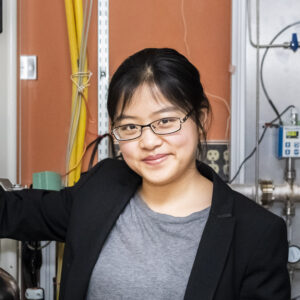
Dr. Xinting Yu wears a black blazer over a gray shirt and glasses at the Johns Hopkins University.

Dr. Xinting Yu is awarded one of two 2025 Harold C. Urey Prizes as a recognition for her broad and impactful work in both planetary and exoplanet science, on both planetary surfaces and atmospheres. Although an exoplanet scientist, she is involved in the solar system science community and has fostered new collaborations. She is learning new skills in geochemistry and thinks of her labwork in the context of theory and observations. Her distinctive expertise in both laboratory experiments and theoretical analysis positions her to play a critical and unique role in the field. Her work is applicable to Cassini, Dragonfly, and JWST and she also studies meteorites to learn about secondary atmospheres and outgassing. She has performed groundbreaking work on particles on Titan that informs on surface conditions applicable to the Dragonfly mission. Xinting has also been very active in mentorship and professional development.


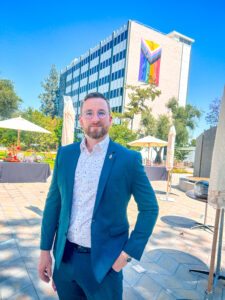
Dr. James Keane wears a blue shirt under a blue suit and glasses, posing in front of an office building at the NASA Jet Propulsion Laboratory with a multi-story Inclusive Pride Flag hanging from the size.

Dr. James Keane is awarded the 2025 Harold C. Urey Prize because he has distinguished himself with his broad and impactful research portfolio studying the geophysics of worlds across the Solar System, including the Moon, Io, Arrokoth, Pluto, and Enceladus. James has worked to combine gravity, topography, and imaging data to expand the science return of several planetary missions, including GRAIL, New Horizons, and Juno. He is a well-known science communicator whose prolific science illustrations have improved the accessibility of planetary science to the broader community and the lay public. Dr. Keane served on the Mercury and Moon panel of the Planetary Science and Astrobiology Decadal Survey (PSADS). He has a strong record of community service and outreach including as a DPS member, a member of the AAS Committee on the Status of Women, co-lead of the American Geophysical Union (AGU) Sketch your Science workshop, science advisor of AGU’s Eos, convenor of several Keck Institute for Space Science workshops, and science mentor for the NASA Planetary Science Summer School (PSSS). Dr. Keane collaborates widely and is currently mentoring graduate students at Caltech, University of Arizona, and Purdue. Dr. Keane is also the recipient of the Presidential Early Career Award for Scientists and Engineers (PECASE) and NASA Early Career Achievement Medal. As a graduate student, James received the Pellas-Graham Ryder Award and the Eugene M. Shoemaker Impact Cratering Award from the Geological Society of America’s Planetary Science Division, and AGU’s Outstanding Student Paper Award. 


Dr. Rosaly Lopes wears a dark blue blouse and looks at the camera.

Dr. Rosaly Lopes is the winner of the 2025 Harold Masursky Award. Dr Lopes has demonstrated deep and broad dedication to the advancement and health of planetary science in countless ways that extend beyond her duties as a JPL scientist. She has done work with the State Department to further planetary science and space studies in other nations. Her comparative studies of volcanology on Earth, Io, Titan and other bodies have allowed her to make an indelible imprint on the field. She has been in leadership positions in various national and international planetary science/geology professional organizations since the mid-2000s, including as DPS Chair and AGU Planetary Section President. Dr. Lopes served on the Space Studies Board of the National Academy of Science, Engineering, and Medicine and participated in the study “Assessing the Health and Vitality of the NASA Science Mission Directorate’s Research Communities”. She was awarded an AGU Ambassador Award and Fellowship.


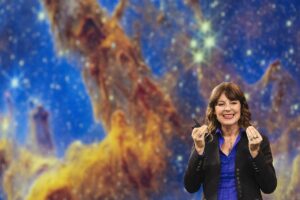
Dr. Lisa Kaltenegger wears a black blazer over a blue blouse in front of a Hubble Space Telescope image at TEDNext, October 22 - 24, 2024, Atlanta, GA. Photo: Erin Lubin / TED

Dr Lisa Kaltenegger is awarded the 2025 Carl Sagan medal which recognizes and honors outstanding communication by an active planetary scientist to the general public. It is awarded to Lisa whose efforts have significantly contributed to a public understanding of, and enthusiasm for, planetary science. Dr Kaltenegger has, throughout her career, made communication and engagement a priority. She is the Founding Director of the Carl Sagan Institute at Cornell University (11 years ago, as an early career scientist) and a gifted communicator. Under her direction, the Carl Sagan Institute has built a YouTube channel with over 26,000 subscribers that showcases technical and popular science talks, and also has established a strong presence on major social media platforms. She has made outstanding contributions to the fields of planetary and exoplanetary science that she has associated with extensive, multi-faceted, and impactful communication of these fields to audiences that range from the general public to those in the critical pipelines of early career talent from the national and international educational systems. Lisa has appeared on high-profile podcasts and has recently published a critically acclaimed popular science book, “Alien Earths”, which has already been translated into 10 languages and has garnered widespread praise. Lisa’s TED Next talk associated with this book accumulated nearly half-a-million views just two months after being posted. Hundreds of stories and media quotations have resulted from her intriguing and accessible science publications. She has performed community service to the profession as a member of the Astronomy and Astrophysics Advisory Committee (AAAC) of the National Academy of Science (NAS), among many other roles.


Liz Kruesi wears a blue blouse and glasses, has purple hair, and looks at the camera.

Ms. Liz Kruesi is awarded the 2025 Jonathan Eberhart Planetary Sciences Journalism award, which recognizes distinguished popular writing on planetary sciences, for her piece entitled, “What has Perseverance found in two years on Mars?” published in February 2023 in Science News. The article provides an up-to-date assessment of the exploration of Jezero Crater by Perseverance and its place within NASA’s larger Mars Program while also making effective arguments for the importance of both. The piece’s description of the different kinds of geology encountered on the crater floor, the explanation of surprise of scientists to new results found by the rover, and the excellent pairing of images with the text all came together to evoke the exploration and excitement that comes with any ongoing mission. In between headlines, these missions are still treading further into the unknown. Through avoiding a focus on a particular result and instead describing the Mars Program as a kind of journey towards deeper understanding of the Red Planet, Ms. Kruesi’s piece successfully wove together multiple ongoing lines of research into a coherent story, which makes the case for not just why these scientists study Mars but why we all ought to care about what they find. Depicting an unfolding scientific understanding — in this case about the broad history of Jezero Crater and what it means for the samples that Perseverance is caching — before there is a clear consensus requires a deft hand as well as an attention to detail and pacing, and Ms. Kruesi’s piece achieved this, and much more, admirably.


“I think I can safely speak for the DPS Committee when I say that these seven awards are going to those who represent the best aspects of our community,” added DPS Press Secretary and Officer Theodore Kareta. “Congratulations again to each and every one of the winners.”

The 2025 DPS prizes will be presented at a joint meeting of the Division for Planetary Sciences and the Europlanet Society Congress (EPSC), which will take place in Helsinki, Finland and online from 7 to 12 September 2025. The prizes will be given out at a ceremony at 2:00 PM local time on 11 September.

Contacts:
Dr. Theodore Kareta
DPS Press Officer (outgoing)
[email protected]

Dr. Athena Coustenis
DPS Chair
[email protected]

More information about DPS prizes:
https://dps.aas.org/prizes

EPSC-DPS Joint Meeting 2025, Helsinki, Finland, 7-12 September 2025:
https://epsc-dps2025.eu/

The Division for Planetary Sciences (DPS), founded in 1968, is the largest special-interest Division of the American Astronomical Society (AAS). Members of the DPS study the bodies of our own solar system, from planets and moons to comets and asteroids, and all other solar-system objects and processes. With the discovery that planets exist around other stars, the DPS has expanded its scope to include the study of extrasolar planetary systems as well.

The American Astronomical Society (AAS), established in 1899, is the major organization of professional astronomers in North America. The mission of the AAS is to enhance and share humanity’s scientific understanding of the universe as a diverse and inclusive astronomical community, which it achieves through publishing, meeting organization, science advocacy, education and outreach, and training and professional development.

DPS Newsletter 25-17

Issue 25-17, Jul 29, 2025

+————————————CONTENTS—————————————-+

  1. MESSAGE FROM THE CHAIR:  CONGRATULATIONS TO THE 2025 DPS COMMITTEE NEW MEMBERS AND DPS PRIZE AWARDEES
  1. EARLY REGISTRATION ENDING SOON FOR THE EPSC-DPS 2025 MEETING
  1. DPS MEMBERS MEETING AT THE EPSC-DPS 2025 MEETING
  1. OPEN MIC NIGHT AT THE 2025 EPSC-DPS MEETING
  1. MENTORING AT EPSC-DPS 2025
  1. DEPENDENT CARE GRANT APPLICATION FOR 2025 EPSC-DPS
  1. CLASSROOM VISITS DURING EPSC-DPS 2025

+——————————————————————————————–+

1———1———1———1———1———1———1———1———1——-

MESSAGE FROM THE CHAIR:  CONGRATULATIONS TO THE 2025 DPS COMMITTEE NEW MEMBERS AND DPS PRIZE AWARDEES

It is with great pleasure that I would like to welcome to our DPS committee the newly elected members:

My sincere congratulations to Dr JA Grier, the incoming Vice-Chair and to Drs Arianna Piccialli and Eddie Schwieterman who are the incoming Committee members.

My heartfelt thanks to all who ran in these elections and were prepared to serve our community. The Division for Planetary Sciences relies on volunteers for its leadership positions and we thank all members who were willing to run for these elected positions. A special thanks to our Nominating Subcommittee, Tim Livengood, Jessica Noviello and Therese Encrenaz for assembling the 2025 slate of candidates and Diane Frendak for her technical support running the elections.

We are also announcing at this time the DPS 2025 Prize and Awards winners. Indeed, as every year the DPS recognizes exceptional achievement in our field with the following Awards and Prizes: 

  • The Gerard P. Kuiper Prize is awarded to Dr Faith Villas and it honors outstanding contributions to the field of planetary science. 
  • The Harold C. Urey Prize recognizes outstanding achievement in planetary research and is awarded this year to two extremely deserving young scientists: Dr Xinting Yu and Dr James Keane 
  • The Harold Masursky Award acknowledges this year Dr Rosaly Lopes’ outstanding service to planetary science and exploration.
  • The Carl Sagan Medal is bestowed to Dr Lisa Kaltenegger and recognizes and honors outstanding communication by an active planetary scientist to the general public.
  • The Alexander Prize recognizes Dr Matt Hedman’s outstanding contributions that have significantly advanced our knowledge of planetary systems, including our solar system.
  • The Jonathan Eberhart Planetary Sciences Journalism Award recognizes and stimulates distinguished popular writing on planetary sciences and is bestowed this year to Liz Kruesi.

Detailed descriptions of each of the prizes and the criteria for nominees for each can be found at http://dps.aas.org/prizes. The prizes will be presented at the 2025 EPSC-DPS Joint meeting at 2 pm on Thursday Sept 11 in Helsinki Finland, which will be 7 am Eastern Time.

We gratefully thank the DPS Prize Subcommittee who worked with the nominations this year (Chair: Carol Raymond) and encourage everyone to make nominations in the coming years.

The DPS committee joins me in warmly congratulating our colleagues for their achievements and service to the community! In these challenging times for planetary sciences it is always appreciated to have a chance to recognize the activities and great results of people in our field that bring merit and pride to our community.

Athena Coustenis

DPS Chair

2———2———2———2———2———2———2———2———2——-

EARLY REGISTRATION ENDING SOON FOR THE EPSC-DPS 2025 MEETING

Early registration for the EPSC-DPS Joint 2025 Meeting in Finlandia Hall, Helsinki, Finland will close on July 31, 2025 at 5:59 pm ET.  The early registration payment can be made by bank transfer, credit card (Mastercard, VISA, JCB or American Express), or PayPal. As of 1 August 2025, the late registration rates will be applied and payment of your registration will only be possible by credit card or PayPal. Bank transfer payments of registrations will not be possible in case of registering after 31 July 2025, 5:59 pm ET. Please consider that a registration at the early registration rate requires the payment of the registration amount within the deadline indicated on the invoice (14 days after receipt of invoice). Unpaid early registrations after the payment deadline will be cancelled and the late registration rates will be applied.

Please use the following link to access the registration page where you can find more information about the rates and the in person or virtual registration process.

https://www.epsc-dps2025.eu/attend/registration.html

Registration is required for all EPSC-DPS 2025 participants including presenting authors of submitted and accepted abstracts, session conveners, and solicited speakers. Registration fees cover access to all scientific events, as well as refreshments during the coffee breaks and networking events.

3———3———3———3———3———3———3———3———3——-

DPS MEMBERS MEETING AT THE EPSC-DPS 2025 MEETING

The DPS Members meeting will be held in Helsinki, Finland at the Joint EPSC-DPS Meeting on Wednesday Sept 10 at 12:30 pm, which will be 5:30 am Eastern Time.  A link will be provided in the future for all DPS members who wish to attend remotely.

4———4———4———4———4———4———4———4———4——-

OPEN MIC NIGHT AT THE 2025 EPSC-DPS MEETING

We will be holding the 2025 EPSC/DPS open mic night on Tuesday Sept 9 at a bar called Storyville, across the street from Finlandia Hall. The exact start time is TBD, but will be late evening. Storyville serves food and drinks and will be open prior to the event. Entry is free.

Any registered DPS attendee is welcome to sign up to perform. We typically have musical acts, poetry, spoken word, etc., so don’t be shy. You can either email Joe Spitale ([email protected]) ahead of time to reserve a slot, or you can sign up during the show for a five-minute walk-on slot, subject to availability. To reserve a slot, send the following information by Sept 2 to [email protected]

  • Name of act, if any
  • Names of participant(s)
  • Description of act (e.g., music w/ singing, opera, aerial acrobatics, Romanian bagpipes, extended bongo solo, etc.)
  • Contact email address
  • Requested duration
  • Requested equipment
  • Any equipment you are willing to share

Regarding sharing equipment, please do not feel in any way pressured or obligated to share any of your personal equipment if you are not comfortable doing so.

Please note that we won’t be able to let you know how much time we can actually give you until after the sign-ups close, but we’ll do our best to get everyone in!

We look forward to seeing you there!

5———5———5———5———5———5———5———5———5——-

MENTORING AT EPSC-DPS 2025

The Europlanet Early Career (EPEC) network invites you to participate in the 7th edition of the Mentoring@EPSC program. The mentoring will provide one-on-one meetings between students, PhD candidates, postdocs, and established researchers for informal conversation and

exchange of experiences. All of this with the goal of offering early-career scientists a better experience at EPSC 2025 and a unique networking opportunity! Information about the program can be found here – https://www.europlanet.org/early-careers-network/epec-epsc-dps-2025-helsinki/.

If you have any questions, please contact [email protected].

Prospective mentors should fill out this form – https://forms.gle/sX6JAzdBxoiRuBcp8

 Prospective mentees should fill out this form – https://forms.gle/RVpwZ6qNo3LhWwEq8.

The deadline for sign-up is Aug 15.

6———6———6———6———6———6———6———6———

DEPENDENT CARE GRANT APPLICATION FOR 2025 EPSC-DPS

The DPS’s Susan Niebur Professional Development Fund provides financial assistance to qualifying DPS members in order to facilitate their meeting attendance by offsetting costs for childcare, elder care, spousal care, etc. at the meeting location or at home during DPS conferences. We are now accepting applications for the EPSC-DPS Joint Meeting 2025 in Helsinki, Finland. First Deadline: Tuesday, August 5, 2025. Review of submissions will begin on the first deadline; further requests will be accepted and reviewed, funding and eligibility permitting. For more information and to apply for the grant, visit: https://dps.aas.org/development/dps-dependent-care-grant-application

7———7———7———7———7———7———7———7———7——-

CLASSROOM VISITS DURING EPSC-DPS 2025

During the week of and week after the EPSC-DPS BIANNUAL JOINT conference, the Lecturers Without Borders organization (https://www.lewibo.org/) and Europlanet Society will schedule classroom visits for scientists attending the conference to local schools in and around Helsinki. The program now counts its 5th edition, and for the first time, it is joined by the American

community of Planetary scientists. It gives travelling scientists from both sides of the Atlantic the opportunity to share their knowledge with the local community of schools, creating a temporary hotspot of sharing science.

If you are interested and available to participate, either in-person or virtually, please fill out the following form to indicate your availability – https://form.jotform.com/241661279538061. Contact Dr. Athanasia Nikolaou ([email protected]) for additional information.

At the same time, schools in the US with students from 9 years old or older can declare their interest to follow online lectures in planetary science in this form:

The programme is supported by Europlanet Society, the Division for Planetary Sciences – AAS,  University of Helsinki, the Finnish Meteorological Institute, Ursa Astronomical Association and Scientix.  LUMA joins a communication partner.

+———————————

Send submissions to: Denise Stephens, DPS Secretary, at this address  [email protected]

You’re receiving this email because you are a DPS member. To unsubscribe or update your information, please send your request to [email protected]. The more general AAS privacy policy is available online at https://aas.org/about/policies/privacy-policy. Current and back issues of the DPS Newsletter can be found at https://dps.aas.org/newsletters

DPS Newsletter 25-16

Issue 25-16, Jul 23, 2025

+————————————CONTENTS—————————————-+

  1. EARLY REGISTRATION ENDING SOON FOR THE EPSC-DPS 2025 MEETING
  1. EPSC-DPS WOMEN IN PLANETARY SCIENCE LUNCH – SAVE THE DATE
  1. OPEN MIC NIGHT AT THE 2025 EPSC-DPS MEETING
  1. MENTORING AT EPSC-DPS 2025
  1. DEPENDENT CARE GRANT APPLICATION FOR 2025 EPSC-DPS
  1. AN UPDATE ON RECENT AAS ADVOCACY BY THE DPS LIAISON TO CAPP
  1. SUGGESTED ADVOCACY ACTIONS FROM AAS
  1. ROSES ROLL OUT WEBINAR FOR PLANETARY SCIENCE DIVISION JULY 29
  1. CALL FOR DONATIONS IN SUPPORT OF DPS STUDENT TRAVEL GRANTS
  1. SUPPORT REQUESTED FOR DPS PARTNER: THE NATIONAL SOCIETY OF BLACK PHYSICISTS (NSBP)
  1. DPS COMMITTEE SEEKS APPLICANTS FOR PUBLICATIONS SUBCOMMITTEE CHAIR TO BEGIN TERM IN FALL 2025
  1. SUBMIT LUNAR EXPLORATION ABSTRACTS TO THE GEOLOGICAL SOCIETY OF AMERICA (GSA) CONNECTS 2025 MEETING
  1. EXCELLENCE IN SCIENCE LEADERSHIP: A NEW WORKSHOP ON STRATEGIES FOR UNLOCKING INDIVIDUAL POTENTIAL
  1. SAVE-THE-DATE: ORIGINS 2026 JULY 5-10, PARIS
  1. JOVIAN ICY MOONS WORKSHOP: ABSTRACT SUBMISSION & TRAVEL GRANT DEADLINE
  1. 5TH MedGU, 10–13 NOVEMBER 2025, ATHENS, GREECE
  1. [AGU 2025, NEW ORLEANS, 15-19 DEC] SESSION P044 – TITAN AT EQUINOX: SEASONAL CHANGES ON AN OCEAN WORLD
  1. CALL FOR ABSTRACTS – AGU 2025 SESSION ON VOLATILES AND PLANETARY HABITABILITY
  1. AGU SESSION: THE NEXUS FOR EXOPLANET SYSTEM SCIENCE (NExSS) – BUILDING A COMMUNITY FOR INTERDISCIPLINARY RESEARCH ACROSS NASA SCIENCE DIVISIONS (SESSION NUMBER P042)
  1. AGU 2025 SPECIAL SESSION: AERIAL EXPLORATION OF MARS
  1. CALL FOR ABSTRACTS – AGU 2025 SESSION P045 – TITAN: ATMOSPHERE, IONOSPHERE, SPACE ENVIRONMENT AND THEIR INTERACTIONS
  1. AGU SESSION P006: CLOSE ENCOUNTERS IN THE EARTH-MOON SYSTEM: APOPHIS, 2024 YR4, AND THE FUTURE OF PLANETARY DEFENSE
  1. AGU SESSION P025 – PLANETARY ANALOG FIELD WORK TO SUPPORT AND ENABLE CREWED AND ROBOTIC EXPLORATION OF OUR SOLAR SYSTEM
  1. AGU SESSION P035 – SMALL SOLAR SYSTEM BODIES: SAMPLE RETURNS, JWST, GROUND-BASED ASTRONOMY AND MORE
  1. AGU 2025 SESSION P010 – ENCELADUS: AN OCEAN WORLD ODYSSEY
  1. AGU 2025 SESSION NH029 – LATEST DEVELOPMENTS IN PLANETARY DEFENSE
  1. CURRENT TABLE OF CONTENTS FOR THE PLANETARY SCIENCE JOURNAL AND ICARUS
  1. JOBS, POSITIONS, AND OPPORTUNITIES

+——————————————————————————————–+

1———1———1———1———1———1———1———1———1——-

EARLY REGISTRATION ENDING SOON FOR THE EPSC-DPS 2025 MEETING

Early registration for the EPSC-DPS Joint 2025 Meeting in Finlandia Hall, Helsinki, Finland will close on July 31, 2025 at 5:59 pm ET.  The early registration payment can be made by bank transfer, credit card (Mastercard, VISA, JCB or American Express), or PayPal. As of 1 August 2025, the late registration rates will be applied and payment of your registration will only be possible by credit card or PayPal. Bank transfer payments of registrations will not be possible in case of registering after 31 July 2025, 5:59 pm ET. Please consider that a registration at the early registration rate requires the payment of the registration amount within the deadline indicated on the invoice (14 days after receipt of invoice). Unpaid early registrations after the payment deadline will be cancelled and the late registration rates will be applied.

Please use the following link to access the registration page where you can find more information about the rates and the in person or virtual registration process.

https://www.epsc-dps2025.eu/attend/registration.html

Registration is required for all EPSC-DPS 2025 participants including presenting authors of submitted and accepted abstracts, session conveners, and solicited speakers. Registration fees cover access to all scientific events, as well as refreshments during the coffee breaks and networking events.

2———2———2———2———2———2———2———2———2——-

EPSC-DPS WOMEN IN PLANETARY SCIENCE LUNCH – SAVE THE DATE

The DPS will be hosting the Women in Planetary Science Lunch at the EPSC-DPS meeting in the Saturn room of Finlandia Hall on Thursday September 11 at 12:30 pm. Bagged lunches and drinks will be provided. Additional details about the event will be sent in future DPS newsletters.

3———3———3———3———3———3———3———3———3——-

OPEN MIC NIGHT AT THE 2025 EPSC-DPS MEETING

We will be holding the 2025 EPSC/DPS open mic night on Tuesday Sept 9 at a bar called Storyville, across the street from Finlandia Hall. The exact start time is TBD, but will be late evening. Storyville serves food and drinks and will be open prior to the event. Entry is free.

Any registered DPS attendee is welcome to sign up to perform. We typically have musical acts, poetry, spoken word, etc., so don’t be shy. You can either email Joe Spitale ([email protected]) ahead of time to reserve a slot, or you can sign up during the show for a five-minute walk-on slot, subject to availability. To reserve a slot, send the following information by Sept 2 to [email protected]

  • Name of act, if any
  • Names of participant(s)
  • Description of act (e.g., music w/ singing, opera, aerial acrobatics, Romanian bagpipes, extended bongo solo, etc.)
  • Contact email address
  • Requested duration
  • Requested equipment
  • Any equipment you are willing to share

Regarding sharing equipment, please do not feel in any way pressured or obligated to share any of your personal equipment if you are not comfortable doing so.

Please note that we won’t be able to let you know how much time we can actually give you until after the sign-ups close, but we’ll do our best to get everyone in!

We look forward to seeing you there!

4———4———4———4———4———4———4———4———4——-

MENTORING AT EPSC-DPS 2025

The Europlanet Early Career (EPEC) network invites you to participate in the 7th edition of the Mentoring@EPSC program. The mentoring will provide one-on-one meetings between students, PhD candidates, postdocs, and established researchers for informal conversation and

exchange of experiences. All of this with the goal of offering early-career scientists a better experience at EPSC 2025 and a unique networking opportunity! Information about the program can be found here – https://www.europlanet.org/early-careers-network/epec-epsc-dps-2025-helsinki/.

If you have any questions, please contact [email protected].

Prospective mentors should fill out this form – https://forms.gle/RVpwZ6qNo3LhWwEq8. Prospective mentees should fill out this form – https://forms.gle/sX6JAzdBxoiRuBcp8

The deadline for sign-up is Aug 15.

5———5———5———5———5———5———5———5———5——-

DEPENDENT CARE GRANT APPLICATION FOR 2025 EPSC-DPS

The DPS’s Susan Niebur Professional Development Fund provides financial assistance to qualifying DPS members in order to facilitate their meeting attendance by offsetting costs for childcare, elder care, spousal care, etc. at the meeting location or at home during DPS conferences. We are now accepting applications for the EPSC-DPS Joint Meeting 2025 in Helsinki, Finland. First Deadline: Tuesday, August 5, 2025. Review of submissions will begin on the first deadline; further requests will be accepted and reviewed, funding and eligibility permitting. For more information and to apply for the grant, visit: https://dps.aas.org/development/dps-dependent-care-grant-application

6———6———6———6———6———6———6———6———

AN UPDATE ON RECENT AAS ADVOCACY BY THE DPS LIAISON TO CAPP

Most AAS/DPS members are aware of the great work that the DPS Committee and the Federal Relations Subcommittee (FRS) have done and are doing in terms of advocacy during the present time of extreme political challenges. The DPS FRS subcommittee is made up of volunteers and led by FRS Officer Dr. Angela Dapremont (https://dps.aas.org/leadership/frs).  Moreover, the AAS office and leadership also has several folks on staff working hard on policy topics (Bahcall Fellow Colin Hamill, Dep. Director of Policy Roohi Dahl, and Joel Parriott in his role as Director of External Affairs and Public Policy), as you read about periodically in AAS and DPS newsletters.  But did you know that the AAS has another volunteer group at the top level?  It is called the Committee on Astronomy and Public Policy (CAPP).  https://aas.org/comms/committee-astronomy-and-public-policy-capp

I’ve served as the DPS Liaison to CAPP in the past few years, starting after my time as FRS Officer/Chair.  Other planetary folks such as Dr. Britney Schmidt (and previously Dr. Makenzie Lystrup) have been appointed to CAPP by the AAS President. The Solar Physics Division (SPD) similarly has a liaison to CAPP.  We’ve been quite busy in service to our community and here is a brief summary of recent advocacy activities beyond what you’ve likely already read about in the newsletters and calls for action (e.g., https://aas.org/action-alert-protecting-astronomical-programs-fiscal-year-2026 and “timeline” of public policy updates):

  • Outside Witness Testimony to the Senate CJS subcommittee regarding FY26 Appropriations.
  • Our group advises the AAS President (currently Dr. Dara Norman) while deliberating a variety of topics beyond NASA funding, including NSF and their large facilities, FCC-related radio spectrum threats, light-pollution from satellite constellations, and more.
  • Representatives from CAPP join the annual AAS Congressional Visits Day (CVD) groups, which always includes representation by DPS folks.
  • AAS recently joined several professional societies in submitting Amicus Brief Nos. 25-1677, 25-2637 regarding the suit filed against the office of personnel in response to copious terminations at federal science agencies (Am. Fed’n of Gov’t Employees, AFL-CIO v. United States Office of Personnel Mgmt., 25-1677, (9th Cir.), March 13, 2025).
  • We review, edit, and comment on numerous such co-signed letters to Congress, OMB, etc., usually in collaboration with the American Physical Society, the Coalition for Aerospace and Science, AGU, Coalition for National Science Funding (CNSF), Energy Sciences Coalition (ESC), and increasingly with the Planetary Society.
  • Good examples of CAPP’s involvement include helping with the letter to Congress that our AAS Policy Team sent in support of NASA Science in late April. In late May, we also authored a letter to Congress (co-signed by over 50 other organizations) in support of NSF, where we voiced concern over the reorganization plans and urged Congress to exercise their oversight authority.

By working together across professional societies our voices are amplified inside the government with these formal letters.  I share this bit of information about AAS/CAPP to encourage your continued support of AAS/DPS and to go ahead and participate in the present and future action alerts (if you haven’t already): https://aas.org/planetary-action-alert.  Continue to speak up in social media as well.  Contact the DPS/FRS Officer if interested in joining the FRS.  We make a difference by standing together. 

Contact Kurt Retherford at [email protected],Angela Dapremont ([email protected]) and AAS Bahcall Fellow (and former FRS member) Colin Hamill [email protected] with further questions or ideas.

Dr. Kurt D. Retherford

AAS CAPP – DPS Liaison

Federal Relations Subcommittee member

[email protected]

7———7———7———7———7———7———7———7———7——-

SUGGESTED ADVOCACY ACTIONS FROM AAS

There are many ways to make your voice heard in support of scientific funding and programs. From sending a quick email to holding an in-person meeting with your representatives and/or staff, every action counts. The following webpage from the AAS provides ideas and tools to assist you in your advocacy efforts:  https://aas.org/advocacy/suggested-advocacy-actions

Recent reports indicate that the White House Office of Management and Budget (OMB) is directing NASA, NSF, and other science agencies to prepare to operate at the deeply cut levels in the President’s Budget Request for FY2026.  If ultimately implemented during a FY2026 Continuing Resolution (CR), the agencies would execute a budget plan at levels dramatically lower than FY2025 CR levels without regard for the CR appropriation that Congress ultimately provides.  We need to act now to protect our scientific agencies from premature and wasteful project cancellations.  You can learn more about this action alert at the following website.

https://aas.org/action-alert-protecting-astronomical-programs-fiscal-year-2026

During August, Congress will be taking a month-long recess.  This is a great time to set up in-district meetings with your members of Congress and/or their staff to talk about the importance of science funding.  Please reach out to [email protected] if there is anything we can do to help facilitate your advocacy.

8———8———8———8———8———8———8———8———8——-

ROSES ROLL OUT WEBINAR FOR PLANETARY SCIENCE DIVISION JULY 29

On July 29, 2025, at 12:30 PM Eastern Time, NASA’s Planetary Science Division (PSD) Research and Analysis (R&A) Programs will host a webinar to discuss the recently released Research Opportunities in Space and Earth Science (ROSES) relevant to the Planetary Science Community.

NASA’s Science Mission Directorate (SMD) announced the release of its annual omnibus solicitation for basic and applied research, ROSES-2025 as NNH25ZDA001N on July 10, 2025, at https://solicitation.nasaprs.com/ROSES2025. This webinar is an opportunity for the PSD to discuss program elements available for the planetary science community to propose to.

In advance of and during the webinar, questions may be submitted and upvoted on at:  

https://nasa.cnf.io/sessions/ss4t/#!/dashboard

Questions regarding this announcement may be directed to Dr. Kathleen Vander Kaaden, Director of Planetary Research Programs, at [email protected].

9———9———9———9———9——–9———9———9———9——-

CALL FOR DONATIONS IN SUPPORT OF  DPS STUDENT TRAVEL GRANTS

During these challenging times, many students are losing access to their funding and are unable to travel to professional meetings to present their research.  The Division for Planetary Science (DPS) Hartmann Student Travel Grant and Underrepresented Minorities (URM) Travel Grant exist to support student presentations at the annual DPS meeting. The need this year has been very great, and our ability to help the applicants was limited by the amount of money available in the Hartmann and URM grant funds.  

Community donations are critical for the health of these awards and our ability to fund students. Each fund functions as an endowment. Please consider making a donation today. Give by logging into your AAS account through this link and submitting a donation to either the Hartmann Student Travel Grants or the URM Travel Grants.

10———10———10———10———10———10———10———10———10——-

SUPPORT REQUESTED FOR DPS PARTNER: THE NATIONAL SOCIETY OF BLACK PHYSICISTS (NSBP)

DPS has been proud to partner with the Earth and Planetary Systems Sciences (EPSS) section of the National Society of Black Physicists (NSBP), supporting a presentation from the DPS-NSBP Speaker Awardee at the DPS annual meeting as well as travel of a few planetary scientists to the NSBP annual meeting. For the latter, DPS has generally focused on sending postdocs and early career scientists to the NSBP meeting as, historically, NSBP has been able fully support the travel for most of the students who attend the conference. However, recent cuts to funding from traditional partners have drastically reduced NSBP’s ability to support most of the students to attend their conference so they are soliciting community donations; on average, the cost to cover a student’s travel and lodging is $1500. The link to donate directly to NSBP is below; alternatively, if you prefer to donate through DPS, community contributions to the DPS URM Travel Grant fund will also be used to support travel to the NSBP meeting. Donations through either path should be U.S. tax deductible. Many thanks to all who support these future planetary scientists!

To donate directly to NSBP: https://nsbp.org/page/conferencestudentsupport

To donate to the DPS URM travel grant: https://dps.aas.org/Inclusivity/support-underrepresented-minority-communities-planetary-science

For more on the DPS-NSBP partnership: https://dps.aas.org/leadership/nsbp_parnership

11———11———11———11———11———11———11———11———

DPS COMMITTEE SEEKS APPLICANTS FOR PUBLICATIONS SUBCOMMITTEE CHAIR TO BEGIN TERM IN FALL 2025

The Publications Subcommittee Chair will serve a three-year term starting with the EPSC-DPS meeting in September 2025. The Publications Subcommittee is responsible for managing the relationship between DPS and its designated publications, Icarus and the Planetary Science Journal, and also stays aware of issues in planetary science publications more generally. The Publications Subcommittee regularly reviews the publication policies of journals that the DPS endorses and supports.

If you’re interested, please send a CV and a brief statement of interest to [email protected]

12———12———12———12———12———12———12———12———

SUBMIT LUNAR EXPLORATION ABSTRACTS TO THE GEOLOGICAL SOCIETY OF AMERICA (GSA) CONNECTS 2025 MEETING

The GSA Connects 2025 meeting will be hosted in San Antonio, TX on 19–22 October 2025. One of the three themes for this meeting is “From Earth to the Cosmos: Geoscience Beyond Our Planet”. We encourage those with active scientific studies of the Moon, involvement in lunar missions, and those developing goals, concepts, or instrumentation for future lunar exploration to submit abstracts to the GSA session: T168. Lunar Science and Exploration in the Artemis Era.

For questions about this session, email Tracy Becker ([email protected]) or Akbar Whizin ([email protected]).

13———13———13———13———13———13———13———13———

EXCELLENCE IN SCIENCE LEADERSHIP: A NEW WORKSHOP ON STRATEGIES FOR UNLOCKING INDIVIDUAL POTENTIAL

August 18-20, 2025, 4 hours daily, 11am-1pm and 2pm-4pm EST (entirely virtual)

We invite planetary scientists to join us for our reinvigorated workshop.  We offer best-practices to meet current challenges while uplifting potential in ourselves and that of our professional partners.  If you are seeking expanded approaches to engage with colleagues, groups, teams, committees, etc. with understanding and ethics, this is your workshop.  The content also includes specific strategies to meet present challenges, including additional resources, staying motivated, and avoiding burnout.  Participants at all career stages and experience levels are welcome, as well as those who have previously attended past workshops.  This offering (~25 people or less, to encourage interaction) provides the basic tools needed to enact positive change in personal and professional spheres.  Entirely on-line. Visit website (below) for more details and to fill out the indication of interest form.

“Well organized and well-facilitated, great breadth and depth of topics, and good novel interactive components as well. The content was expertly curated and extremely well presented …” Participant, Nov. 2022

Facilitators:  Drs. Julie Rathbun (she/her/hers) and JA Grier (ee/em/eir)

Website: https://workforce.psi.edu/leadership/

14———14———14———14———14———14———14———14———

SAVE-THE-DATE: ORIGINS 2026 JULY 5-10, PARIS

We are pleased to announce Origins 2026, jointly organized by the International Society for the Study of the Origins of Life – The International Astrobiology Society (ISSOL) and the Astrobiology Commission of the International Astronomical Union (IAU). The meeting will take place from 5 to 10 July 2026 in Paris, France.

This event will bring together experts from diverse fields, including chemistry, biology, planetary science, and astrophysics, to explore the origins of life and habitability on Earth and beyond. Hosted at the prestigious Muséum National d’Histoire Naturelle and Sorbonne University, the conference will highlight interdisciplinary research on the transition from non-living to living systems, focusing on early Earth environments, evolutionary processes, and the search for biosignatures in the universe.

The program will feature the latest discoveries in prebiotic chemistry, the evolution of early life, and habitability across the Solar System and exoplanets, as well as philosophical and historical perspectives. Special emphasis will be placed on the contributions of early-career researchers. This landmark event aims to strengthen international collaborations and advance our understanding of the emergence of life. 

Registration and abstract submission will open in October 2025, but you can already sign up here (https://forms.gle/5MQj1RroTqD5hrMX8) to receive up-to-date information.

15———15———15———15———15———15———15———15———

JOVIAN ICY MOONS WORKSHOP: ABSTRACT SUBMISSION & TRAVEL GRANT DEADLINE

This is a friendly reminder that the deadline for abstract submissions and travel grant applications for the Jovian Icy Moons Workshop is approaching: July 28, 2025 at 23:59 CET.

The workshop will take place from November 3-7, 2025, at ESA/ESAC in Madrid, Spain, and will bring together researchers to explore the surface-environment interactions of Jupiter’s icy moons.

We are also thrilled to welcome a distinguished lineup of invited speakers, including:

– Scott Bolton (Southwest Research Institute)

– Oliver King (University of Leicester)

– Haje Korth (Johns Hopkins University)

– Alice Lucchetti (INAF – Astronomical Observatory of Padova)

– Tom Nordheim (Johns Hopkins University)

– Fuminori Tsuchiya (Tohoku University)

– Claire Vallat (ESA/ESAC)

– Audrey Vorburger (University of Bern)

– Zhonghua Yao (University of Hong Kong)

Submit your abstract: https://tinyurl.com/mrr9wcba

Apply for a travel grant (early-career researchers): https://tinyurl.com/5n7f2mw5

Register for the workshop (open until October 6, 2025): https://tinyurl.com/ytdkbdp4

If you have any questions, feel free to reach out to us:

We look forward to your contributions and to welcoming you to the workshop!

16———16———16———16———16———16———16———16———

5TH MedGU, 10–13 NOVEMBER 2025, ATHENS, GREECE

The National and Kapodistrian University of Athens in Greece will host the 2025 MedGU Annual Meeting.You are invited to participate and share your most recent research contributions.

Abstract submission deadline: 25 August 2025

Website: MedGU 2025

Scopus-indexed Proceedings: MedGU | SpringerLink

MedGU 2024 YouTube: MedGU-2024 YouTube

17———17———17———17———17———17———17———17———

[AGU 2025, NEW ORLEANS, 15-19 DEC] SESSION P044 – TITAN AT EQUINOX: SEASONAL CHANGES ON AN OCEAN WORLD

On May 6th 2025 the Saturn system passed through Northern Fall Equinox, and the peak sunlight moved from Titan’s northern to southern hemisphere. Thus commenced a period of expected upheaval and change, when Titan’s atmospheric circulation will slowly begin to reverse direction and may be accompanied by intense methane rainstorms as seen soon after the last equinoctial passage in 2009. This year also marks another major milestone: the 20th year since the Huygens landing on Titan and the return to Earth of its incredible in situ dataset. This topical Titan session solicits novel presentations on all aspects of Titan science, including recent observations, new modeling and laboratory work, and related analog and field work.

To submit an abstract, please visit: https://agu.confex.com/agu/agu25/prelim.cgi/Session/248910

Conveners: Conor Nixon, Kathleen Mandt, Kendra Farnsworth, Samuel Birch

18———18———18———18———18———18———18———18———

CALL FOR ABSTRACTS – AGU 2025 SESSION ON VOLATILES AND PLANETARY HABITABILITY

We invite submissions to our AGU 2025 session: Fate of Volatiles During Magmatic Processes in Planetary Interiors: Implications on the Origins of Habitability

Session Link : https://agu.confex.com/agu/agu25/prelim.cgi/Session/251607

Abstract Deadline: 30 July 2025 23:59 EDT/03:59 +1 GMT

This session focuses on how life-enabling elements (e.g., C, S, N, O, H) are acquired, mobilized, and retained within terrestrial planets through magmatic processes such as core formation, magma ocean convection and crystallization, volcanic outgassing, and subduction. These processes are key to understanding the internal distribution of volatiles and how they shape planetary habitability.

We welcome interdisciplinary contributions from fields including:

  • Cosmochemistry and experimental petrology
  • Thermodynamic, molecular, and fluid dynamics modeling
  • Smoothed-particle hydrodynamics simulations
  • Machine learning or AI-based approaches in planetary research

Early-career researchers and those working at the intersection of multiple disciplines are especially encouraged to contribute.

For questions or more information, feel free to contact the conveners:

Please share with colleagues who may be interested. We look forward to your submissions!

19———19———19———19———19———19———19———19———

AGU SESSION: THE NEXUS FOR EXOPLANET SYSTEM SCIENCE (NExSS) – BUILDING A COMMUNITY FOR INTERDISCIPLINARY RESEARCH ACROSS NASA SCIENCE DIVISIONS (SESSION NUMBER P042)

Exoplanet research has provided unique opportunities to promote multidisciplinary work, as it requires expertise from the fields of Earth Science, Planetary Science, Heliophysics, and Astrophysics. NExSS was created to bring together teams that are associated with these corresponding divisions of NASA’s Science Mission Directorate. NExSS’s goal is to make interdisciplinary connections possible, promoting activities that increase communication and collaboration between research teams and individuals, and streamline research objectives across its science community. The session will cover both NExSS activities as well as general topics on interdisciplinary research. In the spirit of broadening connections, we encourage submissions not only about unique NExSS activities or NExSS-related projects, but also non-NExSS projects that demonstrate the unique value of highly interdisciplinary research; effective means to create and encourage interdisciplinary research within the AGU community; the value of interdisciplinary research in public outreach; or the benefits of interdisciplinary research for science education.

More information: https://agu.confex.com/agu/agu25/prelim.cgi/Session/250198

20———20———20———20———20———20———20———20———

AGU 2025 SPECIAL SESSION: AERIAL EXPLORATION OF MARS

Semi-autonomous rotorcraft have revolutionized terrestrial geological and atmospheric science. Their ability to explore high and low, far and wide allows them to deploy instrumentation and collect remote-sensing data in regions and from perspectives otherwise difficult or impossible to access. The success of the Ingenuity Mars helicopter similarly opens prospects for transforming the study of Mars. Rotorcraft on Mars can facilitate geological and geophysical investigations, enable atmospheric measurements, and assist human exploration. Future missions to Mars could involve these aircraft as complements to ground-bound assets, such as rovers or fixed stations, or as stand-alone vehicles. This session welcomes presentations that consider how small rotorcraft may advance our understanding of Mars, both past and present. Submissions on aircraft-enabled Mars science, missions, and human exploration are all welcome. For details of additional activities, including a social, see http://boi.st/AGU-2025-Mars-UAS or e-mail Brian Jackson at [email protected].

Abstracts may be submitted here –

https://agu.confex.com/agu/agu25/prelim.cgi/Session/250381.

21———21———21———21———21———21———21———21———

CALL FOR ABSTRACTS – AGU 2025 SESSION P045 – TITAN: ATMOSPHERE, IONOSPHERE, SPACE ENVIRONMENT AND THEIR INTERACTIONS

We invite submissions to our AGU 2025 session “Titan: Atmosphere, Ionosphere, Space Environment and their Interactions”

Session link: https://agu.confex.com/agu/agu25/prelim.cgi/Session/250591

Saturn’s largest moon, Titan, is unique among the other moons in the solar system. It possesses a thick atmosphere composed of several hydrocarbon species and is home to some of the most complex organic chemistry known. The atmosphere in many ways is analogous to Earth’s with methane forming clouds, rain and surface lakes. One of the major objectives of the Cassini mission was to study Titan’s atmosphere and its interaction with the space environment. New discoveries and insights continue to be made 8 years after the end of the Cassini mission. This session brings together researchers studying Titan’s atmosphere, ionosphere and space environment to present their latest results. Presentations highlighting data analysis, theory, modeling, and any combination thereof that furthers our understanding of the various regions of Titan and the interactions between them are welcome.

We look forward to receiving your contributions.

Best regards,

Matt Fillingim, Steve Ledvina, Jared Bell, Niklas Edberg, and Konstantin Kim

22———22———22———22———22———22———22———22———

AGU SESSION P006: CLOSE ENCOUNTERS IN THE EARTH-MOON SYSTEM: APOPHIS, 2024 YR4, AND THE FUTURE OF PLANETARY DEFENSE

On 27 January 2025, near-Earth asteroid (NEA) 2024 YR4 reached a record Torino Scale impact rating of 3 before additional observations ruled out an Earth impact in 2032. A >1% impact probability remains, though, with the Moon. On 13 April 2029, (99942) Apophis will pass within geosynchronous orbit, offering a once-in-7kyr opportunity for investigations into Earth’s gravitational influence on asteroid properties and collaborative observations with ground and space assets, including NASA’s Apophis Explorer, ESA’s RAMSES, and JAXA’s DESTINY+. These encounters highlight growing public interest in asteroid hazards and scientific opportunities that will be amplified by next-generation asteroid surveys. This session invites abstracts focused on NEA observations, modeling of dynamical or physical evolution, mission concepts, and planetary defense applications. We especially welcome interdisciplinary contributions that bridge science, engineering, and policy to address the evolving landscape of planetary defense in the context of increasing detection rates and upcoming close encounters.

Please submit your abstract here by Wednesday, 30 July 2025, at 23:59 EDT/03:59 UTC, to join us!

https://agu.confex.com/agu/agu25/prelim.cgi/Session/248431

Co-Convenors: Ron Ballouz, Ed Rivera-Valentín, Dawn Graninger, Andy Rivkin

23———23———23———23———23———23———23———23———

P025 – PLANETARY ANALOG FIELD WORK TO SUPPORT AND ENABLE CREWED AND ROBOTIC EXPLORATION OF OUR SOLAR SYSTEM

New science and exploration questions have emerged from recent exploration of terrestrial Solar System bodies. Terrestrial analogs provide a unique opportunity to investigate these bodies and inform future crewed and robotic missions to the Moon and Mars, and beyond. Research is encouraged in areas such as surface modification processes—including impact, erosion, glacial activity, tectonism, and volcanism—as well as astrobiology, field sampling methods, and lab-based simulant experiments. Studies that explore emerging technologies and capabilities for exploration, instrument development using analog environments, and analog fieldwork to validate remote sensing data are also of interest. Additionally, contributions focusing on field safety, operational field experiences, community collaboration, and outreach efforts are welcomed. These studies not only enhance scientific understanding but also contribute to the planning and success of upcoming missions, supporting the development of expertise in practical strategies and tools for exploration in challenging planetary environments.

To submit an abstract, please visit:

https://agu.confex.com/agu/agu25/prelim.cgi/Session/249564

Conveners: Alexandra Matiella Novak, Emileigh Shoemaker, Lizeth Magaña

24———24———24———24———24———24———24———24———

AGU SESSION P035 – SMALL SOLAR SYSTEM BODIES: SAMPLE RETURNS, JWST, GROUND-BASED ASTRONOMY AND MORE

Recent and upcoming space missions (e.g., OSIRIS-REx, Hayabusa 2, New Horizons, Psyche, Lucy, Emirates Mission to the Asteroid Belt) and powerful telescopic facilities (e.g., JWST, adaptive optics, next-generation ground-based observatories) continue to expand our understanding of the diversity and complexity of small solar system bodies. These planetesimals and dwarf planets preserve essential clues about the early solar system, including accretional processes and thermal evolution. Sample return missions are providing ground truth to remote observations, helping decode planetary formation and evolution. At the same time, national and private space programs are entering the arena and private companies are pushing forward with asteroid prospecting missions. Together, these efforts signal a new era in the study of small bodies—one that is increasingly collaborative, diverse in methods, and rich in discovery potential. We invite abstracts including, but not limited to, space mission data, ground-based observations, modeling, sample returns, planetary defense, and private-sector initiatives.

We invite abstract submissions by Wednesday, July 30, at this link:

https://agu.confex.com/agu/agu25/prelim.cgi/Session/247514

Conveners: Bryan Holler, Julie Castillo-Rogez, Franck Marchis

25———25———25———25——–25———25———25———25———

AGU 2025 SESSION P010 – ENCELADUS: AN OCEAN WORLD ODYSSEY

Saturn’s moon Enceladus is a geologically active and habitable ocean world. Enceladus offers fresh opportunities for advancing our understanding of planetary processes and searching for signatures of potential life. The most accessible ocean material beyond Earth erupts from the internal plumbing system of Enceladus, forming a plume that modifies the space environment at Saturn. This is the 20th consecutive year of this session, attesting to the phenomenal enthusiasm of our community. You won’t want to miss this one! We welcome the community to submit contributions diving into diverse ranges of phenomena including but not limited to: cryovolcanism, ice fracturing and other tectonic processes, ocean circulation, water-rock reactions, tidal heating, organic chemistry, life detection approaches, Enceladus’s formation, history, and internal structure, and cross comparisons with other ocean worlds including Earth and Europa. Observational, theoretical, laboratory, and field analogue investigations are all welcome.

To submit an abstract, please visit:

https://agu.confex.com/agu/agu25/prelim.cgi/Session/249971

Abstract deadline: Wednesday, 30 July 2025 at 23:59 EDT

Conveners: Christopher Glein (SwRI), Cynthia Phillips (JPL), Fabian Klenner (UW Seattle)

26———26———26———26——–26———26———26———26———

AGU 2025 SESSION NH029 – LATEST DEVELOPMENTS IN PLANETARY DEFENSE

We want to invite all that are interested to please submit an abstract for the AGU25 annual meeting session NH029: Latest Developments in Planetary Defense!
The link to submit your abstract can be found here!  (https://agu.confex.com/agu/agu25/prelim.cgi/Session/250688)

The deadline to submit is July 30th 2025 at 23:59 EDT/03:59 UTC

NH029: Latest Developments in Planetary Defense
Planetary defense is the effort to detect and mitigate threats from objects like asteroids and comets, with the goal of preventing or minimizing potential impacts with Earth. This session will delve into the asteroid impact hazard and any recent developments in the field of planetary defense. Topics will include deflection simulations and experiments, characterization of asteroid physical and structural properties, surface morphology, the dynamics of small bodies, and the effects of impacts into Earth. By leveraging simulation models and characterization data, the session aims to inform mission design and optimize the effectiveness of mitigation approaches.  We welcome contributions from diverse research perspectives to foster interdisciplinary collaboration and advance global planetary defense efforts.

Please feel free to forward this to anyone you think might be interested, and we look forward to having a productive session with all that can make it!

Sincerely,

Sean Wiggins, LLNL

Jessie Dotson, NASA Ames
Catherine Plesko, LANL
Kathryn Kumamoto, LLNL

27———27———27———27——–27———27———27———27———

CURRENT TABLE OF CONTENTS FOR THE PLANETARY SCIENCE JOURNAL AND ICARUS

The current issues for both DPS-affiliated journals are here:

The Planetary Science Journal:

Issue 7 – Volume 6 – The Planetary Science Journal – IOPscience

Icarus:

Icarus | Vol 435, In progress (15 July 2025) | ScienceDirect.com by Elsevier

28———28———28———28——–28———28———28———28———

JOBS, POSITIONS, AND OPPORTUNITIES

Job seekers and employers are encouraged to browse DPS’s job listings and advertise open positions **for free** on the DPS job board.

Full details for several new positions can be found on the DPS job board.

A summary of recent job announcements and postdoc opportunities are listed below.

  1. Tenure Track Assistant Professor in Astronomy at Mount Holyoke College

The Mount Holyoke College Physics & Astronomy Department invites applications for an Assistant Professor in Astronomy (tenure track) to begin in Fall 2026. We seek a candidate with a strong commitment to undergraduate teaching in a liberal arts environment, who will establish a vigorous research program involving undergraduates. A PhD in astronomy or a related field is required. Mount Holyoke College is an active member of the Five College Astronomy Department (FCAD), which provides multiple opportunities for research collaborations including at nearby UMass Amherst, the flagship campus of the state university system.

The candidate will teach across our core astronomy curriculum, which spans general-education to upper level astrophysics. With the recent merging of physics and astronomy, there is the opportunity to revamp the astronomy major sequence in collaboration with the FCAD.

Submit statements concerning (1) teaching philosophy with illustrative examples, (2) research plan, and (3) a statement about mentoring a diverse student body, as well as a cover letter addressing your interest in Mount Holyoke and CV. To apply, submit materials here:

https://tinyurl.com/2wj4pb86

For further information please contact Prof. Spencer Smith at [email protected]. Review of applications will begin October 1.

  1. Postdoc Opportunity at University of Leicester, UK

The University of Leicester was recently awarded an STFC Large Grant on the topic of “Planet Mercury: Origins, Evolution, and Interactions” with Emma Bunce as PI. The main aim is preparation for, and analysis of, the first data back from the ESA/JAXA BepiColombo mission to

Mercury, which we are well-positioned for here at Leicester given our leadership of the Mercury Imaging X-ray Spectrometer (MIXS). MIXS will revolutionise our understand of Mercury’s surface geochemistry as a nadir pointing instrument capable of global mapping at X-ray

wavelengths.

This grant spans five years and has four post-doc positions associated with it. Two will be hosted at the University of Leicester, one at Imperial College, and one at the Open University. This represents the first of these exciting positions to be advertised, and the role is focused on planetary geochemistry. Further posts will be advertised next year.

The successful candidate will join the BepiColombo MIXS team at Space Park Leicester and will to analyse the first data back from Mercury’s surface.

Please see the advert for further details:

https://tinyurl.com/5ea9jjfw

For any informal enquiries please get in touch directly with Emma Bunce

via email ([email protected]).

  1. NEO Surveyor Moving Object Scientist at IPAC

IPAC at Caltech invites applications for the position of Moving Object Scientist for the NEO Surveyor Survey Data System (NSDS). IPAC is building and will operate the NSDS for NASA’s NEO Surveyor (NEOS) mission. The NSDS ingests imaging and engineering data from the flight system, processes those data into calibrated image and source detection products, performs automated searches for moving Solar System objects, assesses the quality of the survey data, and distributes data products to NASA archives and the user community, including sending moving object tracklets to the Minor Planet Center. A key part of the NSDS is the Moving Object Detection Pipeline (MODP), a software subsystem that is in an advanced state of development and currently undergoing regular performance testing and analysis. 

For more information visit: https://phf.tbe.taleo.net/phf03/ats/careers/v2/viewRequisition?org=CALTECH&cws=37&rid=10473

  1. Tenure-Track Faculty Position at University of Iowa

The School of Earth, Environment, and Sustainability (SEES) at The University of Iowa seeks a tenure-track appointment at the rank of assistant or associate professor with expertise in solid Earth geology, focused on structural geology, tectonics, geochronology, thermochronology, critical minerals, or geodynamics. Required teaching duties will include structural geology, field courses, tectonics, and other courses within the successful applicant’s expertise. We will consider all areas of research but encourage candidates with strong field-based programs and interest in Earth and planetary processes as well as in the interplay between solid earth dynamics and environmental conditions in the hydrosphere, biosphere, or atmosphere.

Apply online at:  https://jobs.uiowa.edu/     Refer to requisition #75645.

Deadline for full consideration is September 15, 2025. Screening of applications will begin in early September. The application window will remain open until the position is satisfactorily filled.

Direct questions regarding this position to Dr. Emily Finzel,  [email protected].

  1. Post-doc Position at University of Central Florida

The McKeown Group in the University of Central Florida (UCF) Department of Physics in the College of Sciences seeks to hire a Postdoctoral Scholar to help set up the new FROSTIE lab, aimed at investigating icy planetary surface processes under simulated planetary conditions. The postdoctoral scholar will have the opportunity to research icy geomorphological signatures of seasonal processes on Mars and transient liquid water activity relevant for icy airless worlds. The successful candidate will lead design, integration and testing of cryo-vacuum regulation and data acquisition systems. Experience working with cryogenic thermal-vacuum systems is necessary. The scholar’s technical expertise will be integral to the successful completion of cutting-edge experiments investigating the roles of ice sublimation and endogenic liquid water activity in modifying the surfaces of Mars, Europa and small bodies. The scholar would begin the position as soon as possible and serve for 24 months, extendable upon the availability of funds and mutual agreement of the scholar and the supervisor.

https://tinyurl.com/4h8dzb9f

+———————————

Send submissions to: Denise Stephens, DPS Secretary, at this address  [email protected]

You’re receiving this email because you are a DPS member. To unsubscribe or update your information, please send your request to [email protected]. The more general AAS privacy policy is available online at https://aas.org/about/policies/privacy-policy. Current and back issues of the DPS Newsletter can be found at https://dps.aas.org/newsletters

DPS 2025 Election Results

From DPS chair Athena Coustenis: It is with great pleasure that I would like to welcome to our DPS committee the newly elected members:

My sincere congratulations to Dr JA Grier, the incoming Vice-Chair and to Drs Arianna Piccialli and Eddie Schwieterman who are the incoming Committee members.

My heartfelt thanks to all who ran in these elections and were prepared to serve our community. The Division for Planetary Sciences relies on volunteers for its leadership positions and we thank all members who were willing to run for these elected positions. A special thanks to our Nominating Subcommittee, Tim Livengood, Jessica Noviello and Therese Encrenaz for assembling the 2025 slate of candidates and Diane Frendak for her technical support running the elections.

Newsletter 25-15

Issue 25-15, July 21, 2025

+————————————CONTENTS—————————————-+

  1. DPS ELECTIONS CLOSING JULY 22, PLEASE VOTE!
  2. DPS ELECTIONS CANDIDATE SLATE 
  3. PROPOSED AMENDMENTS TO THE DPS BYLAWS

+——————————————————————————————–+

1———1———1———1———1———1———1———1———1——-

DPS ELECTIONS CLOSING JULY 22, PLEASE VOTE!

Dear DPS Members,

Thank you to those who have already voted in the DPS elections.  This message is to remind you that the elections will close on Tuesday July 22, 2025.  If you have not voted yet, you should have received another reminder e-mail today, July 21 with your ballot.

We require your attention in a very important process concerning our community. The DPS Committee is asking you to vote and express your preference on two critical items of our activities: the new Committee members and the proposed changes in our bylaws that will allow us to operate more effectively.

The ballot concerns both the 2025 DPS elections and necessary amendments in the DPS bylaws. This e-mail was sent to the address you used when registering with AAS/DPS.  If you do not see a ballot link in your mailbox, please check your spam/junk folder and also check that your DPS membership has not lapsed.  DPS Membership – AAS Division for Planetary Sciences

Please see hereafter the details for both requests of expression of opinion by the DPS membership. The deadline for the voting process is July 22, 2025.

2———2———2———2———2———2———2———2———2——-

DPS ELECTIONS CANDIDATE SLATE

LEADERSHIP: This year we are choosing a new Vice-Chair and two DPS Committee Members.  The Vice-Chair will become Chair in September 2026.  For more information about current officers and committee members, please visit the leadership section of the DPS website.  

CANDIDATES: Information and position statements for the candidates have been collected into this single PDF; however, if you prefer the information separately, please click on each candidate’s name in this section.  The same information is also accessible on your ballot.

Vice-Chair (Vote for 1)

DPS Committee Members (Vote for 2)

NEED HELP? Please contact Diane Frendak at [email protected] or 202-328-2010 x109.

3———3———3———3———3———3———3———3———3——-

PROPOSED AMENDMENTS TO THE DPS BYLAWS

As the DPS Committee has expanded the scope of its activities, Article III Section 9 of the DPS bylaws has been used to create 3-year special appointments to the Committee through the creation of new Subcommittees or tasks. The appointments have persisted but the officers holding them do not currently have voting rights.

As a consequence, the current DPS Committee has a sizable minority of non-voting members.

To restore equal voting rights, the Committee discussed, debated, and on March 27 2025 approved several changes to the bylaws as follows:

  • Reclassified existing special appointments as voting members. This concerns the Publication Subcommittee Chair, the Environmental Subcommittee Chair, the Nominations Subcommittee Chair, the Professional Development Subcommittee Chair and the Historian.
  • Enumerated their terms as presently being served
  • Added descriptions of new voting officers’ roles and responsibilities and enhanced past ones
  • Increased the quorum for Committee business, and specified that a majority of Committee members forming the quorum must be elected

No change will affect the committee’s ability to create new special appointments or in the duration of the terms.

The new bylaws proposed here have also been approved by the AAS Board of Trustees on 7 June 2025. 

We are hereby requesting the approval from the DPS membership. 

+———————————

Send submissions to: Denise Stephens, DPS Secretary, at this address  [email protected]

You’re receiving this email because you are a DPS member. To unsubscribe or update your information, please send your request to [email protected]. The more general AAS privacy policy is available online at https://aas.org/about/policies/privacy-policy. Current and back issues of the DPS Newsletter can be found at https://dps.aas.org/newsletters

LPI REMOVAL OF ACCESS TO PRESENTATIONS AND ABSTRACTS WITH DEI CONTENT

DPS has been closely following the process by which the Universities Space Research Association (USRA) has been implementing the Executive Order (EO) 14151 regarding diversity, equity, and inclusion (DEI) programs in the US federal government, specifically with respect to websites maintained by the Lunar and Planetary Institute (LPI) on behalf of planetary science community and its Assessment/Analysis groups (AGs). 

LPI has been removing links to and mentions of conference abstracts and AG documents from past years, if they include statements about diversity, equity, inclusion, accessibility or related workforce issues – including the full workforce session that was just solicited and convened at the 2025 LPSC. An Astrophysics Data System/Science Explorer (ADS/SciX) team has identified around 1,000 broken links to LPI-hosted content associated with LPSC and other meeting abstracts, though the number of affected documents may be smaller. A large segment of the planetary community received a statement from USRA regarding the removal of DEI Content from LPI Websites on 8 May (link hereafter), which does not satisfy the community’s concerns and questions.

Removal of DEI Content | USRA

On May 19, DPS leadership met with the USRA and LPI leadership to further understand these actions. USRA confirmed that these actions were recommended by their own legal counsel as necessary to comply with the aforementioned EO, and that neither NASA or any other federal agency had provided direction to take these actions. In order to determine which abstracts and other materials to remove, LPI staff searched on all permutations of DEI(A) and component words and synonyms. Tagged materials were then reviewed by a person to confirm that they referred to DEI work. Links were removed, but saved in a list and can be restored at a future time. USRA has released a Fact Sheet clarifying the sequence of events during removal of DEI content. 

Fact Sheet

The conference and AG programs, abstracts, and other documents held by LPI constitute a vital record of past community work in research, community development, and consensus building that needs to be available for current and future researchers. USRA plans to reach out to first authors of affected materials and provide them with copies of the files. However, the impacts are not limited to the authors, but to the entire science community who looks at the record. While DPS recognizes that USRA believes that it acted in the interest of protecting its stakeholders, the removal of this record is nevertheless a violation of the individual and collective intellectual record of planetary science and of community trust.

Community-led efforts are underway to preserve this record, such as by the ADS/SciX team. The DPS encourages the planetary science community to check their own and colleagues’ records, to foster this restoration. If you discover a broken link to your LPI abstract or other scientific publication, email [email protected] so that they can investigate and, if possible, restore access to the content.

DPS has been working with AAS and investigating possibilities to alleviate the consequences of these removals. In the meantime, planetary science members within academia may ascertain whether their institution is a member of USRA and consider raising this issue with their institutional representative(s):  https://www.usra.edu/about-usra/university-oversight/

Newsletter 25-14

Issue 25-14, Jul 9, 2025

+————————————CONTENTS—————————————-+

  1. REGISTRATION IS OPEN FOR THE EPSC-DPS 2025 MEETING
  2. TAKE ACTION NOW IN RESPONSE TO THE FY2026 PRESIDENT’S BUDGET REQUEST 
  3. DPS ELECTIONS AND PROPOSED AMENDMENT TO THE DPS BYLAWS 
  4. RENEW YOUR AAS AND DPS MEMBERSHIP TODAY
  5. URGENT CALL FOR DONATIONS TO THE DPS STUDENT TRAVEL GRANTS
  6. SUPPORT REQUESTED FOR DPS PARTNER: THE NATIONAL SOCIETY OF BLACK PHYSICISTS (NSBP)
  7. DEPENDENT CARE GRANT APPLICATION FOR 2025 EPSC-DPS
  8. DPS COMMITTEE SEEKS APPLICANTS FOR PUBLICATIONS SUBCOMMITTEE CHAIR TO BEGIN TERM IN FALL 2025
  9. PROGRAM AND REGISTRATION: PROGRESS IN UNDERSTANDING THE PLUTO SYSTEM: 10 YEARS AFTER FLYBY
  10. GOOGLE GROUP FOR COMMUNICATION AMONG SMALL BODIES COMMUNITY
  11. NASA SMALL BODIES ASSESSMENT GROUP (SBAG) STEERING COMMITTEE SOLICITATION
  12. [AGU 2025, NEW ORLEANS, 15-19 DEC] SESSION P044 – TITAN AT EQUINOX: SEASONAL CHANGES ON AN OCEAN WORLD
  13. CALL FOR ABSTRACTS – AGU 2025 SESSION ON VOLATILES AND PLANETARY HABITABILITY
  14. THE SOLAR SYSTEM IN CONTEXT – FINAL CALL FOR ABSTRACTS
  15. REGISTRATION OPEN FOR INTERNATIONAL WORKSHOP ON INSTRUMENTATION FOR PLANETARY MISSIONS (IPM-2025)
  16. SUBMIT LUNAR EXPLORATION ABSTRACTS TO THE GEOLOGICAL SOCIETY OF AMERICA (GSA) CONNECTS 2025 MEETING
  17. EXCELLENCE IN SCIENCE LEADERSHIP: A NEW WORKSHOP ON STRATEGIES FOR UNLOCKING INDIVIDUAL POTENTIAL
  18. SAVE-THE-DATE: ORIGINS 2026 JULY 5-10, PARIS
  19. AGU SESSION: THE NEXUS FOR EXOPLANET SYSTEM SCIENCE (NExSS) – BUILDING A COMMUNITY FOR INTERDISCIPLINARY RESEARCH ACROSS NASA SCIENCE DIVISIONS (SESSION NUMBER P042)
  20. MERCURY LABORATORY WORKSHOP 2025: CALL FOR ABSTRACT
  21. JOVIAN ICY MOONS WORKSHOP: ABSTRACT SUBMISSION & TRAVEL GRANT DEADLINE
  22. 5TH MedGU, 10–13 NOVEMBER 2025, ATHENS, GREECE
  23. 20 YEARS OF CELEBRATION OF THE HUYGENS LANDING AND THE CASSINI MISSION’S SUCCESSES
  24. CURRENT TABLE OF CONTENTS FOR ICARUS AND THE PLANETARY SCIENCE JOURNAL
  25. JOBS, POSITIONS, AND OPPORTUNITIES

+——————————————————————————————–+

1———1———1———1———1———1———1———1———1——-

REGISTRATION IS OPEN FOR THE EPSC-DPS 2025 MEETING

Registration is open for the EPSC-DPS Joint 2025 Meeting in Finlandia Hall Helsinki, Finland from September 7-12, 2025. Registration is required for all EPSC-DPS 2025 participants including presenting authors of submitted and accepted abstracts, session conveners, and solicited speakers. Registration fees cover access to all scientific events, as well as refreshments during the coffee breaks and networking events.

Registration at early rates will be possible through July 31, 2025. The early registration payment can be made by bank transfer, credit card (Mastercard, VISA, JCB or American Express), or PayPal. As of 1 August 2025, the late registration rates will be applied and payment of your registration will only be possible by credit card or PayPal.

Please use the following link to access the registration page where you can find more information about the rates and the in person or virtual registration process.

https://www.epsc-dps2025.eu/attend/registration.html

2———2———2———2———2———2———2———2———2——-

TAKE ACTION NOW IN RESPONSE TO THE FY2026 PRESIDENT’S BUDGET REQUEST 

With the details of the FY2026 President’s Budget Request (PBR) now released, grass roots advocacy is more important than ever. During uncertain and unprecedented times of social and economic crisis, YOU can still raise your voice and TAKE ACTION to protect NASA, NSF, and DOE planetary science funding.

The DPS has provided an example e-mail and phone script to help you craft your message when reaching out to Congressional offices.  There is also space to share a “personal message” about your federally funded planetary science research and the impacts of proposed budget cuts on you personally.  You can access these forms at the following link.  

https://aas.org/planetary-action-alert

Please email the AAS Public Policy Office ([email protected]) if you have any questions prior to reaching out to your Senators and Representatives. The AAS Public Policy Office can also provide email addresses of the relevant Congressional staffers who cover NASA, NSF, and DOE Science. The AAS DPS FRS is also available as an advocacy resource and can be reached at: [email protected]. Please note that any messages with crude or inflammatory language will not be passed on, and please be respectful during any communications with Congressional offices (messages should align with the AAS Mission and Vision Statement and AAS Code of Ethics).  

Thank you for advocating for the U.S. planetary science community!

3———3———3———3———3———3———3———3———3——-

DPS ELECTIONS AND PROPOSED AMENDMENT TO THE DPS BYLAWS 

All active DPS members recently received a ballot for a double vote: The ballot concerns both  the 2025 DPS elections and necessary amendments in the DPS bylaws. This e-mail was sent to the address you used when registering with AAS/DPS.  If you do not see a ballot link in your mailbox, please check your spam/junk folder and also check that your DPS membership has not lapsed.  DPS Membership – AAS Division for Planetary Sciences

This year we are voting for a new Vice-Chair and two DPS Committee Members.  The Vice-Chair will become Chair in October 2026.  For more information about current officers and committee members, please visit the leadership section of the DPS website. 

Information and position statements for the candidates have been collected into this single PDF.  The same information is also accessible on your ballot. Details about the proposed amendment to the DPS Bylaws is also included in the links that were sent through the ballot.

If you have not received a ballot, and your DPS membership is current, please research out to Diane Frendak at [email protected] or 202-328-2010 x109 for help.  The election will close on July 22, 2025

4———4———4———4———4———4———4———4———4——-

RENEW YOUR AAS AND DPS MEMBERSHIP TODAY

The DPS Committee and the AAS staff and community thank you for being an AAS/DPS member. For those who have not yet renewed for 2025, it’s not too late!

If you are unsure of your membership status, it’s easy to check. Go to my.aas.org and log in with your AAS username and password. Look for the framed Profile-at-a-Glance section on the right and confirm the Paid through date. If it’s 31 December 2024 or earlier, it’s time to renew.

If you have questions about your benefits or need assistance with your login or renewal, please email the membership team or call (202) 328-2010 x109. You can also send an e-mail to dpssec.org

5———5———5———5———5———5———5———5———5——-

URGENT CALL FOR DONATIONS IN SUPPORT OF  DPS STUDENT TRAVEL GRANTS

During these challenging times, many graduate students are losing access to their funding and are unable to travel to professional meetings to present their research.  The Division for Planetary Science (DPS) Hartmann Student Travel Grant and Underrepresented Minorities (URM) Travel Grant exist to support student presentations at the annual DPS meeting. The need this year has been very great, and our ability to help the applicants is limited by the amount of money available in the Hartmann and URM grant funds.  

Community donations are critical for the health of these awards and our ability to fund students. Each fund functions as an endowment. Please consider making a donation today. For immediate effect for this coming joint DPS-EPSC meeting, give by logging into your AAS account through this link and submitting an undesignated donation to the DPS Division. For longer-term donations to build up the endowments, select either the Hartmann Student Travel Grants or the URM Travel Grants.

6———6———6———6———6———6———6———6———

SUPPORT REQUESTED FOR DPS PARTNER: THE NATIONAL SOCIETY OF BLACK PHYSICISTS (NSBP)

DPS has been proud to partner with the Earth and Planetary Systems Sciences (EPSS) section of the National Society of Black Physicists (NSBP), supporting a presentation from the DPS-NSBP Speaker Awardee at the DPS annual meeting as well as travel of a few planetary scientists to the NSBP annual meeting. For the latter, DPS has generally focused on sending postdocs and early career scientists to the NSBP meeting as, historically, NSBP has been able fully support the travel for most of the students who attend the conference. However, recent cuts to funding from traditional federal partners have drastically reduced NSBP’s ability to support most of the students to attend their conference so they are soliciting for community donations; on average, the cost to cover a student’s travel and lodging is $1500. The link to donate directly to NSBP is below; alternatively, if you prefer to donate through DPS, community contributions, the DPS URM Travel Grant fund will also be used to support travel to the NSBP meeting. Donations through either path should be U.S. tax deductible. Many thanks to all who support these future planetary scientists!

To donate directly to NSBP: https://nsbp.org/page/conferencestudentsupport

To donate to the DPS URM travel grant: https://dps.aas.org/Inclusivity/support-underrepresented-minority-communities-planetary-science

For more on the DPS-NSBP partnership: https://dps.aas.org/leadership/nsbp_parnership

7———7———7———7———7———7———7———7———7——-

DEPENDENT CARE GRANT APPLICATION FOR 2025 EPSC-DPS

The DPS’s Susan Niebur Professional Development Fund provides financial assistance to qualifying DPS members in order to facilitate their meeting attendance by offsetting costs for childcare, elder care, spousal care, etc. at the meeting location or at home during DPS conferences. We are now accepting applications for the EPSC-DPS Joint Meeting 2025 in Helsinki, Finland. First Deadline: Tuesday, August 5, 2025. Review of submissions will begin on the first deadline; further requests will be accepted and reviewed, funding and eligibility permitting. For more information and to apply for the grant, visit: https://dps.aas.org/development/dps-dependent-care-grant-application

8———8———8———8———8———8———8———8———8——-

DPS COMMITTEE SEEKS APPLICANTS FOR PUBLICATIONS SUBCOMMITTEE CHAIR TO BEGIN TERM IN FALL 2025

The Publications Subcommittee Chair will serve a three-year term starting with the EPSC-DPS meeting in September 2025. The Publications Subcommittee is responsible for managing the relationship between DPS and its designated publications, Icarus and the Planetary Science Journal, and also stays aware of issues in planetary science publications more generally. The Publications Subcommittee regularly reviews the publication policies of journals that the DPS endorses and supports.

If you’re interested, please send a CV and a brief statement of interest to [email protected]

9———9———9———9———9——–9———9———9———9——-

PROGRAM AND REGISTRATION: PROGRESS IN UNDERSTANDING THE PLUTO SYSTEM: 10 YEARS AFTER FLYBY

The Progress in Understanding the Pluto System: 10 Years After Flyby meeting is scheduled for July 14–18, 2025, at the Johns Hopkins University Applied Physics Laboratory (JHU APL), in Laurel, Maryland, with virtual participation available (https://www.hou.usra.edu/meetings/plutosystem2025/).

Detailed information about the program is available by viewing the program and abstracts. Authors should review the author index for abstracts accepted for presentation to see where they have been scheduled. If authors’ names in the index need to be updated, email [email protected]. Authors should also review all presenter information for oral and/or poster presentations.  

In-person and virtual registration is open on the relevant page at the meeting website. Before the meeting, all registrants will receive an email from Houston Meeting Info with virtual connection information. 

Optional events are available for meeting attendees.

10———10———10———10———10———10———10———10———10——-

GOOGLE GROUP FOR COMMUNICATION AMONG SMALL BODIES COMMUNITY

A Google group has been created to communicate important announcements to the small bodies community independent of any agency or institution. If you are interested in receiving such informational mailings and want to stay in touch with the small bodies community during this time of uncertainty, please join us at the following link:

https://groups.google.com/g/small-bodies-community

At this time, the group is moderated by a volunteer and is meant primarily for one-way communication and announcements relevant to small bodies science, research, technology, workforce, and support. Contact the moderator through the group if you have an announcement to be shared. The purpose of this group will adapt to the needs of the community and may eventually become a fully open dialog forum.

11———11———11———11———11———11———11———11———

NASA SMALL BODIES ASSESSMENT GROUP (SBAG) STEERING COMMITTEE SOLICITATION

SBAG facilitates and mediates the relationship between the small bodies and planetary defense science and technology communities; identifies, collects, and represents the priorities of these communities; and acts as a bridge between the small bodies community and NASA. SBAG is led by its Steering Committee (SC). Historically, the SC organizes two SBAG meetings per year, writes official SBAG findings, and takes a leadership role in activities requiring community input.  

The SBAG SC is currently soliciting two new general members and a Planetary Defense Lead. Members of the small bodies community from any career stage, including international members, are welcome to apply. The nominal term of service is three years, starting in August 2025.

All applications require: 1) a two-page CV, including a description of participation in SBAG, other small bodies organizations, or related work, and 2) a short (300 words maximum) statement of interest. Criteria for selection are participation in small bodies community organizations/commissions/committees/etc., demonstrated leadership experience, and relevant research or mission experience. 

Additionally, the Planetary Defense Lead serves as the lead representative for the interface between small bodies science and planetary defense activities and leads SC activities related to the joint concerns of these topics. The application should (i) meet the requirements of the general member application, (ii) indicate a preference for the Planetary Defense Lead position, and (iii) include relevant planetary defense experience.

Send application packages to Lori Feaga ([email protected]) by July 11, 2025, 8:00 PM EDT. The new SC members will be announced in August.

https://www.lpi.usra.edu/sbag

12———12———12———12———12———12———12———12———

[AGU 2025, NEW ORLEANS, 15-19 DEC] SESSION P044 – TITAN AT EQUINOX: SEASONAL CHANGES ON AN OCEAN WORLD

On May 6th 2025 the Saturn system passed through Northern Fall Equinox, and the peak sunlight moved from Titan’s northern to southern hemisphere. Thus commenced a period of expected upheaval and change, when Titan’s atmospheric circulation will slowly begin to reverse direction and may be accompanied by intense methane rainstorms as seen soon after the last equinoctial passage in 2009. This year also marks another major milestone: the 20th year since the Huygens landing on Titan and the return to Earth of its incredible in situ dataset. This topical Titan session solicits novel presentations on all aspects of Titan science, including recent observations, new modeling and laboratory work, and related analog and field work.

To submit an abstract, please visit: https://agu.confex.com/agu/agu25/prelim.cgi/Session/248910

Conveners: Conor Nixon, Kathleen Mandt, Kendra Farnsworth, Samuel Birch

13———13———13———13———13———13———13———13———

CALL FOR ABSTRACTS – AGU 2025 SESSION ON VOLATILES AND PLANETARY HABITABILITY

We invite submissions to our AGU 2025 session: Fate of Volatiles During Magmatic Processes in Planetary Interiors: Implications on the Origins of Habitability

Session Link : https://agu.confex.com/agu/agu25/prelim.cgi/Session/251607

Abstract Deadline: 30 July 2025 23:59 EDT/03:59 +1 GMT

This session focuses on how life-enabling elements (e.g., C, S, N, O, H) are acquired, mobilized, and retained within terrestrial planets through magmatic processes such as core formation, magma ocean convection and crystallization, volcanic outgassing, and subduction. These processes are key to understanding the internal distribution of volatiles and how they shape planetary habitability.

We welcome interdisciplinary contributions from fields including:

  • Cosmochemistry and experimental petrology
  • Thermodynamic, molecular, and fluid dynamics modeling
  • Smoothed-particle hydrodynamics simulations
  • Machine learning or AI-based approaches in planetary research

Early-career researchers and those working at the intersection of multiple disciplines are especially encouraged to contribute.

For questions or more information, feel free to contact the conveners:

Please share with colleagues who may be interested. We look forward to your submissions!

14———14———14———14———14———14———14———14———

THE SOLAR SYSTEM IN CONTEXT – FINAL CALL FOR ABSTRACTS

The 2025 NOIRLab Science Conference, The Solar System in Context, which will take place on 29 September – 2 October in Tucson, Arizona. The conference will be focused on the interdisciplinarity of the formation and evolution of the Solar System, exoplanetary systems, and their stars.

Main topics include: disks; stellar evolution; planet-star connections; (exo)planets; planetary demographics; habitability; planet formation, migration, & evolution; rocky small bodies & (exo)moons; active asteroids & (exo)comets; interstellar objects; instrumentation & software tools, and more.

The abstract deadline is approaching! We welcome abstracts submitted using the abstract submission form or through the conference website: https://noirlab.edu/solar-system-in-context. The deadline for submitting abstracts is 11 July 2025.

Registration for the conference can be completed using the registration form or through the website. In-person and virtual attendance options are available. The registration deadline is 15 September.

Important Dates:

11 July – Abstract Submission Closes

15 September – Registration Deadline

Contact: [email protected]

15———15———15———15———15———15———15———15———

REGISTRATION OPEN FOR INTERNATIONAL WORKSHOP ON INSTRUMENTATION FOR

PLANETARY MISSIONS (IPM-2025)

Registration is now open for the sixth International Workshop on Instrumentation for Planetary Missions (IPM-2025), which will be held in Boulder, Colorado on August 4 – 6, 2025. This workshop will convene scientists, engineers, students and other stakeholders who develop or

use instrumentation onboard planetary missions to discuss key planetary science questions and the technology that is required to address these questions.

The in-person registration fee is $225, and the deadline for in-person registration is July 10. Remote registration is free and the deadline for remote registration is July 25, 2025.

IPM-2025 website: https://lasp.colorado.edu/meetings/ipm-2025/

16———16———16———16———16———16———16———16———

SUBMIT LUNAR EXPLORATION ABSTRACTS TO THE GEOLOGICAL SOCIETY OF AMERICA (GSA) CONNECTS 2025 MEETING

The GSA Connects 2025 meeting will be hosted in San Antonio, TX on 19–22 October 2025. One of the three themes for this meeting is “From Earth to the Cosmos: Geoscience Beyond Our Planet”. We encourage those with active scientific studies of the Moon, involvement in lunar missions, and those developing goals, concepts, or instrumentation for future lunar exploration to submit abstracts to the GSA session: T168. Lunar Science and Exploration in the Artemis Era.

For questions about this session, email Tracy Becker ([email protected]) or Akbar Whizin ([email protected]).

17———17———17———17———17———17———17———17———

EXCELLENCE IN SCIENCE LEADERSHIP: A NEW WORKSHOP ON STRATEGIES FOR UNLOCKING INDIVIDUAL POTENTIAL

August 18-20, 2025, 4 hours daily, 11am-1pm and 2pm-4pm EST (entirely virtual)

We invite planetary scientists to join us for our reinvigorated workshop.  We offer best-practices to meet current challenges while uplifting potential in ourselves and that of our professional partners.  If you are seeking expanded approaches to engage with colleagues, groups, teams, committees, etc. with understanding and ethics, this is your workshop.  The content also includes specific strategies to meet present challenges, including additional resources, staying motivated, and avoiding burnout.  Participants at all career stages and experience levels are welcome, as well as those who have previously attended past workshops.  This offering (~25 people or less, to encourage interaction) provides the basic tools needed to enact positive change in personal and professional spheres.  Entirely on-line. Visit website (below) for more details and to fill out the indication of interest form.

“Well organized and well-facilitated, great breadth and depth of topics, and good novel interactive components as well. The content was expertly curated and extremely well presented …” Participant, Nov. 2022

Facilitators:  Drs. Julie Rathbun (she/her/hers) and JA Grier (ee/em/eir)

Website: https://workforce.psi.edu/leadership/

18———18———18———18———18———18———18———18———

SAVE-THE-DATE: ORIGINS 2026 JULY 5-10, PARIS

We are pleased to announce Origins 2026, jointly organized by the International Society for the Study of the Origins of Life – The International Astrobiology Society (ISSOL) and the Astrobiology Commission of the International Astronomical Union (IAU). The meeting will take place from 5 to 10 July 2026 in Paris, France.

This event will bring together experts from diverse fields, including chemistry, biology, planetary science, and astrophysics, to explore the origins of life and habitability on Earth and beyond. Hosted at the prestigious Muséum National d’Histoire Naturelle and Sorbonne University, the conference will highlight interdisciplinary research on the transition from non-living to living systems, focusing on early Earth environments, evolutionary processes, and the search for biosignatures in the universe.

The program will feature the latest discoveries in prebiotic chemistry, the evolution of early life, and habitability across the Solar System and exoplanets, as well as philosophical and historical perspectives. Special emphasis will be placed on the contributions of early-career researchers. This landmark event aims to strengthen international collaborations and advance our understanding of the emergence of life. 

Registration and abstract submission will open in October 2025, but you can already sign up here (https://forms.gle/5MQj1RroTqD5hrMX8) to receive up-to-date information.

19———19———19———19———19———19———19———19———

AGU SESSION: THE NEXUS FOR EXOPLANET SYSTEM SCIENCE (NExSS) – BUILDING A COMMUNITY FOR INTERDISCIPLINARY RESEARCH ACROSS NASA SCIENCE DIVISIONS (SESSION NUMBER P042)

Exoplanet research has provided unique opportunities to promote multidisciplinary work, as it requires expertise from the fields of Earth Science, Planetary Science, Heliophysics, and Astrophysics. NExSS was created to bring together teams that are associated with these corresponding divisions of NASA’s Science Mission Directorate. NExSS’s goal is to make interdisciplinary connections possible, promoting activities that increase communication and collaboration between research teams and individuals, and streamline research objectives across its science community. The session will cover both NExSS activities as well as general topics on interdisciplinary research. In the spirit of broadening connections, we encourage submissions not only about unique NExSS activities or NExSS-related projects, but also non-NExSS projects that demonstrate the unique value of highly interdisciplinary research; effective means to create and encourage interdisciplinary research within the AGU community; the value of interdisciplinary research in public outreach; or the benefits of interdisciplinary research for science education.

More information: https://agu.confex.com/agu/agu25/prelim.cgi/Session/250198

20———20———20———20———20———20———20———20———

MERCURY LABORATORY WORKSHOP 2025: CALL FOR ABSTRACT

The abstract submission for the Mercury Laboratory Workshop 2025 is now open: https://www.cosmos.esa.int/web/bepicolombo-mercury-lab-workshop/abstract-submission

The Mercury Laboratory Workshop 2025 is hosted by the University of Helsinki, Finland on 15-17 September, 2025. The aim of the workshop is to discuss the laboratory experiments available and/or desiderable worldwide relevant to Mercury and to connect laboratory researchers working on related Mercury research.

The abstract submission deadline is July 15th at 11 pm (CEST) and the registration is open until August 23rd.

In addition, we are pleased to inform you that the ESA Education Office sponsors the attendance of up to 4 students to attend the Mercury Laboratory Workshop 2025. To apply please follow the instructions here: COSMOS Student Sponsorship Programme – BepiColombo Mercury Lab Workshop

For more information about the workshop, please visit our website: https://www.cosmos.esa.int/web/bepicolombo-mercury-lab-workshop/home

For any questions please contact: Antti Penttilä ([email protected]), Mikko Vuori ([email protected]) and Océane Barraud ([email protected]).

We look forward to welcoming you to Helsinki!

Océane Barraud, Antti Penttilä and Mikko Vuori

21———21———21———21———21———21———21———21———

JOVIAN ICY MOONS WORKSHOP: ABSTRACT SUBMISSION & TRAVEL GRANT DEADLINE

This is a friendly reminder that the deadline for abstract submissions and travel grant applications for the Jovian Icy Moons Workshop is approaching: July 28, 2025 at 23:59 CET.

The workshop will take place from November 3-7, 2025, at ESA/ESAC in Madrid, Spain, and will bring together researchers to explore the surface-environment interactions of Jupiter’s icy moons.

We are also thrilled to welcome a distinguished lineup of invited speakers, including:

– Scott Bolton (Southwest Research Institute)

– Oliver King (University of Leicester)

– Haje Korth (Johns Hopkins University)

– Alice Lucchetti (INAF – Astronomical Observatory of Padova)

– Tom Nordheim (Jet Propulsion Laboratory)

– Fuminori Tsuchiya (Tohoku University)

– Claire Vallat (ESA/ESAC)

– Audrey Vorburger (University of Bern)

– Zhonghua Yao (University of Hong Kong)

Submit your abstract: https://tinyurl.com/mrr9wcba

Apply for a travel grant (early-career researchers): https://tinyurl.com/5n7f2mw5

Register for the workshop (open until October 6, 2025): https://tinyurl.com/ytdkbdp4

If you have any questions, feel free to reach out to us:

We look forward to your contributions and to welcoming you to the workshop!

22———22———22———22———22———22———22———22———

5TH MedGU, 10–13 NOVEMBER 2025, ATHENS, GREECE

The National and Kapodistrian University of Athens in Greece will host the 2025 MedGU Annual Meeting.You are invited to participate and share your most recent research contributions.

Abstract submission deadline: 25 August 2025

Website: MedGU 2025

Scopus-indexed Proceedings: MedGU | SpringerLink

MedGU 2024 YouTube: MedGU-2024 YouTube

23———23———23———23———23———23———23———23———

20 YEARS OF CELEBRATION OF THE HUYGENS LANDING AND THE CASSINI MISSION’S SUCCESSES

Salle Cassini, Paris Observatory, France, 16-18 September 2025

You can find more information and register or submit an abstract at this web site:

https://huygens20.sciencesconf.org

Kindly note that for security reasons the venue hall can host maximum 100 participants. Thus, participation will be warranted on a first come first served basis.

Contributed papers are accepted as posters, please submit an abstract.

Registration and abstract submission DEADLINE: 15 July 2025.

For the SOC : Athena Coustenis, Marcello Fulchignoni, Jean-Pierre Lebreton, Panayotis Lavvas

24———24———24———24———24———24———24———24———

CURRENT TABLE OF CONTENTS FOR ICARUS AND THE PLANETARY SCIENCE JOURNAL

The current issues for both DPS-affiliated journals are here:

Icarus:

Icarus | Vol 434, In progress (1 July 2025) | ScienceDirect.com by Elsevier

The Planetary Science Journal:

Issue 7 – Volume 6 – The Planetary Science Journal – IOPscience

25———25———25———25——–25———25———25———25———

JOBS, POSITIONS, AND OPPORTUNITIES

Job seekers and employers are encouraged to browse DPS’s job listings and advertise open positions **for free** on the DPS job board.

Full details for several new positions can be found on the DPS job board.

A summary of recent job announcements and postdoc opportunities are listed below.

  1. NEO Surveyor Moving Object Scientist at IPAC

IPAC at Caltech invites applications for the position of Moving Object Scientist for the NEO Surveyor Survey Data System (NSDS). IPAC is building and will operate the NSDS for NASA’s NEO Surveyor (NEOS) mission. The NSDS ingests imaging and engineering data from the flight system, processes those data into calibrated image and source detection products, performs automated searches for moving Solar System objects, assesses the quality of the survey data, and distributes data products to NASA archives and the user community, including sending moving object tracklets to the Minor Planet Center. A key part of the NSDS is the Moving Object Detection Pipeline (MODP), a software subsystem that is in an advanced state of development and currently undergoing regular performance testing and analysis.

For more information visit: https://phf.tbe.taleo.net/phf03/ats/careers/v2/viewRequisition?org=CALTECH&cws=37&rid=10473

  1. Tenure-Track Faculty Position at University of Iowa

The School of Earth, Environment, and Sustainability (SEES) at The University of Iowa seeks a tenure-track appointment at the rank of assistant or associate professor with expertise in solid Earth geology, focused on structural geology, tectonics, geochronology, thermochronology, critical minerals, or geodynamics. Required teaching duties will include structural geology, field courses, tectonics, and other courses within the successful applicant’s expertise. We will consider all areas of research but encourage candidates with strong field-based programs and interest in Earth and planetary processes as well as in the interplay between solid earth dynamics and environmental conditions in the hydrosphere, biosphere, or atmosphere.

Apply online at:  https://jobs.uiowa.edu/     Refer to requisition #75645.

Deadline for full consideration is September 15, 2025. Screening of applications will begin in early September. The application window will remain open until the position is satisfactorily filled.

Direct questions regarding this position to Dr. Emily Finzel,  [email protected].

  1. Graduate Student / Researcher Position in Asteroid Science at TU Braunschweig (Germany)

The Institute of Geophysics and Extraterrestrial Physics at the TU Braunschweig is seeking to fill a three-year researcher position (100% FTE, suitable to work towards obtaining a PhD degree) in asteroid science. Details of the position can be found here:

https://tinyurl.com/3urjw9pv

  1. Post-doc Opportunity at Washington University in St. Louis

The Experimental Studies of Planetary Materials group at Washington University, St. Louis  is asking for help identifying potential candidates for a postdoctoral position.

https://espm.wustl.edu

Our lab investigates the rheology and physical properties of Earth and planetary materials through laboratory experiments and microstructural analysis. Broadly, we seek to understand the dynamics of Earth’s interior and other planetary bodies, with particular emphasis on the

processes that govern plate tectonics, lithosphere dynamics, mantle convection, and deformation across multiple scales.

I am eager to work with scholars from a variety of backgrounds, including those with limited experimental experience. This postdoc would be a great opportunity for someone with a recent PhD in planetary geology or planetary interiors, who would like to diversify their skill set before entering the faculty job market.

Please feel free to share this opportunity with any students or colleagues who may be interested.

Philip Skemer ([email protected])

  1. Post-doc Position at University of Central Florida

The McKeown Group in the University of Central Florida (UCF) Department of Physics in the College of Sciences seeks to hire a Postdoctoral Scholar to help set up the new FROSTIE lab, aimed at investigating icy planetary surface processes under simulated planetary conditions. The postdoctoral scholar will have the opportunity to research icy geomorphological signatures of seasonal processes on Mars and transient liquid water activity relevant for icy airless worlds. The successful candidate will lead design, integration and testing of cryo-vacuum regulation and data acquisition systems. Experience working with cryogenic thermal-vacuum systems is necessary. The scholar’s technical expertise will be integral to the successful completion of cutting-edge experiments investigating the roles of ice sublimation and endogenic liquid water activity in modifying the surfaces of Mars, Europa and small bodies. The scholar would begin the position as soon as possible and serve for 24 months, extendable upon the availability of funds and mutual agreement of the scholar and the supervisor.

https://tinyurl.com/4h8dzb9f

+———————————

Send submissions to: Denise Stephens, DPS Secretary, at this address  [email protected]

You’re receiving this email because you are a DPS member. To unsubscribe or update your information, please send your request to [email protected]. The more general AAS privacy policy is available online at https://aas.org/about/policies/privacy-policy. Current and back issues of the DPS Newsletter can be found at https://dps.aas.org/newsletters

Newsletter 25-11

Issue 25-11, June 17, 2025

+————————————CONTENTS—————————————-+

  1. THE 2025 DPS ELECTIONS WILL BE OPENING SOON!
  2. SOLICITING DONATIONS FOR STUDENT TRAVEL GRANTS TO THE DPS-EPSC JOINT MEETING IN FALL 2025
  3. 2025 DPS TRAVEL GRANT APPLICATION FORM IS OPEN
  4. DPS COMMITTEE SEEKS APPLICANTS FOR PUBLICATIONS SUBCOMMITTEE CHAIR TO BEGIN TERM IN FALL 2025
  5. AAS NEEDS YOUR VOICE TO SUPPORT FEDERAL FUNDING FOR THE SCIENCES
  6. PLANETARY SOCIETY – ADD YOUR NAME TO SAVE NASA SCIENCE
  7. 20 YEARS OF CELEBRATION OF THE HUYGENS LANDING AND THE CASSINI MISSION’S SUCCESS
  8. PLANETARY DATA TRAINING WORKSHOP, AUGUST 12-15, 2025, ARIZONA STATE UNIVERSITY
  9. SECOND ANNOUNCEMENT: JUICE SCHOOL AT LES HOUCHES (FRANCE), 25-30 JANUARY 2026
  10. SOUTH POLE-AITKEN BASIN FOCUS ISSUE IN PLANETARY SCIENCE JOURNAL
  1. 33RD MEETING OF THE NASA SMALL BODIES ASSESSMENT GROUP (SBAG)
  2. THE SOLAR SYSTEM IN CONTEXT – CALL FOR ABSTRACTS
  3. ICARUS SPECIAL ISSUE: CARBON IN PLANETARY ENVIRONMENTS
  4. DASHBOARD: ECONOMIC IMPACT OF NASA SCIENCE ACROSS AMERICA
  5. [ICG 2026] CALL FOR ABSTRACTS: PLANETARY GEOMORPHOLOGY
  6. EUROPA CLIPPER PRESENTATION MOVED TO JUNE 17
  7. HWO25 REGISTRATION OPENS MAY 19, 2025
  8. ANNOUNCING MERCURY LABORATORY WORKSHOP 2025
  9. HWO DRAFT SCIENCE CASES OPEN FOR ENDORSEMENT AND COMMENT
  10. STATEMENT ON MENTAL HEALTH
  11. CURRENT TABLE OF CONTENTS FOR ICARUS AND THE PLANETARY SCIENCE JOURNAL
  12. JOBS, POSITIONS, AND OPPORTUNITIES

+——————————————————————————————–+

1———1———1———1———1———1———1———1———1——-

THE 2025 DPS ELECTIONS WILL BE OPENING SOON

This week you will receive a ballot to vote in the 2025 DPS elections.  This email will be sent to the address you used when registering with AAS/DPS.  If you do not see a ballot by the end of the week, please check your spam/junk folder and also check that your DPS membership has not lapsed.  https://dps.aas.org/membership/

.

LEADERSHIP: This year we are choosing a new Vice-Chair and two DPS Committee Members.  The Vice-Chair will become Chair in October 2026.  For more information about current officers and committee members, please visit the leadership section of the DPS website.  

CANDIDATES: You will be voting for one candidate for DPS Vice-Chair and up to two candidates for DPS Committee Member.  The individuals running this year are:

Vice-Chair 

  • Ralph McNutt – Johns Hopkins Applied Physics Laboratory
  • Paul Hartogh – Max Planck Institute for Solar System Research
  • JA Grier – Planetary Science Institute

DPS Committee Members 

  • Stephanie Jarmak – NASA ADS
  • Eddie Schwieterman – University of California at Riverside
  • Carver Bierson – Scottsdale Community College
  • Arianna Piccialli – Royal Belgian Institute for Space Aeronomy

Biographical statements for each candidate will be included in the ballot and future DPS newsletters.

In addition you will be voting on a proposed change to the DPS bylaws.  Details will be included within the ballot

2———2———2———2———2———2———2———2———2——-

SOLICITING DONATIONS FOR STUDENT TRAVEL GRANTS TO THE DPS-EPSC JOINT MEETING IN FALL 2025

Division for Planetary Science (DPS) Hartmann Student Travel Grants support student presentations at the annual DPS meeting. (Postdoctoral scholars may also be eligible, but students are prioritized.) Underrepresented Minority (URM) Communities in Planetary Science Travel Grants support attendance by students and professionals who are members of groups that have had inadequate access to the planetary science community, such as students and professionals hailing from colleges and non-R1 academic or research institutions that have not traditionally benefited from connections to the planetary science community, and/or students and professionals with degrees in broader STEM disciplines (e.g., chemistry, physics, engineering, mathematics) who are new to the planetary science community.

Community donations are critical to support these awards. To donate, please log in to your AAS account, and select the grant you wish to support. Thank you SO MUCH in advance! 

DPS Donations

 3———3———3———3———3———3———3———3———3——-

2025 DPS TRAVEL GRANT APPLICATION FORM IS OPEN

The DPS Travel Grant application form is open to support participation in the joint meeting of the Europlanet Science Congress and DPS (EPSC-DPS 2025) in Helsinki, Finland 7-12 September 2025, or the National Society of Black Physicists-National Society of Hispanics Physicists annual meeting, via the Hartmann and the Under-Represented Minority (URM) Travel grants.

The Hartmann Student Travel Grant supports student presentations at the annual DPS-EPSC meeting. (Postdoctoral scholars may also be eligible, but students are prioritized.)

The Underrepresented Minority (URM) Communities in Planetary Science Travel Grant supports attendance by students and professionals who are members of groups that have had inadequate access to the planetary science community, in an effort to ensure broad engagement and access to planetary science.  Applications are especially encouraged from members of group(s) whose contributions to STEM may have been overlooked, students and professionals hailing from colleges and non-R1 academic or research institutions* that have not traditionally benefited from connections to the planetary science community, and/or students and professionals with degrees in broader STEM disciplines (e.g., chemistry, physics, engineering, mathematics) who are new to the planetary science community  — to support in-person or virtual attendance at the joint DPS-EPSC or joint NSBP-NSHP meetings.

* Relevant institutions include small colleges and universities, primarily undergraduate institutions, and minority serving institutions (MSIs), including but not limited to Hispanic Serving Institutions (HSIs), Historically Black Colleges and Universities (HBCUs), Native American-Serving Non-Tribal Institutions, and Tribal Colleges and Universities.

Apply here to both/either type of DPS grant: https://dps.aas.org/news/dps-travel-grants-application/ The deadline is July 3.

Note: Members of Europlanet should apply for Europlanet awards through the abstract submission form.

4———4———4———4———4———4———4———4———4——-

DPS COMMITTEE SEEKS APPLICANTS FOR PUBLICATIONS SUBCOMMITTEE CHAIR TO BEGIN TERM IN FALL 2025

The Publications Subcommittee Chair will serve a three-year term starting with the EPSC-DPS meeting in September 2025. The Publications Subcommittee is responsible for managing the relationship between DPS and its designated publications, Icarus and the Planetary Science Journal, and also stays aware of issues in planetary science publications more generally. The Publications Subcommittee regularly reviews the publication policies of journals that the DPS endorses and supports.

If you’re interested, please send a CV and a brief statement of interest to [email protected]

5———5———5———5———5———5———5———5———5——-

AAS NEEDS YOUR VOICE TO SUPPORT FEDERAL FUNDING FOR THE SCIENCES

AAS Needs Your Voice to Support Federal Funding for the Sciences. The President’s Budget Request includes significant cuts to science funding, but Congress has the final say. Contact your members of Congress today and urge them to support robust funding for the sciences. If you have already sent an email to your congressional offices, take five minutes today to make a phone call (switch to the “Phone” tab on the form). The AAS public policy team is happy to help connect you directly with science staffers in your congressional offices, and to help you set up Zoom or in-district meetings. Please reach out to [email protected] if there’s anything we can do to facilitate your advocacy.

6———6———6———6———6———6———6———6———

PLANETARY SOCIETY – ADD YOUR NAME TO SAVE NASA SCIENCE

The full White House budget proposal for FY 2026 is out, and it decimates the NASA Science Mission Directorate. Not only are productive, healthy spacecraft turned off, but the pipeline of new missions, radioisotope power systems, and research opportunities are shuttered. This is a crisis for the future of space science and exploration.

The Planetary Society is pushing back and has launched a petition that will go directly to Congress as part of the official budget process. Anyone from anywhere can sign, and Congress needs to hear from you. The more names on the petition, the more impact it will have in showing

Congress the immense public support for space science.

Add your name at:  https://planet.ly/petition

If you’ve already signed, consider sharing with your friends, neighbors, and colleagues.

7———7———7———7———7———7———7———7———7——-

20 YEARS OF CELEBRATION OF THE HUYGENS LANDING AND THE CASSINI MISSION’S SUCCESS

PLEASE JOIN US !

20 years celebration of the Huygens landing and the Cassini mission’s success

16-18 September 2025

Paris Observatory, France

RATIONALE :

Twenty years ago, on 14 January 2005, the Huygens probe, carried into the Saturnian system by the Cassini probe, landed on the surface of Titan, its largest satellite, after a 2.5-hour parachute descent. Launched in 1997, after 7.5 years of interplanetary travel, the Cassini-Huygens space mission delivered 13 years of exploration of an extremely complex planet-satellites-ring system with unique dynamic processes and couplings.  Huygens demonstrates the exceptional capabilities of the European Space Agency and European laboratories in the exploration of the solar system, in association with many partners around the world. The results of this mission are numerous, rich and continue to provide us with new information to this day.

We propose to take advantage of the 20th anniversary of the Huygens landing to look back on this remarkable event, which marked the history of space exploration, review the information obtained during this exceptional exploration and discuss the future projects of space agencies at the dawn of programs such as ESA’s Voyage 2050 or NASA’s Decadal Survey (Planetary Science and Astrobiology Decadal Survey 2023-2032). During this three-day symposium, we will discuss the origins and discoveries of this international mission (ESA, NASA, ASI) in terms of science and technological processes, but we also look to the future with the increasingly ambitious programs of the space agencies, for a return to Titan and also to Enceladus, Saturn’s other satellite with extraordinary characteristics. 

Indeed, in the decades to come, our knowledge, not only of Titan (thanks to the Dragonfly mission which will be launched in 2028), but also of the other satellites and of icy worlds in general, in particular Enceladus, the preferred target of future flagship missions (NASA’s “Flagship” or ESA’s L4), will be manifold. The same is true for the Saturnian system and our solar system in general. Cassini-Huygens is still cited today as an example of a successful international collaboration by space agencies and experts, who praise its scientific merit and the inspiration it provides for future generations. It can act as a bridge to the future and its legacy will certainly ensure a scientific return of great importance for generations to come.

You can find more information and register or submit an abstract at this web site:

https://huygens20.sciencesconf.org

For the SOC : Athena Coustenis, Marcello Fulchignoni, Jean-Pierre Lebreton, Panayotis Lavvas

8———8———8———8———8———8———8———8———8——-

PLANETARY DATA TRAINING WORKSHOP, AUGUST 12-15, 2025, ARIZONA STATE UNIVERSITY

This in-person only workshop is designed to provide an introduction into using planetary spatial data in Geographic Information Systems (GIS) software, with a focus on studies of terrestrial planets and icy satellite surface research. The workshop will include a combination of lectures, demonstrations, and hands-on exercises with the software. Computer work stations will be provided by ASU, or you may bring your own laptop. Topics will include:  JMARS (Day 1), ArcGIS Pro (Day 2), ISIS3 for image processing (Day 3 morning), Planetary Data Management and an introduction to NASA’s Planetary Data System (Day 3 afternoon), and an introduction to planetary geologic mapping (Day 4, hands-on).  The instructors of each of these activities are experts in their respective fields, some of which were staff of the former NASA Regional Planetary Information Facilities (RPIFs), and have years of experience in the use of digital planetary data for research.

This workshop is offered by the Planetary Data Training program, funded through NASA’s Topical Workshops, Symposia, and Conferences (TWSC), and is facilitated by the Ronald Greeley Center for Planetary Studies, School of Earth and Space Exploration, Arizona State University, Tempe, Arizona.

Two $2000 travel grants are offered to promote workforce enhancement in planetary science and STEM.  These are for domestic travel only by US citizens or foreign nationals at US institutions.  Applications due June 30, 2025.

For Registration form, Travel Grant application, and more information, visit:  https://rgcps.asu.edu/gis-pdtw-aug-2025/

9———9———9———9———9——–9———9———9———9——-

SECOND ANNOUNCEMENT: JUICE SCHOOL AT LES HOUCHES (FRANCE), 25-30 JANUARY 2026

This school is targeted (but not limited) to early career scientists. It will cover the main science topics of the JUICE mission with the goal to best prepare the future exploitation and interpretation of its data. Key topics include Jupiter, its atmosphere and magnetosphere, the

icy Galilean moons (with an emphasis on Ganymede), minor moons and the dust and ring system. Ground- and space-based observations recently obtained on the Jupiter system, as well as links with exoplanet science, will also be presented. The format of the school includes tutorials, seminar-like presentations, inspirational evening talks, a poster session, a workshop on science planning and archive, and a roundtable on future missions to outer planets.

Deadline for registration and request for grants: 15 August 2025

For more information, please visit: https://tinyurl.com/2sw74252

10———10———10———10———10———10———10———10———10——-

SOUTH POLE-AITKEN BASIN FOCUS ISSUE IN PLANETARY SCIENCE JOURNAL

We are organizing a focus issue in the Planetary Science Journal (PSJ) and soliciting papers related to South Pole – Aitken Basin (SPA) science:

https://iopscience.iop.org/collections/psj-250204-01

SPA is central to a diverse range of outstanding questions in lunar geologic history and to planetary science. These include the early impact history of the inner Solar System, initial differentiation and thermal evolution of the lunar interior, and the nature of the lunar dichotomy.

The goal of this Focus Issue is to inspire and compile a diverse set of new analyses of the basin, leveraging modern data and updated analysis techniques. The collection of scientific work in this focus issue will provide essential context for identifying and interpreting SPA samples and will help to inform future sample return strategies.

Feel free to reach out to the Focus Issue editors, Jenny Whitten ([email protected]) and Dan Moriarty ([email protected]), with any questions. PSJ Focus Issues accept and publish papers as they are submitted and reviewed; there is no wait for one manuscript upon

another, and submissions are accepted at any time.

11———11———11———11———11———11———11———11———

33RD MEETING OF THE NASA SMALL BODIES ASSESSMENT GROUP (SBAG)

The 33rd Meeting of the NASA Small Bodies Assessment Group (SBAG) is scheduled for June 24–25, 2025, at the Arvada Center in Arvada, Colorado. The meeting will include opportunities for virtual participation.  The agenda is now available. Please check the website for updates as the meeting date approaches. Registration fees are not being collected for this meeting, but registration is required. Registration will be available through June 25. Before the meeting, all registrants will receive an email from Houston Meeting Info with virtual connection information.

https://www.lpi.usra.edu/sbag/meetings/sbagjune2025

12———12———12———12———12———12———12———12———

THE SOLAR SYSTEM IN CONTEXT – CALL FOR ABSTRACTS

We are happy to announce the 2025 NOIRLab Science Conference: The Solar System in Context, which will take place on 29 September – 2 October in Tucson, Arizona. The conference will be focused on the interdisciplinarity of the formation and evolution of the Solar System, exoplanetary systems, and their stars.

Main topics include: disks; stellar evolution; planet-star connections; (exo)planets; planetary demographics; habitability; planet formation, migration, & evolution; rocky small bodies & (exo)moons; active asteroids & (exo)comets; interstellar objects; instrumentation & software tools, and more.

We welcome abstracts submitted using the abstract submission form or through the conference website: https://noirlab.edu/solar-system-in-context. The deadline for submitting abstracts is 11 July 2025.

Important Dates:

21 May – Abstract Submission Opens 

2 June – Registration Opens (in-person and virtual options) 

11 July – Abstract Submission Closes 

15 September – Registration Deadline

Contact: [email protected]

Please join us as we deepen our understanding of the formation and evolution of planetary systems and broaden our perspectives on the context of our Solar System.

Sarah Greenstreet (on behalf of the SOC and LOC)
The Solar System in Context (https://noirlab.edu/solar-system-in-context)

13———13———13———13———13———13———13———13———

ICARUS SPECIAL ISSUE: CARBON IN PLANETARY ENVIRONMENTS

Icarus is now accepting submissions of manuscripts to be published in a special issue entitled “Carbon in Planetary Environments: Sources and Evolution.” Guest editors are Dr. Kelly Miller (SwRI), Dr. Nora Hänni (Univ. of Bern), Dr. Fabian Klenner (Univ. of Washington), Prof. Brett McGuire (MIT) and Prof. Joshua Krissansen-Totton (Univ. of Washington). This cross-disciplinary issue will cover topics related to carbon in the solar system and beyond, including exoplanet and astrochemical environments. Submissions related to space missions, modeling and laboratory work are welcomed. The submission deadline is 30 November 2025. Manuscripts will be published online when they are accepted, and we expect the print issue to be published in the first half of 2026. Submitted manuscripts must be unpublished and should not be under consideration elsewhere. More information is available here:

https://www.sciencedirect.com/special-issue/321476/carbon-in-planetary-environments-sources-and-evolution

14———14———14———14———14———14———14———14———

DASHBOARD: ECONOMIC IMPACT OF NASA SCIENCE ACROSS AMERICA

This new, interactive dashboard displays the breadth and scope of benefits from NASA’s science activities, with detail at the state and congressional levels. It additionally provides custom-generated economic impact reports for every state and impacted district, providing detailed spending highlights and potential consequences of the cuts. These are a great reference for outreach to congressional representatives.

https://dashboards.planetary.org/nasa-science.html

15———15———15———15———15———15———15———15———

[ICG 2026] CALL FOR ABSTRACTS: PLANETARY GEOMORPHOLOGY

Abstract submission is now open for the International Conference on Geomorphology to be held in Christchurch, New Zealand (Otautahi, Aotearoa) from 2-6 February 2026. We invite you to submit to our session on planetary geomorphology.

https://www.confer.co.nz/icg2026/call-for-abstracts

Planetary missions over the past decade have shown that while surface conditions on planetary bodies across the Solar System vary widely, their landscapes often mirror features found on Earth. Understanding how geophysical flows-such as wind, water, ice, and sediment transport-shape these landscapes is key to interpreting both current and past climatic conditions. This session welcomes abstracts on any aspect of planetary geomorphology, including but not restricted to: Earth analogues, laboratory experiments, numerical models, planetary comparison, mapping, in situ data or remote sensing studies. Studies are welcome that concern rocky or icy solid bodies of the Solar System as well as exoplanets. By bringing together researchers from both planetary science and Earth surface processes, this session aims to foster collaboration and deeper insights into how diverse environments, both on Earth and beyond, respond to physical forces.

We hope to see you in New Zealand!

Conveners: Susan Conway, Alex Morgan, Lonneke Roelofs, Marisa Palucis

16———16———16———16———16———16———16———16———

EUROPA CLIPPER PRESENTATION MOVED TO JUNE 17

Join the LPI for a hybrid presentation (offered in-person and virtually) by Dr. Walter Kiefer, Director of the LPI. Dr. Kiefer will discuss NASA’s Europa Clipper mission and its 1.8-billion-mile journey to Jupiter’s moon, Europa. Launched in October 2024, Europa Clipper is the first mission designed to conduct a detailed study of Europa. A vast ocean lies beneath Europa’s icy shell, and there is scientific evidence that the ingredients for life may exist on Europa right now.

  • Tuesday, June 17
  • 7:30 p.m. CT (8:30 p.m. ET / 6:30 p.m. MT / 5:30 p.m. PT)
  • In person or the LPI YouTube channel
  • To view the full announcement, please visit:

https://www.lpi.usra.edu/features/2025/050225/exploring-europa

17———17———17———17———17———17———17———17———

HWO25 REGISTRATION OPENS MAY 19, 2025

We are pleased to announce the inaugural open community event for NASA’s Habitable Worlds Observatory, to be held at the Johns Hopkins Bloomberg Center in Washington, DC, from July 28‐31, 2025. This milestone event will bring together scientists, engineers, industry and community stakeholders to propel the development of HWO, a mission expected to usher in a new era of astrophysics discovery and address one of humanity’s oldest questions “Are we alone?”  A tentative agenda can be found here: https://www.stsci.edu/files/live/sites/www/files/home/events/event-assets/2025/_documents/TentativeHWO25PlenarySchedule.pdf

Important Dates

May 15Abstract Acceptance Notifications (these are on-going and are expected to conclude by May 15)
May 19In-Person and Virtual Registration Opens
May 19Preliminary Program Released

Topics of interest include, but are not limited to:  

Science

  • Galaxy Growth: Intergalactic & Circumgalactic Medium, Active Galactic Nuclei & Black Holes
  • Evolution of the Elements: Stars & Stellar Populations, Star Formation & Interstellar Medium, Cosmic Explosions
  • Cosmology: Nature of Dark Matter & Dark Energy, Distance Scale, Hubble Tension
  • Planetary Systems: Formation, Evolution, Architectures, Our Solar System, Exoplanet Demographics
  • Search for Life: Target Stars & Systems, Biosignatures, Habitability

Technology

  • Starlight Suppression: Contrast Technology & Methods
  • Ultrastable Telescope and Observatory Technology
  • Ultraviolet, Optical, & Near-Infrared Instrument Technologies: mirror coatings, gratings, detectors, spectroscopic multiplexing technologies
  • Emerging Technologies: photonics, quantum sensing
  • L2 Servicing technology and commercial synergies
  • Artificial Intelligence & Machine Learning for mission development, engineering, science research

Accepted presenters will be invited to contribute to the HWO25 conference proceedings, which will serve as the foundation for the first HWO Community Science Book.

For more conference information, please see https://www.stsci.edu/events/HWO25 .

Keep apprised of updates through our HWO mailing list, save the date, and be part of this exciting journey!

 18———18———18———18———18———18———18———18———

ANNOUNCING MERCURY LABORATORY WORKSHOP 2025

We are excited to announce that the second edition of the Mercury Laboratory Workshop will be held from September 15 to 17, 2025, in Helsinki, Finland. After the success of our first workshop in Berlin which brought together almost 60 participants, we are looking forward to another engaging and productive workshop on our favorite planet!

The goal of this workshop is to bring together researchers, scientists, and professionals to:

  • Present recent advances in laboratory studies related to Mercury,
  • Discuss key findings and ongoing research on Mercury’s analogs and science,
  • Foster collaborations and design future joint experiments and studies,
  • Prepare for upcoming BepiColombo observations.

Registration is open until August 23!

For further details, including the registration process, abstract submission, and last year program, please visit our website:

https://www.cosmos.esa.int/web/bepicolombo-mercury-lab-workshop/home

Additional information will be shared in the coming weeks.

For any questions, please feel free to contact Antti Penttila ([email protected]), Mikko Vuori ([email protected]) and Oceane Barraud ([email protected]).

The 2025 edition is sponsored by ESA, the University of Helsinki, and Europlanet.

We hope to see you in Helsinki for this exciting workshop!

Antti Penttila, Mikko Vuori and Oceane Barraud

19———19———19———19———19———19———19———19———

HWO DRAFT SCIENCE CASES OPEN FOR ENDORSEMENT AND COMMENT

The Habitable Worlds Observatory (HWO) is NASA’s next flagship space telescope mission after Roman and is currently being planned. The HWO scientific community has written 60+ Science Case Development Documents (SCDDs) to inform HWO’s science objectives and investigations. Many of these cases focus on HWO’s role in advancing Solar System science and astrobiology. These documents are now available for public viewing, endorsement, and comment.

To read the SCDDs and endorse or offer comments on them, please visit the HWO 2025 conference website:

https://tinyurl.com/3dw8tzj9

The endorsement and commentary period will end on June 22, 2025.

20———20———20———20———20———20———20———20———

STATEMENT ON MENTAL HEALTH

Accomplishing NASA’s science objectives is currently being challenged by rapidly changing federal priorities. Significant changes have been proposed for the next fiscal year’s federal budget, and the delay of the Research Opportunities in Space and Earth Sciences (ROSES) 2025 call has created immense funding uncertainty  for our community of planetary scientists. Additionally, varied interpretations of U.S. Executive Orders have resulted in situations where certain types of work remain unfunded and/or censored. 

The present workplace climate adds to the already high stresses of our vocation, which often calls upon us to work long hours and commit to volunteer efforts to advance our understanding of the solar system. This heightened stress comes about against a backdrop of broader societal and political unrest and fears. As a result of these ongoing events, many members of our community are understandably feeling anxious or stressed.

The Professional Climate and Culture Subcommittee encourages everyone to take a moment, whenever possible, to acknowledge that times are overwhelmingly difficult right now. We urge you to consider ways to be extra kind to yourselves and to others. Pausing when things feel difficult and overwhelming can put them in perspective. Many institutions offer mental health support services, and we encourage the members of our community to utilize any resources they may need.

21———21———21———21———20———21———20———21———

CURRENT TABLE OF CONTENTS FOR ICARUS AND THE PLANETARY SCIENCE JOURNAL

The current issues for both DPS-affiliated journals are here:

Icarus:

Icarus | Vol 433, In progress (June 2025) | ScienceDirect.com by Elsevier

The Planetary Science Journal:

Issue 6 – Volume 6 – The Planetary Science Journal – IOPscience

22———22———22———22———22———22———22———22———

JOBS, POSITIONS, AND OPPORTUNITIES

Job seekers and employers are encouraged to browse DPS’s job listings and advertise open positions **for free** on the DPS job board.

Full details for several new positions can be found on the DPS job board.

A summary of recent job announcements and postdoc opportunities are listed below.

  1. Post-doc Position at University of Central Florida

The McKeown Group in the University of Central Florida (UCF) Department of Physics in the College of Sciences seeks to hire a Postdoctoral Scholar to help set up the new FROSTIE lab, aimed at investigating icy planetary surface processes under simulated planetary conditions. The postdoctoral scholar will have the opportunity to research icy geomorphological signatures of seasonal processes on Mars and transient liquid water activity relevant for icy airless worlds. The successful candidate will lead design, integration and testing of cryo-vacuum regulation and data acquisition systems. Experience working with cryogenic thermal-vacuum systems is necessary. The scholar’s technical expertise will be integral to the successful completion of cutting-edge experiments investigating the roles of ice sublimation and endogenic liquid water activity in modifying the surfaces of Mars, Europa and small bodies. The scholar would begin the position as soon as possible and serve for 24 months, extendable upon the availability of funds and mutual agreement of the scholar and the supervisor.

https://tinyurl.com/4h8dzb9f

  1. Purdue Hiring For Electron Microprobe Staff Scientist

Purdue University is seeking candidates for a Staff Scientist position to operate and maintain the JXA-iHP200F FE-EPMA laboratory and other relevant electron microscopy instrumentation. The successful candidate will provide technical training to researchers, students, and external collaborators, and support cutting-edge research in Earth, planetary, and synthetic materials. The Staff Scientist will join a multidisciplinary team at Purdue’s Electron Microscopy Center (PEMC), including Research Assistants and Staff Scientists with a wide array of

expertise. This role will include providing expert consultation and research support for consortium-style and highly coordinated investigations conducted as part of the newly established NASA Planetary Science Enabling Facility: Purdue Resources Empowering

Coordinated Investigations for Sample Exploration (PRECISE). Here the successful candidate will professionally liaise with external collaborators to strengthen academic, industry, and government partnerships. Additional details can be found on the application page at:

https://careers.purdue.edu/job/Staff-Scientist/37380-en_US

  1. Postdoc Position in ML Supported Cloud Formation Modelling

The successful candidate will be part of Prof Christiane Helling’s research group “Exoplanets: Weather & Climate” at the Space Research Institute in Graz. The project is conducted in collaboration with Prof. Robert Peharz from the Graz University of Technology.

In this project, we are interested in understanding cloud formation in exoplanets and specifically the formation of molecular cluster as pre-coursers of cloud formation in the diversity of exoplanets. We aim to explore advanced neural network architectures, particularly Graph

Neural Networks (GNNs) and generative models, to predict the 3D structures and thermo-chemical properties of large molecular clusters-tasks that are computationally prohibitive using traditional methods like Density functional theory (DFT) and molecular dynamics. Our modelling efforts support JWST and CHEOPS in physically interpreting observational data. We further contribute to science case studies and science preparation for PLATO, the high-energy space mission NewATHENA as well as HWO.

Which domain competence are we looking for:

  • Astrochemistry (including carbo-hydrates),
  • Cloud formation modelling (including the Solar System, exoplanets, brown dwarfs, AGB stars),
  • Computational chemistry (including molecular cluster simulations), or
  • Theoretical physics (quantum chemistry, material sciences).

Further information can be found here:

+———————————

Send submissions to: Denise Stephens, DPS Secretary, at this address  [email protected]

You’re receiving this email because you are a DPS member. To unsubscribe or update your information, please send your request to [email protected]. The more general AAS privacy policy is available online at https://aas.org/about/policies/privacy-policy. Current and back issues of the DPS Newsletter can be found at https://dps.aas.org/newsletters

To unsubscribe from this list please go to https://lists.aas.org/confirm/?u=IcltVLtaBw4O1qXm6Duwv1XeRxoPdch3