
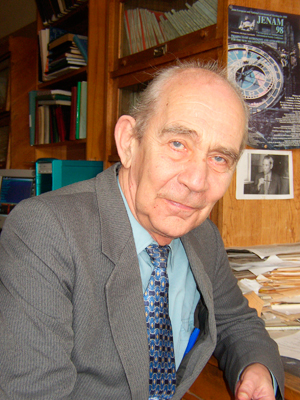
 The Ukrainian scientific community is very sad to announce the passing of Professor Edgard G. Yanovitskij on 23 June 2016. Dr. Yanovitskij spent his entire professional life as a leading researcher at the Main Astronomical Observatory of the Ukrainian National Academy of Sciences in Kyiv. As a prominent member of the famous Soviet school of radiative transfer founded by Academicians Viktor Ambartsumian and Viktor Sobolev, he had devoted most of his exemplary career to the study of radiative energy transport in planetary atmospheres and analyses of spectrophotometric observations of planets. His most profound accomplishments include the general analysis of principles of invariance, the analytical theory of radiative transfer in vertically inhomogeneous atmospheres, and the development of extremely efficient and numerically accurate computer solvers of the radiative transfer equation. His seminal contributions were summarized in the monograph on “Light Scattering in Inhomogeneous Atmospheres” published by Springer. For many years, Dr. Yanovitskij served as an Editorial Board Member for the “Journal of Quantitative Spectroscopy and Radiative Transfer” and “Kinematics and Physics of Celestial Bodies.” His research accomplishments were celebrated by numerous professional awards, including the National Prize of Ukraine in Science and Technology. The relatives, colleagues, and friends of Professor Edgard Yanovitsky will always remember him as an outstanding scientist and an exceptional human being.
Tag: Obituary
Gerald J. Wasserburg 1927-2016
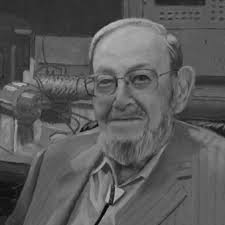 Gerald J. Wasserburg was an American geologist. At the time of his death, he was the John D. MacArthur Professor of Geology and Geophysics, Emeritus, at the California Institute of Technology. He was best known for his work in the fields of isotope geochemistry, cosmochemistry, meteoritics, and astrophysics.
After leaving the U.S. Army, where he received the Combat Infantryman Badge, he attended college on the G.I. Bill. Wasserburg completed his Ph.D. from the University of Chicago in 1954, with a thesis on the development of krypton-argon dating. He joined the faculty at the California Institute of Technology (Caltech) in 1955 as Assistant Professor. He became Associate Professor in 1959 and Professor of Geology and Geophysics in 1962, and in 1982, became the John D. MacArthur Professor of Geology and Geophysics, retiring in 2001. Along with Typhoon Lee and Dimitri Papanastassiou, he discovered the presence of short-lived radioactive aluminum-26 in the early solar system and short-lived palladium-107.
Wasserburg was deeply involved in the Apollo program with the returned lunar samples, and was the last living member of the so-called “Four Horsemen,” whose other members were Bob Walker, Jim Arnold, and Paul Gast. He pioneered the precise measurement of ultra-small samples under strict clean room conditions with minimal contamination. He was also the co-inventor of the Lunatic Spectrometer (the first fully digital, mass spectrometer with computer controlled magnetic field scanning and rapid switching) and founder of the “Lunatic Asylum” research laboratory at Caltech, which specialized in high-precision, high-sensitivity isotopic analyses of meteorites and lunar samples. He and his co-workers were major contributors to establishing a chronology for the Moon and proposed the hypothesis of the late heavy bombardment (LHB) of the whole inner solar system.
Wasserburg’s research led to a better understanding of the origins and history of the solar system and its component bodies and the precursor stellar sources contributing to the solar system. This research established a timescale for the development of the early solar system, including the processes of nucleosynthesis and the formation and evolution of the planets, the Moon, and the meteorites.
Wasserburg was a member of the U.S. National Academy of Science, the American Philosophical Society, the American Academy of Arts and Sciences, and the Norwegian Academy of Science and Letters. He was also the recipient of numerous awards, including the Arthur L. Day Medal in 1970, the NASA Distinguished Public Service Medal in 1972 and 1978, the Wollaston Medal in 1985, the Gold Medal of the Royal Astronomical Society in 1991, the Bowie Medal in 2008, the H. Hess Medal of the American Geophysical Union in 1985, the Leonard Medal of the Meteoritical Society in 1975, the J. Lawrence Smith Medal of the National Academy of Science in 1985, the Holmes Medal of the European Union of Geosciences in 1986, and the V. M. Goldschmidt Medal of the Geochemical Society in 1978.
S. Ichtiaque Rasool 1930-2016
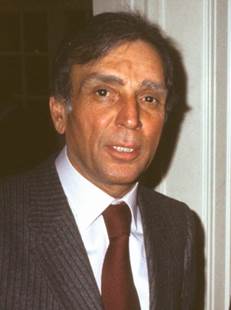 S. Ichtiaque Rasool passed away peacefully on April 20, 2016. Born in 1930 in Lucknow, India, Ichtiaque moved to France where he earned his doctorate in atmospheric sciences in 1956 at the University of Paris and met his wife of 51 years, Francoise. He came to United States in 1961 at the invitation of Robert Jastrow of the Goddard Institute of Space Science and began what turned out to be an amazing 45 year career with NASA eventually retiring from the position of Chief Scientist for Global Change. In 1968, Ichtiaque spent a sabbatical year in Paris, during which he gave lectures that were instrumental in the formation of a planetology group at the Paris Observatory and attracted Catherine de Bergh, Thérèse Encrenaz, and Daniel Gautier to pursue careers in planetary science. While at GISS, he was appointed an editor of the Journal of The Atmospheric Sciences and actively solicited papers on planetary atmospheres. Ichtiaque became a US citizen in 1970 and in 1971 he moved to NASA Headquarters as the Deputy Director for Planetary Programs under Director Robert S. Kraemer when the Grand Tour Mission was under consideration and cancelled and resurrected as Voyager 1 (Mariner Jupiter Saturn) and 2 (Mariner Jupiter Uranus Neptune). During this period there was also the launch and landing of Viking Spacecrafts on Mars. Later Ichtiaque served as Noel Hinner’s Deputy for Science before moving over to the Earth Science side of NASA. After joining GISS he collaborated with Arv Kliore on Mariner radio occultation measurements of the atmospheres/ionospheres of Mars and Venus. With Catherine de Bergh he wrote one of the early papers about the runaway greenhouse on Venus and with Stephen Schneider he raised the issue about the combined effects of large increases in CO2 and aerosols in a Science publication. He was the recipient of the NASA Medal for Exceptional Scientific Achievement in 1974, the William T. Pecora Award in 2002, and the COSPAR William Nordberg Medal in 1988. Throughout his career he was a strong advocate for international cooperation in Earth and planetary sciences, even during waning years of the cold war. Ichtiaque is survived by his wife, his son, Immanuel Rasool, his daughter, Elisa Petit, and four grandchildren. For those who would like to know more about his unique career, his book entitled “My Life: From Riches to Rags and (almost) back! A Memoire” is recommended and available from Amazon.com.
Darrell Strobel, Catherine de Bergh, Thérèse Encrenaz, Tobias Owen
Andre Brahic 1942-2016
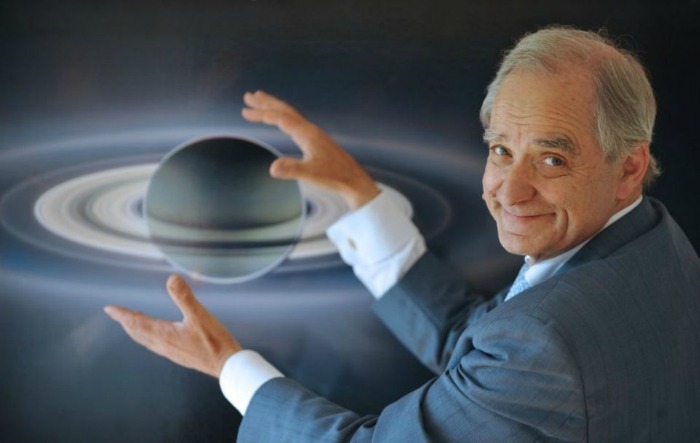 The planetary community, and in particular his French colleagues and friends, are very sad to announce the passing of André Brahic. Professor at the University Paris-Diderot, based at the Observatory of Paris until 1995 and the AIM laboratory at CEA Saclay, André Brahic devoted most of his career to the study of solar system bodies, in particular of planetary rings and the formation of planets, but started out by working on the chaos theory, the dynamics of galaxies and the supernovas. He was a member of the scientific teams of the cameras on Voyager 1 and 2, through which he made many discoveries and notably confirmed the existence of Neptune rings and the arcs of the Adams ring, that he had predicted. With an international team, he showed that the Adams ring, is actually composed of four arcs that he and his collaborators baptized “Courage”, “Liberté”, “Egalité”, “Fraternité” (CLEF for “KEY” in French). He was also a member of the science team on the Cassini mission, still returning amazing science results from the Saturnian system, that André would have liked to follow until the mission’s end. André Brahic was of course also an extraordinary communicator, who transmitted his passion for science and astrophysics to generations of students and to the public. This has probably incited many of today astronomers career choices, as it was for me – André was my professor during the Master degree. He knew how to communicate his enthusiasm for science to everyone, whatever their level of education. André Brahic received the DPS Carl Sagan Medal in 2001 and the Jean Perrin 2006 award for scientific popularization. In July 2015, he received the insignia of Chevalier de la Legion d’Honneur in France. André Brahic has left an impressive heritage and will always be remembered as a great scientist, a great teacher and a great advocate of communicating with the public.
Athena Coustenis
Mildred Shapley Matthews 1915-2016
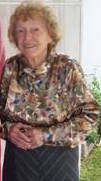 On February 11, just four days short of her 101st birthday, Mildred Shapley Matthews passed away peacefully at her home in California with her family present. Mildred was the daughter of Harvard College Observatory Director Harlow Shapley and she held the interesting distinction of being “lost in the solar system” for 75 years. As a commemoration of his newborn daughter, Shapley bestowed the name Mildred to asteroid 878 discovered in 1916. Unfortunately the initial observations of the asteroid were limited, and the object was “lost” with highly uncertain orbital elements until recovered in 1991. Friends and colleagues seeing Mildred over the years would always ask, “are you found yet?” Matthews’ foundational contributions to planetary science began around the time of her nominal retirement age, when in the 1970s she began working as the production editor in the inaugural years of the Space Science Series created by Tom Gehrels. Her role became most prominently recognized as co-editor on more than a dozen volumes extending in to the 1990s. Overall for more than 20 Space Science Series volumes she edited, operating through friendly (then increasingly stern, but always polite) post cards and phone calls to delinquent authors, it was Matthews who brought the books into their final published form. Matthews leaves behind a legacy of books that have served as the gateway for countless planetary science careers and insights toward future advancements in our field. In 1993, Matthews received the DPS’ Harold Masursky Award for Meritorious Service to Planetary Science.
Lloyd V. Wallace 1927-2015
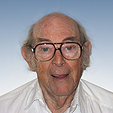 Lloyd V. Wallace, Ph.D, Emeritus Astronomer at the Kitt Peak National Observatory, passed away on October 26, 2015 in Tucson. Born in 1927 in Detroit, Michigan, in humble circumstances, Lloyd developed an early interest in solar and planetary astronomy and was a protégé of Ralph Nichols, a physics professor at the University of Western Ontario. Later he moved back to the United States and obtained his Ph.D in Astronomy at the University of Michigan in 1957 under Leo Goldberg. It was while he was at the University of Michigan that he met and married his wife, Ruth. At various times in his early career, and as the result of a complex series of events, he held Canadian, British, and United States citizenships and even found time to become an expert professional electrician. On acquiring his degree he obtained a position with Joe Chamberlain at the Yerkes Observatory and began a lifetime association with Chamberlain and Don Hunten (then a visitor to Yerkes) in atmospheric and spectroscopic research. In 1962 they moved to Tucson where Chamberlain became the head of the Space Division at the Kitt Peak National Observatory, a unit set up by the first director, Aden Meinel, to apply advances in technology to astronomical research. Lloyd was hired as the principal experimenter in the observatory’s sounding rocket program, which was set up by the National Science Foundation to provide staff and visitor access to the upper atmosphere for research purposes. With this program he supervised a series of 39 Aerobee rocket flights from the White Sands Missile range to investigate upper atmosphere emissions, aeronomic processes, and make astronomical observations over a period of about 10 years. He was also involved in the first attempts to establish a remotely controlled 50&rdquo telescope on Kitt Peak and efforts within the Division to create an Earth orbiting astronomical telescope. In parallel with these activities Lloyd conducted research which was largely focused on spectroscopic investigations. In the early days these included measurement of upper atmospheric emissions, particularly visual dayglow, the discovery of Raman lines in Uranus, Lightning spectrum, and auroral emissions. During this time he also pursued theoretical studies of resonant line transfer and some of the first modelling of the thermal structure of outer planet atmospheres. With the conclusion of the rocket program he turned his attention to high-resolution studies of the sun and cool stars and to long-term study of the variability of atmospheric pollutants (HCl, HF. CO2) over Kitt Peak. His solar and cool star studies led to the production of several high-resolution digital atlases extending from the UV to the thermal IR, and in addition, studies of line variability and the molecular content of sunspots. Lloyd was a very private and genuine person, but with a very sharp wit. He was highly productive with 135 published papers bearing his name.
Giovanni Picardi 1936-2015
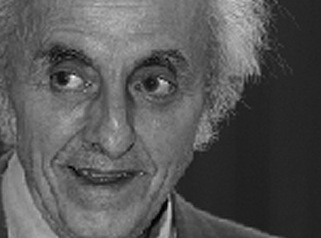
On the night of August 16th Prof. Giovanni Picardi passed suddenly away. Born in 1936
Prof Picardi has been during all his long career a brilliant and innovative radar scientist and
an admired teacher at the University of Rome Sapienza. Among the many radar projects he
carried on, he has provided fundamental contributions to all the radars presently operating
around other bodies of the Solar System and planetary radar sounding would not have
developed into the field of study we see today without his ingenuity and work. What he has
done and what he has given to radar science will remain for the present and future students
and scientists and the seeds of his activity will remain in the Italian and International community.
Enrico Flamini
Raul A. Baragiola 1945-2015
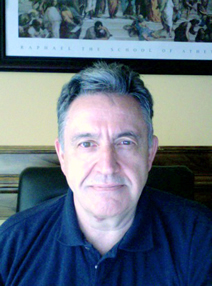 A man of diverse interests and avid curiosity, Raúl A. Baragiola, the Alice and Guy Wilson Chair Professor of Materials Science at the University of Virginia, passed away 21 June 2015, only few months after his seventieth birthday. Raúl began his career at the Balseiro Institute in Bariloche, Argentina, studying electron emission from solid materials, later expanding his expertise to ion, electron, and photon interactions with surfaces. His interest in the surface properties of semi-conductors and insulators led him to the field of Space and Planetary Science, where for the last 25 years he studied the interaction of radiation with condensed ices, minerals, and extraterrestrial materials.
Born 31 March, 1945, Raul came to the US after working many years at the Centro Atómico in Bariloche, Argentina when concerns about the Argentina’s political stability and the safety of his family lead him to emigrate. He joined Ted Madey’s laboratory at Rutgers in 1988. He settled permanently at the University of Virginia (UVa) to direct the Laboratory for Astrophysics and Surface Physics (LASP) in 1990.
At UVa, Raúl started working on electronic sputtering from condensed gases and water ice in close collaboration with R. E. Johnson (UVa) and Walter Brown (AT & T Bell Laboratory), but he soon initiated key experiments designed to explore the complexities of sputtering of water ice. He had notable success in studying water ice photodesorption induced by Lyman-alpha light and its implications for interstellar ices. Subsequent efforts in a similar vein included investigating the existence of condensed O2 on Ganymede, measuring the sputtering yield of various ices, and characterizing the physical and chemical effects of radiations on laboratory analogs of planetary ices, while making laboratory data available to guide interpretation of astronomical spectra. In collaboration with R. W. Carlson (JPL), results from ion irradiation of water ice were used to explain the infrared signature of hydrogen peroxide on the surface of Europa. Raúl made numerous other significant research contributions towards understanding of the properties of planetary and interstellar water ice and the effects of radiation on these extraterrestrial surfaces. Recent ongoing research centered on laboratory astrochemistry, focusing on the synthesis, destruction and sputtering of plethora of condensed ices which include H2, CO, CO2, CH4, NH3, O2, O3, H2O2 and more complex species by ion and UV irradiation.
In collaboration with Lucy McFadden (NASA-Goddard) to understand the sulfur deficit on the surface of the Eros during NEAR’s encounter, Raul initiated research focused on the effects of space weathering on airless bodies. The combined in situ ability to measure reflectance, surface chemistry, and sputtered species due to solar-wind type ion irradiation was a hallmark feature of Raúl’s laboratory. In particular, Raúl was interested in the formation of Fe nano-particles and the effects of Earth’s atmosphere on ion bombarded silicates and minerals. With the discovery of water on the lunar surface, Raúl investigated formation for -OH species by solar wind proton irradiation of silicate minerals. Recent experiments characterizing electron emission from lunar soils echoed his early work on electron-induced secondary electron measurements.
Raúl was a prominent member in the Planetary Science and the Laboratory Astrophysics community and a frequent, vocal participant at DPS, AGU, and LPSC conferences. He was a Fellow of the American Physical Society (APS) and the Institute of Physics (London), receiving a Lifetime Achievement Award from the International Committee on Atomic Collisions in Solids and a NASA Achievement Award for his work on the Cassini mission. He served as a science member on the Cassini Plasma Spectrometer (CAPS) team, collaborating with D. T. Young at Southwest Research Institute (SwRI). Over the course of his career, Raúl published ~ 200 refereed scientific articles and book chapters, contributed to more than 140 conferences presentations and 80 invited lectures, advised more than 40 students and post-doctoral researchers on multiple continents, and collaborated with more research groups than is possible to name. His scientific legacy endures through them.
He leaves behind his dear wife of 46 years, Beatriz; three children: Verena, Valeria, and Pablo; his three precious grandchildren: Maya, Ella, and Leo who were the pride and joy of his later life; and his family of students and post-docs. All of whom will greatly miss Raul’s ability to simplify deeply complex problems, as well as his passion for life, philosophy, and wicked sense of humor.
————————————-
Catherine Dukes – Research Scientist – Laboratory for Astrophysics and Surface Physics – UVa
Ujjwal Raut – Research Scientist – Laboratory for Astrophysics and Surface Physics – UVa
Claudia J. Alexander 1959-2015
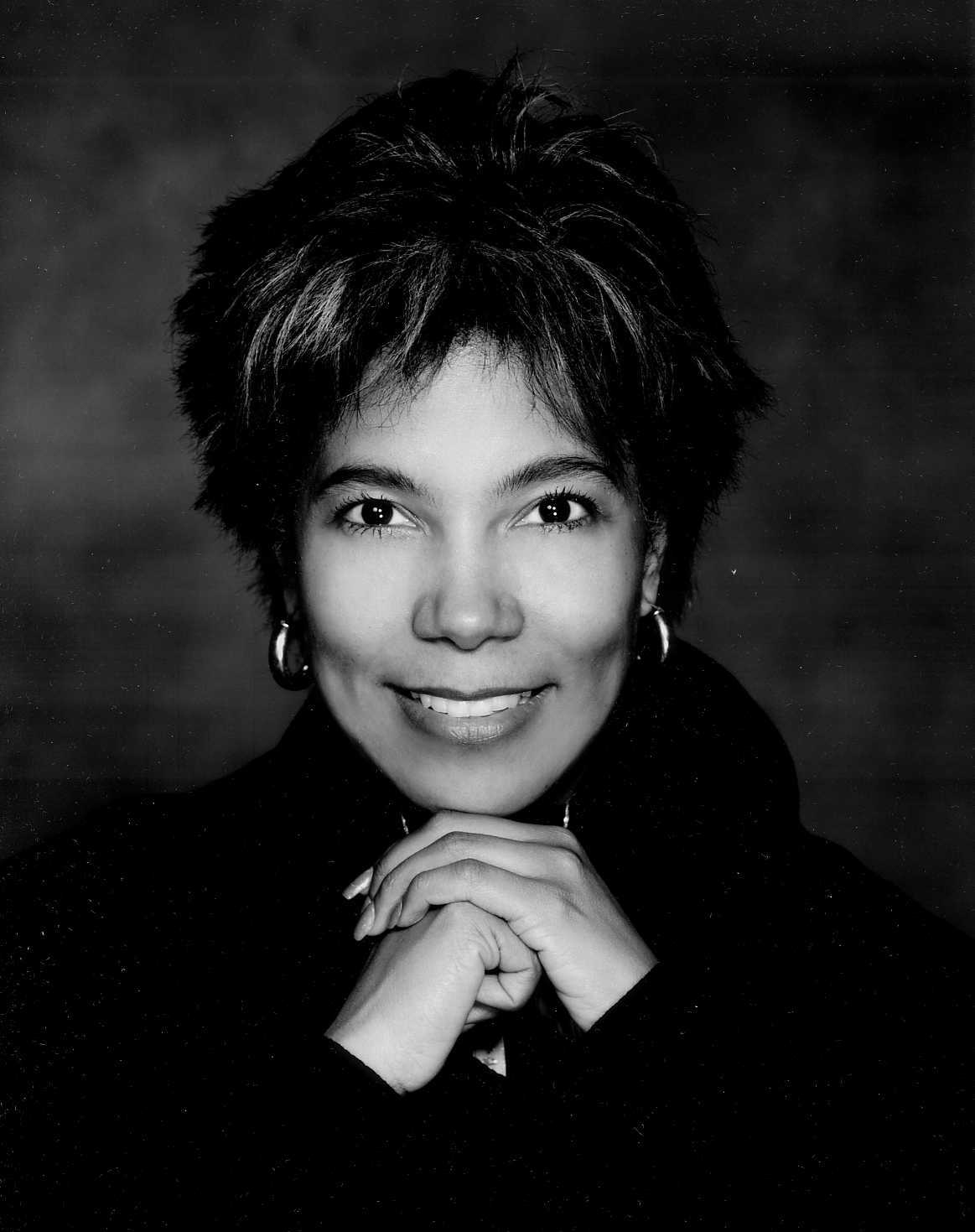 Claudia J. Alexander (1959–2015), Ph.D. was a research scientist specializing in geophysics
and planetary science. She has worked for the United States Geological Survey and the
National Aeronautics and Space Administration. As member of the technical staff at the Jet
Propulsion Laboratory, she was the last project manager of NASA’s Galileo mission to Jupiter
and until the time of her passing had served as project scientist of NASA’s role in the European
led Rosetta mission to study comet 67P/Churyumov-Gerasimenko. Claudia was the 17th African
American woman to get a PhD in physics or astronomy (http://www.aawip.com/physics-astro-only-list.html)
and the winner was several awards, including the Emerald Honor for Women of Color in
Research & Engineering by Career Communications Group, Inc.at the National Women of Color
Research Sciences and Technology Conference. She was also very active in education and outreach,
and a mentor to several younger scientists. Our condolences go out to her family, co-workers and friends
at this time.
Stanton J. Peale 1937-2015
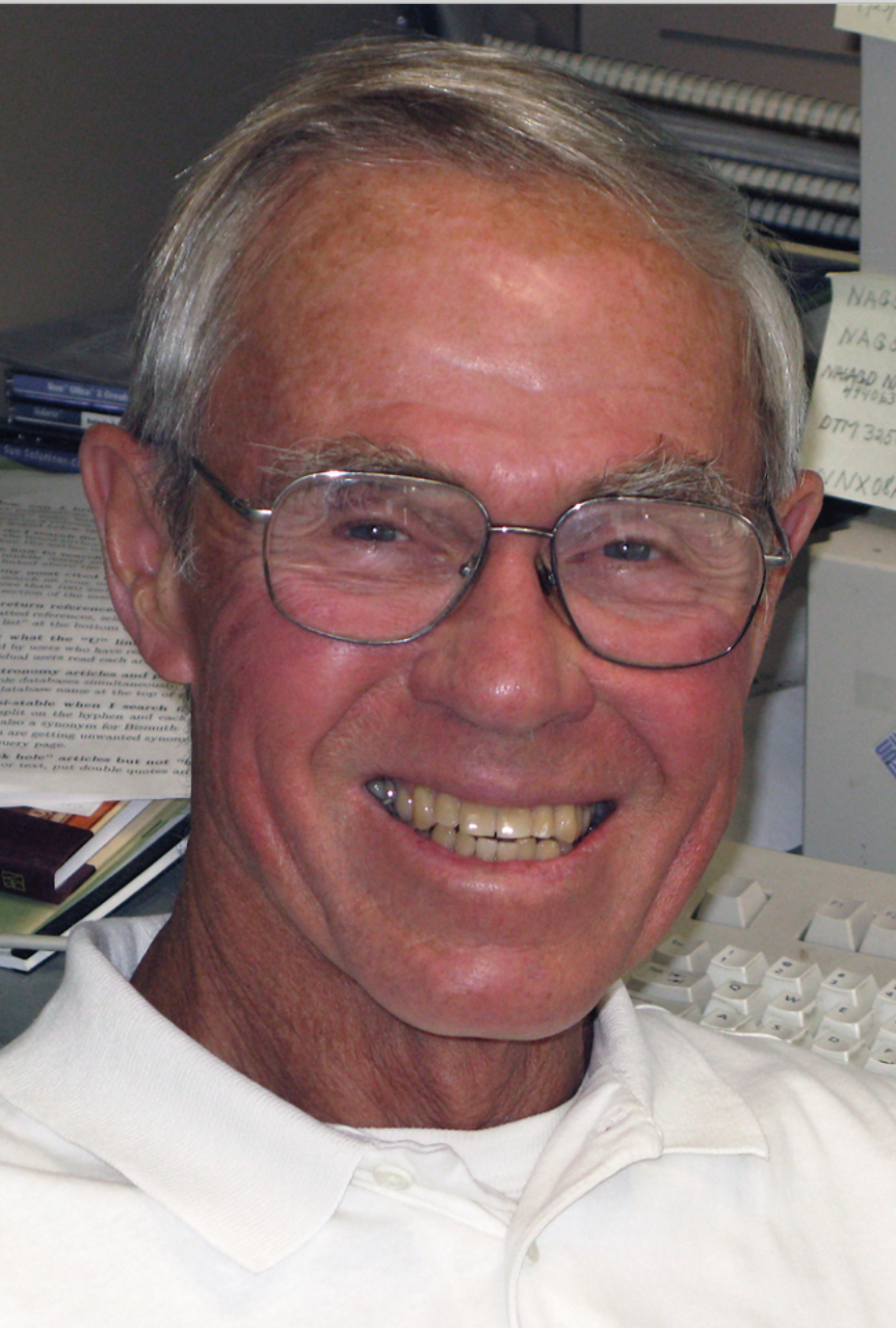 Stanton J. Peale passed away on May 14, 2015 in Santa Barbara from complications of leukemia. He was 78. Stan was surrounded by family and friends prior to and during his passing. He was a kind and brilliant planetary scientist with expertise in dynamics and geophysics. His career spanned over five decades. After earning his PhD at Cornell University in 1965, he took a faculty position at the University of California, Los Angeles, and then at the University of California, Santa Barbara, where he worked from 1968 until 2015. His most recent work was submitted for publication on May 11, 2015. His contributions include the prediction of widespread volcanism on Jupiter’s moon Io, the derivation of a general theoretical framework that governs the rotational states of bodies subject to tides, the study of tidal evolution in satellite systems, and the development of an ingenious procedure to determine the size and state of Mercury’s core. He was also a pioneer in the study of extrasolar planets, both in terms of their dynamics and their detection by microlensing. Stan’s work illustrated the power of physics to probe the interiors of planets. Stan was awarded the Newcomb Cleveland Prize (1979), the James Craig Watson Medal (1982), and the Brouwer Award (1992). He was elected to the National Academy of Sciences in 2009. He was a wonderful, beloved colleague and will be deeply missed.