Newsletter 16-22

Issue 16-22, June 19, 2016

+————————————CONTENTS—————————————-+

  1. IN MEMORIAM: S. ICHTIAQUE RASOOL (1930-2016)
  2. REMINDER: DPS 48/EPSC 11 ABSTRACT DEADLINE MOVED UP ONE DAY TO JUNE 22
  3. HARTMANN STUDENT TRAVEL GRANTS FOR DPS 48/EPSC 11
  4. ABSTRACTS ON LABORATORY RESEARCH FOR PLANETARY SCIENCE
  5. SAVE THE DATE FOR THE FIFTH INTERNATIONAL PLANETARY DUNES WORKSHOP

+——————————————————————————————–+

1———1———1———1———1———1———1———1———1———1

IN MEMORIAM: S. ICHTIAQUE RASOOL (1930-2016)

S. Ichtiaque Rasool passed away peacefully on April 20, 2016. Born in 1930
in Lucknow, India, Ichtiaque moved to France where he earned his doctorate
in atmospheric sciences in 1956 at the University of Paris and met his wife
of 51 years, Francoise. He came to United States in 1961 at the invitation of Robert Jastrow of the Goddard Institute of Space Science and began what turned out to be an amazing 45 year career with NASA eventually retiring from the position of Chief Scientist for Global Change. In 1968, Ichtiaque spent a sabbatical year in Paris, during which he gave lectures that were instrumental in the formation of a planetology group at the Paris Observatory and attracted Catherine de Bergh, Thérèse Encrenaz, and Daniel Gautier to pursue careers in planetary science. While at GISS, he was appointed an editor of the Journal of The Atmospheric Sciences and actively solicited papers on planetary atmospheres. Ichtiaque became a US citizen in 1970 and in 1971

he moved to NASA Headquarters as the Deputy Director for Planetary Programs under Director Robert S. Kraemer when the Grand Tour Mission was under consideration and cancelled and resurrected as Voyager 1 (Mariner Jupiter Saturn) and 2 (Mariner Jupiter Uranus Neptune). During this period there was also

the launch and landing of Viking Spacecrafts on Mars. Later Ichtiaque served as Noel Hinner’s Deputy for Science before moving over to the Earth Science side of NASA. After joining GISS he collaborated with Arv Kliore on Mariner radio occultation measurements of the atmospheres/ionospheres of Mars and Venus. With Catherine de Bergh he wrote one of the early papers about the runaway greenhouse on Venus and with Stephen Schneider he raised the issue about the combined effects of large increases in CO2 and aerosols in a Science

publication. He was the recipient of the NASA Medal for Exceptional Scientific Achievement in 1974, the William T. Pecora Award in 2002, and the COSPAR

William Nordberg Medal in 1988. Throughout his career he was a strong

William Nordberg Medal in 1988. Throughout his career he was a strong advocate for international cooperation in Earth and planetary sciences, even during waning years of the cold war. Ichtiaque is survived by his wife, his son, Immanuel Rasool, his daughter, Elisa Petit, and four grandchildren. For those who would like to know more about his unique career, his book entitled “My Life: From Riches to Rags and (almost) back! A Memoire” is recommended and available from Amazon.com.

Darrell Strobel, Catherine de Bergh, Thérèse Encrenaz, Tobias Owen

2———2———2———2———2———2———2———2———2———2

REMINDER: DPS 48/EPSC 11 ABSTRACT DEADLINE MOVED UP ONE DAY TO JUNE 22

As a result of the AAS moving to new offices this month, we have moved up the abstract deadline for this Fall’s DPS/EPSC meeting in Pasadena to Wednesday June 22 at 9:00 PM (21:00) Eastern Daylight Time. The AAS will be physically unplugging the servers to migrate them to the new offices on the old deadline date. Apologies for the change, but it’s the best solution under the circumstances. Please update your calendars with the new date:

9:00 PM EDT Wednesday June 22, 2016

3———3———3———3———3———3———3———3———3———3

HARTMANN STUDENT TRAVEL GRANTS FOR DPS 48/EPSC 11

A generous contribution from William K. Hartmann, supplemented by member contributions and matching funds from the DPS Committee, has enabled a limited number of student travel grants to assist participation by early-career scientists at the annual DPS meeting.

Application details are at meetings/travel_grant_application Travel grants are primarily intended for students, but post-doctoral scientists

without other means of support will also be considered. The due date for applications is July 8, 2016 11:59 PM.

The DPS Leadership is also soliciting additional contributions from members
for the Hartmann Fund. Your tax-deductible gift promotes the careers of our next generation of planetary scientists. Thanks so much for your generosity.

4———4———4———4———4———4———4———4———4———4

ABSTRACTS ON LABORATORY RESEARCH FOR PLANETARY SCIENCES

Dear Experimental Planetary Science Colleagues,

The Abstracts deadline is June 22, 2016 for the 48th Division for Planetary

Science (DPS) Meeting jointly with European Planetary Sciences Congress (EPSC) to be held from 16-21 October 2016 at the Pasadena Convention Center, Pasadena, California, USA. You are strongly encouraged to submit abstracts that focus on the main sessions of DPS/EPSC.

This year we are also bringing the Laboratory Astrophysics Division (LAD) of AAS closer to DPS.

We are pleased to inform you that some of the laboratory related abstracts that are selected for oral presentations at the DPS/EPSC will be designated as “jointly with LAD”. If you are not a member of LAD yet, we strongly encourage you to become a member at https://lad.aas.org/

As laboratory research is an important aspect of planetary science, strong participation by the LAD community is needed for a successful meeting. A significant presence by the LAD community would greatly enrich the quality
of the scientific discussions that are held at the DPS meeting. In an effort to increase the impact of laboratory research presentations to the community at
this meeting, the DPS Science Organizing Committee is committed to integrating these talks and posters within the appropriate planetary science topics, and not relegating laboratory talks and posters to an isolated laboratory session. This is the approach that has been used very successfully for the past several DPS meetings, and we aim to continue this integrated approach. The degree to which
we can achieve this will depend on strong participation from the LAD community, so please consider submitting an abstract (abstract submissions is open now through 9:00 pm ET, 22 June 2016) for this year’s DPS/EPSC meeting. Please do not hesitate to contact me or Murthy if you have any questions.

If the DPS receives a large number of high-quality abstracts from LAD members, we will be in a better position to highlight some of the accepted talks as “Joint DPS/EPSC and LAD Talks”.

Best regards,

Nancy Chanover
Member-at-Large, LAD Committee 2013-2016
[email protected]

Murthy Gudipati
SOC Member, 2016 DPS/EPSC [email protected]

5———5———5———5———5———5———5———5———5———5

SAVE THE DATE FOR THE FIFTH INTERNATIONAL PLANETARY DUNES WORKSHOP

The Fifth International Planetary Dunes Workshop will be conducted

May 16–19, 2017, at Dixie State University, St. George, Utah. The workshop format will consist of 21⁄2 days of topical discussions, a poster session/social,
and one-day field trip to Zion National Park and Coral Pink Sand Dunes State Park. The workshop will focus on the following science questions: (1) Under what conditions are terrestrial subaqueous dunes a suitable analog for planetary dunes? (2) Can sediment composition be used to better understand sediment source, transport, sorting, and in situ weather processes? (3) Can bedform scale be used to characterize a planetary body’s surface-atmosphere interface (e.g., boundary layer, fluid/air properties)? (4) Under what conditions will the principle of equifinality apply and how does this affect our interpretations? More details can be found at http://www.hou.usra.edu/meetings/dunes2017/

LTC(Ret) Timothy N. Titus Ph.D. Supervisory Research Space Scientist Mission Operations Group Chief Astrogeology Science Center

United States Geological Survey

———————————+
Send submissions to:
Anne Verbiscer, DPS Secretary ([email protected])

To unsubscribe visit http://aas.org/unsubscribe or email [email protected]. To change your address email [email protected]

S. Ichtiaque Rasool 1930-2016

Ichtiaque RasoolS. Ichtiaque Rasool passed away peacefully on April 20, 2016. Born in 1930 in Lucknow, India, Ichtiaque moved to France where he earned his doctorate in atmospheric sciences in 1956 at the University of Paris and met his wife of 51 years, Francoise. He came to United States in 1961 at the invitation of Robert Jastrow of the Goddard Institute of Space Science and began what turned out to be an amazing 45 year career with NASA eventually retiring from the position of Chief Scientist for Global Change.  In 1968, Ichtiaque spent a sabbatical year in Paris, during which he gave lectures that were instrumental in the formation of a planetology group at the Paris Observatory and attracted Catherine de Bergh, Thérèse Encrenaz, and Daniel Gautier to pursue careers in planetary science.  While at GISS, he was appointed an editor of the Journal of The Atmospheric Sciences and actively solicited papers on planetary atmospheres. Ichtiaque became a US citizen in 1970 and in 1971 he moved to NASA Headquarters as the Deputy Director for Planetary Programs under Director Robert S. Kraemer when the Grand Tour Mission was under consideration and cancelled and resurrected as Voyager 1 (Mariner Jupiter Saturn) and 2 (Mariner Jupiter Uranus Neptune).  During this period there was also the launch and landing of Viking Spacecrafts on Mars. Later Ichtiaque served as Noel Hinner’s Deputy for Science before moving over to the Earth Science  side of NASA. After joining GISS he collaborated with Arv Kliore on Mariner radio occultation measurements of the atmospheres/ionospheres of Mars and Venus. With Catherine de Bergh he wrote one of the early papers about the runaway greenhouse on Venus and with Stephen Schneider he raised the issue about the combined effects of large increases in CO2 and aerosols in a Science publication. He was the recipient of the NASA Medal for Exceptional Scientific Achievement in 1974, the William T. Pecora Award in 2002, and the COSPAR William Nordberg Medal in 1988. Throughout his career he was a strong advocate for international cooperation in Earth and planetary sciences, even during waning years of the cold war.  Ichtiaque is survived by his wife, his son, Immanuel Rasool, his daughter, Elisa Petit, and four grandchildren. For those who would like to know more about his unique career, his book entitled “My Life: From Riches to Rags and (almost) back! A Memoire” is recommended and available from Amazon.com.

Darrell Strobel, Catherine de Bergh, Thérèse Encrenaz, Tobias Owen

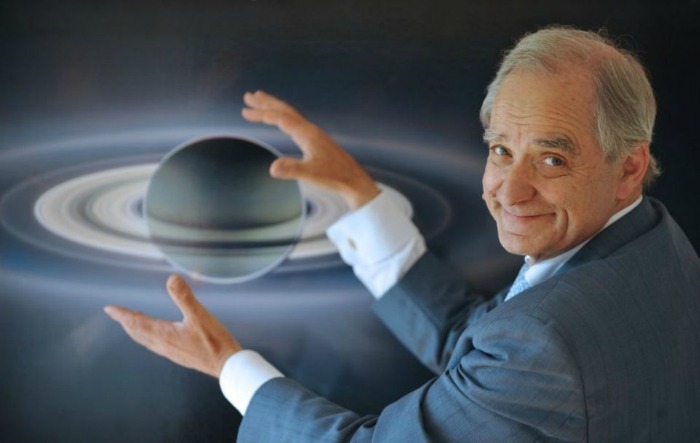
Andre Brahic 1942-2016

Andre BrahicThe planetary community, and in particular his French colleagues and friends, are very sad to announce the passing of André Brahic. Professor at the University Paris-Diderot, based at the Observatory of Paris until 1995 and the AIM laboratory at CEA Saclay, André Brahic devoted most of his career to the study of solar system bodies, in particular of planetary rings and the formation of planets, but started out by working on the chaos theory, the dynamics of galaxies and the supernovas. He was a member of the scientific teams of the cameras on Voyager 1 and 2, through which he made many discoveries and notably confirmed the existence of Neptune rings and the arcs of the Adams ring, that he had predicted. With an international team, he showed that the Adams ring, is actually composed of four arcs that he and his collaborators baptized “Courage”, “Liberté”, “Egalité”, “Fraternité” (CLEF for “KEY” in French). He was also a member of the science team on the Cassini mission, still returning amazing science results from the Saturnian system, that André would have liked to follow until the mission’s end.  André Brahic was of course also an extraordinary communicator, who transmitted his passion for science and astrophysics to generations of students and to the public. This has probably incited many of today astronomers career choices, as it was for me – André was my professor during the Master degree. He knew how to communicate his enthusiasm for science to everyone, whatever their level of education. André Brahic received the DPS Carl Sagan Medal in 2001 and the Jean Perrin 2006 award for scientific popularization. In July 2015, he received the insignia of Chevalier de la Legion d’Honneur in France.  André Brahic has left an impressive heritage and will always be remembered as a great scientist, a great teacher and a great advocate of communicating with the public.

Athena Coustenis

Message From The Chair: Publication Survey

At the Members’ Meeting in National Harbor I was pleased to see the general interest and engagement on publication matters.  Last December, in a message from the chair, I informed you about the details of the agreement that we made with Elsevier regarding Icarus and the formation of a Publications Subcommittee. That Subcommittee has assembled a survey that we would like you to take.

Shortly, you will be sent a link from the AAS SurveyMonkey account inviting you to take the survey. I encourage you to take some of your time to respond so that the DPS Committee can get a strong sense of your ideas and desires regarding our strategy for planetary publication matters and how it might evolve in the future.

The Publications Subcommittee has written up a brief overview and background for the survey that you can find below. Look for the survey coming in the next couple of days.

Jason W. Barnes
DPS Chair

History
Academic Press first published Icarus in 1962.  The DPS was formed in 1970, and became affiliated with Icarus in 1975.  Since Icarus was published for more than a decade before DPS involvement, the intellectual property that is Icarus originated under Academic Press.  Harcourt acquired Academic Press in 1969, which was in turn purchased by Reed Elsevier in 2000; Elsevier now publishes Icarus.

The fact that the DPS does not own the primary journal in which its members publish, review, and edit the content is very different from the DPS’s parent organization, the American Astronomical Society, which owns the Astrophysical Journal, the Astronomical Journal, etc.  Some similar scholarly societies own and operate journals (e.g. the American Geophysical Union publishes JGR and GRL).

Changing Circumstances
The Division was happily associated with Icarus for many decades, but the Internet has changed perspectives on academic publishing.  A part of the process that came under scrutiny was the retention of copyright by the publishing companies.  This scrutiny and analysis gave rise to the Open Access movement about a decade ago.  Issues about Open Access have been raised in past DPS Members meetings, but no consensus was arrived at.

Changes for NASA-Funded Research
NASA plans to adopt a policy requiring papers and research based on NASA-funded research to be deposited in a publicly accessible NASA online archive within one year of publication.

How does that impact Icarus papers?  Well, it depends. If all authors of a paper are civil servants, then Elsevier can’t (and doesn’t now) claim copyright of the paper, and it can be easily and legally submitted by its authors to this new NASA archive. But if even one author of an Icarus paper is not a civil servant, then the copyright must be transferred to Elsevier, which then owns it and it cannot legally be deposited in NASA’s archive. Elsevier’s solution is for the author to pay an Open Access fee (currently $2,750) making the published article Open Access under an author-selected Creative Commons license so that it can now be legally placed in the NASA archive.  This is an extra publication cost, but the ROSES-2015 and 2016 documents indicate that Open Access fees, like page charges, may be included in proposals as allowable charges on a grant, so should be requested in future proposal budgets.

The Committee Contemplates
By 2011, the DPS Committee felt that its relationship with Icarus should be re-evaluated, especially regarding what more the DPS could get out of its connection with Icarus, so discussions were started with Elsevier, which sparked discussion about the more general nature of the relation of the Division to scientific publishing.  Soon, knowledge of the Open Access movement and its impact on publishing was more widespread among the Committee and DPS members in general.

Beyond Open Access issues, there are concerns about Elsevier’s actions on the global stage that seemed to prioritize Elsevier profits over scholarship.  Elsevier desired to control more of the editorial process than they had traditionally done with Icarus.  Beyond that, the DPS Committee contemplated how the Division might benefit if it had more ownership and control of our scientific journal.

2015 Agreement with Elsevier
The Committee had much information but it was unclear what course should be taken, so it decided not to make any bold moves.  The DPS would stay with Icarus for the time being and sign an agreement with Elsevier effective October 1, 2015. The agreement automatically renews every three years, if neither party objects.

The Future
During the last year, the DPS Committee was concerned about its relationship with Elsevier and seriously considered the implications and possibilities of ending the relationship.  But it did not feel that it had a sufficient sense of the membership’s concerns to make that decision or navigate between various options in the wake of such a decision.

DPS members have voiced concern about our relationship with Elsevier over the years, but in order for the Committee to chart a way forward, they must feel confident about the sense of the membership at large, and that is why you will be receiving an invitation to take a survey that covers these topics, please respond and let your voice be heard.

Newsletter 16-20

Issue 16-20, June 7, 2016


+————————————CONTENTS—————————————-+

  1. MESSAGE FROM THE CHAIR: PUBLICATION SURVEY
  2. REMINDER: DPS 48/EPSC 11 ABSTRACT DEADLINE MOVED UP ONE DAY TO JUNE 22 
  3. SBAG 15 MEETING REGISTRATION
  4. SBAG STEERING COMMITTEE CANDIDATE SOLICITATION
  5. JOBS, POSITIONS, OPPORTUNITIES

+——————————————————————————————–+


1———1———1———1———1———1———1———1———1———1

MESSAGE FROM THE CHAIR: PUBLICATION SURVEY


At the Members’ Meeting in National Harbor I was pleased to see the general 

interest and engagement on publication matters.  Last December, in a message 

from the chair (news/message-chair-icarus-agreement-reached),

I  informed you about the details of the agreement that we made with Elsevier 

regarding Icarus and the formation of a Publications Subcommittee.  That

Subcommittee has assembled a survey that we would like you to take. 

Shortly, you will be sent a link from the AAS SurveyMonkey account inviting 

you to take the survey.  I encourage you to take some of your time to respond 

so that the DPS Committee can get a strong sense of your ideas and desires 

regarding our strategy for planetary publication matters and how it might evolve 

in the future. 

The Publications Subcommittee has written up a brief overview and background 

for the survey that you can find here: 


news/message-chair-publication-survey


Look for the survey coming in the next couple of days. 

Jason W. Barnes 
DPS Chair 


2———2———2———2———2———2———2———2———2———2

REMINDER: DPS 48/EPSC 11 ABSTRACT DEADLINE MOVED UP ONE 

DAY TO JUNE 22 


As a result of the AAS moving to new offices this month, we have moved up 

the abstract deadline for this Fall’s DPS/EPSC meeting in Pasadena to 

Wednesday June 22 at 9:00 PM (21:00) Eastern Daylight Time.  The AAS 

will be physically unplugging the servers to migrate them to the new offices 

on the old deadline date.  Apologies for the change, but it’s the best solution 

under the circumstances. Please update your calendars with the new date:


9:00 PM EDT Wednesday June 22, 2016


3———3———3———3———3———3———3———3———3———3

SBAG 15 MEETING REGISTRATION


Registration for the SBAG 15 meeting in now available from the SBAG 

website:

http://www.lpi.usra.edu/sbag/


SBAG 15 Meeting

June 28 – June 30, 2016

Johns Hopkins University Applied Physics Laboratory

Laurel, MD


Additional logistical details and the agenda are also available on the SBAG 

website as well. 


If you plan to attend the SBAG 15 meeting, please register. Registration is 

free but is used for planning purposes and to document community interest in 

SBAG meetings, to ensure continued support. 


Please feel free to contact me with any questions, and I’m looking forward 

to a productive meeting at the end of the month. 


Best wishes,

Nancy Chabot

SBAG Chair


4———4———4———4———4———4———4———4———4———4

SBAG STEERING COMMITTEE CANDIDATE SOLICITATION

Dear SBAG community, 

The SBAG (Small Bodies Assessment Group) Steering Committee is composed 

of members who represent the diverse nature of the small bodies community. 

The Steering Committee organizes SBAG meetings, drafts and edits findings 

relating to topics of interest to the small bodies community, and provides input 

to NASA on topics relating to the science of small bodies, the use of small bodies 

in support of human space activities, technology relating to the exploration and 

utilization of small bodies, and planetary defense. Each member serves a multi-year 

term. There are three positions open on the SBAG Steering Committee starting in 

August 2016. We are looking for candidates in the following areas:


* SBAG  Planetary Defense Lead – Serve as a Steering Committee member and 

lead SBAG activities relating to topics of planetary defense at SBAG meetings and 

Steering Committee discussions. Three-year term.


* Outer Solar System Small Bodies Expert – Serve as a SBAG Steering Committee 

member and provide specific expertise on topics and issues related to the science of 

small bodies in the outer Solar System, to complement the expertise of the continuing

 Steering Committee members. The Steering Committee already has specific expertise 

relating to comets, so this position is intended to be for an expert in KBOs, Jupiter 

Trojans, small moons of the outer planets, and/or Centaurs. Three-year term.


* Member with any expertise relevant to SBAG – The Steering Committee tries to 

maintain expertise in several specific areas, including those mentioned above, but 

also wants to represent a broad cross-section of the small bodies community, and 

seeks potential members who are interested in small bodies topics, regardless of 

specific expertise. The intent of describing this position this way is to encourage 

potential candidates from across the community (candidates for the first two 

positions will automatically be considered as well). Three-year term.


To indicate your willingness to serve in any of these positions, please email 

Tim Swindle ([email protected]) by June 23, 2016, and include a two- to 

four-page CV. 

The current Steering Committee will select new members at the 15th Meeting of 

SBAG, June 28-30, 2016.

Tim Swindle
Incoming SBAG Chair
http://www.lpi.usra.edu/sbag/


5———5———5———5———5———5———5———5———5———5

JOBS, POSITIONS, OPPORTUNITIES


A) POSTDOC – IONOSPHERIC RADIO OCCULTATIONS AT SATURN, 

     TITAN, AND MARS

     Boston University 


The Center for Space Physics at Boston University invites applications 

for a postdoctoral researcher position supervised by Professor Paul Withers. 

The research will involve the analysis of radio occultation observations of 

the ionospheres of Saturn, Titan, and Mars. Candidates should possess 

a PhD degree in a relevant field. Experience conducting research on planetary 

ionospheres is desirable. The salary offered will be competitive and 

commensurate with experience. Funding is available for two years with 

the possibility of extension. The appointment is expected to begin as soon 

as possible after 1 September 2016. Please contact Paul Withers 

([email protected]) for further information.


Applications should be sent by email to Paul Withers ([email protected]).


The application should be submitted in PDF format and contain a curriculum 

vitae, statement of research interests, and contact information for three 

referees. Review of applications will begin on 1 July 2016. Women and 

underrepresented minorities are particularly encouraged to apply. 

Boston University is an equal opportunity/affirmative action employer.


———————————+

Send submissions to:

Anne Verbiscer, DPS Secretary ([email protected]


To unsubscribe visit http://aas.org/unsubscribe or email [email protected].

To change your address email [email protected].



Urgent Message From The Chair: DPS 48/EPSC 11 Abstract Deadline Moved Up One Day To June 22

As a result of the AAS moving to new offices this month, we have moved up the abstract deadline for this Fall’s DPS/EPSC meeting in Pasadena to Wednesday June 22 at 9:00 PM (21:00) Eastern Daylight Time.  It turns out that the AAS will be physically unplugging the servers to migrate them to the new offices on the old deadline date.  Apologies for the change, but it’s the best solution under the circumstances. Please update your calendars with the new date:

9:00 PM EDT Wednesday June 22, 2016

Jason W. Barnes
DPS Chair

Newsletter 16-19

Issue 16-19, June 2, 2016


+————————————CONTENTS—————————————-+

  1. DEADLINE MOVED UP ONE DAY TO JUNE 22

+——————————————————————————————–+


1———1———1———1———1———1———1———1———1———1

URGENT MESSAGE FROM THE CHAIR: DPS 48/EPSC 11 ABSTRACT 

DEADLINE MOVED UP ONE DAY TO JUNE 22 

As a result of the AAS moving to new offices this month, we have moved up 

the abstract deadline for this Fall’s DPS/EPSC meeting in Pasadena to 

Wednesday June 22 at 9:00 PM (21:00) Eastern Daylight Time.  It turns out 

that the AAS will be physically unplugging the servers to migrate them to the 

new offices on the old deadline date.  Apologies for the change, but it’s the best 

solution under the circumstances. Please update your calendars with the new date:


9:00 PM EDT Wednesday June 22, 2016

Jason W. Barnes 
DPS Chair


———————————+

Send submissions to:

Anne Verbiscer, DPS Secretary ([email protected]


To unsubscribe visit http://aas.org/unsubscribe or email [email protected].

To change your address email [email protected].


Newsletter 16-18

Issue 16-18, May 29, 2016


+————————————CONTENTS—————————————-+

  1. THIRD COMMUNITY ANNOUNCEMENT REGARDING NEW FRONTIERS PROGRAM ANNOUNCEMENT OF OPPORTUNITY
  2. NASA APPROVAL TO EXCEED PER DIEM LODGING FOR DPS 48/ EPSC 11
  3. EARLY CAREER PARTICIPANT SUPPORT AVAILABLE FOR NASA OPAG MEETING
  4. STUDENT AND EARLY CAREER TRAVEL GRANTS FOR VEXAG MEETING #14 IN WASHINGTON, DC
  5. NOTICE OF INTENT TO INITIATE ENVIRONMENTAL REVIEW FOR ARECIBO OBSERVATORY
  6. JOBS, POSITIONS, OPPORTUNITIES
  7. UPCOMING MEETINGS

+——————————————————————————————–+


1———1———1———1———1———1———1———1———1———1


THIRD COMMUNITY ANNOUNCEMENT REGARDING NEW FRONTIERS


PROGRAM ANNOUNCEMENT OF OPPORTUNITY


This third community announcement about the fourth New Frontiers


Announcement of Opportunity (AO) provides the agenda for Technology


Workshop being held June 1, 2016, at the Bethesda North Marriott Hotel


and Conference Center in Bethesda, MD. The goal of this workshop is to


educate the potential proposing community on technologies being offered


by NASA and other organizations and inform how each technology will be


supported to the proposal team.


The workshop agenda is posted on the New Frontiers Acquisition website at


http://newfrontiers.larc.nasa.gov/. The workshop will be broadcast via 

WebEx


using the following information:


Meeting Link: 

https://nasa.webex.com/nasa/j.php?MTID=m4ea7385a798ab6e9bdea3a039688643a


Meeting number: 996 367 002


Meeting password: W@lc0m31


Audio connection:


Free phone/Toll Free: USA callers: 888-989-9772


International callers 1-203-827-7011


Participant Passcode: 7270833


A poster session will be held in parallel with and after the oral 

presentations


are complete to encourage interaction between technology providers and


potential proposers.  In addition, attendees may request a one-on-one 

meeting


for more in depth discussions with any technology provider(s) listed on the


agenda.  To request such a meeting, please contact Dr. Curt Niebur via 

E-mail


([email protected] <http://newfrontiers.larc.nasa.gov/ as it becomes available. 

Questions


may be addressed to Dr. Curt Niebur, New Frontiers Program Lead Scientist,


Planetary Science Division, Science Mission Directorate, NASA,


Washington, DC 20546; Tel.: (202) 358-0390; E-mail: 

[email protected] <[email protected] <http://science.nasa.gov/researchers/sara/


3———3———3———3———3———3———3———3———3———3


EARLY CAREER PARTICIPANT SUPPORT AVAILABLE FOR NASA


OUTER PLANETS ASSESSMENT GROUP (OPAG) MEETING


NASA’s Outer Planets Assessment Group will provide travel grants for a


limited number of interested Early Career participants to attend the OPAG


meeting August 11-12 in Flagstaff, AZ.These individuals may also attend


the Roadmap for Ocean Worlds meeting on August 10.OPAG plays a key


role in sculpting the planetary science community’s input into NASA 

activities


for outer planets science and exploration.Thus it is critical for Early 

Career


scientists to attend these meetings both to learn how NASA and Planetary


Science programs operate and to represent the community that will work on


OPAG-relevant projects in the coming decade.Interested graduate students,


postdocs, and other Early Career scientists (within 5 years of PhD/MS/BS)


should submit a one page letter of interest and a CV to 

[email protected] <[email protected] containing:


1. A one-page description of how your participation in this meeting

    will benefit you professionally and contribute to NASA’s

    explorations of Venus.

2. An abstract for a 5-10 minute presentation

3. Your resume

4. An endorsement from a faculty member.


For logistical reasons, also provide:


– Legal Full Name

– Date of Birth

– City/State of Birth

– Preferred Email Address and Phone Numbers

– Home Address

– Emergency Contact – Name, Relationship, and Phone Number

– Your Affiliation with Full Address and Phone Number

– Gender


If you are a foreign national or permanent resident alien, also provide:


– Country of Citizenship

– Birth Date and Birth City, State/Region and Country

– Passport Number, with Expiration Date

– Visa Type, with Effective and Expiration Dates

– Alien Registration # (if applicable)


5———5———5———5———5———5———5———5———5———5


NOTICE OF INTENT TO INITIATE ENVIRONMENTAL REVIEW


FOR ARECIBO OBSERVATORY


The National Science Foundation has issued a Notice of Intent (NOI) to


Prepare an Environmental Impact Statement and Initiate Section 106


Consultation for Proposed Changes to Arecibo Observatory Operations,


Arecibo, Puerto Rico and Notice of Public Scoping Meetings and Comment


Period.  As indicated in the NOI, scoping comments may be submitted to the


National Science Foundation during the public comment period, which


extends through June 23, 2016, via email ([email protected]) or via


mail to Ms. Elizabeth Pentecost, National Science Foundation Division of


Astronomical Sciences, Suite 1045, 4201 Wilson Blvd, Arlington VA 22230.


Comments may also be provided during the two public scoping meetings


scheduled for June 7, 2016 in Puerto Rico, at locations listed in the 

Federal


Register notice linked below.


Federal Register:


https://www.gpo.gov/fdsys/pkg/FR=2016-05-23/pdf/2016-12036.pdf


Information will be posted throughout the process at: www.nsf.gov/AST.


Please note that comments must be submitted via the mechanisms described


above in order to be considered.


James S. Ulvestad, Division Director, Division of Astronomical Sciences


Paul B. Shepson, Division Director, Division of Atmospheric and Geospace 

Sciences


6———6———6———6———6———6———6———6———6———6


JOBS, POSITIONS, OPPORTUNITIES


A) RESEARCH SCIENTIST IN PLANETARY RADAR


Arecibo, Puerto Rico


The Universities Space Research Association (USRA) is seeking applicants


for a Research Scientist position in the Planetary Radar group at the 

Arecibo


Observatory in Puerto Rico. The research emphasis of the group is the study


and characterization of near-Earth objects and other Solar System bodies.


Experience and interest in astronomical observations of Solar System 

objects,


small-bodies geophysics, astronomical instrumentation, and/or numerical


inverse modeling are desirable. Experience with radar observations and


techniques, programming languages, and Linux systems is preferred, but


not required. Applications from members of underrepresented groups are


particularly encouraged.


The incumbent should hold a Ph.D. in planetary science, astronomy, physics


or a related field. Postdoctoral experience is preferred, but not 

required. The


successful candidate should demonstrate the ability to perform independent


research, have a track record of scientific publications in planetary 

science,


and would be encouraged to apply for partial funding. The incumbent would


be expected to participate in radar observations, data processing, 

archiving,


and modeling of near-Earth asteroids and other Solar System bodies with the


Arecibo Planetary radar system.


A complete application must include a cover letter, curriculum vitae, a


research plan, which is limited to three (3) pages, and contact information


for three (3) references. Review of applications will begin August 29, 2016


and continue until the position is filled.


The Arecibo Observatory is managed for the NSF by a consortium comprising


SRI International, USRA, and Universidad Metropolitana. It is home to the


largest radio telescope in the world and conducts research programs in 

Radio


Astronomy, Planetary Radar, and Atmospheric Sciences. All appointments


are contingent upon the continuation of the cooperative agreement with the


NSF for the operation of Arecibo Observatory.


The successful applicant will be a resident in Arecibo, Puerto Rico and 

will


be an employee of USRA. All interested candidates must apply directly on


our website at ** 

<http://www.elsi.jp/en/about/recruitment/public-offering-positions/2016/0…


7———7———7———7———7———7———7———7———7———7


UPCOMING MEETINGS


A) U.S. RADIO-MM-SUBMM FUTURES II MEETING


August 3-5, 2016


Baltimore, MD


http://go.nrao.edu/Futures2


Dear Colleagues,


Registration is now open for the second of three conferences for the


astronomical community to broadly discuss potential futures for


radio-millimeter-submillimeter (RMS) science in the U.S. Funded


by Associated Universities, Inc. and the Kavli Foundation, Futures II


will take place 3-5 August in Baltimore, Maryland, and will focus on


the four broad areas of RMS community interest and opportunity that


emerged from the Futures I conference held in Chicago in December


2015.


Each Futures II focus area will explore the Flagship and Small/Midscale


instrument initiatives required for transformational scientific progress at


RMS wavelengths. Flagship initiatives are major investments with broad


community benefit and support that require funding by or on a scale


comparable to the National Science Foundation (NSF) – Major Research


Equipment and Facility Construction program. Small/Midscale initiatives


are significant investments that might be funded via the NSF Mid-Scale


Initiative Program, such as experiments emerging from smaller groups


and collaborations.


All Futures II conference events will take place at the Renaissance


Baltimore Harborplace Hotel. The $150 registration fee includes:


– 3-day conference


– plenary and breakout sessions


– all meeting materials


– breaks


– opening reception Wednesday evening


– conference dinner Thursday night


– $50 discount on rooms at Renaissance Baltimore Harborplace Hotel


(some restrictions apply).


Some funding is available to assist attendees who may need travel


support. If you need financial assistance to attend Futures II, please


email Local Organizing Committee Chair Karen Ransom


([email protected] <http://go.nrao.edu/Futures2


I hope you will join us 3-5 August 2016 for this important and


continuing discussion of the future of U.S. radio-millimeter-submillimeter


science.


Tony Beasley (NRAO Director)


on behalf of the Kavli/AUI Meetings Organizing Committee.


B) SBAG 15 MEETING


Dear SBAG community,


Just a reminder that the SBAG 15 meeting is roughly one month away:


June 28-30, 2016


Laurel, MD


A few logistical details, including a list of nearby hotels, is available


on the SBAG website:


http://www.lpi.usra.edu/sbag/meetings/


An agenda for the meeting is also available from this website.


I’m looking forward to a productive meeting at the end of June, and I


hope to see many of you there!


Best wishes,


Nancy Chabot


SBAG Chair


———————————+


Send submissions to:


Anne Verbiscer, DPS Secretary ([email protected] <http://aas.org/unsubscribe or email 

[email protected] <[email protected] <

Newsletter 16-17

Issue 16-17, May 22, 2016


+————————————CONTENTS—————————————-+

  1. MESSAGE FROM THE CHAIR: FUTURE OF THE PLANETARY BUDGET
  2. SPITZER CYCLE 13 PROPOSAL DEADLINE JUNE 8
  3. JOBS, POSITIONS, OPPORTUNITIES

+——————————————————————————————–+


1———1———1———1———1———1———1———1———1———1

MESSAGE FROM THE CHAIR: FUTURE OF THE PLANETARY BUDGET


I wanted to relay to you a brief note on the budget situation.  The NASA 

Planetary Science budget has recovered from the hard times in 2013 and 

2014 when we suffered a 20% cut in the President’s proposed budget.  

But even though Earth Science and Planetary Science had nearly the same 

enacted budget back in 2006, this past year PSD got $1.631B and Earth

Science was up at $1.931.  We want to grow the Planetary budget by 

increasing the topline numbers, not by cannibalizing other science programs. 

And with our strong support from Congress, continued Planetary budget 

increases are entirely within the realm of possiblility.  The new House

language mandates a 2022 Europa Clipper launch and a 2024 launch of a 

Europa Lander, and puts its money where its mouth is by allocating $260M 

for Europa.  But the disconnect between the legislative branch and the 

executive branch is making for an inefficient way forward. 

Congress has consistently supported Planetary Science over and above 

Presidential budget requests in recent years.  But the disconnect between 

enacted budgets and executive future budget runouts leads to a less than 

optimal use of money from an efficiency standpoint.  To illustrate the issue, 

we’ve put together this graph of requested and projected versus enacted 

budgets (real-year dollars, not inflation adjusted) since 2013:

http://tinyurl.com/PSDbudget .  These projections force NASA to plan 

assuming that it will get less money in the future, when its nearly certain 

that Congress will pass higher numbers.  These low projections make it 

hard to, for instance, plan for Europa Clipper’s development or choose a 

healthy number of competed missions. 

This administration has made it clear that Planetary Science is not their 

priority.  But a new administration will come into the picture for the next 

budget cycle.  Hopefully their outlook will be more in tune with that of 

Congress and supportive for us, whoever it is that ends up in the White

House in 2017. 

Jason W. Barnes 
DPS Chair


2———2———2———2———2———2———2———2———2———2

SPITZER CYCLE 13 PROPOSAL DEADLINE JUNE 8


The Cycle-13 proposal deadline is less than a month away. 

** Proposals are due by 8 June 2016, 4:00 PM PDT ** 


This is Spitzer’s last big proposal call and solicits all proposal sizes,

including the new category Frontier Legacy for programs requesting

> 2000 hours. 14,000 hours of new observations are solicited for

execution between October 1, 2016 and September 30, 2018. 


Priority in the selection of Cycle-13 will be given to programs that highlight 

— Astro2010 science themes

— PLANETARY SCIENCE PROGRAMS OBSERVING TARGETS

    IN OUR SOLAR SYSTEM.

— Investigations that concentrate on developing the scientific landscape

    that JWST will explore, or will help maximize the JWST scientific return. 


All programmatic and technical information for Cycle-13 is available

electronically from the Proposal Kit section of the Spitzer Science Center

website at  http://ssc.spitzer.caltech.edu/warmmission/propkit/


If you have any questions please contact us at the Spitzer Helpdesk at

[email protected] 


The details of the execution of Spitzer Cycle-13 are contingent on the

results from the 2016 NASA Astrophysics Senior Review. We will

notify the community when NASA has finalized the details.


3———3———3———3———3———3———3———3———3———3

JOBS, POSITIONS, OPPORTUNITIES


A) PLANETARY GIS SPECIALIST


SETI Institute

Mountain View, CA


The Planetary GIS Data Specialist is responsible for producing 

“research ready” cartographic and geospatial data for various projects.  

This work involves interfacing with the supervisor to determine the 

data processing strategy for a particular project and then executing

that strategy.

Responsibilities

  • Image processing of experimental data records up to map projected images
  • Mosaicking of images
  • Production of digital terrain models from stereo pairs of images


  • Production of other data products derived from the above
  • Production of visualizations of the above data products
  • Work with supervisor to find the best ways to perform various kinds of cartographic analyses 

Qualifications

  • Masters degree or equivalent experience in geographic information systems
  • Experience working with planetary data
  • Experience with Unix operating systems
  • Experience with the Integrated Software for Imagers and Spectrometers software
  • Some programming experience (any language)

Physical Requirements

  • Frequent to continuous sitting
  • Frequent to continuous use of computer monitor, mouse and keyboard
  • Frequent use of standard office equipment
  • Occasional bending, reaching, kneeling

For consideration, please send resume and cover letter to: https://home.eease.adp.com/recruit/?id=15252021

B) POSTDOCTORAL RESEARCH SCIENTISTS


The Planetary Science Institute (EOE/M/F/Vet/Disability) in collaboration 

with The CosmoQuest Virtual Research Facility is interested in hiring two 

Postdoctoral Research Scientists with concentrations in (1) earth and 

planetary science and (2) astrophysics and heliophysics, to work closely

with scientists, educators, and the general public through CosmoQuest.  

CosmoQuest provides the general public and educators opportunities to 

learn through classes and web content, and to contribute to NASA SMD

related science in meaningful ways. These postdocs are research-focused 

positions.  Postdocs will collaboratively work to ensure that citizen science 

results can be used to advance the understanding of the universe, and will 

be expected to aid in or lead projects that produce peer-reviewed science 

publications.  The official job(s) description and application can be found at

http://www.psi.edu/about/hr under “Science Support Staff – Current Openings.”


C) STAFF SCIENTIST IN GEOPHYSICS, GEOCHEMISTRY, 

AND/OR COSMOCHEMISTRY


The Department of Terrestrial Magnetism (DTM) at the Carnegie Institution 

for Science seeks applicants for the position of Staff Scientist in the broad 

categories of geophysics, geochemistry, and/or cosmochemistry.  We are 

particularly interested in innovative researchers whose observations help to 

constrain the role of fluids (e.g., water, other volatiles, melt) in: the past and 

present evolution of the solid Earth; the formation and early development of 

Earth’s atmosphere; and/or the origin of volatiles on Earth and other rocky 

planets. Subfields of interest include, but are not limited to, geodesy, geo/

cosmochemistry, magnetotellurics, noble gases, remote sensing, seismology


and/or astrochemistry. Applicants who integrate across traditional boundaries 

are particularly encouraged to apply. The applicant should complement 

existing strengths within the Department (http://dtm.carnegiescience.edu/research).

We especially encourage applications from early career scientists and from 

members of traditionally underrepresented groups. 

The Carnegie Institution is a basic research organization with a history of 

innovative instrumentation development. DTM staff scientists hold 12-month 

salaried appointments and pursue independent research supported by a 

combination of endowment and federal funds. DTM staff scientists do not

have teaching duties, but we place considerable emphasis on the mentoring 

of postdoctoral scholars. 

Applications should be submitted online at

https://jobs.carnegiescience.edu/jobs/dtm/ and should include a curriculum 

vitae, a brief statement of research plans, and abstracts from the applicant’s 

three most important papers. Please also provide the names, email addresses, 

and phone numbers of three professional referees, whose letters may be 

requested by DTM. Review of the applications will begin on August 1, 2016. 

Please contact the chair of the search committee Lara Wagner with any

questions regarding this position by email at [email protected].

The Carnegie Institution is an Equal Opportunity Employer.  All qualified 

applicants will receive consideration for employment and will not be 

discriminated against on the basis of gender, race/ethnicity, protected 

veteran status, disability, or other protected group status.

———————————+

Send submissions to:

Anne Verbiscer, DPS Secretary ([email protected]


To unsubscribe visit http://aas.org/unsubscribe or email [email protected].

To change your address email [email protected].


Message From The Chair: Future Of The Planetary Budget

I wanted to relay to you a brief note on the budget situation.  The NASA Planetary Science budget has recovered from the hard times in 2013 and 2014 when we suffered a 20% cut in the President’s proposed budget. But even though Earth Science and Planetary Science had nearly the same enacted budget back in 2006, this past year PSD got $1.631B and Earth Science was up at $1.931. We want to grow the Planetary budget by increasing the topline numbers, not by cannibalizing other science programs. 

And with our strong support from Congress, continued Planetary budget increases are entirely within the realm of possiblility. The new House language mandates a 2022 Europa Clipper launch and a 2024 launch of a Europa Lander, and puts its money where its mouth is by allocating $260M for Europa. But the disconnect between the legislative branch and the executive branch is making for an inefficient way forward.

Congress has consistently supported Planetary Science over and above Presidential budget requests in recent years.  But the disconnect between enacted budgets and executive future budget runouts leads to a less than optimal use of money from an efficiency standpoint.  To illustrate the issue, we’ve put together this graph of requested and projected versus enacted budgets (real-year dollars, not inflation adjusted) since 2013: http://tinyurl.com/PSDbudget. These projections force NASA to plan assuming that it will get less money in the future, when its nearly certain that Congress will pass higher numbers.  These low projections make it hard to, for instance, plan for Europa Clipper’s development or choose a healthy number of competed missions. 

This administration has made it clear that Planetary Science is not their priority.But a new administration will come into the picture for the next budget cycle.  Hopefully their outlook will be more in tune with that of Congress and supportive for us, whoever it is that ends up in the White House in 2017.

Jason W. Barnes
DPS Chair