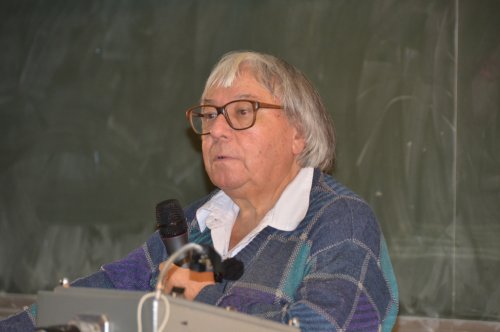
Nathan Bridges 1966-2017

Nathan Bridges, a planetary research scientist at the Johns Hopkins University Applied Physics Laboratory (APL), died on April 26. He was 50 years old.

Bridges, who joined APL’s Planetary Exploration (SRE) Group in 2009, was a senior expert on the geology of Mars, remote sensing techniques, and the role of wind-driven processes in planetary erosion and sedimentation on Earth, Mars, and Titan, Saturn’s largest moon. Among his many important findings, Bridges discovered that wind is as important a geologic process on Mars as it is on Earth, despite the much lower density of the Martian atmosphere.

He was an integral part of multiple Mars missions and instrument teams: he served as a Co-Investigator on the High Resolution Imaging Science Experiment (HiRISE) instrument on the Mars Reconnaissance Orbiter, a Co-Investigator on the Mars Science Laboratory (Curiosity rover) ChemCam instrument, and a science teammember on two Mars-2020 rover instruments, SuperCam and the Mars EnvironmentalDynamics Analyzer.

Bridges was also an associate research professor in the Department of Earth and Planetary Sciences at Johns Hopkins University, where he taught a class and advised graduate students. Additionally, he took leadership roles in the international planetary science community. For example, he served as editor of the American Geophysical Union publication EOS, secretary of the AGU Planetary Science Section, guest editor of several special issues of the journal Icarus, and on numerous NASA panels and advisory committees.

Bridges developed research collaborations with colleagues from around the world. His work included field studies at dune fields on Earth, experiments in wind tunnels to simulate conditions on other planets, and analysis of data from spacecraft observations.

He earned a B.A. in geology from the University of Colorado in 1989, an M.S. in geology from Arizona State University in 1992, and a Ph.D. in geology from the University of Massachusetts in 1997. He spent twelve years at NASA’s Jet Propulsion Laboratory in Pasadena, California, before joining APL.

Bridges is survived by his wife Karen, daughter Sarah, and son Matthew.

A tribute to Bridges from the Planetary Society, of which he was a member since 1980, can be read here.


Newsletter 17-20

Issue 17-20, May 13, 2017


+————————————CONTENTS—————————————-+

  1. IN MEMORIAM: NATHAN BRIDGES (1966-2017)
  2. DPS ELECTIONS 2017: CANDIDATE SLATE
  3. NOMINATIONS FOR THE 7TH PAOLO FARINELLA PRIZE NOW OPEN
  4. JWST EXPOSURE TIME CALCULATOR (ETC) WEBINAR FOR SOLAR SYSTEM SCIENCE
  5. AAS LABORATORY ASTROPHYSICS DIVISION (LAD) 2017 ELECTIONS OPEN
  6. LLOYD V. BERKNER SPACE POLICY INTERNSHIPS AUTUMN 2017
  7. SUMMER SCHOOL IN SOFTWARE SYSTEMS FOR ASTRONOMY
  8. NASA SMD SEEKS PROPOSAL REVIEWERS
  9. SOFIA CYCLE 6 CALL FOR PROPOSALS
  10.  SBAG ANNOUNCEMENT: PSP WHITE PAPER NOW AVAILABLE

+——————————————————————————————–+


1———1———1———1———1———1———1———1———1———1

IN MEMORIAM: NATHAN BRIDGES (1966-2017)


Nathan Bridges, a planetary research scientist at the Johns Hopkins University

Applied Physics Laboratory (APL), died on April 26. He was 50 years old.


Bridges, who joined APL’s Planetary Exploration (SRE) Group in 2009, was a

senior expert on the geology of Mars, remote sensing techniques, and the role

of wind-driven processes in planetary erosion and sedimentation on Earth, Mars,

and Titan, Saturn’s largest moon. Among his many important findings, Bridges

discovered that wind is as important a geologic process on Mars as it is on Earth,

despite the much lower density of the Martian atmosphere.


He was an integral part of multiple Mars missions and instrument teams: he served

as a Co-Investigator on the High Resolution Imaging Science Experiment (HiRISE)

instrument on the Mars Reconnaissance Orbiter, a Co-Investigator on the Mars

Science Laboratory (Curiosity rover) ChemCam instrument, and a science team

member on two Mars-2020 rover instruments, SuperCam and the Mars Environmental

Dynamics Analyzer. 


Bridges was also an associate research professor in the Department of Earth

and Planetary Sciences at Johns Hopkins University, where he taught a class

and advised graduate students. Additionally, he took leadership roles in the

international planetary science community. For example, he served as editor

of the American Geophysical Union publication EOS, secretary of the AGU

Planetary Science Section, guest editor of several special issues of the journal

Icarus, and on numerous NASA panels and advisory committees.


Bridges developed research collaborations with colleagues from around the

world. His work included field studies at dune fields on Earth, experiments

in wind tunnels to simulate conditions on other planets, and analysis of data

from spacecraft observations.


He earned a B.A. in geology from the University of Colorado in 1989, an M.S.

in geology from Arizona State University in 1992, and a Ph.D. in geology

from the University of Massachusetts in 1997. He spent twelve years at

NASA’s Jet Propulsion Laboratory in Pasadena, California, before joining APL.


Bridges is survived by his wife Karen, daughter Sarah, and son Matthew. 


A tribute to Bridges from the Planetary Society, of which he was a member

since 1980, can be read here.


2———2———2———2———2———2———2———2———2———2

DPS ELECTIONS 2017: CANDIDATE SLATE


The DPS Nominating Subcommittee has identified the following candidates

for the 2017 DPS elections for Vice Chair and Committee :


Vice-Chair (1 to be elected):

o Reggie Hudson, Goddard Space Flight Center

o Linda Spilker, Jet Propulsion Laboratory/Caltech


Committee (2 to be elected):

o Michele Bannister, Queen’s University Belfast, UK

o David Morrison, NASA Ames

o Migo Mueller, University of Groningen, The Netherlands

o Padma Yanamandra-Fisher, Space Science Institute


Additional candidates, supported by a petition of at least 20 DPS members,

may be nominated by May 24th. Please send any nominations to the

DPS Secretary, Anne Verbiscer, at [email protected].


3———3———3———3———3———3———3———3———3———3

NOMINATIONS FOR THE 7TH PAOLO FARINELLA PRIZE NOW OPEN


To honor the memory and the outstanding figure of Paolo Farinella (1953-2000),

an extraordinary scientist and person, a prize has been established in recognition

of significant contributions given in the fields of interest of Paolo, which span

from planetary sciences to space geodesy, fundamental physics, science

popularization, security in space, weapons control and disarmament. The prize

has been proposed during the “International Workshop on Paolo Farinella, the

scientist and the man”, held in Pisa in 2010, and is supported by the following

Italian Institutions: University of Pisa, ASI, INAF, IFAC-CNR.

Previous recipients of the “Paolo Farinella Prize” were:

– 2011: William F. Bottke, for his contribution to the field of “Physics and
         dynamics of small solar system bodies”
– 2012: John Chambers, for his contribution to the field of “Formation and
         early evolution of the solar system “
– 2013: Patrick Michel, for his contribution to the field of ” Collisional
         processes in the Solar System”
– 2014: David Vokrouhlicky, for his contribution to the field of “Non
         gravitational forces in the Solar System”
– 2015: Nicolas Biver, for his contribution to the field of “Dynamics and
         physics of comets”
– 2016: Kleomenis Tsiganis, for his contribution to the field of “Applications
         of celestial mechanics to the natural bodies of our solar system”.

The seventh Paolo Farinella Prize is devoted to planetary sciences and
specifically to studies on the

   “Physics and dynamics of the inner planets of the solar system and their
    satellites”.

The award ceremony will be hosted by the European Planetary Science
Congress (EPSC) meeting in Riga, Latvia (17th to 22nd of September 2017).

The call and the nomination forms can be found at:

http://www.europlanet-eu.org/nominations-for-the-7th-paolo-farinella-prize-now-open/

For the 7 th “Paolo Farinella” Prize the terms and rules are as follows:

1. A competition is announced to award the “Paolo Farinella” Prize for the
    year 2017. The prize consists of a plate, a certificate and the amount of
    1500 ?.  The winner is expected to give a Prize lecture at the EPSC awards
    special session.

2. The winner will be selected on the basis of his/her overall research
    results in the field of “Physics and dynamics of the inner planets of
    the solar system and their satellites”.

3. Nominations must be sent by email not later than May 25th, 2017, to the
    following addresses:

        [email protected] and [email protected]

4. The nominations for the “Paolo Farinella” Prize can be made by any
    researcher that works in the field of planetary sciences following the

    indications in the attached form. Self nominations are cceptable. The

    candidates should have international and interdisciplinary collaborations

    and should be not older than 47 years, the age of Paolo when he passed

    away, at the date of April 30th, 2017.

5. The winner of the prize will be selected before June 15th, 2017 by the
    “Paolo Farinella” Prize Committee composed of outstanding scientists in
    planetary sciences, with specific experience in the field.

6. The Prize Committee will consider all the nominations, but will be entitled
    to autonomously consider other candidates in case the reported candidates do
    not meet criteria 2. and 4.


4———4———4———4———4———4———4———4———4———4

JWST EXPOSURE TIME CALCULATOR (ETC) WEBINAR

FOR SOLAR SYSTEM SCIENCE 


ETC Webinar: Thursday, June 15, 12-1 PM EDT (US) 

Webex info: Link: https://tinyurl.com/n662ezq

Meeting number: 640 002 474

Password: JWST2018 


The General Observer (GO) Call for Proposals will be released on November 30, 2017,

with a submission due date of March 2, 2018. Get ahead of the game by joining

STScI’s John Stansberry and Bryan Holler for a hands-on demonstration of the

ETC in the context of Solar System observations. This webinar will also feature

an overview of Pandeia, the downloadable ETC engine written in Python, and a

request for community input on Pandeia tools and capabilities that would be useful

for planning observations. 


Attendance information and a recording of the webinar will also be available on

the JWST events page at: jwst.stsci.edu/news-events/events. 


Other useful links:  JWST ETC web-interface: jwst.etc.stsci.edu 

(Note that you must create a MyST log-in to save your workbooks in the ETC.) 


Pandeia download page: ssb.stsci.edu/pandeia/engine/1.0/ 


JWST Documentation (JDOX) for Solar System targets will begin to be

published on May 19 at: jwst-docs.stsci.edu


5———5———5———5———5———5———5———5———5———5

AAS LABORATORY ASTROPHYSICS DIVISION (LAD) 2017 ELECTIONS OPEN

Dear Colleagues, 


Laboratory Astrophysics Division (LAD) Electrons are “OPEN”.

Please participate and elect one each of the candidates. If you are not yet a full

member of LAD (one of the Divisions of American Astronomical Society) ,

please do consider becoming a member and vote. It is important for Planetary

Sciences and Astrophysics to have a strong LAD. If you think laboratory data are

important, if you think future space instrumentation is important, you need to

support LAD. 


To Vote (LAD): https://aas.org/vote 

To Join LAD: https://lad.aas.org/ 


Regards, Murthy Gudipati


6———6———6———6———6———6———6———6———6———6

LLOYD V. BERKNER SPACE POLICY INTERNSHIPS AUTUMN 2017 


The goal of the Lloyd V. Berkner Space Policy Internship is to provide

promising undergraduate and graduate students with the opportunity to

work in the area of civil space research policy in the nation’s capital,

under the aegis of the National Academies of Sciences, Engineering,

and Medicine’s Space Science Board. 


The autumn program is open to undergraduate and graduate students. 

The deadline for applications is 2 June.  Candidate(s) selected will be

contacted no later than 7 July. 


Additional information about the program, including the application

procedure, can be found at

http://sites.nationalacademies.org/SSB/SSB_052239.


7———7———7———7———7———7———7———7———7———7 

SUMMER SCHOOL IN SOFTWARE SYSTEMS FOR ASTRONOMY


Registration is now open for the 4th offering of Software Systems for Astronomy.  

The course covers software design and implementation of telescope and instrument

control systems, observation planning tools, and software for analyzing and

archiving astronomical data. SSfA-4 will be offered as a two week intensive

course this summer, 24-Jul to 04-Aug, 2017, on the Big Island of Hawaii.


To register, visit the following web page and follow the instructions

(UHH students skip steps 1-4):


http://astro.uhh.hawaii.edu/Summer/Summer-2017/summer2017.php#Special_Summer_Note


The course number is ASTR394.  For more information visit:


http://astro.uhh.hawaii.edu/Summer/Summer-2017/summer2017.php


or send email to [email protected]


8———8———8———8———8———8———8———8———8———8

NASA SMD SEEKS PROPOSAL REVIEWERS


SMD is seeking subject matter experts to serve as mail-in and panel reviewers

for the following programs:


Fire Impacts on Regional Emissions and Chemistry (ROSES-2017 A.23)

AVIRIS-NG Flights in India (ROSES-2016 A.31)

Emerging Worlds (ROSES-2017 C.2)

Solar System Observations (ROSES-2017 C.6)

Planetary Data Archiving, Restoration, and Tools (ROSES-2017 C.7)

Cassini Data Analysis Program (ROSES-2017 C.10)

The New Frontiers Data Analysis Program (ROSES-2016 C.19)

OSIRIS REx Participating Scientists Program (ROSES-2017 C.22)

Exoplanet Research Program (ROSES-2017 E.3)

ROSES-2017 Heliophysics Programs


Either click on the titles above or start at this permanent link

https://science.nasa.gov/researchers/volunteer-review-panels

where the volunteer reviewer forms are always posted.


9———9———9———9———9———9———9———9———9———9

SOFIA CYCLE 6 CALL FOR PROPOSALS


The Stratospheric Observatory for Infrared Astronomy (SOFIA) is pleased

to announce the release of its Cycle 6 Call for Proposals (CfP) on May 1, 2017.  


The Call solicits proposals from the U.S., and international, astronomical 

community for approximately 500 hours of SOFIA observations, and is issued

on behalf of NASA by the Universities Space Research Association (USRA).  

The proposal deadline is June 30, 2017, and the Cycle 6 observing period will

be from February 2, 2018 to February 1, 2019.  NASA expects approximately

$5M to be available for support of U.S. affiliated investigators.


Instruments offered for Cycle 6 observations are: (1) the EXES mid-IR 

high-resolution spectrometer, (2) the FIFI-LS far-IR imaging spectrometer,

(3) the FORCAST mid-IR camera, including its grism spectrometer (4) the

FPI+ camera in science mode (5) the GREAT heterodyne spectrometer, and

(6) The HAWC+ far-IR imager and polarimeter.  New in Cycle 6 is the

availability of the GREAT dual-array mode LFA/HFA, as well as two of

the bands in the new lower-frequency 4GREAT receiver.


Starting with the Cycle 6 Call for Proposals the proposal category “Thesis 

Enabling Programs” is introduced, specifically aimed at supporting graduate 

student research.


For further details, please see:

https://www.sofia.usra.edu/science/proposing-and-observing/proposal-calls/cycle-6


10——–10——–10——–10——–10——–10——–10——–10——–10——–10

SBAG ANNOUNCEMENT: PSP WHITE PAPER NOW AVAILABLE


This is a community announcement that the Participating Scientist White

Paper (entitled: The Value of Participating Scientist Programs to NASA’s

Planetary Science Division, by L. Prockter et al.) has been posted to the

SBAG website under the “Documents” page. To access the document,

please follow this link: http://www.lpi.usra.edu/sbag/documents/


Thanks,

Angela Stickle

SBAG Early-career secretary


———————————+

Send submissions to:

Anne Verbiscer, DPS Secretary ([email protected]


To unsubscribe visit http://aas.org/unsubscribe or email [email protected].

To change your address email [email protected]

Newsletter 17-19

Issue 17-19, April 30, 2017


+————————————CONTENTS—————————————-+

  1. DPS ELECTIONS 2017: CANDIDATE SLATE
  2. NASA FRONTIER DEVELOPMENT LAB 2017 CALL FOR APPLICANTS
  3. EPSC 2017 SESSIONS ON OUTER PLANET SYSTEMS
  4. EPSC 2017 SESSION ON PLANETARY AEROSOLS AND CLOUDS
  5. EPSC 2017 SESSION ON CERES AND VESTA

+——————————————————————————————–+


1———1———1———1———1———1———1———1———1———1

DPS ELECTIONS 2017: CANDIDATE SLATE


The DPS Nominating Subcommittee has identified the following candidates

for the 2017 DPS elections for Vice Chair and Committee :


Vice-Chair (1 to be elected):

o Reggie Hudson, Goddard Space Flight Center

o Linda Spilker, Jet Propulsion Laboratory/Caltech


Committee (2 to be elected):

o Michele Bannister, Queen’s University Belfast, UK

o David Morrison, NASA Ames

o Migo Mueller, University of Groningen, The Netherlands

o Padma Yanamandra-Fisher, Space Science Institute


Additional candidates, supported by a petition of at least 20 DPS members,

may be nominated by May 24th. Please send any nominations to the

DPS Secretary, Anne Verbiscer, at [email protected].


2———2———2———2———2———2———2———2———2———2

NASA FRONTIER DEVELOPMENT LAB 2017 CALL FOR APPLICANTS


NASA Frontier Development Lab (FDL) is looking for masters, doctorate or 

post-doc researchers with an understanding or interest in one of this year’s 

problem areas:  


Planetary Defense: Near-Earth Object 3D shape modeling or Comet detection

Space Weather: Coronal Mass Ejections (CMEs) or Solar-Terrestrial Interactions 

Space Resources: Lunar Water or Asteroid Prospecting 

Hosted by the SETI Institute and NASA Ames in Mountain View and supported 

by leaders in AI from the private sector, such as IBM, Nvidia, and Autodesk, 

FDL brings together teams of experts in the physical sciences and specialists in 

data science and machine learning for an intense 8-week concentrated study on 

topics important to NASA – and to humanity’s future. 


The format encourages rapid iteration and prototyping to create outputs with 

meaningful application, papers and conference posters. 


All participants are paid and provided accommodation and transport in Silicon Valley. 

The 2017 8-week program is still accepting qualified participants and will run 

June 26 – August 18, 2017. 


Applications will be accepted until the closing date of the 19th of May,

although we encourage you to apply sooner to ensure a place. 

To learn more about FDL and submit your application, please visit the FDL website at

 frontierdevelopmentlab.org


3———3———3———3———3———3———3———3———3———3

EPSC 2017 SESSIONS ON OUTER PLANET SYSTEMS


Dear colleagues,

We encourage you to submit an abstract at the European Planetary Science 

Congress 2017 to be held in Riga, Latvia, on 17–22 September 2017.


See : http://www.epsc2017.eu/home.html

Please note that the abstract deadline is fast approaching: May 3, 2017.


Please see: http://meetingorganizer.copernicus.org/EPSC2017/sessionprogramme

The Outer Planet Systems Theme offers several sessions this year, as follows:


OPS1
Outer planets systems and Pluto
Convener: A. Coustenis  | Co-conveners: S. K. Atreya , G. S. Orton , 

L.N. Fletcher , O. Witasse , N. Altobelli          

OPS2
Ocean worlds and Icy Moons
Convener: E. Turtle  | Co-conveners: O. Grasset , J.-P. Lebreton , 

A. Coustenis , F. Tosi          


OPS3
Juno at Jupiter and Supporting Earth-Based Observations
Convener: A. Mura  | Co-conveners: S. Bolton , J. Connerney , A. Adriani , 

T. Guillot , G. S. Orton          


OPS4/TP8.2
Aerosols and clouds in planetary atmospheres (co-organized)
Convener: N. Carrasco  | Co-conveners: A. Määttänen , P. Lavvas          


TP5/OPS5/SB14
Planetary Geomorphology (co-organized)
Convener: S. Adeli  | Co-conveners: A. Johnsson , E. Hauber          

Please consider submitting an abstract and informing your colleagues, 


We hope to see you in Riga !

With best regards,
For the conveners

Athena Coustenis


4———4———4———4———4———4———4———4———4———4

EPSC SESSION ON PLANETARY AEROSOLS 


Dear Colleagues, 

The abstract submission for the European Planetary Science Congress 2017 

organized in Riga, Latvia, on 17–22 September 2017, is open and the deadline is May 3! 

We invite you to submit abstracts to our (co-organized) session OPS4/TP8.2 

“Aerosols and clouds in planetary atmospheres”! 

http://meetingorganizer.copernicus.org/EPSC2017/session/26063 

Atmospheric aerosols and cloud particles are found in every atmosphere of the 

solar system, as well as, in exoplanets. Depending on their size, shape, chemical 

composition, latent heat, and distribution, their effect on the radiation budget 

varies drastically and is difficult to predict. When organic, aerosols also carry a 

strong prebiotic interest reinforced by the presence of heavy atoms such as 

nitrogen, oxygen or sulfur. 

The aim of the session is to gather presentations on these complex objects for 

both terrestrial and giant planet atmospheres, including the special case of 

Titan’s hazy atmosphere. All research aspects from their production and 

evolution processes, their observation/detection, to their fate and atmospheric 

impact are welcomed, including laboratory investigations and modeling. 

The ambition of the session is a review effort beginning in our solar system, 

and which would be valuable to further investigate atmospheric aerosols in 

exoplanetary systems. 

Spread the word, and see you in Riga! 

With best regards, 
The conveners 

Nathalie Carrasco, Panayotis Lavvas, Anni Määttänen


5———5———5———5———5———5———5———5———5———5

EPSC 2017 SESSION ON CERES AND VESTA


Dear colleagues,


this is a reminder for the upcoming abstract submission deadline of the next 

EPSC conference (http://www.epsc2017.eu) that will be held in Riga on 

17-22 September 2017.


The “Abstract submission deadline” is  May 3, 2017, 13:00 CEST.


We would like to invite you to submit an abstract to the Session: 

SB5 – “Ceres and Vesta – 10th anniversary of Dawn Special Session”. 


Session summary: September 2017 marks 10 years since the launch of NASA’s 

Dawn mission. Dawn has been the first mission to orbit two different targets in 

the main asteroid belt: the largest asteroid Vesta and the dwarf planet Ceres. 

Dawn’s overall results represent a huge leap in our understanding of these bodies.

In this session we welcome contributions that cover: 1) latest results obtained from 

the Dawn mission on both Ceres and Vesta, concerning geology, mineralogy, 

surface composition and/or geophysics, 2) comparative analysis of Vesta and 

Ceres in terms of surface processes, internal structure, thermal evolution and 

origins. The goal of this session is to highlight the major achievements of the 

Dawn mission, and to illustrate recent discoveries and ongoing work on Vesta 

and Ceres through direct analysis of Dawn data, study of analogs and/or 

theoretical models.


To submit you may use the following link:

https://administrator.copernicus.org/authentication.php


Looking forward to see you in Riga,


the conveners


Katrin Stephan

Michael Toplis

Francesca Zambon

———————————+

Send submissions to: 

Anne Verbiscer, DPS Secretary ([email protected]


To unsubscribe visit http://aas.org/unsubscribe or email [email protected].

To change your address email [email protected]
 

Newsletter 17-18

Issue 17-18, April 23, 2017


+————————————CONTENTS—————————————-+

  1. DPS ELECTIONS 2017: CANDIDATE SLATE
  2. SMALL BODIES ASSESSMENT GROUP (SBAG) 17 MEETING: ACCEPTING APPLICATIONS FOR EARLY CAREER TRAVEL SUPPORT
  3. SUMMER SCHOOL IN SOFTWARE SYSTEMS FOR ASTRONOMY
  4. ROADMAPS TO OCEAN WORLDS (ROW) TOWNHALL AT ABSCICON
  5. JOBS, POSITIONS, OPPORTUNITIES

+——————————————————————————————–+


1———1———1———1———1———1———1———1———1———1

DPS ELECTIONS 2017: CANDIDATE SLATE


The DPS Nominating Subcommittee has identified the following candidates

for the 2017 DPS elections for Vice Chair and Committee :


Vice-Chair (1 to be elected):

o Reggie Hudson, Goddard Space Flight Center

o Linda Spilker, Jet Propulsion Laboratory/Caltech


Committee (2 to be elected):

o Michele Bannister, Queen’s University Belfast, UK

o David Morrison, NASA Ames

o Migo Mueller, University of Groningen, The Netherlands

o Padma Yanamandra-Fisher, Space Science Institute


Additional candidates, supported by a petition of at least 20 DPS members,

may be nominated by May 24th. Please send any nominations to the

DPS Secretary, Anne Verbiscer, at [email protected].


2———2———2———2———2———2———2———2———2———2

SMALL BODIES ASSESSMENT GROUP (SBAG) 17 MEETING:

ACCEPTING APPLICATIONS FOR EARLY CAREER TRAVEL SUPPORT


As a reminder, the next SBAG meeting will be June 12-14 at NASA Goddard 

Spaceflight Center in Greenbelt, MD. Note that we will be starting at 1 pm on 

June 12 and ending at noon on June 14.


We are very excited for early-career scientists and engineers to participate in 

SBAG meetings. We have two opportunities at the upcoming SBAG meeting 

in June specifically aimed to people early in their career:


We are now accepting applications for early-career travel support to attend the 

upcoming SBAG meeting. Please pass the information on to any students, 

post-docs or early career scientists/engineers that may be interested in attending 

the meeting.
 

Early career travel support: We are planning to offer limited U.S. travel support 

for early career scientists to participate in the SBAG 17 meeting, to be held at the 

NASA Goddard Space Flight Center in Greenbelt, MD on June 12-14, 2017.  

Interested undergraduate students, graduate students, postdocs, and other early 

career scientists (within 3 years of PhD/MS/BS) should submit a letter and a CV to 

SBAG Early Career Secretary Angela Stickle ([email protected]) by COB 

(5 pm Eastern time) May 5, 2017. Included in the letter, which must not exceed 2 

pages, should be a demonstration of financial need and an explanation of how the 

applicant’s work relates to the purposes of the SBAG. The letter and CV should be 

combined into a single PDF document for submission by e-mail attachment.  

Recipients of travel support will be expected to give a short presentation (~10-15 

minutes) of their SBAG-relevant work at the SBAG 17 meeting.


Lightning Talks: We are providing time on the agenda for early-career scientists 

and engineers present at the meeting to introduce themselves and their research to 

the community. The talks will be 3 minutes each. If you are interested in giving a 

lightning talk, please contact the early-career secretary Angela Stickle 

([email protected]). Please encourage students and postdocs that you 

know to participate!


Thanks

Angela Stickle

SBAG Early-career Secretary


3———3———3———3———3———3———3———3———3———3

SUMMER SCHOOL IN SOFTWARE SYSTEMS FOR ASTRONOMY


Registration is now open for the 4th offering of Software Systems for Astronomy.

The course covers software design and implementation of telescope and instrument 

control systems, observation planning tools, and software for analyzing and 

archiving astronomical data. SSfA-4 will be offered as a two week intensive 

course this summer, 24-Jul to 04-Aug, 2017, on the Big Island of Hawaii.


To register, visit the following web page and follow the instructions (UHH 

students skip steps 1-4):


  http://astro.uhh.hawaii.edu/Summer/Summer-2017/summer2017.php#Special_Summer_Note


The course number is ASTR394.  For more information visit:


  http://astro.uhh.hawaii.edu/Summer/Summer-2017/summer2017.php


or send email to [email protected]


4———4———4———4———4———4———4———4———4———4

ROADMAPS TO OCEAN WORLDS (ROW) TOWNHALL AT ABSCICON


The Roadmaps to Ocean Worlds (ROW) team was chartered by OPAG to 

identify science objectives for Ocean Worlds and to design a roadmap (or 

roadmaps) to explore these worlds to address the identified science objectives. 

We will be holding a ROW townhall at AbSciCon (Monday, April 24, 12:15-1:15PM) 

to share our progress and allow for astrobiology community input.

We hope to see you there!

Amanda Hendrix ([email protected])
Terry Hurford ([email protected])


5———5———5———5———5———5———5———5———5———5

JOBS, POSITIONS, OPPORTUNITIES


A) POSTDOCTORAL POSITION IN PLANET FORMATION AT SWRI BOULDER


There is an open postdoctoral research position open at Southwest 
Research Institute’s office in Boulder Colorado to work with Hal 
Levison and Kevin Walsh on a variety of topics related to Planet 
Formation. More details and application information can be found at:

https://resapp.swri.org/ResApp/Job_Search_Results.aspx?DETAIL=15-01225

and

https://resapp.swri.org/ResApp/Job_Search_Results.aspx?DETAIL=15-01226 

Contact:

Kevin Walsh: [email protected]


B) PH.D. OPPORTUNITY IN MARTIAN GEOCHEMISTRY

Wesleyan University has funding for a student to complete a Ph.D. in 
the Department of Chemistry with a Concentration in Planetary Science.
The program of study will be tailored to include a relevant geoscience 
curriculum. The proposed project is to create a series of Mars 
analogue brines and precipitate them under terrestrial and martian 
conditions in a Mars chamber. Visible – near-infrared spectra of the 
precipitates will then be compared to similar data collected in Mars 
orbit. The research will be under the tutelage of Prof. Gilmore in the 
Dept. of Earth and Environmental Sciences. The opening is available for 
Fall of 2017. Please apply to the Chemistry Department at: 

http://www.wesleyan.edu/grad/  

Applications will be reviewed as they are received. More information 
about Planetary Sciences at Wesleyan may be found at:

http://www.wesleyan.edu/planetary/  

Please direct all inquiries to: 

Prof. Martha Gilmore  
[email protected]


———————————+

Send submissions to: 

Anne Verbiscer, DPS Secretary ([email protected]


To unsubscribe visit http://aas.org/unsubscribe or email [email protected].

To change your address email [email protected]


Message From The Chair: The March For Science Saturday April 22, 2017

I’m marching for science on Saturday April 22, 2017 in Washington, DC, to ensure that knowledge derived from scientific investigation is included in policy deliberations. I invite you to join me by meeting at AAS offices before the march. Can’t make it to DC? Explore satellite marches across the US and world wide.

Consider participating in the AAS’s social media campaign by writing one or two sentences about why science is important to you and include a picture. 

Hope to see you at the march!

Lucy McFadden
DPS Chair

Message From The DPS Federal Relations Subcommittee

On 6-7 April 2017, our AAS/DPS Federal Relations Subcommittee (FRS) visited Capitol Hill to advocate for planetary science and to educate congressional representatives and staffers about our organization. The FRS conducts one or more such visits each year in consultation and coordination with AAS Public Policy and the Committee on Astronomy and Public Policy.

These visits are typically most effective in the spring when budget priorities are being established between the executive and legislative branches — although this transition year is atypical. This year our DPS subcommittee met with 7 key offices in various states, including California, Maryland, Texas, Colorado, and Georgia.

During these visits we offered our thanks to the Congressman either directly or through the staff member we me with for their interest and support of space sciences. We expressed excitement about the President’s proposed fiscal year (FY) 2018 budget of $1.93 billion for NASA’s Planetary Science division, while also communicating concern about maintaining a balance across all disciplines at NASA — to be specific, across the Planetary Science, Earth Science, Heliophysics, and Astrophysics divisions — in order to achieve the goals prioritized in the Decadal Surveys.

Many staffers were interested to learn about the total solar eclipse on August 21. We pointed them to the AAS Eclipse website and encouraged them to participate in local events in their home districts. Find more information about FRS activities.

Kurt Retherford, AAS/DPS Federal Relations Subcommittee Chair
Heather Bloemhard, AAS Bahcall Fellow

Michel Combes 1939-2017

Michel CombesA Tribute to Michel Combes

Michel Combes passed away on March 9, following a week of hospitalization. As a former Director of the Paris Observatory DESPA Laboratory (which later became LESIA) and a former President of Paris Observatory, Michel has played a major role in the life of the laboratory, the Observatory, and, beyond, in the development of planetology and of astronomical instrumentation in France and internationally.

As a former student of the Institut d’Optique in Paris, Michel entered the Observatory in the early 1960s. In 1969, Michel was a major actor in the establishment of a planetology group at the Observatory, first hosted within the Department of Solar Physics and later within the Space Research Department (DESPA).

Mainly interested in optics, Michel was convinced that new projects in astronomy require instrumental innovation.  In 1973, he led a campaign in South Africa to observe the occultation of the star Beta Scorpio by Jupiter. This successful experiment made possible the retrieval of the thermal structure in the stratosphere of Jupiter. In parallel, Michel worked on the development of a Fourier Transform spectrometer operating in the thermal infrared, devoted to the spectral analysis of Jupiter. This instrument was flown on the Kuiper Airborne Observatory in 1973, and has been mounted several times on large ground-based telescopes.

In the 1980s, with Tobias Owen in the US and Vassili Moroz in Moscow, and in partnership with other laboratories, Michel developed the concept of a new instrument for analyzing the near-infrared emission of comets. This successful experiment, launched on the Soviet probes Vega 1 and Vega 2, has led to the first measurement of the temperature of a cometary nucleus, and the detection of several parent molecules outgassed from the nucleus.

In the mid-1980s, Michel became the Director of DESPA, and drove the laboratory toward participation in the ISOCAM camera of the Infrared Space Observatory (ISO) of ESA. In parallel, the planetology group got involved in space projects of planetary infrared sounding. This was the beginning of a series of infrared imaging spectrometers, conceived and developed at DESPA in partnership with Institut d’Astrophysique Spatiale in Orsay and several international laboratories. The first ones were devoted to the exploration of Mars, with ISM/PHOBOS and OMEGA/Mars-96 in partnership with Russia. These instruments inspired the imaging spectrometers of Cassini/Huygens, Rosetta and Venus Express.  

In 1991, Michel became the President of Paris Observatory. This duty allowed him to express all his human and international relationship qualities, based on his excellent knowledge of men and institutions.  As a President, Michel initiated a re-organization of the scientific departments of the Observatory.  This was the first step of a global restructuration of the scientific departments, which was completed later in the early 2000. In the meantime, Michel continued to follow the development of infrared space projects at DESPA, in particular in the domain of stellar photometry and planetology. After the failure of the Mars-96 spacecraft just after launch, both experiments were rebuilt and used in other contexts, the French CoRoT mission and, under IAS’ PIship, the OMEGA instrument aboard Mars Express. Later, in collaboration with other international partners, the VIRTIS-H instrument was flown on two other European missions, Rosetta and Venus Express. He was also strongly involved in the NASA-ESA Cassini/Huygens mission through participation as co-investigator in DISR/Huygens and team member on VIMS/Cassini until recently.

In 1999, after two mandates, Michel came back to DESPA, which later transformed into LESIA, and became involved in teaching activities regarding optics, and in the development of instrumental concepts. He also became more and more involved in outreach activities within the Service of Communication of the Observatory, as well as within the team working on History of Sciences.

Thanks to his strong personality, his acute sense of politics, his engagement toward society, his sense of organization and dialog, Michel Combes has played a major role in the field of planetology but also at the level of the Observatory and beyond. Michel was a leader with a strong sense of responsibility, respectful of his international collaborators. He had a very strong capability for bringing teams together – scientists, engineers, technicians, administrative employees – and to make them work together towards a common objective. He will be deeply missed by his friends and colleagues. 

Therese Encrenaz and Pierre Drossart


Message From The FRS Chair: Revised And Corrected Action Alert

Please see this updated Action Alert and text for your letters to Congress. The FRS Chair apologizes for using an older version of the text while reacting to the news of the day.

Action alert!

This week we are asking each AAS/DPS member to write letters and make phone calls to your representatives in order to advocate for planetary science.

Why now?

•    The President’s fully detailed Budget Request for Fiscal Year 2018 is planned for release in mid-May, and initial guidelines indicate that dramatic cuts in discretionary, non-defense areas such as science are in store across the government.

•    The President’s just released “skinny budget” for FY18 generously increases Planetary Science to $1.9B, while NASA’s top line would be cut by 0.8%.  NASA fares better in this budget than almost every other agency not related to national security and veterans.  A top line number for the Science Mission Directorate is not given, and neither are totals for the Astrophysics and Heliophysics divisions, but a cut for Earth Science is specified. The National Science Foundation (NSF) is not shown as separate a line item, but it is potentially facing a 10% cut if one assumes an across-the-board cut for all the agencies in the budget line into which NSF has been aggregated.

•    The House and Senate still haven’t passed a full year FY17 science appropriations bill and we want them to know where we stand on targets for FY18. The current continuing resolution funds the government through April 28.  

•    With numerous other policy issues dominating the political landscape, we are trying to remain above the noise and leverage the attention of Congressional staff who favor planetary science funding. Recall that the President proposes, but Congress disposes.

•    Science advocacy is broadly important for us to all engage in, now more than ever, and responding to this action alert provides a focused, proven-effective means to have your concerns heard by decision makers.


Why should you participate?

•    Constituents matter to Members of Congress! Letters and especially calls from constituents force staffers to sit up and take notice of an issue. If a number of letters and calls come in at once from constituents, it has an even greater impact.

•    Even if your elected official is not on one of the following committees: House Committee on Science, Space, & Technology, House Committee on Appropriations, Senate Committee on Commerce, Science, & Transportation, they still vote on bills and have influence with their colleagues. Often it is the congressional Member without a NASA center or other large vested interest in their district who needs the most education and convincing on space-related topics.

•    We have had success in garnering Congressional support for planetary science, and we need to maintain and build on that momentum.

It is important to get as many people to contact as many Members of Congress as possible, so please participate! We encourage you to use social media to promote this call to action to help amplify the message and encourage others to act (use Twitter hashtag #FundPlanetary).  Here’s what we’re asking you to do this week:

Letters

•    The letter template below provides a clear, disciplined message that is consistent with the messages DPS has been pushing in our overall advocacy campaign.

•    Do customize your communications! In particular, stories about your own scientific work, the interactions with your students, and public outreach are compelling to Congressional offices. Keep it short and concise.  Tailor one or more paragraphs in the template.

•    You will likely need to submit your letter through a form on your Members of Congress’s websites. And most members of Congress communicate through social media, so use those channels as well!


Phone calls

•    After you have sent the emails, call each of the Congressional offices. Be polite and nice! The people who answer the phones work hard and tend to suffer a lot of abuse from angry constituents; when you’re nice, you get more carefully listened to. You can ask to speak to the staffer who handles science and space issues; in most cases, they will connect you and you can speak directly to that staffer or leave a voicemail.

•                      Hello, my name is ________, and I am a constituent from _________. I am also a planetary scientist working at _______________. I’m calling to ask Representative/Senator _____________ to support planetary science and solar system exploration programs. Congress has consistently supported planetary science in recent years, and I hope the field can rely on its continued support. I have sent a more detailed letter to your boss using your website; I hope your office has time read it. Thank you very much.

•    Once you realize how painless this ~5 min process was, plan to call back and firm up your connection the following week.  Or better yet, call weekly for each of the next 5 weeks to elaborate more on each of your favorite 5 topics listed in the letter. 


How do you know who to write to and call?

To find out who your Members of Congress are and get their phone numbers and websites, the AAS website has helpful search tool.

An important final note: Be certain you understand your employer’s rules about such action. Federal employees, for example, must not conduct such activities using federal resources, i.e. you must participate using your personal time/email/phone number/electronic devices. No matter where you work, your Constitutional rights to petition your government are always valid; you can always participate in advocacy like this, but you may need to be careful about doing it on your own time and resources.

Thank you – we’re looking forward to a strong response to this call to action!


Dear [Representative/Senator] [Last name],

I am a constituent from [town where you live] and a planetary scientist working at [your institution]. I write to you to ask for your support in maintaining a healthy program of U.S. solar system exploration as you and your colleagues look ahead to the Fiscal Year 2018 budget. I am asking that you support an FY18 budget level of $1.9B for NASA’s Planetary Science Division – the same as the President has just requested – in order to accomplish the goals set out in the National Research Council’s 2013 Vision and Voyages Decadal Survey. I am also requesting a commensurate increase for the entire NASA Science Mission Directorate so that the increase for planetary science does not come at the expense of the important goals set out by the decadal surveys for the astrophysics, heliophysics, and earth science divisions. I am also concerned about potential cuts to the National Science Foundation (NSF) in the President’s budget since the recent “skinny budget” lumped NSF into an “other agency” line with a 10% cut. NSF supports critical research grants in the planetary sciences so I request that Congress appropriate at least $8B for NSF in Fiscal Year 2018. You may have seen some of the milestones and scientific advances that have been made by this highly successful government office in this area in recent months: [Choose which highlights you want to use, remove the others, and/or add your own]

•    NASA’s Juno mission recently started its primary science mission in orbit about the planet Jupiter. Over the next couple of years, Juno is poised to shed light on the origin of the planets in our Solar System.

•    All of New Horizons’ Pluto observations have now been downlinked to Earth, and new discoveries continue to flow while it travels on to Kuiper Belt target (486958) 2014 MU69.

•    Observations from NSF’s Very Large Array have provided an unprecedented look at a previously unexplored region of Jupiter’s atmosphere and revealed new information about Jupiter’s atmospheric dynamics.

•    The OSIRIS-REx spacecraft successfully launched from Cape Canaveral last September to begin its journey to a nearby asteroid. There it will collect a sample of this cosmic building block and return it for study here on the Earth.

•    NSF’s Large Synoptic Survey Telescope will survey the entire visible sky every few nights, which could catalog millions of asteroids and thousands of near-Earth objects. 

•    NASA’s Cassini spacecraft convincingly determined that Enceladus, an icy moon of Saturn, contains a global ocean of liquid water beneath its surface. Like Europa, this may be an ideal place to search for life.

•    NASA’s Kepler and Spitzer missions have detected and characterized nearly 5,000 exoplanets, including seven Earth-sized worlds in the TRAPPIST-1 system. These detections have revolutionized our understanding of planetary formation and the prevalence of habitable worlds.

•    The Dawn mission has been orbiting and studying the dwarf planet Ceres, where it revealed vast deposits of carbonate salts, the solid residue from evaporation of salt-saturated water, indicative of recent geologic activity.

•    When the James Webb Space Telescope is launched in 2018, planetary scientists will have a new, powerful tool for observing solar system targets.

•    Recent orbital observations at Mars have revealed a possible source of liquid water near the Curiosity rover. NASA is now investigating the feasibility of using Curiosity to study flowing water on Mars for the first time.

Events like these reaffirm America’s pioneering role in planetary science and exploration. Furthermore, they capture the imagination of the public and inspire the next generation of scientists, engineers, and technologists. Vital partnerships between NASA and private industry ensure that we make full use of the latest technological innovations and advance scientific discoveries.

[Discussion of your scientific work, work with students, impact in your district/state]

We strive to maintain America’s leadership role in planetary science and exploration and NASA’s and NSF’s ability to support a vibrant science community. In general, Congress has consistently supported planetary science, and I want to thank you and your colleagues for that support. I hope you will continue that support by enacting a Fiscal Year 2018 budget in regular order for the NASA Planetary Science Division at a level of $1.9B – the same as the President has just requested. This level of support will help ensure that we can meet the goals laid out in the National Research Council’s Decadal Survey report for Planetary Science. This includes the report’s recommendation that the Planetary Science Division maintain a balanced program of large, medium, and small missions across the solar system, research and analysis, and technology development. A commensurate increase to NASA’s Science Mission Directorate budget for Fiscal year 2018 will further strengthen a well-balanced program across the disciplines. And at least $8B for the National Science Foundation will help ensure our nation’s scientific leadership while supporting critical planetary science research grants and facilities.

Sincerely,

[Your name]

[Town, State]


16 March 2017

Message From The Chair: The March For Science, The AAS/DPS And You

The importance of science to the advancement of humanity is clear to our DPS membership, yet its ability to inform governmental policy appears to be imperiled. The AAS will support our members who plan to participate in the March for Science on April 22, as described in this detailed post by AAS Executive Officer Kevin Marvel. 

Core principles of the march as presently defined are: science that serves the common good; cutting-edge science education; open and honest science communication and inclusive public outreach; evidence-based policy and regulations in the public interest; and funding for scientific research and its applications. Related goals for the march are to: humanize science; partner with the public; advocate for open, inclusive, and accessible science; support scientists; and affirm science as a democratic value.

The AAS office at 1667 K Street NW (very near the White House) will open its doors on the morning of the march and serve refreshments. Our leadership participates in weekly information-sharing phone calls (but, as for AGU and other science organizations, does not control the messaging). We will provide logistical support and report any late breaking developments. Additional assistance provided by the AAS includes web tools for a roommate and housing search and/or carpool search. For more information or questions feel free to contact the DPS FRS Chair or the AAS policy experts listed on Marvel’s website post. If you are actively involved in the organization of a local march please let us know.

Lucy McFadden and Kurt Retherford
DPS Chair and FRS Chair

Newsletter 17-12

Issue 17-12, March 11, 2017


+————————————CONTENTS—————————————-+

  1. MESSAGE FROM THE CHAIR: THE MARCH FOR SCIENCE, THE AAS/DPS AND YOU
  2. RELEASE OF OSIRIS-REX PARTICIPATING SCIENTIST PROGRAM ELEMENT DRAFT TEXT FOR COMMUNITY COMMENT
  3. ALMA CALL FOR STUDY PROPOSALS
  4. ASTROPHYSICS DATA ANALYSIS PROGRAM LETTERS OF INTENT DUE
  5. UPCOMING WORKSHOPS AND MEETINGS
  6. JOBS, POSITIONS, OPPORTUNITIES

+——————————————————————————————–+


1———1———1———1———1———1———1———1———1———1

MESSAGE FROM THE CHAIR: THE MARCH FOR SCIENCE, THE AAS/DPS, AND YOU


The importance of science to the advancement of humanity is clear to our 

DPS membership, yet its ability to inform governmental policy appears to 

be imperiled.  The AAS will support our members who plan to participate 

in the March for Science on April 22 (www.marchforscience.com), as 

described in this detailed post by AAS Executive Officer Kevin Marvel:   

https://aas.org/posts/news/2017/02/march-science-aas-and-you


Core principles of the march as presently defined are: science that serves 

the common good; cutting-edge science education; open and honest science 

communication and inclusive public outreach; evidence-based policy and 

regulations in the public interest; and funding for scientific research and its 

applications.  Related goals for the march are to: humanize science; partner

with the public; advocate for open, inclusive, and accessible science; support

scientists; and affirm science as a democratic value.


The AAS office at 1667 K Street NW (very near the White House) will open 

its doors on the morning of the march and serve refreshments.  Our leadership 

participates in weekly information-sharing phone calls (but, as for AGU and 

other science organizations, does not control the messaging).  We will provide 

logistical support and report any late breaking developments.  Additional

assistance provided by the AAS includes web tools for a roommate and housing 

search and/or carpool search.  For more information or questions feel free to 

contact the DPS FRS Chair at [email protected] or the AAS policy 

experts listed on Marvel’s website post.  If you are actively involved in the 

organization of a local march please let us know ([email protected],

[email protected]).


Lucy McFadden and Kurt Retherford

DPS Chair and FRS Chair


2———2———2———2———2———2———2———2———2———2

RELEASE OF OSIRIS-REX PARTICIPATING SCIENTIST PROGRAM 

ELEMENT DRAFT TEXT FOR COMMUNITY COMMENT


The objective of the OSIRIS-REx Participating Scientist Program (OREx-PSP) 

is to enhance the scientific return during the asteroid-operational phase of the

OSIRIS-REx mission by expanding participation in the mission through new

investigations that broaden and/or complement existing principal investigator

(PI) and co-investigator (Co-I)-led investigations.


This amendment releases a draft version of C.22, the OSIRIS-REx participating

scientist program element for community comment. Questions and comments 

on this draft program element should be directed to Jeffrey Grossman at 

[email protected] and Christina Richey at [email protected] by

March 16, 2017.


On or about March 2, 2017, this Amendment to the NASA Research 

Announcement “Research Opportunities in Space and Earth Sciences 

(ROSES) 2017″ (NNH17ZDA001N) will be posted on the NASA research 

opportunity homepage at: http://nspires.nasaprs.com/ and will appear on the 

RSS feed at:

https://science.nasa.gov/researchers/sara/grant-solicitations/roses-2017/


3———3———3———3———3———3———3———3———3———3

ALMA CALL FOR STUDY PROPOSALS


The National Radio Astronomy Observatory and the National Science

Foundation  are pleased to announce a Call for Study Proposals for the

North American  ALMA Cycle 5 Development program:        
https://go.nrao.edu/ALMA_Cycle5_Development 


This Call is open to the community of scientists from North American

ALMA partner countries. The primary objectives of the Cycle 5 Development

Program Studies are to:

(a) enable groups in North America to propose ALMA upgrade studies

that may later be implemented via the ALMA Development Plan;

(b) support the development of conceptual and detailed designs for ALMA

upgrades; and

(c) encourage relevant long-term research and development in areas

important for ALMA.


Two categories of proposals are being sought via this Call:

(a) General Studies (funded for 1 year and up to $200,000 USD per award); and

(b) Strategic Studies (funded for 2 years and up to $400,000 USD per award). 


Strategic Studies is a new ALMA Development proposal category intended

to support in-depth studies aligned with the development priorities identified

by the ALMA Science Advisory Committee in the ‘A Roadmap for

Developing ALMA’ document: https://go.nrao.edu/Roadmap_for_ALMA


The proposal submission deadline for this Call for Studies is 1 May 2017

at 23:59 EDT. Prospective Principal Investigators are encouraged, but not

required, to submit Notices of Intent by 20 March 2017.  Questions should

be directed to [email protected]


4———4———4———4———4———4———4———4———4———4

ASTROPHYSICS DATA ANALYSIS PROGRAM LETTERS OF INTENT DUE


The deadline for ROSES ADAP 2017 letters of intent is March 28, 2017.

Scientists with approved Priority 1 GO observations involving < 200 hours

of Spitzer time are eligible to propose for data analysis support under ADAP

2017. The solicitation also includes archival funding opportunities. Spitzer

investigators with observations in our solar system that are not eligible for

support through ADAP should consult the Solar System Observations 2017

(SSO17) solicitation in the ROSES-2017. The deadline for SSO17 Step 1

proposals is April 6, 2017.  Please see

http://ssc.spitzer.caltech.edu/warmmission/propkit/ar/  for more information

on these funding opportunities.


Spitzer Science User Support


5———5———5———5———5———5———5———5———5———5

UPCOMING WORKSHOPS AND MEETINGS


A) SPRING 2017 GBT OBSERVER TRAINING WORKSHOP

     May 15-17, 2017, Green Bank Observatory


Registration is now open for the May 2017 Green Bank Telescope (GBT)

Observer Training Workshop


The workshop will povide the essential skills and knowledge needed to use

the GBT and maximize its scientific output. In addition, after completing the 

workshop, an attendee will be certified to use the GBT as a remote observer.

The workshop will consist of classroom lectures that provide background on

observing techniques with the GBT and single dish radio telescopes more 

generally, as well as hands-on use of the GBT under the guidance of observatory

staff. Topics to be covered include radio telescope fundamentals, observing

and calibration techniques, the impact of weather, the GBT observing procedures

and software, data reduction, telescope scheduling, and remote observing.


For more information and to register, please visit the Observer Training 

Workshop page: http://greenbankobservatory.org/science/observer-training-workshops/


B) RADIO EXPLORATION OF PLANETARY HABITABILITY

     AAS TOPICAL CONFERENCE SERIES 5 (AASTCS 5)

     7-12 May 2017

     Palm Springs, California


Abstract Deadline 15 March 2017 9:00pm EDT

Travel Grant Application Deadline 17 March 2017


https://aas.org/meetings/aastcs/radiohab


Radio astronomy provides means that allow the most direct investigation of 

the processes driving stellar activity. It also offers the best chance to detect 

and characterize exoplanetary magnetic fields over a wide range of planet 

masses and ages. The idea of this meeting has grown out of the need to better 

understand star-planet interaction and its impact on habitability of planetary 

companions, especially those in close orbits around low-mass stars. The 

meeting will address a wide range of the related topics, broadly divided into 

the following three categories: (i) stellar activity and planetary habitability, 

(ii) detection of planets and planetary magnetic fields, and (iii) the relevant 

theoretical considerations, emphasizing a potential impact of radio astronomy, 

especially the existing and the planned, large radio telescopes, in this area 

of research.


6———6———6———6———6———6———6———6———6———6

JOBS, POSITIONS, OPPORTUNITIES

A) POSTDOCTORAL RESEARCH FELLOW

     University of Michigan

     Ann Arbor, Michigan


The University of Michigan astrophysics group invites applications for a 

postdoctoral research fellow in observational Solar System astronomy, 

under the supervision of Profs. David Gerdes and Fred Adams. The 

successful candidate will help lead our ongoing efforts to search for, 

discover, and characterize new objects in the trans-Neptunian Solar 

System (including the hypothesized Planet 9) using data collected by 

the Dark Energy Survey and related projects in which we are participants.


The University of Michigan is one of the world’s leading public research 

universities. Astrophysics research areas include, in addition to Solar 

System science, observational and theoretical cosmology, CMB studies, 

star and planet formation, gravitational waves, and direct dark matter 

searches. The Michigan Astronomy Department has shared time on the 

Magellan, MDM, and NOEMA telescope facilities. 


We seek an outstanding and motivated scientist with leadership potential,

a strong research background in optical astronomy and analysis of large 

data sets, as well as an ability to interpret data in the context of dynamical 

models of Solar System evolution. The candidate will be encouraged to 

mentor graduate and undergraduate students.


Candidates should have a Ph.D. in physics, astrophysics, or astronomy. 

This NASA-funded position is for an initial period of one year beginning 

in summer or fall 2017, with expectation of renewal for up to two additional 

years contingent upon satisfactory performance and continued funding. 

To apply, please send a single pdf containing a research statement and 

curriculum vitae to Ms. Beth Demkowski, [email protected].

Candidates should also arrange to have three letters of reference sent to 

the same address. 


Review of applications will begin on April 15, 2017 and will continue 

until the position is filled. The University of Michigan is an equal 

opportunity/affirmative action employer.


———————————+

Send submissions to:

Anne Verbiscer, DPS Secretary ([email protected]


To unsubscribe visit http://aas.org/unsubscribe or email [email protected].

To change your address email [email protected]