
Newsletter 17-15

Issue 17-15, March 25, 2017


+————————————CONTENTS—————————————-+

  1. IN MEMORIAM: MICHEL COMBES (1939-2017)
  2. HST OBSERVATIONS TO DETECT PLUMES/OUTGASSING FROM EUROPA
  3. 2017 ANNUAL MEETING OF THE AMERICAN ASTRONOMICAL SOCIETY’S DIVISION OF DYNAMICAL ASTRONOMY
  4. SSERVI AWARD NOMINATIONS DUE 31 MARCH
  5. NOAO 2017B OBSERVING PROPOSALS DUE 31 MARCH 2017
  6. ALMA CYCLE 5 CALL FOR PROPOSALS AND PROPOSAL WRITING WORKSHOPS
  7. STUDENT OPPORTUNITY: SUDBURY FIELD CAMP
  8. UPCOMING WORKSHOPS AND MEETINGS

+——————————————————————————————–+


1———1———1———1———1———1———1———1———1———1

IN MEMORIAM: MICHEL COMBES (1939-2017)


A Tribute to Michel Combes


Michel Combes passed away on March 9, following a week of hospitalization. 

As a former Director of the Paris Observatory DESPA Laboratory (which later 

became LESIA) and a former President of Paris Observatory, Michel has played 

a major role in the life of the laboratory, the Observatory, and, beyond, in the 

development of planetology and of astronomical instrumentation in France and 

internationally.


As a former student of the Institut d’Optique in Paris, Michel entered the Observatory 

in the early 1960s. In 1969, Michel was a major actor in the establishment of a 

planetology group at the Observatory, first hosted within the Department of Solar 

Physics and later within the Space Research Department (DESPA).


Mainly interested in optics, Michel was convinced that new projects in astronomy 

require instrumental innovation.  In 1973, he led a campaign in South Africa to 

observe the occultation of the star Beta Scorpio by Jupiter. This successful 

experiment made possible the retrieval of the thermal structure in the stratosphere 

of Jupiter. In parallel, Michel worked on the development of a Fourier Transform 

spectrometer operating in the thermal infrared, devoted to the spectral analysis of 

Jupiter. This instrument was flown on the Kuiper Airborne Observatory in 1973, 

and has been mounted several times on large ground-based telescopes.


In the 1980s, with Tobias Owen in the US and Vassili Moroz in Moscow, and in 

partnership with other laboratories, Michel developed the concept of a new

instrument for analyzing the near-infrared emission of comets. This successful 

experiment, launched on the Soviet probes Vega 1 and Vega 2, has led to the first 

measurement of the temperature of a cometary nucleus, and the detection of

several parent molecules outgassed from the nucleus.


In the mid-1980s, Michel became the Director of DESPA, and drove the 

laboratory toward participation in the ISOCAM camera of the Infrared Space 

Observatory (ISO) of ESA. In parallel, the planetology group got involved in 

space projects of planetary infrared sounding. This was the beginning of a series 

of infrared imaging spectrometers, conceived and developed at DESPA in 

partnership with Institut d’Astrophysique Spatiale in Orsay and several international 

laboratories. The first ones were devoted to the exploration of Mars, with 

ISM/PHOBOS and OMEGA/Mars-96 in partnership with Russia. These instruments 

inspired the imaging spectrometers of Cassini/Huygens, Rosetta and Venus Express.  


In 1991, Michel became the President of Paris Observatory. This duty allowed 

him to express all his human and international relationship qualities, based on 

his excellent knowledge of men and institutions.  As a President, Michel initiated 

a re-organization of the scientific departments of the Observatory.  This was the 

first step of a global restructuration of the scientific departments, which was 

completed later in the early 2000. In the meantime, Michel continued to follow 

the development of infrared space projects at DESPA, in particular in the domain 

of stellar photometry and planetology. After the failure of the Mars-96 spacecraft 

just after launch, both experiments were rebuilt and used in other contexts, the 

French CoRoT mission and, under IAS’ PIship, the OMEGA instrument aboard 

Mars Express. Later, in collaboration with other international partners, the 

VIRTIS-H instrument was flown on two other European missions, Rosetta and 

Venus Express. He was also strongly involved in the NASA-ESA Cassini/Huygens 

mission through participation as co-investigator in DISR/Huygens and team 

member on VIMS/Cassini until recently.


In 1999, after two mandates, Michel came back to DESPA, which later transformed 

into LESIA, and became involved in teaching activities regarding optics, and in the 

development of instrumental concepts. He also became more and more involved in 

outreach activities within the Service of Communication of the Observatory, as well 

as within the team working on History of Sciences.


Thanks to his strong personality, his acute sense of politics, his engagement toward 

society, his sense of organization and dialog, Michel Combes has played a major 

role in the field of planetology but also at the level of the Observatory and beyond. 

Michel was a leader with a strong sense of responsibility, respectful of his 

international collaborators. He had a very strong capability for bringing teams 

together – scientists, engineers, technicians, administrative employees – and to make 

them work together towards a common objective. He will be deeply missed by his 

friends and colleagues. 


Therese Encrenaz and Pierre Drossart


2———2———2———2———2———2———2———2———2———2

HST OBSERVATIONS TO DETECT PLUMES/OUTGASSING FROM EUROPA


The STScI Director has commissioned a committee to provide advice on 

optimizing future strategies for using Hubble to investigate potential outgassing 

from Europa. The committee is currently developing recommendations that will 

include suggestions for pilot observations in the near future. The full report will 

not be available until after the Cycle 25 proposal deadline (April 7, 2017). 

Consequently, interested parties should not submit proposals at this time unless 

the observations must be executed before October 27 2017. Time will be set aside 

for observations at later dates, and proposals related to the Europan plumes will 

be solicited as part of the first Cycle 25 Call for Mid-Cycle proposals, deadline 

September 30 2017.   


3———3———3———3———3———3———3———3———3———3

2017 ANNUAL MEETING OF THE AMERICAN ASTRONOMICAL SOCIETY’S

DIVISION OF DYNAMICAL ASTRONOMY
 

The AAS Division of Dynamical Astronomy is pleased to announce that its annual

meeting will take place at Queen Mary University of London on June 11-15, 2017.


The annual AAS-DDA meeting brings together researchers in astronomy,

astrophysics, planetary science, and astrodynamics for discussions and talks on

all aspects of dynamics in the space sciences.  The DDA meeting features invited

talks on a range of topics, contributed talks (with no parallel sessions), and posters

that can be displayed throughout the entire conference. 


The 2017 meeting also features three special sessions:  

   * Impact of Gaia Astrometry on Dynamical Astronomy

      (Chair:  Norbert Zacharias, US Naval Observatory)  

* Post-Main Sequence Planetary System Science

      (Chair: Dimitri Veras, University of Warwick)  

* Cassini Ring-Grazing Orbits and Grand Finale (Chair: Matthew Tiscareno SETI) 


In addition, Prof. Rosemary F. G. Wyse will be honoured with the AAS-DDA

Brouwer Award. The 2017 DDA meeting is being co-sponsored by the Royal

Astronomical Society. 


Abstract Deadline April 10, 2017


For additional information see the meeting website 

https://dda.aas.org/meetings/2017


4———4———4———4———4———4———4———4———4———4

SSERVI AWARD NOMINATIONS

NASA’s Solar System Exploration Research Virtual Institute (SSERVI) is 

soliciting nominations for the following SSERVI Awards: Shoemaker Award 

(lifetime career achievement award in lunar and planetary sciences), the 

Wargo Award (scientist or engineer who has focused on integrating science 

and exploration throughout their career) and the Niebur Award (early career 

award for significant contributions to exploration science). Nominees from 

previous years will automatically be carried forward to the upcoming year. 

Further descriptions of each award and the nomination form may be found at:

http://lunarscience.arc.nasa.gov/awards/

Thank you in advance for your nominations and recognition of those who have 

contributed so substantially to our field! We do accept nominations year-round, 

but to be considered for the 2017 awards, please provide your nominations by 

March 31, 2017. 


5———5———5———5———5———5———5———5———5———5

NOAO 2017B OBSERVING PROPOSALS DUE 31 MARCH 2017


Proposal forms and information for observing time requests for the 2017B

semester (August 2017 – January 2018) are available on the  NOAO web page:
http://ast.noao.edu/observing/proposal-info 


Time requests for 2017B may be made for Gemini North and South, Cerro

Tololo Inter-American Observatory (including SOAR and SMARTS), and

Kitt Peak National Observatory (including WIYN).  This semester will see

the commencement of public access to the Large Binocular  Telescope (LBT)

and a significant increase in the public time  available with the CHARA

interferometer.  Public access also continues for the Subaru and AAT telescopes

through time-exchange agreements.  


The Call for Proposals is available in HTML at

http://ast.noao.edu/observing/call-for-proposals-2017b 

and as a self-contained, downloadable PDF document at

http://ast.noao.edu/sites/default/files/cfp2017b.pdf  


Observing proposals for all facilities available through NOAO in 2017B are

due by Friday evening, 31 March 2017, 11:59pm MDT.


6———6———6———6———6———6———6———6———6———6

ALMA CYCLE 5 CALL FOR PROPOSALS AND PROPOSAL WRITING WORKSHOPS


The ALMA Director, on behalf of the Joint ALMA Observatory (JAO) and the 

partner organizations in East Asia, Europe, and North America, is pleased to 

announce the ALMA Cycle 5 Call for Proposals (CfP) for scientific observations 

to be scheduled from October 2017 to September 2018. It is anticipated that 4000 

hours of the 12-m Array time and 3000 hours of the Atacama Compact Array 

(ACA) time, also known as the Morita Array, will be available for successful 

proposals from Principal Investigators (PIs) in Cycle 5.


The Cycle 5 proposal submission deadline is

15:00 UT on Thursday, 20 April 2017

https://almascience.nrao.edu/proposing/call-for-proposals


To prepare the North American community to fully participate in the ALMA 

Call for Proposals, the North American ALMA Science Center (NAASC) is 

organizing community outreach events in the months leading up to the Cycle 5 

proposal deadline.


For more information go to https://science.nrao.edu/facilities/alma/community1


7———7———7———7———7———7———7———7———7———7

STUDENT OPPORTUNITY: SUDBURY FIELD CAMP


2017 Fall Session
September 23, 2017 – September 30, 2017

The Short Course and Field School at the Sudbury Impact Structure is a week 

long classroom and field training program based in Sudbury, Ontario. The goal 

of the program will be to introduce students to impact cratering processes and 

observe, in the field, the attributes of an immense basin-size impact structure. 

Sudbury is known for spectacular shatter cones, tremendously thick melt-bearing 

impact breccias (the Onaping Fm.), and a differentiated impact melt sheet (the 

Sudbury Igneous Complex). Skills developed during the program should better 

prepare students for their own thesis studies in impact cratered terrains, whether 

they be on Earth, the Moon, Mars, or some other solar system planetary surface. 


This field camp is being organized under the auspices of the 

NASA Solar System Exploration Research Virtual Institute, which is designed, 

in part, to train a new generation of explorers for the Moon and beyond. The 

activity is being led by an SSERVI international partner, the

Canadian Lunar Research Network and coordinated 

with the LPI-JSC Center for Lunar Science and Exploration.


Students are responsible for transportation to Sudbury, ON. They will also be 

responsible for lodging and other costs while in Sudbury. Course organizers will 

reserve lodging space, local transportation, and other logistical details. Class size 

is limited, so this will be a competitive process. Applicants who are accepted for 

the program will be asked to formally register and pay those fees in advance of 

the course. Students should plan to arrive on Saturday, September 23, 2017 and 

depart on Saturday, September 30, 2017. Additional logistical details will be 

provided to the selected participants.


http://www.lpi.usra.edu/exploration/sudbury/


8———8———8———8———8———8———8———8———8———8

UPCOMING WORKSHOPS AND MEETINGS


A) JWST PROPOSAL PLANNING WORKSHOP

     May 15-18, 2017

     Baltimore, Maryland


In support of the first JWST call for proposals, Space Telescope Science 

Institute (STScI) is pleased to announce a workshop to educate the general 

astronomical community about the JWST Proposal Planning process. This 

workshop will take place at STScI in Baltimore, MD on May 15-18, 2017. 

The main goal of this workshop is to provide hands-on teaching for the JWST 

Exposure Time Calculator (ETC), the JWST Target Visibility Tools, and the 

JWST Astronomer’s Proposal Tool (APT).

Registration to the workshop is now open.


The Exposure Time Calculator (ETC) calculates the detailed performance of 

the observatory by modeling astronomical scenes consisting of single or multiple 

point and extended sources. It offers full support for all of the JWST observing 

modes. There are two Target Visibility Tools to help you assess target visibilities

before you enter information in APT: the General Target Visibility Tool (GTVT) 

predicts visibility windows and position angles for all instruments, and the 

Coronagraphic Visibility Tool (CVT) provides target visibility information for the 

NIRCam and MIRI coronagraphic modes. The Astronomer’s Proposal Tool (APT)

is used to write, validate and submit proposals.


The JWST Guaranteed Time Observers (GTOs) will submit Cycle 1 observing 

descriptions on April 1, 2017. We plan to illustrate the proposal planning process 

and the tools mentioned above using a subset of the NIRCam, NIRSpec, NIRISS, 

MIRI and Telescope Scientist GTO programs. During the workshop, GTOs will 

describe the science and technical motivation for half a dozen programs. STScI 

staff will step participants through ETC calculations and Target Visibility and 

APT planning for each program. The science programs to be discussed illustrate 

planning for (1) Multi Object Spectroscopy of bright and faint sources, (2) NIRCam 

and MIRI Coordinated Parallel Imaging, (3) NIRISS Wide Field Slitless Spectroscopy, 

(4) NIRSpec and MIRI Integral Field Spectroscopy of compact, extended sources, 

and (5) NIRcam and MIRI Coronagraphy of bright targets. In addition, STScI staff 

will be available to provide help with ERS and GO cycle 1 proposal planning 

during unstructured open periods.


More information on JWST capabilities and observing opportunities can be 

found in the user documentation (JDox) pages. 


For questions regarding the workshop you can contact us at: 

[email protected]


B) ASTROBIOLOGY 2017

     Coyhaique, Chile

     Nov. 26-Dec 1, 2017


We announce that registration is open for Astrobiology 2017.  This
conference will take place in beautiful Chilean Patagonia at Coyhaique
(November 26th-December 1st, 2017).

  http://www.astrobiology2017.org

The astrobiology community in the IAU has the tradition to hold a series
of scientific meetings every three years.  For a truly multidisciplinary
discussion, we welcome researchers at the frontier of science from the
fields of astronomy, planetary and space science, chemistry, biology,
geology, philosophy, sociology and ethical issues, among others.

KEY DATES

* Early Registration deadline: May 19th
* Oral contribution submission deadline: July 28th
* Regular registration deadline: Oct 13th
* Poster contribution deadline: Oct 13th
* Late registration deadline: Nov 17th
* Conference starts: Nov 26th

CONFERENCE TOPICS

* Star and planet formation
* Extrasolar planets / Habitable zones and habitable planets
* Planets in the solar system / Comets and meteorites
* Prebiotic molecules in the ISM and protoplanetary disks
* Early Earth environments and the emergence of life
* Life in extreme conditions and early life
* Search for life in the Universe
* Societal and ethical issues linked to astrobiology
* Education in Astrobiology

INVITED SPEAKERS

Over 20 superb invited speakers have already confirmed.  The updated
list can be found at:  http://astrobiology2017.org/speakers/

TRAINING SCHOOL

We are also preparing a two day training school with lectures on
basics of Astrobiology open to all participants.  This school will
precede the conference and take place on Santiago during Friday 24th and
Saturday 25th. There is no extra cost for participants of the conference
but space is limited.  Interested participants of the TS should reserve
a seat during registration.

STUDENT SUPPORT

We expect to be able to provide a reduced number of travel funds for
students. Instructions to apply for it will be provided on the webpage
during coming March.

With best regards,
Patricio Rojo (LOC’s chair)


———————————+

Send submissions to:

Anne Verbiscer, DPS Secretary ([email protected]


To unsubscribe visit http://aas.org/unsubscribe or email [email protected].

To change your address email [email protected]
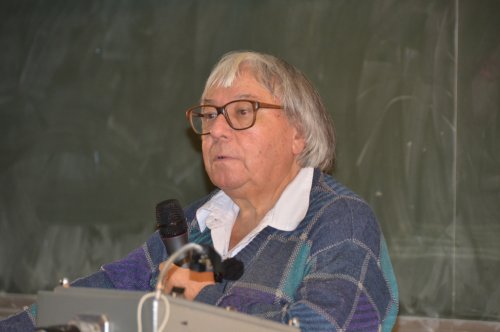
Michel Combes 1939-2017

Michel CombesA Tribute to Michel Combes

Michel Combes passed away on March 9, following a week of hospitalization. As a former Director of the Paris Observatory DESPA Laboratory (which later became LESIA) and a former President of Paris Observatory, Michel has played a major role in the life of the laboratory, the Observatory, and, beyond, in the development of planetology and of astronomical instrumentation in France and internationally.

As a former student of the Institut d’Optique in Paris, Michel entered the Observatory in the early 1960s. In 1969, Michel was a major actor in the establishment of a planetology group at the Observatory, first hosted within the Department of Solar Physics and later within the Space Research Department (DESPA).

Mainly interested in optics, Michel was convinced that new projects in astronomy require instrumental innovation.  In 1973, he led a campaign in South Africa to observe the occultation of the star Beta Scorpio by Jupiter. This successful experiment made possible the retrieval of the thermal structure in the stratosphere of Jupiter. In parallel, Michel worked on the development of a Fourier Transform spectrometer operating in the thermal infrared, devoted to the spectral analysis of Jupiter. This instrument was flown on the Kuiper Airborne Observatory in 1973, and has been mounted several times on large ground-based telescopes.

In the 1980s, with Tobias Owen in the US and Vassili Moroz in Moscow, and in partnership with other laboratories, Michel developed the concept of a new instrument for analyzing the near-infrared emission of comets. This successful experiment, launched on the Soviet probes Vega 1 and Vega 2, has led to the first measurement of the temperature of a cometary nucleus, and the detection of several parent molecules outgassed from the nucleus.

In the mid-1980s, Michel became the Director of DESPA, and drove the laboratory toward participation in the ISOCAM camera of the Infrared Space Observatory (ISO) of ESA. In parallel, the planetology group got involved in space projects of planetary infrared sounding. This was the beginning of a series of infrared imaging spectrometers, conceived and developed at DESPA in partnership with Institut d’Astrophysique Spatiale in Orsay and several international laboratories. The first ones were devoted to the exploration of Mars, with ISM/PHOBOS and OMEGA/Mars-96 in partnership with Russia. These instruments inspired the imaging spectrometers of Cassini/Huygens, Rosetta and Venus Express.  

In 1991, Michel became the President of Paris Observatory. This duty allowed him to express all his human and international relationship qualities, based on his excellent knowledge of men and institutions.  As a President, Michel initiated a re-organization of the scientific departments of the Observatory.  This was the first step of a global restructuration of the scientific departments, which was completed later in the early 2000. In the meantime, Michel continued to follow the development of infrared space projects at DESPA, in particular in the domain of stellar photometry and planetology. After the failure of the Mars-96 spacecraft just after launch, both experiments were rebuilt and used in other contexts, the French CoRoT mission and, under IAS’ PIship, the OMEGA instrument aboard Mars Express. Later, in collaboration with other international partners, the VIRTIS-H instrument was flown on two other European missions, Rosetta and Venus Express. He was also strongly involved in the NASA-ESA Cassini/Huygens mission through participation as co-investigator in DISR/Huygens and team member on VIMS/Cassini until recently.

In 1999, after two mandates, Michel came back to DESPA, which later transformed into LESIA, and became involved in teaching activities regarding optics, and in the development of instrumental concepts. He also became more and more involved in outreach activities within the Service of Communication of the Observatory, as well as within the team working on History of Sciences.

Thanks to his strong personality, his acute sense of politics, his engagement toward society, his sense of organization and dialog, Michel Combes has played a major role in the field of planetology but also at the level of the Observatory and beyond. Michel was a leader with a strong sense of responsibility, respectful of his international collaborators. He had a very strong capability for bringing teams together – scientists, engineers, technicians, administrative employees – and to make them work together towards a common objective. He will be deeply missed by his friends and colleagues. 

Therese Encrenaz and Pierre Drossart


Message From The FRS Chair: Revised And Corrected Action Alert

Please see this updated Action Alert and text for your letters to Congress. The FRS Chair apologizes for using an older version of the text while reacting to the news of the day.

Action alert!

This week we are asking each AAS/DPS member to write letters and make phone calls to your representatives in order to advocate for planetary science.

Why now?

•    The President’s fully detailed Budget Request for Fiscal Year 2018 is planned for release in mid-May, and initial guidelines indicate that dramatic cuts in discretionary, non-defense areas such as science are in store across the government.

•    The President’s just released “skinny budget” for FY18 generously increases Planetary Science to $1.9B, while NASA’s top line would be cut by 0.8%.  NASA fares better in this budget than almost every other agency not related to national security and veterans.  A top line number for the Science Mission Directorate is not given, and neither are totals for the Astrophysics and Heliophysics divisions, but a cut for Earth Science is specified. The National Science Foundation (NSF) is not shown as separate a line item, but it is potentially facing a 10% cut if one assumes an across-the-board cut for all the agencies in the budget line into which NSF has been aggregated.

•    The House and Senate still haven’t passed a full year FY17 science appropriations bill and we want them to know where we stand on targets for FY18. The current continuing resolution funds the government through April 28.  

•    With numerous other policy issues dominating the political landscape, we are trying to remain above the noise and leverage the attention of Congressional staff who favor planetary science funding. Recall that the President proposes, but Congress disposes.

•    Science advocacy is broadly important for us to all engage in, now more than ever, and responding to this action alert provides a focused, proven-effective means to have your concerns heard by decision makers.


Why should you participate?

•    Constituents matter to Members of Congress! Letters and especially calls from constituents force staffers to sit up and take notice of an issue. If a number of letters and calls come in at once from constituents, it has an even greater impact.

•    Even if your elected official is not on one of the following committees: House Committee on Science, Space, & Technology, House Committee on Appropriations, Senate Committee on Commerce, Science, & Transportation, they still vote on bills and have influence with their colleagues. Often it is the congressional Member without a NASA center or other large vested interest in their district who needs the most education and convincing on space-related topics.

•    We have had success in garnering Congressional support for planetary science, and we need to maintain and build on that momentum.

It is important to get as many people to contact as many Members of Congress as possible, so please participate! We encourage you to use social media to promote this call to action to help amplify the message and encourage others to act (use Twitter hashtag #FundPlanetary).  Here’s what we’re asking you to do this week:

Letters

•    The letter template below provides a clear, disciplined message that is consistent with the messages DPS has been pushing in our overall advocacy campaign.

•    Do customize your communications! In particular, stories about your own scientific work, the interactions with your students, and public outreach are compelling to Congressional offices. Keep it short and concise.  Tailor one or more paragraphs in the template.

•    You will likely need to submit your letter through a form on your Members of Congress’s websites. And most members of Congress communicate through social media, so use those channels as well!


Phone calls

•    After you have sent the emails, call each of the Congressional offices. Be polite and nice! The people who answer the phones work hard and tend to suffer a lot of abuse from angry constituents; when you’re nice, you get more carefully listened to. You can ask to speak to the staffer who handles science and space issues; in most cases, they will connect you and you can speak directly to that staffer or leave a voicemail.

•                      Hello, my name is ________, and I am a constituent from _________. I am also a planetary scientist working at _______________. I’m calling to ask Representative/Senator _____________ to support planetary science and solar system exploration programs. Congress has consistently supported planetary science in recent years, and I hope the field can rely on its continued support. I have sent a more detailed letter to your boss using your website; I hope your office has time read it. Thank you very much.

•    Once you realize how painless this ~5 min process was, plan to call back and firm up your connection the following week.  Or better yet, call weekly for each of the next 5 weeks to elaborate more on each of your favorite 5 topics listed in the letter. 


How do you know who to write to and call?

To find out who your Members of Congress are and get their phone numbers and websites, the AAS website has helpful search tool.

An important final note: Be certain you understand your employer’s rules about such action. Federal employees, for example, must not conduct such activities using federal resources, i.e. you must participate using your personal time/email/phone number/electronic devices. No matter where you work, your Constitutional rights to petition your government are always valid; you can always participate in advocacy like this, but you may need to be careful about doing it on your own time and resources.

Thank you – we’re looking forward to a strong response to this call to action!


Dear [Representative/Senator] [Last name],

I am a constituent from [town where you live] and a planetary scientist working at [your institution]. I write to you to ask for your support in maintaining a healthy program of U.S. solar system exploration as you and your colleagues look ahead to the Fiscal Year 2018 budget. I am asking that you support an FY18 budget level of $1.9B for NASA’s Planetary Science Division – the same as the President has just requested – in order to accomplish the goals set out in the National Research Council’s 2013 Vision and Voyages Decadal Survey. I am also requesting a commensurate increase for the entire NASA Science Mission Directorate so that the increase for planetary science does not come at the expense of the important goals set out by the decadal surveys for the astrophysics, heliophysics, and earth science divisions. I am also concerned about potential cuts to the National Science Foundation (NSF) in the President’s budget since the recent “skinny budget” lumped NSF into an “other agency” line with a 10% cut. NSF supports critical research grants in the planetary sciences so I request that Congress appropriate at least $8B for NSF in Fiscal Year 2018. You may have seen some of the milestones and scientific advances that have been made by this highly successful government office in this area in recent months: [Choose which highlights you want to use, remove the others, and/or add your own]

•    NASA’s Juno mission recently started its primary science mission in orbit about the planet Jupiter. Over the next couple of years, Juno is poised to shed light on the origin of the planets in our Solar System.

•    All of New Horizons’ Pluto observations have now been downlinked to Earth, and new discoveries continue to flow while it travels on to Kuiper Belt target (486958) 2014 MU69.

•    Observations from NSF’s Very Large Array have provided an unprecedented look at a previously unexplored region of Jupiter’s atmosphere and revealed new information about Jupiter’s atmospheric dynamics.

•    The OSIRIS-REx spacecraft successfully launched from Cape Canaveral last September to begin its journey to a nearby asteroid. There it will collect a sample of this cosmic building block and return it for study here on the Earth.

•    NSF’s Large Synoptic Survey Telescope will survey the entire visible sky every few nights, which could catalog millions of asteroids and thousands of near-Earth objects. 

•    NASA’s Cassini spacecraft convincingly determined that Enceladus, an icy moon of Saturn, contains a global ocean of liquid water beneath its surface. Like Europa, this may be an ideal place to search for life.

•    NASA’s Kepler and Spitzer missions have detected and characterized nearly 5,000 exoplanets, including seven Earth-sized worlds in the TRAPPIST-1 system. These detections have revolutionized our understanding of planetary formation and the prevalence of habitable worlds.

•    The Dawn mission has been orbiting and studying the dwarf planet Ceres, where it revealed vast deposits of carbonate salts, the solid residue from evaporation of salt-saturated water, indicative of recent geologic activity.

•    When the James Webb Space Telescope is launched in 2018, planetary scientists will have a new, powerful tool for observing solar system targets.

•    Recent orbital observations at Mars have revealed a possible source of liquid water near the Curiosity rover. NASA is now investigating the feasibility of using Curiosity to study flowing water on Mars for the first time.

Events like these reaffirm America’s pioneering role in planetary science and exploration. Furthermore, they capture the imagination of the public and inspire the next generation of scientists, engineers, and technologists. Vital partnerships between NASA and private industry ensure that we make full use of the latest technological innovations and advance scientific discoveries.

[Discussion of your scientific work, work with students, impact in your district/state]

We strive to maintain America’s leadership role in planetary science and exploration and NASA’s and NSF’s ability to support a vibrant science community. In general, Congress has consistently supported planetary science, and I want to thank you and your colleagues for that support. I hope you will continue that support by enacting a Fiscal Year 2018 budget in regular order for the NASA Planetary Science Division at a level of $1.9B – the same as the President has just requested. This level of support will help ensure that we can meet the goals laid out in the National Research Council’s Decadal Survey report for Planetary Science. This includes the report’s recommendation that the Planetary Science Division maintain a balanced program of large, medium, and small missions across the solar system, research and analysis, and technology development. A commensurate increase to NASA’s Science Mission Directorate budget for Fiscal year 2018 will further strengthen a well-balanced program across the disciplines. And at least $8B for the National Science Foundation will help ensure our nation’s scientific leadership while supporting critical planetary science research grants and facilities.

Sincerely,

[Your name]

[Town, State]


16 March 2017

Newsletter 17-14

Issue 17-14, March 17, 2017


+————————————CONTENTS—————————————-+

  1. MESSAGE FROM THE FRS CHAIR: REVISED AND CORRECTED ACTION ALERT

+——————————————————————————————–+


1———1———1———1———1———1———1———1———1———1

MESSAGE FROM THE FRS CHAIR: REVISED AND CORRECTED ACTION ALERT

Please see this updated Action Alert and text for your letters to Congress (also posted at public-policy/action-alerts). The FRS Chair apologizes for using an older version of the text while reacting to the news of the day.

Action alert!

This week we are asking each AAS/DPS member to write letters and make phone calls to your representatives in order to advocate for planetary science.

Why now?

•    The President’s fully detailed Budget Request for Fiscal Year 2018 is planned for release in mid-May, and initial guidelines indicate that dramatic cuts in discretionary, non-defense areas such as science are in store across the government.

•    The President’s just released “skinny budget” for FY18 generously increases Planetary Science to $1.9B, while NASA’s top line would be cut by 0.8%.  NASA fares better in this budget than almost every other agency not related to national security and veterans.  A top line number for the Science Mission Directorate is not given, and neither are totals for the Astrophysics and Heliophysics divisions, but a cut for Earth Science is specified. The National Science Foundation (NSF) is not shown as separate a line item, but it is potentially facing a 10% cut if one assumes an across-the-board cut for all the agencies in the budget line into which NSF has been aggregated.

•    The House and Senate still haven’t passed a full year FY17 science appropriations bill and we want them to know where we stand on targets for FY18. The current continuing resolution funds the government through April 28.  

•    With numerous other policy issues dominating the political landscape, we are trying to remain above the noise and leverage the attention of Congressional staff who favor planetary science funding. Recall that the President proposes, but Congress disposes.

•    Science advocacy is broadly important for us to all engage in, now more than ever, and responding to this action alert provides a focused, proven-effective means to have your concerns heard by decision makers.


Why should you participate?

•    Constituents matter to Members of Congress! Letters and especially calls from constituents force staffers to sit up and take notice of an issue. If a number of letters and calls come in at once from constituents, it has an even greater impact.

•    Even if your elected official is not on one of the following committees: https://science.house.gov/subcommittees/subcommittee-space-115th-congresshttp://appropriations.house.gov/about/members/commercejusticescience.htmhttps://www.commerce.senate.gov/public/index.cfm/scienceandspace, they still vote on bills and have influence with their colleagues. Often it is the congressional Member without a NASA center or other large vested interest in their district who needs the most education and convincing on space-related topics.

•    We have had success in garnering Congressional support for planetary science, and we need to maintain and build on that momentum.

It is important to get as many people to contact as many Members of Congress as possible, so please participate! We encourage you to use social media to promote this call to action to help amplify the message and encourage others to act (use Twitter hashtag #FundPlanetary).  Here’s what we’re asking you to do this week:

Letters

•    The letter template below provides a clear, disciplined message that is consistent with the messages DPS has been pushing in our overall advocacy campaign.

•    Do customize your communications! In particular, stories about your own scientific work, the interactions with your students, and public outreach are compelling to Congressional offices. Keep it short and concise.  Tailor one or more paragraphs in the template.

•    You will likely need to submit your letter through a form on your Members of Congress’s websites. And most members of Congress communicate through social media, so use those channels as well!


Phone calls

•    After you have sent the emails, call each of the Congressional offices. Be polite and nice! The people who answer the phones work hard and tend to suffer a lot of abuse from angry constituents; when you’re nice, you get more carefully listened to. You can ask to speak to the staffer who handles science and space issues; in most cases, they will connect you and you can speak directly to that staffer or leave a voicemail.

•                      Hello, my name is ________, and I am a constituent from _________. I am also a planetary scientist working at _______________. I’m calling to ask Representative/Senator _____________ to support planetary science and solar system exploration programs. Congress has consistently supported planetary science in recent years, and I hope the field can rely on its continued support. I have sent a more detailed letter to your boss using your website; I hope your office has time read it. Thank you very much.

•    Once you realize how painless this ~5 min process was, plan to call back and firm up your connection the following week.  Or better yet, call weekly for each of the next 5 weeks to elaborate more on each of your favorite 5 topics listed in the letter. 


How do you know who to write to and call?

•    To find out who your Members of Congress are and get their phone numbers and websites, the AAS website has helpful search tool.

•                      http://aas.org/resources/contacting-congress

An important final note: Be certain you understand your employer’s rules about such action. Federal employees, for example, must not conduct such activities using federal resources, i.e. you must participate using your personal time/email/phone number/electronic devices. No matter where you work, your Constitutional rights to petition your government are always valid; you can always participate in advocacy like this, but you may need to be careful about doing it on your own time and resources.

Thank you – we’re looking forward to a strong response to this call to action!


Dear [Representative/Senator] [Last name],

I am a constituent from [town where you live] and a planetary scientist working at [your institution]. I write to you to ask for your support in maintaining a healthy program of U.S. solar system exploration as you and your colleagues look ahead to the Fiscal Year 2018 budget. I am asking that you support an FY18 budget level of $1.9B for NASA’s Planetary Science Division – the same as the President has just requested – in order to accomplish the goals set out in the National Research Council’s 2013 Vision and Voyages Decadal Survey. I am also requesting a commensurate increase for the entire NASA Science Mission Directorate so that the increase for planetary science does not come at the expense of the important goals set out by the decadal surveys for the astrophysics, heliophysics, and earth science divisions. I am also concerned about potential cuts to the National Science Foundation (NSF) in the President’s budget since the recent “skinny budget” lumped NSF into an “other agency” line with a 10% cut. NSF supports critical research grants in the planetary sciences so I request that Congress appropriate at least $8B for NSF in Fiscal Year 2018. You may have seen some of the milestones and scientific advances that have been made by this highly successful government office in this area in recent months: [Choose which highlights you want to use, remove the others, and/or add your own]

•    NASA’s Juno mission recently started its primary science mission in orbit about the planet Jupiter. Over the next couple of years, Juno is poised to shed light on the origin of the planets in our Solar System.

•    All of New Horizons’ Pluto observations have now been downlinked to Earth, and new discoveries continue to flow while it travels on to Kuiper Belt target (486958) 2014 MU69.

•    Observations from NSF’s Very Large Array have provided an unprecedented look at a previously unexplored region of Jupiter’s atmosphere and revealed new information about Jupiter’s atmospheric dynamics.

•    The OSIRIS-REx spacecraft successfully launched from Cape Canaveral last September to begin its journey to a nearby asteroid. There it will collect a sample of this cosmic building block and return it for study here on the Earth.

•    NSF’s Large Synoptic Survey Telescope will survey the entire visible sky every few nights, which could catalog millions of asteroids and thousands of near-Earth objects. 

•    NASA’s Cassini spacecraft convincingly determined that Enceladus, an icy moon of Saturn, contains a global ocean of liquid water beneath its surface. Like Europa, this may be an ideal place to search for life.

•    NASA’s Kepler and Spitzer missions have detected and characterized nearly 5,000 exoplanets, including seven Earth-sized worlds in the TRAPPIST-1 system. These detections have revolutionized our understanding of planetary formation and the prevalence of habitable worlds.

•    The Dawn mission has been orbiting and studying the dwarf planet Ceres, where it revealed vast deposits of carbonate salts, the solid residue from evaporation of salt-saturated water, indicative of recent geologic activity.

•    When the James Webb Space Telescope is launched in 2018, planetary scientists will have a new, powerful tool for observing solar system targets.

•    Recent orbital observations at Mars have revealed a possible source of liquid water near the Curiosity rover. NASA is now investigating the feasibility of using Curiosity to study flowing water on Mars for the first time.

Events like these reaffirm America’s pioneering role in planetary science and exploration. Furthermore, they capture the imagination of the public and inspire the next generation of scientists, engineers, and technologists. Vital partnerships between NASA and private industry ensure that we make full use of the latest technological innovations and advance scientific discoveries.

[Discussion of your scientific work, work with students, impact in your district/state]

We strive to maintain America’s leadership role in planetary science and exploration and NASA’s and NSF’s ability to support a vibrant science community. In general, Congress has consistently supported planetary science, and I want to thank you and your colleagues for that support. I hope you will continue that support by enacting a Fiscal Year 2018 budget in regular order for the NASA Planetary Science Division at a level of $1.9B – the same as the President has just requested. This level of support will help ensure that we can meet the goals laid out in the National Research Council’s Decadal Survey report for Planetary Science. This includes the report’s recommendation that the Planetary Science Division maintain a balanced program of large, medium, and small missions across the solar system, research and analysis, and technology development. A commensurate increase to NASA’s Science Mission Directorate budget for Fiscal year 2018 will further strengthen a well-balanced program across the disciplines. And at least $8B for the National Science Foundation will help ensure our nation’s scientific leadership while supporting critical planetary science research grants and facilities.

Sincerely,

[Your name]

[Town, State]

END OF LETTER TEMPLATE ************************************

———————————+

Send submissions to:

Anne Verbiscer, DPS Secretary ([email protected]


To unsubscribe visit http://aas.org/unsubscribe or email [email protected].

To change your address email [email protected]

Message From The Chair: The March For Science, The AAS/DPS And You

The importance of science to the advancement of humanity is clear to our DPS membership, yet its ability to inform governmental policy appears to be imperiled. The AAS will support our members who plan to participate in the March for Science on April 22, as described in this detailed post by AAS Executive Officer Kevin Marvel. 

Core principles of the march as presently defined are: science that serves the common good; cutting-edge science education; open and honest science communication and inclusive public outreach; evidence-based policy and regulations in the public interest; and funding for scientific research and its applications. Related goals for the march are to: humanize science; partner with the public; advocate for open, inclusive, and accessible science; support scientists; and affirm science as a democratic value.

The AAS office at 1667 K Street NW (very near the White House) will open its doors on the morning of the march and serve refreshments. Our leadership participates in weekly information-sharing phone calls (but, as for AGU and other science organizations, does not control the messaging). We will provide logistical support and report any late breaking developments. Additional assistance provided by the AAS includes web tools for a roommate and housing search and/or carpool search. For more information or questions feel free to contact the DPS FRS Chair or the AAS policy experts listed on Marvel’s website post. If you are actively involved in the organization of a local march please let us know.

Lucy McFadden and Kurt Retherford
DPS Chair and FRS Chair

Newsletter 17-12

Issue 17-12, March 11, 2017


+————————————CONTENTS—————————————-+

  1. MESSAGE FROM THE CHAIR: THE MARCH FOR SCIENCE, THE AAS/DPS AND YOU
  2. RELEASE OF OSIRIS-REX PARTICIPATING SCIENTIST PROGRAM ELEMENT DRAFT TEXT FOR COMMUNITY COMMENT
  3. ALMA CALL FOR STUDY PROPOSALS
  4. ASTROPHYSICS DATA ANALYSIS PROGRAM LETTERS OF INTENT DUE
  5. UPCOMING WORKSHOPS AND MEETINGS
  6. JOBS, POSITIONS, OPPORTUNITIES

+——————————————————————————————–+


1———1———1———1———1———1———1———1———1———1

MESSAGE FROM THE CHAIR: THE MARCH FOR SCIENCE, THE AAS/DPS, AND YOU


The importance of science to the advancement of humanity is clear to our 

DPS membership, yet its ability to inform governmental policy appears to 

be imperiled.  The AAS will support our members who plan to participate 

in the March for Science on April 22 (www.marchforscience.com), as 

described in this detailed post by AAS Executive Officer Kevin Marvel:   

https://aas.org/posts/news/2017/02/march-science-aas-and-you


Core principles of the march as presently defined are: science that serves 

the common good; cutting-edge science education; open and honest science 

communication and inclusive public outreach; evidence-based policy and 

regulations in the public interest; and funding for scientific research and its 

applications.  Related goals for the march are to: humanize science; partner

with the public; advocate for open, inclusive, and accessible science; support

scientists; and affirm science as a democratic value.


The AAS office at 1667 K Street NW (very near the White House) will open 

its doors on the morning of the march and serve refreshments.  Our leadership 

participates in weekly information-sharing phone calls (but, as for AGU and 

other science organizations, does not control the messaging).  We will provide 

logistical support and report any late breaking developments.  Additional

assistance provided by the AAS includes web tools for a roommate and housing 

search and/or carpool search.  For more information or questions feel free to 

contact the DPS FRS Chair at [email protected] or the AAS policy 

experts listed on Marvel’s website post.  If you are actively involved in the 

organization of a local march please let us know ([email protected],

[email protected]).


Lucy McFadden and Kurt Retherford

DPS Chair and FRS Chair


2———2———2———2———2———2———2———2———2———2

RELEASE OF OSIRIS-REX PARTICIPATING SCIENTIST PROGRAM 

ELEMENT DRAFT TEXT FOR COMMUNITY COMMENT


The objective of the OSIRIS-REx Participating Scientist Program (OREx-PSP) 

is to enhance the scientific return during the asteroid-operational phase of the

OSIRIS-REx mission by expanding participation in the mission through new

investigations that broaden and/or complement existing principal investigator

(PI) and co-investigator (Co-I)-led investigations.


This amendment releases a draft version of C.22, the OSIRIS-REx participating

scientist program element for community comment. Questions and comments 

on this draft program element should be directed to Jeffrey Grossman at 

[email protected] and Christina Richey at [email protected] by

March 16, 2017.


On or about March 2, 2017, this Amendment to the NASA Research 

Announcement “Research Opportunities in Space and Earth Sciences 

(ROSES) 2017″ (NNH17ZDA001N) will be posted on the NASA research 

opportunity homepage at: http://nspires.nasaprs.com/ and will appear on the 

RSS feed at:

https://science.nasa.gov/researchers/sara/grant-solicitations/roses-2017/


3———3———3———3———3———3———3———3———3———3

ALMA CALL FOR STUDY PROPOSALS


The National Radio Astronomy Observatory and the National Science

Foundation  are pleased to announce a Call for Study Proposals for the

North American  ALMA Cycle 5 Development program:        
https://go.nrao.edu/ALMA_Cycle5_Development 


This Call is open to the community of scientists from North American

ALMA partner countries. The primary objectives of the Cycle 5 Development

Program Studies are to:

(a) enable groups in North America to propose ALMA upgrade studies

that may later be implemented via the ALMA Development Plan;

(b) support the development of conceptual and detailed designs for ALMA

upgrades; and

(c) encourage relevant long-term research and development in areas

important for ALMA.


Two categories of proposals are being sought via this Call:

(a) General Studies (funded for 1 year and up to $200,000 USD per award); and

(b) Strategic Studies (funded for 2 years and up to $400,000 USD per award). 


Strategic Studies is a new ALMA Development proposal category intended

to support in-depth studies aligned with the development priorities identified

by the ALMA Science Advisory Committee in the ‘A Roadmap for

Developing ALMA’ document: https://go.nrao.edu/Roadmap_for_ALMA


The proposal submission deadline for this Call for Studies is 1 May 2017

at 23:59 EDT. Prospective Principal Investigators are encouraged, but not

required, to submit Notices of Intent by 20 March 2017.  Questions should

be directed to [email protected]


4———4———4———4———4———4———4———4———4———4

ASTROPHYSICS DATA ANALYSIS PROGRAM LETTERS OF INTENT DUE


The deadline for ROSES ADAP 2017 letters of intent is March 28, 2017.

Scientists with approved Priority 1 GO observations involving < 200 hours

of Spitzer time are eligible to propose for data analysis support under ADAP

2017. The solicitation also includes archival funding opportunities. Spitzer

investigators with observations in our solar system that are not eligible for

support through ADAP should consult the Solar System Observations 2017

(SSO17) solicitation in the ROSES-2017. The deadline for SSO17 Step 1

proposals is April 6, 2017.  Please see

http://ssc.spitzer.caltech.edu/warmmission/propkit/ar/  for more information

on these funding opportunities.


Spitzer Science User Support


5———5———5———5———5———5———5———5———5———5

UPCOMING WORKSHOPS AND MEETINGS


A) SPRING 2017 GBT OBSERVER TRAINING WORKSHOP

     May 15-17, 2017, Green Bank Observatory


Registration is now open for the May 2017 Green Bank Telescope (GBT)

Observer Training Workshop


The workshop will povide the essential skills and knowledge needed to use

the GBT and maximize its scientific output. In addition, after completing the 

workshop, an attendee will be certified to use the GBT as a remote observer.

The workshop will consist of classroom lectures that provide background on

observing techniques with the GBT and single dish radio telescopes more 

generally, as well as hands-on use of the GBT under the guidance of observatory

staff. Topics to be covered include radio telescope fundamentals, observing

and calibration techniques, the impact of weather, the GBT observing procedures

and software, data reduction, telescope scheduling, and remote observing.


For more information and to register, please visit the Observer Training 

Workshop page: http://greenbankobservatory.org/science/observer-training-workshops/


B) RADIO EXPLORATION OF PLANETARY HABITABILITY

     AAS TOPICAL CONFERENCE SERIES 5 (AASTCS 5)

     7-12 May 2017

     Palm Springs, California


Abstract Deadline 15 March 2017 9:00pm EDT

Travel Grant Application Deadline 17 March 2017


https://aas.org/meetings/aastcs/radiohab


Radio astronomy provides means that allow the most direct investigation of 

the processes driving stellar activity. It also offers the best chance to detect 

and characterize exoplanetary magnetic fields over a wide range of planet 

masses and ages. The idea of this meeting has grown out of the need to better 

understand star-planet interaction and its impact on habitability of planetary 

companions, especially those in close orbits around low-mass stars. The 

meeting will address a wide range of the related topics, broadly divided into 

the following three categories: (i) stellar activity and planetary habitability, 

(ii) detection of planets and planetary magnetic fields, and (iii) the relevant 

theoretical considerations, emphasizing a potential impact of radio astronomy, 

especially the existing and the planned, large radio telescopes, in this area 

of research.


6———6———6———6———6———6———6———6———6———6

JOBS, POSITIONS, OPPORTUNITIES

A) POSTDOCTORAL RESEARCH FELLOW

     University of Michigan

     Ann Arbor, Michigan


The University of Michigan astrophysics group invites applications for a 

postdoctoral research fellow in observational Solar System astronomy, 

under the supervision of Profs. David Gerdes and Fred Adams. The 

successful candidate will help lead our ongoing efforts to search for, 

discover, and characterize new objects in the trans-Neptunian Solar 

System (including the hypothesized Planet 9) using data collected by 

the Dark Energy Survey and related projects in which we are participants.


The University of Michigan is one of the world’s leading public research 

universities. Astrophysics research areas include, in addition to Solar 

System science, observational and theoretical cosmology, CMB studies, 

star and planet formation, gravitational waves, and direct dark matter 

searches. The Michigan Astronomy Department has shared time on the 

Magellan, MDM, and NOEMA telescope facilities. 


We seek an outstanding and motivated scientist with leadership potential,

a strong research background in optical astronomy and analysis of large 

data sets, as well as an ability to interpret data in the context of dynamical 

models of Solar System evolution. The candidate will be encouraged to 

mentor graduate and undergraduate students.


Candidates should have a Ph.D. in physics, astrophysics, or astronomy. 

This NASA-funded position is for an initial period of one year beginning 

in summer or fall 2017, with expectation of renewal for up to two additional 

years contingent upon satisfactory performance and continued funding. 

To apply, please send a single pdf containing a research statement and 

curriculum vitae to Ms. Beth Demkowski, [email protected].

Candidates should also arrange to have three letters of reference sent to 

the same address. 


Review of applications will begin on April 15, 2017 and will continue 

until the position is filled. The University of Michigan is an equal 

opportunity/affirmative action employer.


———————————+

Send submissions to:

Anne Verbiscer, DPS Secretary ([email protected]


To unsubscribe visit http://aas.org/unsubscribe or email [email protected].

To change your address email [email protected]

Newsletter 17-11

Issue 17-11, March 8, 2017


+————————————CONTENTS—————————————-+

  1. IN MEMORIAM: TOBIAS C. OWEN (1936-2017)

+——————————————————————————————–+


1———1———1———1———1———1———1———1———1———1

IN MEMIORIAM: TOBIAS C. OWEN (1936-2017)


Tobias (Toby) C. Owen died on March 4, 2017.  With his passing, science has 

lost a great talent, a valued colleague, and to many in the US and abroad, a close 

friend.  A former student of G. P. Kuiper, Toby’s earliest work was in spectroscopy 

of the giant planets, and this interest quickly broadened to encompass all aspects 

of the origin and evolution of planetary atmospheres.  With a special interest in 

isotopic abundances, he pursued and promoted a wide range of observational and 

theoretical investigations toward understanding the origins of all the planets and 

small bodies of the Solar System.  As one of the world’s leading planetary scientists, 

he was an active participant in a great number of missions, including Apollo 15 and 16, 

Viking, Voyager, Galileo, Rosetta, Juno, and Cassini-Huygens.  He played a leading 

role in the development of the Cassini-Huygens mission as a joint project of NASA 

and ESA, and was called upon frequently to promote this and other missions to 

funding agencies in Europe as well as to NASA.  Toby had close ties with European 

colleagues, notably in France where he inspired a vigorous planetary group at the 

Paris Observatory, and also promoted collaboration with planetary scientists in the 

USSR/Russia and in other countries.  The DPS as a division of the AAS began with 

the initiative of Frank Drake, Carl Sagan, and Toby, acting on a suggestion of Juan 

Oro and with the support of several planetary specialists at Kitt Peak National 

Observatory.  In 1968, Toby and Carl forged the relationship with the AAS that 

persists to the present time.  The full story can be found on the DPS website at:


history/chamberlain_cruikshank_1999

Toby was a professor at SUNY Stony Brook for many years, and then at the 

University of Hawaii, where he was affiliated until his passing.  He will be 

remembered as a man of the world, unfailingly generous and modest, and a 

great scientist.  He inspired all of his many colleagues with his enthusiasm for 

all aspects of planetary science, including the big questions of the origin of the 

Solar System and of life in the Universe.  Toby received a number of honors in 

the US and in Europe, and in 2009, he was awarded the Gerard P. Kuiper Prize 

of the DPS.


Dale Cruikshank

DPS Historian


———————————+

Send submissions to:

Anne Verbiscer, DPS Secretary ([email protected]


To unsubscribe visit http://aas.org/unsubscribe or email [email protected].

To change your address email [email protected]

Tobias C. Owen 1936-2017

Tobias (Toby) C Owen died on March 4, 2017.  With his passing, science has lost a great talent, a valued colleague, and to many in the US and abroad, a close friend. A former student of G. P. Kuiper, Toby’s earliest work was in spectroscopy of the giant planets, and this interest quickly broadened to encompass all aspects of the origin and evolution of planetary atmospheres. With a special interest in isotopic abundances, he pursued and promoted a wide range of observational and theoretical investigations toward understanding the origins of all the planets and small bodies of the Solar System. As one of the world’s leading planetary scientists, he was an active participant in a great number of missions, including Apollo 15 and 16, Viking, Voyager, Galileo, Rosetta, Juno, and Cassini-Huygens. He played a leading role in the development of the Cassini-Huygens mission as a joint project of NASA and ESA, and was called upon frequently to promote this and other missions to funding agencies in Europe as well as to NASA. Toby had close ties with European colleagues, notably in France where he inspired a vigorous planetary group at the Paris Observatory, and also promoted collaboration with planetary scientists in the USSR/Russia and in other countries. The DPS as a division of the AAS began with the initiative of Frank Drake, Carl Sagan, and Toby, acting on a suggestion of Juan Oro and with the support of several planetary specialists at Kitt Peak National Observatory. In 1968, Toby and Carl forged the relationship with the AAS that persists to the present time. The full story can be found on the DPS website.

Toby was a professor at SUNY Stony Brook for many years, and then at the University of Hawaii, where he was affiliated until his passing. He will be remembered as a man of the world, unfailingly generous and modest, and a great scientist. He inspired all of his many colleagues with his enthusiasm for all aspects of planetary science, including the big questions of the origin of the Solar System and of life in the Universe. Toby received a number of honors in the US and in Europe, and in 2009, he was awarded the Gerard P. Kuiper Prize of the DPS.

Dale Cruikshank
DPS Historian

Newsletter 17-10

Issue 17-10, March 5, 2017


+————————————CONTENTS—————————————-+

  1. MESSAGE FROM THE CHAIR: CALL FOR 2017 DPS PRIZE NOMINATIONS
  2. NOMINATIONS FOR NASA PLANETARY SCIENCE ADVISORY COMMITTEE (PAC) DUE MARCH 31, 2017
  3. APPLICATIONS BEING ACCEPTED FOR THE 2017 JOHN N. BAHCALL PUBLIC POLICY FELLOWSHIP
  4. 2017B NASA IRTF CALL FOR PROPOSALS
  5. ROADMAPS TO OCEAN WORLDS (ROW) TOWNHALL AT LPSC
  6. SUMMER SCHOOL “IMPACTS AND THEIR ROLE IN THE EVOLUTION OF LIFE”
  7. UPCOMING WORKSHOPS AND MEETINGS
  8. JOBS, POSITIONS, OPPORTUNITIES

+——————————————————————————————–+


1———1———1———1———1———1———1———1———1———1

MESSAGE FROM THE CHAIR: CALL FOR 2017 DPS PRIZE NOMINATIONS


Every year the DPS recognizes exceptional achievements in our field and 

nominations for this year’s prizes will be accepted until April 1, 2017. 

Detailed descriptions of each of the prizes and the criteria for nominees for 

each can be found at prizes. The nomination form and 

instructions can also be retrieved from prizes/nomination-form.

Please contact [email protected] or the prize subcommittee ([email protected])

with questions.  Being recognized by our colleagues for exceptional work is a 

great honor and inspires outstanding scientific research. Please take the time 

to recognize your colleagues for their exceptional work.


Anyone except current DPS Committee members may submit a nomination. 

A completed nomination will be retained and considered by the Prize Subcommittee 

for three years, or as long as the nominee is eligible, whichever is less. Past nominees 

may be re-nominated after the expiration of a prior nomination. For specific details, 

see the URL noted above.


Lucy McFadden

DPS Chair


2———2———2———2———2———2———2———2———2———2

NOMINATIONS FOR NASA PLANETARY SCIENCE ADVISORY COMMITTEE

(PAC) DUE MARCH 31, 2017


Dear Colleagues:


NASA’s Planetary Science Division (PSD) is announcing the establishment 

of the Planetary Science Advisory Committee (PAC), a new committee 

replacing the Planetary Science Subcommittee (PSS) of the NASA Advisory

Council, Science Committee (NAC SC). The PAC has been constituted under

the Federal Advisory Committee Act (FACA) and will advise the Planetary 

Science Division of the NASA Science Mission Directorate (SMD).  On 

December 2, 2016, NASA provided notice of their establishment via Federal 

Register Notice 16-083. 


The Planetary Science Advisory Committee (PAC) 

(https://science.nasa.gov/nac/science-advisory-committees/pac ) supports 

the advisory needs of the Planetary Science Division (PSD), the Science 

Mission Directorate (SMD) and other mission directorates as required, and 

NASA Administrator.  The scope of the PAC includes all aspects of NASA’s 

planetary science program,. In addition to scientific research, the scope also 

encompasses considerations of the development of near-term enabling 

technologies, systems, and computing and information management 

capabilities, as well as developments with the potential to provide long-term 

improvements in future mission operational systems.  Responsibility for 

biological planetary protection is outside the purview of the PAC.


NASA’s PSD is extending the invitation for nominations for service on the 

PAC.  Interested member of the community are invited to review the charter 

and to submit self-nominations for consideration to fill intermittent vacancies 

on the committees.  


To be considered by NASA, self-nomination packages from interested U.S. 

citizens must be sent to NASA as an email and must include the name of the 

Planetary Science Advisory Committee (PAC).  The deadline for NASA 

receipt of all public nominations is March 31, 2017.


The following information is required to be included as part of each 

self-nomination package:  

(1) a cover email including the name and full mailing and email addresses of nominee; 

(2) a professional resume (one-page maximum, included as an attachment); and, 

(3) a professional biography (one-page maximum; included as an attachment).  


Please submit the nomination as a single package containing the cover email 

and both required attachments electronically to the email for the Planetary 

Science Advisory Committee (PAC):  [email protected]. All

self-nomination packages must be submitted electronically via email to NASA; 

paper-based documents sent through postal mail (hard-copies) will not be accepted.  


Self-nomination packages that do not include the three (3) mandatory elements

listed above will not receive further consideration by NASA.


The following qualifications/experience are highly desirable in nominees, and 

should be clearly presented in their self-nomination packages:


• At least 10 years post-Ph.D. research experience including publications in the 

scientific field of the committee for which they are nominated, or comparable 

experience;

• Leadership in scientific and/or education and public outreach fields as 

evidenced by award of prizes, invitation to national and international meetings as 

speaker, organizer of scientific meetings/workshops, or comparable experience;

• Participation in NASA programs either as member of NASA mission science team, 

Research and Analysis program, membership on an advisory/working group or a 

review panel, or comparable experience;

• Good knowledge of NASA programs in the scientific field of the committee for 

which they are applying, including the latest NASA Science Plan (available as a 

link from http://science.nasa.gov/about-us/science-strategy/); and,

• Knowledge of the latest Decadal Survey conducted by the National Academies 

or other relevant advisory reports for the scientific field of the committee.


Nominees from any category of organizations or institutions within the U.S. are 

welcome, including, but not limited to, educational, industrial, and not-for-profit 

organizations, Federally Funded Research and Development Centers (FFRDCs), 

University Affiliated Research Centers (UARCs), NASA Centers, the Jet Propulsion 

Laboratory (JPL), and other Government agencies.  Nominees need not be presently 

affiliated with any organization or institution.


There will also be member vacancies from time to time throughout the year, and 

NASA will consider self-nominations to fill such intermittent vacancies as well.  

Nominees will only be contacted should a vacancy be available and it is judged 

that their area(s) of expertise is appropriate for that specific vacancy.  NASA is 

committed to selecting members to serve on the committee based on their

individual expertise, knowledge, experience, current/past contributions to the 

relevant subject area and overall diversity of the committee.  These appointments 

are non-compensated. These are not full-time positions.  Successful nominees 

will be required to attend meetings of the committee approximately two or three 

times a year, either in person (NASA covers travel-related expenses for this 

non-compensated appointment) or via telecon and/or virtual meeting medium.  

All successful nominees will be required to submit confidential financial disclosure 

forms, and undergo conflict of interest reviews by the NASA Office of the General 

Counsel, before their appointment can be finalized. Once appointed, successful 

nominees will be required to complete FACA training and annual ethics briefings. 

Successful nominees who are not U.S. Government employees will be formally 

appointed as Special Government Employees (SGEs).  


James. L. Green

Director, Planetary Science Division


Jonathan A. R. Rall

Director, Planetary Science Research and Analysis


3———3———3———3———3———3———3———3———3———3

APPLICATIONS BEING ACCEPTED FOR THE 2017 JOHN N. BAHCALL 

PUBLIC POLICY FELLOWSHIP


If you love writing, giving talks and meeting new people, if you are energetic 

and outgoing, if you have an affection for committee meetings and may be 

interested in a career in science policy, consider applying for the 2017 

Bahcall Public Policy Fellowship. Applications accepted until March 31, 2017.


https://aas.org/posts/opportunity/2017/02/applications-being-accepted-2017-john-n-bahcall-public-policy-fellowship


Please see the post on the AAS Job Register  and the AAS online application form

for additional details, and please don’t hesitate to contact Joel Parriott <[email protected]> with any questions.


4———4———4———4———4———4———4———4———4———4

2017B NASA IRTF CALL FOR PROPOSALS


The due date for the 2017B semester (August 1, 2017 to January 31, 2018) is 

Monday, April 3, 2017. See our online submission form 


http://irtfweb.ifa.hawaii.edu/observing/applicationForms.php,


which is available for proposal submission from 12:00AM on March 01, 2017 

until 5:00PM on April 03, 2017 HST. Available instruments include: 

(1) SpeX, a 0.7 – 5.3 micron cross-dispersed medium-resolution spectrograph 

(up to R=2,500) and imager; (2) MORIS, a 512×512 pixel Andor CCD camera 

(60″x60″ field-of-view) mounted at the side-facing window of the SpeX cryostat 

that can be used simultaneously with SpeX; (3) iSHELL, a 1.1 – 5.3 micron 

cross-dispersed echelle spectrograph (up to R=75,000) and imager. Information

on available facility and visitor instruments and performance can be found at: 

http://irtfweb.ifa.hawaii.edu/Facility.  Exposure time calculators for SpeX and 

iSHELL are available on the respective instrument webpages.


Please see  http://irtfweb.ifa.hawaii.edu/observing/callForProposals.php 

for the full text.


5———5———5———5———5———5———5———5———5———5

ROADMAPS TO OCEAN WORLDS (ROW) TOWNHALL AT LPSC


The Roadmaps to Ocean Worlds (ROW) team was chartered by OPAG to 

identify science objectives for Ocean Worlds and to design a roadmap (or 

roadmaps) to explore these worlds to address the identified science objectives. 

We will be holding a ROW townhall at LPSC (Thursday, March 23, 12-1PM) 

to share our progress and allow for community input. We hope to see you there!

Amanda Hendrix ([email protected])
Terry Hurford ([email protected])


6———6———6———6———6———6———6———6———6———6

SUMMER SCHOOL “IMPACTS AND THEIR ROLE IN THE EVOLUTION OF LIFE”


Saaremaa, Estonia 

25 July – 3 August


This school will give attendees a thorough introduction into impacts,

impactors, and the role of impacts in the evolution of life.


Apart from lectures, poster presentations, student-led discussions and

excursions to geologically interesting sites several practical

exercises including search for meteorite fragments, microscopy of

pollen in order to assess the ecological consequences of impacts,

petrographic microscopy of impactites, electrometric and georadar

mapping of impact sites, excavation into the boundary layer between the

ejecta blanket and the glacial till as well as excursions to other

geologically interesting sites are planned. The website for the summer

school can be found under:


http://www.nordicastrobiology.net/Impacts2017


Deadline for applications in the 30th April 2017. Please forward this

announcement possibly interested students and early career scientists.


Bursaries are available for students and scientists from the

Universities of Tartu, Turku, Tallinn, Vilnius, Porto, Utrecht,

Bordeaux, Iceland, Stockholm and the Open University.


7———7———7———7———7———7———7———7———7———7

UPCOMING WORKSHOPS AND MEETINGS


A) WOMEN IN ASTRONOMY IV: 

     THE MANY FACES OF WOMEN ASTRONOMERS


Registration is now open for “Women in Astronomy IV: The Many Faces

of Women  Astronomers (WiA IV),” a conference sponsored by the National

Radio Astronomy  Observatory and the American Astronomical Society (AAS),

with support from  the National Science Foundation. The conference will take

place in Austin, Texas 9 – 11 June 2017, immediately following the 2017 AAS

Summer Meeting. 


Through extensive use of workshops, panels, and small group discussions,

WiA  IV will focus on issues that affect a broad spectrum of women in

astronomy.  It will address the challenges specific to women and what

institutions can do  to create welcoming, equitable workplaces. Workshops

and breakout sessions  will be structured with the aim of producing policy

white papers, tool kits,  and resource lists. 


The conference website (http://go.nrao.edu/wiaiv) includes: the conference

registration form; the preliminary program; a travel grant application form; 

a hotel reservation form for the conference venue, the JW Marriott; and a 

poster abstract submission form.  


Please note the following key conference deadlines. 


Travel grant application: 2 April 2017

Early registration: 15 April

Abstract submission: 9 May 


Please help spread the word by circulating this announcement to your

departments and networks. Astronomy professionals at all career levels

and in all settings are invited to participate. 


Questions can be addressed to [email protected]


We look forward to seeing you in Austin in June!


8———8———8———8———8———8———8———8———8———8

JOBS, POSITIONS, OPPORTUNITIES

A) POSTDOCTORAL RESEARCH ASSOCIATE IN GIANT PLANET ATMOSPHERES

Physics and Astronomy Department, University of Leicester

Salary Grade 7 – £32,958 to £38,183 per annum
Full-time open-ended contract subject to external fixed-term funding.

Full Details: goo.gl/DVpnWe

Ref: SEN00830

The Physics and Astronomy Department at the University of Leicester wishes 

to appoint a postdoctoral researcher to undertake a programme of original research 

in the field of giant planet atmospheric science, utilising remote sensing data 

from a range of space- and ground-based observatories.  You will join a planetary 

science team addressing the aims of a grant awarded by the European Research 

Council (ERC) to Dr. Leigh Fletcher.  The appointment will initially be for a

period of up to four years.

The “GIANTCLIMES” programme seeks to study the climates of the four giant 

planets over large spans of time, allowing us to investigate cycles of meteorology, 

circulation, and chemical processes shaping the environments on these worlds.  

Inversions of planetary spectra, from the ultraviolet to the microwave, will be used 

to reconstruct these atmospheres in three dimensions to explore their temporal 

variability and the processes coupling different atmospheric regimes. You will 

analyse subsets of data from Juno, Cassini, Spitzer and the James Webb Space 

Telescope (among others), complemented by observations from Earth-based facilities.  

We are therefore particularly interested in candidates with a background in planetary 

atmospheres and spectroscopic modelling techniques, but all applicants with a strong 

background in planetary science are encouraged to apply.

You will be expected to carry out independent and collaborative research for this 

project and to disseminate the results to the international scientific community.  

There will be significant opportunities to collaborate within Leicester’s Planetary 

Science team (whose existing research includes planetary magnetospheres, 

ionospheres, atmospheres and surface science), Earth Observation group, and

with an international team specialising in radiative transfer and spectral inversion 

for planetary atmospheres.

Applications:
In addition to the online application form, applicants are requested to provide:  

[1] a CV and publication list; [2] academic references covering your research 

career to date; [3] a cover letter detailing how your prior experience and future

research aims are commensurate with the broad aims of the programme outlined 

above.  Full details on how to apply can be found here: goo.gl/DVpnWe

Informal enquiries are welcome and should be made to Dr. Leigh Fletcher on [email protected] 

The closing date for this post is midnight on 5 April 2017.


B) LSST DATA SCIENCE FELLOWSHIP


Dear LSST Community,


I am pleased to announce that applications are now open for the LSSTC 

Data Science Fellowship Program! The LSSTC DSFP is a supplement to

graduate education in astronomy, intended to teach astronomy graduate 

students essential skills for dealing with big data. Here’s a list of some of 

the things LSSTC DSFP students will learn: the basics of managing and 

building code; statistics; machine learning; scalable programming, data

management, image processing, visualization, and communication.


Please distribute this announcement widely, and encourage any interested 

students to apply! Prospective students don’t need to know anything about 

data science to join, they just need to be excited to learn. The LSSTC DSFP 

is committed to building a culturally diverse student cohort, and strongly 

encourages applications from underrepresented members of the astronomy 

community.


To learn more about the program and apply, please visit our website:

http://ciera.northwestern.edu/Education/LSSTC_DSFPOverview.php

The direct link to the application is: https://goo.gl/forms/tQi0L4oYjzXVn7zu1


Application deadline: March 15, 2017


Cheers,

Lucianne Walkowicz, on behalf of the LSSTC DSFP Leadership Team


———————————+

Send submissions to:

Anne Verbiscer, DPS Secretary ([email protected]


To unsubscribe visit http://aas.org/unsubscribe or email [email protected].

To change your address email [email protected]

Newsletter 17-09

Issue 17-09, February 26, 2017


+————————————CONTENTS—————————————-+

  1. MESSAGE FROM THE CHAIR: CALL FOR 2017 DPS PRIZE NOMINATIONS
  2. APPLICATIONS BEING ACCEPTED FOR THE 2017 JOHN N. BAHCALL PUBLIC POLICY FELLOWSHIP
  3. NOMINATIONS FOR NASA FEDERAL ADVISORY COMMITTEES DUE MARCH 8, 2017
  4. UPCOMING WORKSHOPS AND MEETINGS
  5. JOBS, POSITIONS, OPPORTUNITIES

+——————————————————————————————–+


1———1———1———1———1———1———1———1———1———1

MESSAGE FROM THE CHAIR: CALL FOR 2017 DPS PRIZE NOMINATIONS


Every year the DPS recognizes exceptional achievements in our field and 

nominations for this year’s prizes will be accepted until April 1, 2017. 

Detailed descriptions of each of the prizes and the criteria for nominees for 

each can be found at prizes. The nomination form and 

instructions can also be retrieved from prizes/nomination-form.

Please contact [email protected] or the prize subcommittee ([email protected]

with questions.  Being recognized by our colleagues for exceptional work is a 

great honor and inspires outstanding scientific research. Please take the time 

to recognize your colleagues for their exceptional work.


Anyone except current DPS Committee members may submit a nomination. 

A completed nomination will be retained and considered by the Prize Subcommittee 

for three years, or as long as the nominee is eligible, whichever is less. Past nominees 

may be re-nominated after the expiration of a prior nomination. For specific details, 

see the URL noted above.


Lucy McFadden

DPS Chair


2———2———2———2———2———2———2———2———2———2

APPLICATIONS BEING ACCEPTED FOR THE 2017 JOHN N. BAHCALL 

PUBLIC POLICY FELLOWSHIP


If you love writing, giving talks and meeting new people, if you are energetic 

and outgoing, if you have an affection for committee meetings and may be 

interested in a career in science policy, consider applying for the 2017 

Bahcall Public Policy Fellowship. Applications accepted until March 31, 2017.


https://aas.org/posts/opportunity/2017/02/applications-being-accepted-2017-john-n-bahcall-public-policy-fellowship


Please see the post on the AAS Job Register  and the AAS online application form

for additional details, and please don’t hesitate to contact Joel Parriott <[email protected]

with any questions.


3———3———3———3———3———3———3———3———3———3

NOMINATIONS FOR NASA FEDERAL ADVISORY COMMITTEES

DUE MARCH 8, 2017


NASA invites public nominations for service on four new Federal advisory 

committees that advise NASA on science. The four new committees, which 

were formerly subcommittees of the NASA Advisory Council, are The 

Astrophysics Advisory Committee (APAC), The Earth Science Advisory 

Committee (ESAC), The Heliophysics Advisory Committee (HPAC), and 

The Planetary Science Advisory Committee (PAC).


U.S. citizens may submit self-nominations for consideration to fill vacancies 

on these four new committees. There will be member vacancies from time to 

time throughout the year, and NASA will consider self-nominations to fill 

such intermittent vacancies. Nominees will be contacted only if a vacancy 

should arise and the expertise of the nominees is appropriate for that specific 

vacancy. The deadline for NASA receipt of all public nominations is March 8, 2017. 


For more information, please see the federal register notice at:

https://www.federalregister.gov/documents/2017/02/23/2017-03541/nasa-federal-advisory-committees.


4———4———4———4———4———4———4———4———4———4

UPCOMING WORKSHOPS AND MEETINGS


A) PLANETARY SCIENCE VISION 2050 MEETING

     February 27-March 1, 2017


Watch the livestream here: https://livestream.com/viewnow/vision2050


B) GORDON RESEARCH CONFERENCE AND 

     GORDON RESEARCH SEMINAR ON ORIGINS OF SOLAR SYSTEMS 

We would like to invite all interested in any aspect of origin of planetary 

systems to participate in the 2017 Origins of Solar Systems GRC (“Making 

a Habitable Planet”) and/or GRS (“The Foundations of Planets”) to be held 

at Mount Holyoke College in South Hadley, MA 

Gordon Research Conference 
June 18-23, 2017 
Chair: Edwin Bergin 
Vice Chair: Larry Nittler 

The GRC brings together a diverse group of scientists to discuss research 

at the frontier of understanding how planetary systems form. Discussions 

will focus on how the Earth and its analogs received their inventory of 

volatile compounds that provide the basis for a habitable world. 

Gordon Research Seminar 
June 18-19, 2017 
Chairs: Kamber Schwarz & Richard Lyons 

The inaugural GRS on “The Foundations of Planets” is a unique forum for 

junior scientists, such as graduate students and postdoctoral fellows, to 

exchange cutting-edge ideas across astronomy, astrophysics, cosmochemistry, 

planetary science, and geochemistry. Topics to be explored include the 

characteristics of exoplanets, gas and dust in protoplanetary and debris 

disks and the history of the Solar System as revealed by small bodies. 

Information and scientific programs available at: 

http://www.grc.org/programs.aspx?id=12346 
http://www.grc.org/programs.aspx?id=17506 
 

C) PRE-REGISTRATION OPEN: THE THIRD WORKSHOP ON 

     EXTREMELY PRECISE RADIAL VELOCITIES (EPRV III)


The Pennsylvania State University, University Park, PA, USA

August 14-17, 2017

bit.ly/EPRVIII


The Penn State Center for Exoplanets and Habitable Worlds is proud to 

announce the Third Workshop on Extremely Precise Radial Velocities to 

be held in State College, Pennsylvania, USA, Aug 14-17, 2017. Following 

the tradition of previous workshops, participants will dig into the “nuts and 

bolts” of exoplanetary discovery and orbit characterization via Doppler 

velocimetry, and be a forum for practitioners to discuss challenges, lessons 

learned, and the details of their work, “warts and all”.  


This edition of the workshop will focus on: 

– specific hardware challenges

– lessons learned from the newest generation of EPRV instruments

– statistical methods for signal extraction and analysis

– physical models and diagnostics of stellar granulation, activity, and other sources of jitter

– machine learning methods for Doppler extraction and jitter diagnostics


As with previous workshops, there will be a mix of plenary talks, 

breakout sessions, and posters.


We anticipate there will be travel support for some participants, especially 

junior participants, and we encourage strong international participation 

from all of the teams working on the EPRV problem.  Overseas participants 

may wish to extend their stay in the US to experience the total solar eclipse 

the following Monday. The path of totality is not near the conference, but 

many scenic sites in the US will be, including the Carolina coast, the 

Smoky Mountains of Tennessee, and the Grand Tetons of Wyoming.


Pre-registration is available now at the conference website:  http://bit.ly/EPRVIII


There will be a limited number of spaces for on-site childcare for children 

under 6, which we hope to subsidize—advance notice will be required, so 

interested participants should contact Jason Wright ([email protected])

ASAP for more information.


D) FAR INFRARED NEXT GENERATION INSTRUMENTATION 

     COMMUNITY WORKSHOP

Thursday, March 23, 2017
Caltech, Pasadena, California

Community input is sought for far-infrared instrument needs across multiple 

platforms (balloons, SOFIA, sub-orbital, FIR probes). Bring your knowledge of 

what science gaps we still have in the far-IR and how we can shape our existing 

and future platforms to get these measurements. We hope to see you there.
 
More information at: https://www.cfa.harvard.edu/~mmacgreg/FIR_SIG/workshop.html
 
Registration is open for the workshop: http://tinyurl.com/FIRNextGen-2017
 
If you are unable to attend in person, you may join us by Webex.

Your inputs will be important contributions to the discussion at the workshop.  
 
Please leave your ideas as answers to questions in Section 2 of the registration form: 

http://tinyurl.com/FIRNextGen-2017  
 
SOFIA Observatory Tour
Sign-up is also available for a tour of your SOFIA Observatory in 

Palmdale, Calif., on Friday, March 24, 2017 morning (transport to/from 

Pasadena provided).  
 
For any questions, contact members of the organizing committee:
Kimberly Ennico – [email protected]
Ravi Sankrit – [email protected]
Duncan Farrah – [email protected]
Meredith MacGregor – [email protected]
JD Smith – [email protected]


5———5———5———5———5———5———5———5———5———5

JOBS, POSITIONS, OPPORTUNITIES

A) PURDUE UNIVERSITY POSTDOCTORAL FELLOW IN

     PLANETARY SCIENCES 


Purdue University has recently established a program in Extraterrestrial 

Habitat Engineering. The program aims at the identification and development 

of solutions to problems of long-term design and construction of sustainable 

and permanent human settlements outside Earth. The successful candidate 

will join a growing multidisciplinary group of faculty, researchers and 

students, working at the interface of planetary sciences, aeronautical 

engineering, structural engineering, geomechanics and social sciences.


We seek a dynamic individual with expertise at the interface of Planetary 

Science and Civil Engineering, with excellent communication and management 

skills. The candidate will collaborate with the research group in establishing 

research goals, identifying and quantifying risk hazards to create permanent 

habitats that will protect future explorers in extreme environments in space, 

will supervise graduate and undergraduate research assistants, and will 

participate in the organization of seminar series and workshops.


Qualified individuals should have a Ph.D. in Planetary Sciences, Astronomy, 

Geosciences, or a related field at the time of appointment. Review of 

candidates will begin March 1, 2017, and the position will remain open until 

filled. The appointment is for one year, renewable for a second year. 

Salary will be competitive.


Please send an application consisting of: (1) letter of interest; (2) CV, and 

(3) names of three references to:


Prof. Jay Melosh, [email protected]

Prof. Antonio Bobet, [email protected]


Purdue University is an EOE/AA employer. All individuals, including 

minorities, women, individuals with disabilities and veterans are encouraged 

to apply. A background check will be required for employment in this position.


B) PLANETARY GIS DATA SPECIALIST

     CARL SAGAN CENTER FOR RESEARCH

     SETI INSTITUTE

     Mountain View, California


Application Due Date: March 24, 2017


http://www.seti.org/seti-institute/news/seti-institute-hiring-planetary-gis-data-specialist

content/planetary-gis-data-specialist-0

———————————+

Send submissions to:

Anne Verbiscer, DPS Secretary ([email protected]


To unsubscribe visit http://aas.org/unsubscribe or email [email protected].

To change your address email [email protected]