Von R. Eshleman 1924-2017

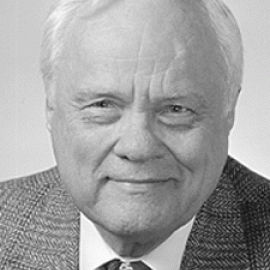
Von R. EshlemanVon R. Eshleman died peacefully on September 22, 2017, five days after his 93rd birthday.  Although he began his career in radar astronomy, he is best known as a pioneer in the use of spacecraft radio signals for precise measurements in planetary exploration — specifically, the radio occultation method for profiling planetary atmospheres and ionospheres, which has now been “brought home” for monitoring Earth’s atmosphere using GPS satellites.

Von was the youngest of four boys born in Covington, Ohio, a farming community with a large population of Old German Baptist Brethren, from which his grandfather had broken away in the late 1800s.  He progressed rapidly through his early school years, then served as an electronics technician in the U.S. Navy during World War II (1943-46).  While stationed in Italy at the end of the war, he became intrigued by the possibility of bouncing radio signals from the lunar surface.  Although his own ship-based experiments were unsuccessful, this curiosity guided his professional life for the next 60 years.

He attended the General Motors Institute of Technology and Ohio State University before graduating with a bachelor’s degree in electrical engineering from George Washington University in 1949.  While at GWU, he met and married Patricia Middleton and they had the first of four children.  Recruited to graduate school at Stanford University by Fred Terman, he obtained an MS in 1950 and a Ph.D. in 1952.  His doctoral research, supervised by Mike Villard and Larry Manning, was on radio reflections from ionized meteor trails in the upper Earth’s atmosphere.

After serving five years as a member of Stanford’s Electrical Engineering research staff, Von was promoted to Assistant Professor in 1957, then Associate Professor, and finally full Professor in 1962.  With colleagues Allen Peterson and Ray Leadabrand, he founded the Stanford Center for Radar Astronomy in 1962, which oversaw two-way dual-frequency radio propagation experiments between Stanford’s 150-foot antenna (‘The Dish’) and Pioneers 6-9 in orbit around the Sun, measuring the density, velocity, and structure of the solar wind.

By the mid-1960s Eshleman’s team had refocused on planets and on the telecommunications signals normally used to transmit spacecraft images and other remotely acquired data.  The radio signals themselves are perturbed when a spacecraft flies behind a planet; by measuring the small changes in frequency, it is possible to determine the temperature and pressure profile of an occulting atmosphere (very similar to the results returned by a weather balloon) and the electron density of an ionosphere. The experiments were originally proposed for an ‘uplink’ geometry (transmission from Earth to the spacecraft), but only ‘downlink’ implementations were approved.  Nonetheless, graduate students Gunnar Fjeldbo and Len Tyler (among others) perfected the technique and were rewarded with the first profiles from Mars (cold and thin) and Venus (hot and dense) in 1965 and 1967, respectively.  Eshleman and his associates also demonstrated that properties of planetary surfaces could be derived from radio echoes reflected from the Moon and Mars.

Eshleman was not involved in Pioneer 10 and 11 radio occultation experiments at Jupiter until it became apparent that the radio results differed radically from  results obtained by other instruments.  Over several years, Von and others worked out the corrections needed for analysis when planets are oblate (as the gas giants are because of their rapid rotation).  The effects of turbulence and magnetic fields were incorporated by Bjarne Haugstad and Dave Hinson.  Von led the Radio Science Team through the very successful Voyager 1 and 2 planning, implementation, and Jupiter encounters, then handed off day-to-day operations to Tyler.

After Voyager, Eshleman focused on topics such as evolute flashes during deep radio occultations, stellar gravitational lenses and their effects on propagating radio waves, ring particle dynamics, absorption in planetary atmospheres (with students Paul Steffes and Tom Spilker), and retro-reflection from icy planetary surfaces.  Although not a member of the science team, he got to see the ultimate radio occultation experiment (an uplink implementation) when New Horizons passed Pluto and signals transmitted from Earth were perturbed by its barely detectable atmosphere.

Dozens of graduate students benefited from Von’s direct mentoring; but he was also an innovative classroom teacher.  He converted a mezzanine-level class on electromagnetics to a generalized “waves” class for a broader audience of Stanford graduate students — such as those interested in acoustics, seismology, and oceanography.  For advanced undergraduates, he developed a new class called “Planetary Exploration”, which was attractive to students with science, engineering, and mathematics skills but who were not majoring in astronomy.

Von maintained contacts with industry, serving as a consultant for North American Rockwell and Watkins-Johnson.  He advised the McGraw-Hill Book Company, the National Bureau of Standards, and (of course) the National Aeronautics and Space Administration.  He also served briefly as Deputy Director of the Office of Technology Policy and Space Affairs in the U.S. Department of State.  But he always returned to the skilled and productive use of electromagnetics to explore the universe — a task that his associates recall that he not only wanted to do, but to do well.

Richard Simpson and other colleagues

Newsletter 17-40

Issue 17-40, October 5, 2017


+————————————CONTENTS—————————————-+

  1. MESSAGE FROM THE CHAIR: DPS 49 BANQUET
  2. LSST AND THE SOLAR SYSTEM WORKSHOP AT DPS 49
  3. FUTURE KUIPER BELT MISSIONS WORKSHOP AT DPS 49
  4. REMINDER: ACCEPTING APPLICATIONS FOR ICARUS EDITOR-IN-CHIEF POSITION
  5. TRICK OR TREAT AND TELESCOPES
  6. STUDENT AND EARLY CAREER TRAVEL GRANTS FOR VEXAG MEETING #15
  7. OPAG FINDINGS AND NEXT MEETING
  8. JOBS, POSITIONS, OPPORTUNITIES

+——————————————————————————————–+


1———1———1———1———1———1———1———1———1———1

MESSAGE FROM THE CHAIR: DPS 49 BANQUET 


I just signed up for the DPS 49 Banquet (https://tinyurl.com/y7q7n6rf) and an

 art class before the banquet that Sundance has made available to DPS members 

(https://aas.org/meetings/dps49/events#banquet). Note that the banquet cost 

includes transportation to and from Sundance Mountain Resort, a beautiful 

property at the base of Mount Timpanogos, ~15 miles from downtown Provo.  

It is a special place and I know it will facilitate collegial interactions and 

discussions about our scientific work. 


The activities prior to the meeting include pottery, jewelry making, painting 

and journal making. I finally decided on painting to exercise a different part 

of my brain. These classes are offered for a fee and I hope you’ll take the time 

to sign up for this different experience for two hours before the banquet if 

you’re so inclined. No experience is necessary. I’m looking forward to 

@DPSMeeting #DPS17 (or DPS49) in Provo, UT next month and hope you 

are too.


Lucy McFadden

DPS Chair


2———2———2———2———2———2———2———2———2———2

LSST AND THE SOLAR SYSTEM WORKSHOP AT DPS 49


Thursday October 19 2017, 4:30-6:30 pm, 49th DPS meeting, Cascade E 

(Utah Valley Convention Center) 

This workshop serves as the annual meeting of the Large Synoptic Sky 

Survey Telescope (LSST) Solar System Science Collaboration (SSSC) 

and is open to all DPS attendees. We will provide a brief status of LSST 

with respect to Solar System science and provide updates on current and 

future activities within the SSSC. 

The presentation schedule is as follows: 

  •  LSST & Solar System Science Collaboration (SSSC) Update: Where is the SSSC Headed in 2018? – Meg Schwamb (Gemini Observatory) & David Trilling (NAU) 
  • The LSST Observing Strategy: Upcoming Opsim Simulations, Small Body Metrics, and White Papers – Lynne Jones (University of Washington/LSST) 
  •  LSST Solar System Data Products and Moving Object Processing System (MOPS) Status – Mario Jurić (University of Washington/LSST)
  • The Minor Planet Center: Status and Plans – Matt Holman (Harvard CfA/MPC)
  •  Community Feedback on the Planned LSST Solar System Database Schema

Contact organizers Meg Schwamb ([email protected]) and 

David Trilling ([email protected]) with any questions 


3———3———3———3———3———3———3———3———3———3

FUTURE KUIPER BELT MISSIONS WORKSHOP AT DPS 49


Sunday, 3:30 pm at DPS 49 Provo, Battle Creek Room


Interested DPS members please join us Sunday, October 15th, from 3:30-5:30

pm for a focused workshop on future missions to the Kuiper Belt.  The workshop 

will take place in the Battle Creek room of the Utah Valley Convention Center 

(DPS 49 conference venue).  No pre-registration required. 


The Kuiper Belt (KB) is a scientific treasure trove consisting of comets, 

planetesimals, and small planets like Pluto. Since its discovery in the early 

1990s, the KB has yielded fundamental insights into planetary accretion, the 

migration of planets, and the population structure of our solar system—

including the discovery that dwarf planets like Pluto are common there.


In this workshop we will review the scientific case to return to Pluto with an 

orbiter, as well as the scientific case to explore other small KB planets and 

smaller bodies with flybys or orbiters. We will go beyond this to discuss 

possible mission payloads. Finally, we will solicit community and individual 

scientist interest in future studies leading to the next Decadal Survey.


4———4———4———4———4———4———4———4———4———4

REMINDER: ACCEPTING APPLICATIONS FOR ICARUS EDITOR-IN-CHIEF POSITION


The DPS Committee, its publications subcommittee and representatives of 

Elsevier, publisher of Icarus, are accepting applications for the position of Icarus

Editor-in-Chief. The application, consisting of a cover letter with a 5-year vision 

statement and skills and experience brought to the position, Curriculum Vita and 

publications list, should be submitted here.  


Application deadline is October 8, 2017.  


Questions, contact Lucy McFadden or Kate Hibbert


Please distribute this announcement widely among our colleagues.


5———5———5———5———5———5———5———5———5———5

TRICK OR TREAT AND TELESCOPES


DPS is  continuing its Trick-or-Treat and Telescopes Program. We are encouraging 

people to put out their telescopes during trick-or-treat time on Halloween, in their 

own lawns or in a neighbor’s lawn with better viewing (or more traffic). The 

following website gives advice and connections to resources. 


education/trick-or-treat-and-telescopes


6———6———6———6———6———6———6———6———6———6

STUDENT AND EARLY CAREER TRAVEL GRANTS FOR VEXAG MEETING #15


Student and early career (less than 5 years from PhD) travel support

may be available for VEXAG Meeting #15, November 14-16, 2017, Applied

Physics Laboratory, Laurel, Maryland. Selected recipients of travel

grants are expected to present a poster.


Provide a Notice of Intent by Friday, October 20, 2017 to

[email protected] containing:


1. A one-page description of how your participation in this meeting

will benefit you professionally and contribute to NASA’s explorations

of Venus and an overview of your poster,

2. Your resume

3. An endorsement from a faculty member.


For logistical reasons, also provide:

– Legal Full Name

– Date of Birth

– City/State of Birth

– Preferred Email Address and Phone Numbers

– Home Address

– Emergency Contact – Name, Relationship, and Phone Number

– Your Affiliation with Full Address and Phone Number

– Gender


If you are a foreign national or permanent resident alien, also 

provide:

– Country of Citizenship

– Birth Date and Birth City, State/Region and Country

– Passport Number, with Expiration Date

– Visa Type, with Effective and Expiration Dates

– Alien Registration # (if applicable)


7———7———7———7———7———7———7———7———7———7

OPAG FINDINGS AND NEXT MEETING


Dear OPAG community,


Findings from the September meeting in La Jolla have been posted at http://www.lpi.usra.edu/opag/.


Also, please pencil in the following for the next OPAG meeting:  

February 21-22 in Hampton, Virginia


-Alfred McEwen and the OPAG steering committee 


8———8———8———8———8———8———8———8———8———8

JOBS, POSITIONS, OPPORTUNITIES


A) POSTDOCTORAL SCHOLAR POSITION

     UNIVERSITY OF CALIFORNIA, IRVINE


Applications are invited for a postdoctoral scholar position in astronomy at 

the University of California, Irvine. The postdoctoral researcher will work 

with Prof. Aomawa Shields at UCI on theoretical climate modeling studies 

of potentially habitable exoplanets, including systems discovered by NASA’s 

Kepler mission, the upcoming Transiting Exoplanet Survey Satellite (TESS), 

and other space- and ground-based observatories. Desirable qualifications 

include experience in climate modeling in 1D, 2D, and/or 3D; research 

experience and interests related to atmospheric science, orbital dynamics, 

glaciology, or land surface geology; strong written and oral communication 

skills; an interest in interdisciplinary science education; and an ability to work 

well in a collaborative environment. 


The appointment can begin as early as summer 2018, with a negotiable starting 

date. The initial appointment will be for one year, with a possibility of extension 

to longer terms contingent upon availability of funds and successful performance. 

Applicants must have a Ph.D. in astronomy, astrobiology, physics, or one of the 

earth science disciplines prior to beginning the appointment. Salary will be 

commensurate with experience.


Candidates should submit a CV, publication list, and a statement of research 

interests (in pdf format) through the UC Irvine academic personnel recruiting 

portal at https://recruit.ap.uci.edu/apply/JPF04311.Through this site, applicants 

will also provide names and email addresses of three referees who will be 

contacted to submit letters of reference. For full consideration, applications and 

reference letters should be received by December 15, 2017.  All application 

materials must be submitted through the UCI RECRUIT website.


Information on postdoctoral appointments and resources at UC Irvine is available at

http://www.grad.uci.edu/postdoctoral-scholars.


The University of California, Irvine is an Equal Opportunity/Affirmative Action 

Employer advancing inclusive excellence. All qualified applicants will receive 

consideration for employment without regard to race, color, religion, sex, sexual 

orientation, gender identity, national origin, disability, age, protected veteran 

status, or other protected categories covered by the UC nondiscrimination policy.


B) POSTDOC POSITIONS IN COMETARY SCIENCE AT MPS, GERMANY 


The Max Planck Institute for Solar System Research in Göttingen, Germany,

invites applications for postdoc positions in the field of cometary science. 


Two positions will be in the working group on the role of comets in the

formation of the planetary system. The following research topics – in order

of their priority

– are identified for collaboration in the working group:

– The growth of cometary nuclei

– The size and mass distribution of cometary dust and solids

– The Carbon-chain material in cometary nuclei

– The elemental composition of cometary material

Details of the positions and the application are found at
http://www.mps.mpg.de/5074883/job_full_offer_11530192?c=2169 


One position will be in a newly forming group on activity in comets and asteroids,

funded by an ERC Starting Grant. The position will focus on one of the following

topics:

– Physical, thermal, and optical properties of cometary material

– Activity in comet 67P/Churyumov-Gerasimenko from a Rosetta

   multi-instrument perspective

– Activity in asteroids

Details of the position and the application are found at
http://www.mps.mpg.de/5066843/job_full_offer_11485198?c=2169


———————————+ 

Send submissions to: 

Anne Verbiscer, DPS Secretary ([email protected]


To unsubscribe visit http://aas.org/unsubscribe or email [email protected].

To change your address email [email protected]

Newsletter 17-39

Issue 17-39, September 28, 2017


+————————————CONTENTS—————————————-+

  1. MESSAGE FROM THE CHAIR: DPS 49 BANQUET
  2. WOMEN IN PLANETARY SCIENCE DISCUSSION HOUR AT DPS 49 PROVO
  3. REMINDER: ACCEPTING APPLICATIONS FOR ICARUS EDITOR-IN-CHIEF POSITION
  4. THE ORIGIN OF GALAXIES, STARS, AND PLANETS IN THE ERA OF ALMA: A SYMPOSIUM TO HONOR ANNEILA SARGENT
  5. JWST PROPOSAL WORKSHOPS
  6. JOBS, POSITIONS, OPPORTUNITIES

+——————————————————————————————–+


1———1———1———1———1———1———1———1———1———1

MESSAGE FROM THE CHAIR: DPS 49 BANQUET 


I just signed up for the DPS 49 Banquet (https://tinyurl.com/y7q7n6rf) and an

 art class before the banquet that Sundance has made available to DPS members 

(https://aas.org/meetings/dps49/events#banquet). Note that the banquet cost 

includes transportation to and from Sundance Mountain Resort, a beautiful 

property at the base of Mount Timpanogos, ~15 miles from downtown Provo.  

It is a special place and I know it will facilitate collegial interactions and 

discussions about our scientific work. 


The activities prior to the meeting include pottery, jewelry making, painting 

and journal making. I finally decided on painting to exercise a different part 

of my brain. These classes are offered for a fee and I hope you’ll take the time 

to sign up for this different experience for two hours before the banquet if 

you’re so inclined. No experience is necessary. I’m looking forward to 

@DPSMeeting #DPS17 (or DPS49) in Provo, UT next month and hope you 

are too.


Lucy McFadden

DPS Chair


2———2———2———2———2———2———2———2———2———2

WOMEN IN PLANETARY SCIENCE DISCUSSION HOUR AT DPS 49 PROVO


Announcing the 2017 DPS Women in Planetary Science Lunch, Tuesday, 

Oct. 17th from 12:00-1:30 pm! Join us for an informal meeting and discussion

hour at the Division for Planetary Sciences Meeting in Provo, UT.  There will 

be a short presentation and plenty of time for discussion. A BIG Thanks!!

to both AURA and the DPS commitee for sponsoring this event again this year!


**Registration Deadline is Sept. 29th** All are welcome but pre-registration

is requested so we can place lunch orders and balance the attendance size vs room size.  

Registration page: http://bit.ly/DPS_WIPS_2017


Please share widely! We look forward to seeing you there!


~Kelsi Singer, Jennifer Hanley, Karly Pitman and The Professional Development

Committee of the DPS


3———3———3———3———3———3———3———3———3———3

REMINDER: ACCEPTING APPLICATIONS FOR ICARUS EDITOR-IN-CHIEF POSITION


The DPS Committee, its publications subcommittee and representatives of 

Elsevier, publisher of Icarus, are accepting applications for the position of Icarus

Editor-in-Chief. The application, consisting of a cover letter with a 5-year vision 

statement and skills and experience brought to the position, Curriculum Vita and 

publications list, should be submitted here.  


Application deadline is October 8, 2017.  


Questions, contact Lucy McFadden or Kate Hibbert


Please distribute this announcement widely among our colleagues.


4———4———4———4———4———4———4———4———4———4

THE ORIGIN OF GALAXIES, STARS, AND PLANETS IN THE ERA OF ALMA:  

A SYMPOSIUM TO HONOR ANNEILA SARGENT  


California Institute of Technology, Pasadena, CA, USA

November 29 – December 2, 2017 


Deadline for registration/abstract submission: October 1, 2017

Deadline for late registration and payment due: November 1, 2017
http://www.astro.caltech.edu/alma2017/


5———5———5———5———5———5———5———5———5———5

JWST PROPOSAL WORKSHOPS

Two 2.5 day workshops will be held this Fall for those interested in
proposing solar system observations with the James Webb Space Telescope
(JWST). The first (Nov. 13-15, 2017) will be at the Space Telescope 
Science Institute (STScI), in Baltimore Maryland. The second (Dec. 
13-15, 2017) will be held at the European Space Research Technology 
Center (ESTEC), in Noordwijk, the Netherlands.

Each workshop will include a mixture of presentations about 
the promise of JWST for solar system science, specifics on observer 
planning tools and observatory capabilities, and hands-on training 
and Q&A with the planning tools. Observations of solar system targets 
approved for guaranteed-time observers (GTOs) and through the Early 
Release Science (ERS) program will be summarized. The workshop is 
timed to support JWST cycle-1 open time proposals, which will be due 
early March 2018. 

Registration and (optional) abstract submission is now open for both events. 

STScI workshop: 
    Registration: https://tinyurl.com/y94onvh3 (closes Sept. 30) 
    See “Registration Fee” in the left navigation panel.

ESTEC Workshop:
    Registration: https://www.cosmos.esa.int/web/jwst-ssws-2017/home (closes Nov. 1) 
 

6———6———6———6———6———6———6———6———6———6

JOBS, POSITIONS, OPPORTUNITIES


A) CELESTIAL DYNAMICIST

Meteoroid Environment Office (MEO) within the Natural Environments 

Branch at NASA Marshall Space Flight Center (MSFC)

Huntsville, Alabama


content/celestial-dynamicist-0

https://jacobs.taleo.net/careersection/ex/jobdetail.ftl?job=AS0001NF&tz=GMT-05%3...


The Engineering & Science Services and Skills Augmentation (ESSSA) 

contract provides engineering, scientific and engineering technician support 

to NASA Marshall Space Flight Center (MSFC) in Huntsville, AL.  Come 

join the team whose work is destined to have a long-range effect on future 

generations!

 To learn more about:

  The ESSSA Group, visit http://YesWeAreRocketScientists.com  

  The Huntsville area, visit http://www.huntsville.org/


As a CELESTIAL DYNAMICIST the selected candidate will support the 

Meteoroid Environment Office (MEO) within the Natural Environments 

Branch at NASA Marshall Space Flight Center (MSFC). The selected 

candidate will work to improve NASA’s knowledge of the meteoroid 

environment, particularly with regard to those particles posing a hazard 

to spacecraft. 


———————————+ 

Send submissions to: 

Anne Verbiscer, DPS Secretary ([email protected]


To unsubscribe visit http://aas.org/unsubscribe or email [email protected].

To change your address email [email protected]
Message From The Chair: DPS 49 Banquet

I just signed up for the DPS 49 Banquet and an art class before the banquet that Sundance has made available to DPS members. Note that the banquet cost includes transportation to and from Sundance Mountain Resort, a beautiful property at the base of Mount Timpanogos, ~15 miles from downtown Provo. It is a special place and I know it will facilitate collegial interactions and discussions about our scientific work. 

The activities prior to the meeting include pottery, jewelry making, painting and journal making. I finally decided on painting to exercise a different part of my brain. These classes are offered for a fee and I hope you’ll take the time to sign up for this different experience for two hours before the banquet if you’re so inclined. No experience is necessary. I’m looking forward to @DPSMeeting #DPS17 (or DPS49) in Provo, UT next month and hope you are too.

Lucy McFadden
DPS Chair

DPS 49 Banquet Announcement

DPS Community, 

I am happy to announce that the DPS meeting banquet will be held on Wednesday 18 October at Sundance Mountain Resort. At just 20 minutes from the conference center, on the back side of Mount Timpanogos, Robert Redford’s Sundance is the ski resort of my youth and was instantly my banquet choice for this meeting. I feel it is the perfect place for all of us to gather and enjoy a nice meal in the mountains. 

The challenge of securing this location meant that we were not able to announce it prior to the early registration deadline, so I hope you will take the time now to go back and add the banquet to your registration. From the link below, modify your registration at the bottom of the page for the banquet. 

https://tinyurl.com/y7q7n6rf

Attendees can participate in activities prior to the banquet unique to rustic Sundance, such as jewelry making, painting, pottery and journal making, for an additional fee, from 5-7 pm. The banquet will be held at 7 pm in the rehearsal hall, with large barn doors opening onto patios bordering woods and a pond. 

The meal will be buffet style, with vegan and gluten-free options available. 

The cost is $91 for members and $65 for student members. Please email me with any questions.

I hope to see you there! 

Jani Radebaugh 
LOC Chair

Newsletter 17-38

Issue 17-38, September 20, 2017


+————————————CONTENTS—————————————-+

  1. DPS 49 BANQUET ANNOUNCEMENT
  2. REMINDER: ACCEPTING APPLICATIONS FOR ICARUS EDITOR-IN-CHIEF POSITION
  3. A FREE WORKSHOP FOR EARLY-CAREER ASTRONOMERS WHO WANT TO DO BETTER OUTREACH TO STUDENTS & THE PUBLIC
  4. WOMEN IN PLANETARY SCIENCE AND EXPLORATION
  5. JWST PROPOSAL WORKSHOPS
  6. JOBS, POSITIONS, OPPORTUNITIES

+——————————————————————————————–+


1———1———1———1———1———1———1———1———1———1

DPS 49 BANQUET ANNOUNCEMENT


DPS Community, 

I am happy to announce that the DPS meeting banquet will be held on 

Wednesday 18 October at Sundance Mountain Resort. At just 20 minutes 

from the conference center, on the back side of Mount Timpanogos, Robert 

Redford’s Sundance is the ski resort of my youth and was instantly my 

banquet choice for this meeting. I feel it is the perfect place for all of us to 

gather and enjoy a nice meal in the mountains. 

The challenge of securing this location meant that we were not able to 

announce it prior to the early registration deadline, so I hope you will take 

the time now to go back and add the banquet to your registration. From the 

link below, modify your registration at the bottom of the page for the banquet. 

https://tinyurl.com/y7q7n6rf

Attendees can participate in activities prior to the banquet unique to rustic 

Sundance, such as jewelry making, painting, pottery and journal making, 

for an additional fee, from 5-7 pm. The banquet will be held at 7 pm in the 

rehearsal hall, with large barn doors opening onto patios bordering woods 

and a pond. 

https://aas.org/meetings/dps49/events#banquet 
https://www.sundanceresort.com/venues/rehearsal-hall/ 

The meal will be buffet style, with vegan and gluten-free options available. 

The cost is $91 for members and $65 for student members. Please email me 

with any questions. [email protected] 

I hope to see you there! 

Jani Radebaugh 
LOC Chair 


2———2———2———2———2———2———2———2———2———2

REMINDER: ACCEPTING APPLICATIONS FOR ICARUS EDITOR-IN-CHIEF POSITION


The DPS Committee, its publications subcommittee and representatives of 

Elsevier, publisher of Icarus, are accepting applications for the position of Icarus

Editor-in-Chief. The application, consisting of a cover letter with a 5-year vision 

statement and skills and experience brought to the position, Curriculum Vita and 

publications list, should be submitted here.  


Application deadline is October 8, 2017.  


Questions, contact Lucy McFadden or Kate Hibbert


Please distribute this announcement widely among our colleagues.


3———3———3———3———3———3———3———3———3———3

A FREE WORKSHOP FOR EARLY-CAREER ASTRONOMERS WHO 

WANT TO DO BETTER OUTREACH TO STUDENTS & THE PUBLIC


Sunday-Monday, 7-8 January 2018, in conjunction with the 231st meeting of the 

American Astronomical Society in National Harbor, MD, near Washington, DC.


The American Astronomical Society (AAS) is sponsoring a skill-building 

workshop — and an ongoing community — to support early-career astronomers 

in doing effective outreach to schools, families, and the public. Working with 

the Astronomical Society of the Pacific, the Pacific Science Center, and other 

outreach organizations, the AAS Astronomy Ambassadors program (now in 

its sixth year) offers you two days of hands-on training, extensive resources, 

and pre-tested activities — plus a like-minded group of peers. If you are a 

graduate student, postdoc, new faculty, or advanced undergraduate committed 

to a career in the astronomical sciences, and if you’re interested in spending a 

small fraction of your time helping laypeople become more scientifically literate, 

this is an invitation to sharpen your outreach skills and join the growing AAS 

Astronomy Ambassadors community.


The sixth annual AAS Astronomy Ambassadors workshop will be held on 

the Sunday and Monday before the start of the 231st AAS meeting, 7-8 

January 2018. Participants will spend two active days learning techniques, 

examining selected materials, and getting to know each other and an existing 

community of astronomers doing and supporting outreach. There will be 

sessions appropriate for those who have done outreach already and for those 


who are just beginners. No experience is required. We especially want to 

encourage participation by members of groups underrepresented in science.


Workshop costs are being underwritten by the AAS Board of Trustees, so 

registration (for the workshop only, not for the AAS meeting), materials, and 

two days’ lunches are free. We can also reimburse you for up to two nights’ 

lodging if your attendance at the workshop requires you to travel to the 

meeting venue earlier than you otherwise would.


Applications are due by 19 October 2017, and applicants will be notified of 

their acceptance into the program before the meeting’s regular registration 

deadline of 2 November 2017.


For more information about the AAS Astronomy Ambassadors program, 

see https://aas.org/outreach/aas-astronomy-ambassadors-program

For more information about the workshop and a link to the online application, 

see https://aas.org/meetings/aas231/aas-astronomy-ambassadors-workshop


4———4———4———4———4———4———4———4———4———4

WOMEN IN PLANETARY SCIENCE AND EXPLORATION


February 17-18, 2018

Toronto, Canada


WPSE 2018 is an opportunity for scientists and engineers to showcase their 

recent findings in the field of planetary science and exploration. The event 

highlights the achievements of female, non-binary, and female identifying 

researchers, while offering an opportunity to discuss, challenge, network, 

and support their peers.


Supporting #WomenInSTEM is the prime goal of this event.


Taking place in the vibrant City of Toronto, attendees of WPSE 2018 will see 

a dynamic city which offers great food and attractions. The event will take place 

at the University of Toronto in the Bahen Centre for Information Technology.


WPSE 2018 will be our inaugural year for the conference. We hope that this event 

becomes a yearly occurrence. We encourage geologists, geophysicists, engineers, 

biologists, chemists, physicists, astronomers, and any other people working or 

researching in a related field to apply. Of particular interest would be students 

studying space law, space exploration history, or commercial aspects of space 

exploration.


For details on how to submit an abstract for a poster session or a talk click here.

For details on how to register to attend the conference click here.

Corporate, government, and academic organizations wishing to sponsor the 

event can contact WPSE 2018 here.


5———5———5———5———5———5———5———5———5———5

JWST PROPOSAL WORKSHOPS

Two 2.5 day workshops will be held this Fall for those interested in
proposing solar system observations with the James Webb Space Telescope
(JWST). The first (Nov. 13-15, 2017) will be at the Space Telescope 
Science Institute (STScI), in Baltimore Maryland. The second (Dec. 
13-15, 2017) will be held at the European Space Research Technology 
Center (ESTEC), in Noordwijk, the Netherlands.

Each workshop will include a mixture of presentations about 
the promise of JWST for solar system science, specifics on observer 
planning tools and observatory capabilities, and hands-on training 
and Q&A with the planning tools. Observations of solar system targets 
approved for guaranteed-time observers (GTOs) and through the Early 
Release Science (ERS) program will be summarized. The workshop is 
timed to support JWST cycle-1 open time proposals, which will be due 
early March 2018. 

Registration and (optional) abstract submission is now open for both events. 

STScI workshop: 
    Registration: https://tinyurl.com/y94onvh3 (closes Sept. 30) 
    See “Registration Fee” in the left navigation panel.

ESTEC Workshop:
    Registration: https://www.cosmos.esa.int/web/jwst-ssws-2017/home (closes Nov. 1) 
 

6———6———6———6———6———6———6———6———6———6

JOBS, POSITIONS, OPPORTUNITIES


A) ARIZONA STATE UNIVERSITY EXPLORATION FELLOWSHIP IN EARTH AND SPACE SCIENCE


Tempe, Arizona

Deadline : November 15, 2017


The School of Earth and Space Exploration (SESE) at Arizona State University 

invites applications for a Postdoctoral Research Associate who will serve as an 

Exploration Fellow. The mission of the postdoctoral fellowship is to foster SESE’s

interdisciplinary research program by attracting and supporting outstanding early-

career scientists and engineers to pursue independent research in collaboration 

with faculty. Research areas within the School encompass Earth and planetary 

science, astrophysics, astrobiology, cosmology, instrumentation and systems 

engineering, and science education. Anticipated start date for the position is 

July 2018. Incoming Fellows will receive an annual stipend of $63,000 with 

health benefits, plus $9,000 per year in discretionary research funds. 

A relocation allowance will be provided. 


https://sese.asu.edu/about/opportunities/sese-exploration-postdoctoral-fellows


———————————+ 

Send submissions to: 

Anne Verbiscer, DPS Secretary ([email protected]


To unsubscribe visit http://aas.org/unsubscribe or email [email protected].

To change your address email [email protected]


Newsletter 17-37

Issue 17-37, September 17, 2017


+————————————CONTENTS—————————————-+

  1. REMINDER: ACCEPTING APPLICATIONS FOR ICARUS EDITOR-IN-CHIEF POSITION
  2. DPS PROFESSIONAL CULTURE AND CLIMATE SUBCOMMITTEE NOMINATIONS
  3. OBSERVATIONS OF PLUMES ON EUROPA: SEPTEMBER 30 DEADLINE
  4. INTERNATIONAL VENUS CONFERENCE 2018
  5. JWST PROPOSAL WORKSHOPS
  6. JOBS, POSITIONS, OPPORTUNITIES

+——————————————————————————————–+


1———1———1———1———1———1———1———1———1———1

REMINDER: ACCEPTING APPLICATIONS FOR ICARUS EDITOR-IN-CHIEF POSITION


The DPS Committee, its publications subcommittee and representatives of 

Elsevier, publisher of Icarus, are accepting applications for the position of Icarus

Editor-in-Chief. The application, consisting of a cover letter with a 5-year vision 

statement and skills and experience brought to the position, Curriculum Vita and 

publications list, should be submitted here.  


Application deadline is October 8, 2017.  


Questions, contact Lucy McFadden or Kate Hibbert


Please distribute this announcement widely among our colleagues.


2———2———2———2———2———2———2———2———2———2

DPS PROFESSIONAL CULTURE AND CLIMATE SUBCOMMITTEE (PCCS) NOMINATIONS


The DPS Professional Culture and Climate Subcommittee (PCCS) is currently

soliciting nominations (including self-nominations) for membership for a

two-year term.  The purpose of the PCCS is to work towards making the

community of planetary scientists an environment in which professional merit

is the only criterion that determines each person’s success.  The detailed

charge of the PCCS, along with a list of current members, is available on the

DPS web site: leadership/climate


The PCCS is seeking new members who are interested in working on issues

that promote a broadly inclusive professional planetary science community. 

Members are expected to participate in bi-monthly telecons, along with

completing individual or group tasks between our regularly scheduled calls. 

Any active DPS member who is interested in participating in the PCCS should

send an expression of interest containing:

– a 2-3 sentence biographical sketch

– a 2-3 sentence description of why you wish you serve on PCCS, including

a description of any prior experience you may have in working on diversity and

inclusion-related issues 


Expressions of interest should be sent to the PCCS Incoming Chair, Julie

Rathbun, at [email protected]


3———3———3———3———3———3———3———3———3———3

OBSERVATIONS OF PLUMES ON EUROPA: SEPTEMBER 30 DEADLINE


STScI is also issuing a call for observing programs aimed at detecting outgassing 

from Jupiter’s satellite Europa. A priority target for a NASA Flagship Mission, 

observations obtained with Hubble show evidence for activity suggestive of 

outgassing from the sub-crustal ocean. There is high scientific importance in 

learning more about potential Europa plumes, their properties and locations.  

Following the recommendations of  a small advisory committee (John Clarke, 

Boston University, chair; Amanda Hendrix, Planetary Science Institute; John 

Spencer, Southwest Research institute), the STScI Director is making up to 

50-100 orbits available for observations directed towards this purpose during the 

2017/2018 Jupiter apparition. The submitted proposals must be aimed specifically 

at detecting plume activity. In that context, the community’s attention is drawn 

to recent observations taken with STIS (GO 15371) that are designed to measure 

the level of scattered light in proximity to Jupiter.


The Europa proposals are not subject to the size and scheduling restrictions 

associated with Mid-Cycle proposals. Proposals may only request time with 

HST; joint proposals with other facilities (Chandra, XMM, NOAO) are not 

permitted. The default proprietary period for these proposals is 6 months.


Proposal Submission and Review


Proposals should be submitted via the Astronomer’s Proposal Tool (APT) as 

type GO, using the Cycle 25 template for the pdf attachment. Proposals must 

be submitted by 23:59 pm on September 30, 2017. The proposals will be 

distributed for review by members of the community, with the results released 

by early November. 


4———4———4———4———4———4———4———4———4———4

INTERNATIONAL VENUS CONFERENCE 2018 

The 74th Fujihara Seminar: “Akatsuki” Novel Development of Venus Science 

The Akatsuki team and community in Japan are pleased to announce the 2018 

Venus conference, the successor of previous Venus conferences (La Thuile 

(2007, 2008), Aussois (2010), Catania (2013), and Oxford (2016)).  The 

conference is intended to cover all areas of Venus science with special focus 

on new results obtained from Japan’s Venus Climate Orbiter “Akatsuki”.  

Results from previous missions, from ground-based observations, numerical 

simulations, and theoretical works of various aspects of Venus are all welcome. 

Although the dates, 11-14 September 2018, will not be skiing season, you will 

be able to enjoy a beautiful and comfortable resort in Hokkaido.  We hope this 

conference is fruitful and will contribute to the advancement of planetary science. 

Registration will open in early 2018. 

Contact: [email protected] 
Please visit https://www.cps-jp.org/~akatsuki/venus2018/


5———5———5———5———5———5———5———5———5———5

JWST PROPOSAL WORKSHOPS

Two 2.5 day workshops will be held this Fall for those interested in
proposing solar system observations with the James Webb Space Telescope
(JWST). The first (Nov. 13-15, 2017) will be at the Space Telescope 
Science Institute (STScI), in Baltimore Maryland. The second (Dec. 
13-15, 2017) will be held at the European Space Research Technology 
Center (ESTEC), in Noordwijk, the Netherlands.

Each workshop will include a mixture of presentations about 
the promise of JWST for solar system science, specifics on observer 
planning tools and observatory capabilities, and hands-on training 
and Q&A with the planning tools. Observations of solar system targets 
approved for guaranteed-time observers (GTOs) and through the Early 
Release Science (ERS) program will be summarized. The workshop is 
timed to support JWST cycle-1 open time proposals, which will be due 
early March 2018. 

Registration and (optional) abstract submission is now open for both events. 

STScI workshop: 
    Registration: https://tinyurl.com/y94onvh3 (closes Sept. 30) 
    See “Registration Fee” in the left navigation panel.

ESTEC Workshop:
    Registration: https://www.cosmos.esa.int/web/jwst-ssws-2017/home (closes Nov. 1) 
 

6———6———6———6———6———6———6———6———6———6

JOBS, POSITIONS, OPPORTUNITIES


A) POSTDOCTORAL POSITION AT SWRI (OSIRIS-REX)


The Department of Space Studies at Southwest Research Institute

(Boulder) seeks a postdoctoral researcher to support activities of the

Spectral Analysis Working Group of the OSIRIS-REx mission prior to and

during spacecraft operations at the asteroid (101955) Bennu. The

successful candidate will have a demonstrated ability to carry out

independent research in the area(s) of solid surface planetary and/or

laboratory spectroscopy, and is expected to publish scientific papers

on a regular basis. This position entails regular travel (~two weeks

duration, every other month) to Ithaca College (Ithaca, NY), travel to

science team meetings (two/year, usually in Tucson AZ), and co-location

in Tucson AZ for mission-critical events, primarily in the first half

of calendar year 2019. The desired start date is 2 January 2018; the

position is for two years, with the potential to extend for a third

year.


Applications must include a curriculum vitae, cover letter, statement

of research interests and contact information for three professional

references.


Applications will be accepted immediately, with reviews starting 15

October, and the application deadline is 5:00 pm CDT, 30 October 2018. 

For more information on desired qualifications and to submit an

application go to:


https://resapp.swri.org/ResApp/Job_Search_Results.aspx?DETAIL=15-01241


Contact: Vicky Hamilton ([email protected])


B) T.C. CHAMBERLIN POSTDOCTORAL FELLOWSHIP AVAILABLE 


The Department of the Geophysical Sciences at The University of Chicago

invites applications for the T.C. Chamberlin Postdoctoral Fellowship. We

seek outstanding scientists who lead creative investigations into the nature

of Earth and other planetary bodies — their physics, biology, chemistry,

climate, and history — and who have a desire to participate in the broad

intellectual life of the Department and the University. Start date is negotiable,

with a target of October 2018. The initial term of the Fellowships will be one

year, renewable for a second year. A competitive salary will be offered, plus

benefits. Research funds are also available. Applications should be received

before 16 October 2017 to receive full consideration, and exceptional applicants

will be contacted in November to schedule on-campus interviews in January 2018.

Please email a single pdf file containing a CV, a 2-4 page research plan, and names

and contact information for at least three references, to:

[email protected]


The University of Chicago is an Affirmative Action/Equal Opportunity/

Disabled/Veterans Employer and does not discriminate on the basis of race,

color, religion, sex, sexual orientation, gender identity, national or ethnic origin,

age, status as an individual with a disability, protected veteran status, genetic

information, or other protected classes under the law.  For additional information

please see the University’s Notice of Nondiscrimination at
http://www.uchicago.edu/about/non_discrimination_statement/


Job seekers in need of a reasonable accommodation to complete the application

process should call 773-702-5671 or email [email protected]

with their request


C) TENURE TRACK POSITION IN GEOLOGY OR EARTH SCIENCE


Berea College invites applications for a tenure‐track appointment in 

Geology/Earth Science (or closelyrelated field) starting fall 2018.


Teaching responsibilities will consist of core introductory geology courses 

such as Physical Geology, more advanced Geology/Earth Science courses 

in the applicant’s area of expertise, and eventual contributions to Berea’s 

general studies program. While Berea College’sGeology program has been 

inactive recently, its long history started nearly a century ago and has produced 

many successful geologists. The successful applicant will have a Ph.D. in 

hand, help rebuild the Geology Program, and begin teaching and pursuing 

undergraduate research in Berea College’s brand new Margaret A. Cargill 

Natural Sciences and Health Building, slated to open in summer 2018.


Berea College is committed in its mission to provide a quality education to 

high‐ability students of limited economic means, to foster interracial and

intercultural education, and to serve the Appalachian region. Berea seeks faculty 

committed to excellence in teaching, invested in scholarship and their discipline, 

dedicated to involving students in research, and who are also supportive of 

Berea’s core mission.


Interested applicants should send a curriculum vitae, graduate and undergraduate 

academic transcripts, a statement of teaching philosophy, research proposal, 

and three letters of recommendation to [email protected]. Applicants 

should also complete and send the Faculty Application available at

http://www.berea.edu/FacApp along with other materials. 

Review of materials will begin November 15, 2017, and continue until the 

position is filled.


Contact Email: [email protected]


D) GEOSCIENCES LABORATORY MANAGER, UNIVERSITY OF NEVADA, RENO


The Department of Geological Sciences and Engineering at the University

of Nevada, Reno seeks a full-time Lab Manager to oversee the use and

maintenance of the department’s major equipment and analytical

facilities. These facilities include two modern scanning electron

microscopes, and a Laser Ablation Inductively Coupled Plasma Mass

Spectrometer (LA-ICP-MS). The Lab Manager is responsible for the

operation, maintenance, business development, budgeting and accounting

for the SEM and LA-ICP-MS facilities. Applications are due by October

9, 2017 and review will begin shortly after. All interested applicants

should view the application and submit their materials at:


https://www.unrsearch.com/postings/25906 


Questions regarding the search may be addressed to the head of the

search committee, Philipp Ruprecht, [email protected]. The University

of Nevada, Reno is an Equal Opportunity/Affirmative Action Employer.

Women and underrepresented groups are encouraged to apply.


E) ASSISTANT PROFESSOR, GEOLOGY, UNIVERSITY OF NEVADA, RENO


The Department of Geological Sciences and Engineering at the University

of Nevada, Reno seeks an Earth Scientist for a tenure-track faculty

position at the Assistant Professor level specializing in the general

theme of Earth Surface Dynamics. This geoscience discipline includes

the coevolution of landscapes, climate, tectonic systems, life, and the

study of Earth’s sedimentary record. The specific field of interest is

open, but preference will be given to candidates who can fortify and/or

complement our existing areas of expertise in tectonics, sedimentary

geochemistry, geomorphology, micropaleontology and paleolimnology,

geological engineering, natural hazards, economic geology, geothermal

systems, and/or planetary geology.


Applications are due by November 30, 2017, and review will begin

shortly after. For full details and to apply to the position go to:


https://www.unrsearch.com/postings/25909


The University of Nevada, Reno recognizes that diversity promotes

excellence in education and research. We are an inclusive and engaged

community and recognize the added value that students, faculty, and

staff from different backgrounds bring to the educational experience.


Questions regarding the search may be addressed to the head of the

search committee, Dr. Paula Noble, at [email protected]


F) POSTDOCTORAL OPPORTUNITY IN PLANETARY SCIENCE AT 

    STONY BROOK UNIVERSITY


The Research Foundation of Stony Brook University seeks a Postdoctoral

Associate in the field of Planetary Science to work with Prof. Scott

McLennan in the Department of Geosciences. The successful candidate

will assist with remote operations of the Mars Science Laboratory

Curiosity rover on Mars and carry out sedimentary petrological research

using data returned from Curiosity. Further details of the position

and application procedures can be found at: 


https://stonybrooku.taleo.net/careersection/post_docs/jobdetail.ftl?job

=1702401&tz=GMT-04%3A00.


The position number is Postdoctoral Associate-1702401. The application

deadline is October 31, 2017.


G) JOB ADVERT FOR PHD STUDENT


I have an opening for a PhD student to investigate the geodynamics of

Earth-like planets. Complete details including a project description

are available here:


https://danjbower.wordpress.com/phd-projects/


Location is Bern, Switzerland, and the project is fully funded (3.5

years duration).


———————————+ 

Send submissions to: 

Anne Verbiscer, DPS Secretary ([email protected]


To unsubscribe visit http://aas.org/unsubscribe or email [email protected].

To change your address email [email protected]


Newsletter 17-36

Issue 17-36, September 10, 2017


+————————————CONTENTS—————————————-+

  1. SPITZER PROPOSAL DEADLINE SEPTEMBER 12, 2017
  2. 2018A NASA IRTF CALL FOR PROPOSALS
  3. REQUEST FOR MISSION SUPPORTING OBSERVATIONS OF PATROCLUS–MENOETIUS MUTUAL EVENTS
  4. JWST PROPOSAL WORKSHOPS
  5. NASA SMD PLANETARY SCIENCE DIVISION SEEKS PEER REVIEWERS

+——————————————————————————————–+


1———1———1———1———1———1———1———1———1———1

SPITZER PROPOSAL DEADLINE SEPTEMBER 12, 2017


Director’s Discretionary Time (DDT) Second Review Deadline – Sept 12, 2017


Spitzer continues to execute exciting science in the “Beyond” phase of the mission-

the final 2.5 years. The Cycle-13 call for proposals was the last comprehensive

proposal call for Spitzer. We have enough observations in the scheduling pool

to fill the schedule through at least October 2018. The Beyond phase of the mission

is funded for operations through the commissioning of JWST in March 2019. 


To support emerging science opportunities that could not have been proposed

for in Cycle-13 we still support DDT programs.  The DDT proposal handling

process works as follows: 


1. DDT proposals may continue to be submitted at any time. 

2. The review of time-critical proposals will continue to be done immediately. 

3. Proposals that are not time critical will be reviewed on a structured schedule.


The first structured DDT review deadline was in February and the next deadline is: 

Tuesday, 12 September 2017 – noon, PDT  Details regarding the final structured

DDT proposal deadline, scheduled for April 10, 2018, will be announced this fall. 


4. DDT proposals must be submitted using the new DDT proposal template and

follow the page limits and other instructions in the DDT proposal guidelines

available on the Proposal Kit webpage

http://ssc.spitzer.caltech.edu/warmmission/propkit/ 


DDT proposals must be submitted via the DDT submission webpage at 
https://catcopy.ipac.caltech.edu/ddt/proposal.php    


Spitzer Science User Support


2———2———2———2———2———2———2———2———2———2

2018A NASA IRTF CALL FOR PROPOSALS


The due date for the 2018A semester (February 1, 2018 to July 31, 2018) 

is Monday, October 2, 2017. See our online submission form 

http://irtfweb.ifa.hawaii.edu/observing/applicationForms.php, which is 

available for proposal submission from 12:00AM on September 01, 2017 

until 5:00PM on October 02, 2017 HST. 


Available instruments include: (1) SpeX, a 0.7 – 5.3 micron cross-dispersed 

medium-resolution spectrograph (up to R=2,500) and imager; (2) MORIS, 

a 512×512 pixel Andor CCD camera (60″x60″ field-of-view) mounted at the 

side-facing window of the SpeX cryostat that can be used simultaneously with 

SpeX; (3) iSHELL, a 1.06 – 5.3 micron cross-dispersed echelle spectrograph 

(up to R=75,000) and imager. Information on available facility and visitor 

instruments and performance can be found at: http://irtfweb.ifa.hawaii.edu/Facility.

Exposure time calculators for SpeX and iSHELL are available on the respective 

instrument webpages.


Please see http://irtfweb.ifa.hawaii.edu/observing/callForProposals.php for the full text.


3———3———3———3———3———3———3———3———3———3

REQUEST FOR MISSION SUPPORTING OBSERVATIONS OF 

PATROCLUS–MENOETIUS MUTUAL EVENTS


We encourage interested observers to plan observations of mutual events of the 

Trojan binary system (617) Patroclus-Menoetius in semester 2018A. Contact 

times for the events and their photometric depth are the measurement objectives.


The Patroclus-Menoetius binary system undergoes a series of mutual events 

approximately every six years with the next season occurring from October 2017 

– June 2019. Individual events have a duration of up to 8 hours, but the initial 

events will be short. Events occur with a cadence of half the binary orbital period

of 4.28 days. Multiple events will be observable over the course of the 2018 

apparition. Patroclus-Menoetius is at opposition on 7 March 2018 with an 

apparent magnitude of 15.9.


A detailed set of predictions is available upon request from Will Grundy ([email protected]).


Patroclus and Menoetius are targets of the Lucy Discovery mission, planned for 

launch in October 2021. Observations of the mutual events will help refine the 

binary mutual orbit, which is critical for planning the encounter. We encourage 

any interested observers to communicate their plans to the Lucy Earth-based 

Observing Working group lead, Richard Binzel ([email protected]).


4———4———4———4———4———4———4———4———4———4

JWST PROPOSAL WORKSHOPS

Two 2.5 day workshops will be held this Fall for those interested in
proposing solar system observations with the James Webb Space Telescope
(JWST). The first (Nov. 13-15, 2017) will be at the Space Telescope 
Science Institute (STScI), in Baltimore Maryland. The second (Dec. 
13-15, 2017) will be held at the European Space Research Technology 
Center (ESTEC), in Noordwijk, the Netherlands.

Each workshop will include a mixture of presentations about 
the promise of JWST for solar system science, specifics on observer 
planning tools and observatory capabilities, and hands-on training 
and Q&A with the planning tools. Observations of solar system targets 
approved for guaranteed-time observers (GTOs) and through the Early 
Release Science (ERS) program will be summarized. The workshop is 
timed to support JWST cycle-1 open time proposals, which will be due 
early March 2018. 

Registration and (optional) abstract submission is now open for both events. 

STScI workshop: 
    Registration: https://tinyurl.com/y94onvh3 (closes Sept. 30) 
    See “Registration Fee” in the left navigation panel.

ESTEC Workshop:
    Registration: https://www.cosmos.esa.int/web/jwst-ssws-2017/home (closes Nov. 1) 
 

5———5———5———5———5———5———5———5———5———5

NASA SMD PLANETARY SCIENCE DIVISION SEEKS PEER REVIEWERS


The Planetary Science Division in NASA’s Science Mission Directorate is 

seeking subject matter experts to serve as reviewers and has recently posted 

volunteer forms for the following ROSES-2017 programs:


C.9 Mars Data Analysis

C.11 Discovery Data Analysis

C.12 Planetary Instrument Concepts for the Advancement of Solar System Observations (PICASSO)

C.14 Planetary Science and Technology Through Analog Research

C.20 Rosetta Data Analysis


Either click on the titles above or start at this permanent link

https://science.nasa.gov/researchers/volunteer-review-panels that list all of the current forms.


———————————+ 

Send submissions to: 

Anne Verbiscer, DPS Secretary ([email protected]


To unsubscribe visit http://aas.org/unsubscribe or email [email protected].

To change your address email [email protected]


Newsletter 17-35

Issue 17-35, September 3, 2017


+————————————CONTENTS—————————————-+

  1. ACCEPTING APPLICATIONS FOR ICARUS EDITOR-IN-CHIEF POSITION
  2. UPCOMING DEADLINE FOR DPS 49 DEPENDENT CARE GRANTS
  3. WEBEX INFORMATION FOR THE UPCOMING OPAG SUMMER 2017 MEETING
  4. LSST AND THE SOLAR SYSTEM WORKSHOP AT DPS 49
  5. JOBS, POSITIONS, OPPORTUNITIES

+——————————————————————————————–+


1———1———1———1———1———1———1———1———1———1

ACCEPTING APPLICATIONS FOR ICARUS EDITOR-IN-CHIEF POSITION


The DPS Committee, its publications subcommittee and representatives of 

Elsevier, publisher of Icarus, are accepting applications for the position of Icarus

Editor-in-Chief. The application, consisting of a cover letter with a 5-year vision 

statement and skills and experience brought to the position, Curriculum Vita and 

publications list, should be submitted here.  


Application deadline is October 8, 2017.  


Questions, contact Lucy McFadden or Kate Hibbert


Please distribute this announcement widely among our colleagues.


2———2———2———2———2———2———2———2———2———2

UPCOMING DEADLINE FOR DPS49 DEPENDENT CARE GRANTS


The DPS Susan Niebur Professional Development Fund provides financial 

assistance to qualifying members in order to facilitate their meeting attendance 

by offsetting costs for dependent care at the meeting location or at home during 

the DPS49 meeting. Dependent Care Grant applications are due 15 September.


3———3———3———3———3———3———3———3———3———3

WEBEX INFORMATION FOR THE UPCOMING OPAG SUMMER 2017 MEETING 


Wednesday, September 6, 2017
Recurrence: Every day, from Wednesday, September 6, 2017, to Thursday, September 7, 2017
Meeting Link: https://nasa.webex.com/nasa/j.php?MTID=m06f9fc6d92cb1b1bc61f668d94a5ecb3
Meeting number: 398 419 323
Meeting password: W@lc0m31

Audio connection:
Country (USA)
Toll Number: 1-312-470-7337
Toll Free Number: 1-888-994-8792
Participant Passcode: 5637426


4———4———4———4———4———4———4———4———4———4

LSST AND THE SOLAR SYSTEM WORKSHOP AT DPS49


Thursday October 19 2017, 4:30-6:30 pm  – Open to all DPS attendees 

Location: Cascade E (Utah Valley Convention Center)

Organizers: Meg Schwamb (Gemini) & David Trilling (NAU) 

Over its 10 year lifespan, the Large Synoptic Sky Survey Telescope (LSST) will 

catalog over 5 million Main Belt asteroids, almost 300,000 Jupiter Trojans, over 

100,000 NEOs, and over 40,000 KBOs. Many of these objects will receive 

hundreds of observations in multiple bandpasses. The LSST Solar System Science 

Collaboration (SSSC) is preparing methods and tools to analyze this data, as well 

as understand optimum survey strategies for discovering moving objects throughout 

the Solar System. 

This workshop serves as the annual meeting of the LSST SSSC, and is open to all 

DPS attendees. We will provide a brief status of LSST with respect to Solar System 

science and provide updates on current and future activities within the SSSC. The 

focus will not be on general LSST background but on details relevant to Solar System 

science topics. There will be time set aside for open discussion for both members of 

the SSSC and the broader planetary community. 

Contact Meg Schwamb ([email protected]) and David Trilling 

([email protected]) with any questions 


5———5———5———5———5———5———5———5———5———5

JOBS, POSITIONS, OPPORTUNITIES

A) TWO POSTDOCTORAL POSITIONS IN MARS SCIENCE

The Department of Planetology and Habitability at the Centro de 
Astrobiologia (CAB) invites applications for two postdoctoral positions 
to support investigations on the nature of the early Mars environments. 
The successful candidate will work with Dr. Alberto Fairen in the 
ERC-funded Project “icyMARS”.

Applicants should have a recent Ph.D. in the field of Planetary 
Science or related discipline, and background in sedimentology of 
ice-covered lakes, or in biology of psychrophilic microorganisms.

The positions, placed in Madrid, would be for one year, with possible 
extension to a second year contingent upon funding availability and 
satisfactory performance. Benefits include working in a young 
enthusiastic team at one of the leading Planetary Sciences institutions 
in Europe, full social benefits according to the Spanish social care 
system, and a very competitive salary.

Applicants should send a letter of interest, a curriculum with a list 
of publications, a brief (maximum two pages) statement of research 
interests, and a list of three references, no later than September 10, 
2017, to Alberto Fairen ([email protected]).

The starting date is negotiable, but should be no later than Jan 1, 
2018.

B) SIX POSTDOC POSITIONS IN ORIGINS OF LIFE RESEARCH

The Origins Center is a recent, multidisciplinary and multi-institute, 
Netherlands Organisation for Scientific Research NWO funded initiative 
of a large number of top tier scientists in the Netherlands. Over 17 
Dutch universities and research institutes participate in the Center 
that is coordinated by the University of Groningen, the Netherlands.

Within the Center we are now recruiting postdoctoral research fellows 
for five three-year pathfinder projects that together should lay the 
groundwork for a future, far larger research programme which aims at 
game-changing understanding of the origin of life and of life-bearing 
planets, predicting evolution, building and steering life from molecule 
to biosphere, finding extra-terrestrial life and of the mathematical 
concepts needed for bridging large spatial, temporal and organisatorial 
scale differences:

http://www.origins-center.nl/vacancies

Fellowships are available within each of the following five projects:

Developing, testing and operating the Origins Simulator
Identifying factors enabling predictability of evolution
Building and directing life
Modelling planet earth as an exoplanet
Mathematically understanding downward causation

Candidates should have a strong background in astronomy, biophysics, 
chemistry, microbiology, ecology, evolutionary biology, mathematics, 
computational science, molecular biosciences or planetary and 
geosciences, and be able to perform innovative and multidisciplinary 
research.

———————————+

Send submissions to: 

Anne Verbiscer, DPS Secretary ([email protected]


To unsubscribe visit http://aas.org/unsubscribe or email [email protected].

To change your address email [email protected]

Newsletter 17-34

Issue 17-34, August 27, 2017


+————————————CONTENTS—————————————-+

  1. DPS 49 REGULAR REGISTRATION AND LATE ABSTRACT DEADLINES APPROACHING
  2. JWST PROPOSAL WORKSHOPS: REGISTRATION NOW OPEN
  3. ARIZONA-JAXA WORKSHOP ON SMALL JAPANESE MISSIONS
  4. SPICE WORKSHOP
  5. MARS EXPLORATION SCIENCE MONTHLY NEWSLETTER FOR AUGUST 2017
  6. UPCOMING MEETINGS
  7. JOBS, POSITIONS, OPPORTUNITIES

+——————————————————————————————–+


1———1———1———1———1———1———1———1———1———1

DPS 49 REGULAR REGISTRATION AND LATE ABSTRACT DEADLINES APPROACHING


If you plan to attend the AAS Division for Planetary Sciences meeting in Provo 

this October, note that the regular registration deadline is Tuesday, 29 August, 

and late abstracts are due Thursday, 31 August!


2———2———2———2———2———2———2———2———2———2

JWST PROPOSAL WORKSHOPS: REGISTRATION NOW OPEN


Two 2.5 day workshops will be held this Fall for those interested in
proposing solar system observations with the James Webb Space

Telescope(JWST). The first (Nov. 13-15, 2017) will be at the Space 

Telescope Science Institute (STScI), in Baltimore Maryland. The second 

(Dec. 13-15, 2017) will be held at the European Space Research Technology 

Center (ESTEC), in Noordwijk, the Netherlands.

Each workshop will include a mixture of presentations about 
the promise of JWST for solar system science, specifics on observer 
planning tools and observatory capabilities, and hands-on training 
and Q&A with the planning tools. Observations of solar system targets 
approved for guaranteed-time observers (GTOs) and through the Early 
Release Science (ERS) program will be summarized. The workshop is 
timed to support JWST cycle-1 open time proposals, which will be due 

early March 2018. 

Registration and abstract submission is now open for both events. 

Please also feel free to sign up to the mailing list for further details.

STScI workshop: 
    Registration: https://tinyurl.com/y94onvh3 (closes Sept. 9) 
    Email: [email protected]

ESTEC Workshop:
    Registration: https://www.cosmos.esa.int/web/jwst-ssws-2017/home (closes Nov. 1) 
    Email: [email protected]


3———3———3———3———3———3———3———3———3———3

ARIZONA-JAXA WORKSHOP ON SMALL JAPANESE MISSIONS

The Institute of Space and Astronautical Science (ISAS) of the Japan Aerospace 

Exploration Agency (JAXA) and the Lunar and Planetary Laboratory (LPL) of

the University of Arizona will hold the second annual workshop dedicated to 

planetary science enabled by missions to be led JAXA on November 12 and 13, 

2017, at LPL in Tucson, Arizona. Given the nature of the workshop described

below, participation will be limited to the first 50 registrants. 


This workshop will be devoted to discussions of planetary missions that are

within the reach of ISAS capability and how to make these missions fruitful 

for the world-wide planetary science community. 


Three specific topics regarding candidate missions in different phases of 

development will be subject to discussion among the participants of this 

workshop. 1) The DESTINY+ (Demonstration and Experiment of Space 

Technology for INterplanetary voYage, Phaethon fLyby with reusable probe) 

mission will fly by asteroid 3200 Phaethon, the parent body of the Geminid

meteor shower. 2) JAXA is studying the SolarPowerSail (SPS) mission to 

the Jupiter Trojans. 3) Small body science would benefit greatly from 

opportunities to perform flybys of a wide variety of asteroids – the workshop 

will include a discussion of asteroids suggested by workshop participants as

flyby targets. Presentations for this portion of the workshop will be selected 

based on short abstracts from registered participants.


To register (including the opportunity to submit an abstract), or to see more 

details of the workshop plans and objectives, please see the workshop website

at www.lpl.arizona.edu/jaxaworkshop


Deadline for abstract submission is 5 p.m. MST, October 27, 2017 or when 

registration is full, whichever is earlier.


4———4———4———4———4———4———4———4———4———4

SPICE WORKSHOP


NASA’s Navigation and Ancillary Information Facility (NAIF) announces a 

“SPICE” training class to be held November 7 – 9, 2017, in the Pasadena 

California area. SPICE is a system used by scientists worldwide to compute 

observation geometry associated with instruments aboard robotic spacecraft. 

The class is free and open to all persons, including foreign and commercial. 

Further information and a registration form are available at 

https://naif.jpl.nasa.gov/naif/WS2017_prelim_announcement


5———5———5———5———5———5———5———5———5———5

MARS EXPLORATION SCIENCE MONTHLY NEWSLETTER FOR AUGUST 2017


To the Mars Community,


On behalf of Jeff Johnson (MEPAG Chair), Dave Beaty, Rich Zurek, and

James Ashley of the Mars Program Science Office, the August 2017 edition

of the Mars Exploration Science Monthly Newsletter can be found on the

web at: 


http://mepag.jpl.nasa.gov


Please send your Mars community announcements and calendar items for

inclusion in the newsletter to James Ashley at:


[email protected]


6———6———6———6———6———6———6———6———6———6

UPCOMING MEETINGS


A) 22ND INTERNATIONAL MICROLENSING CONFERENCE


Location: University of Auckland, New Zealand

Dates: Thursday, 25 January 2018–Sunday, 28 January 2018


Website:

https://www.physics.auckland.ac.nz/en/about/international-microlensing-conference.html


Brief Description:

Registration and abstract submission are now open for the 22nd International 

Microlensing Conference, which will take place at the University of Auckland 

in New Zealand from Thursday, 25 January 2018 through Sunday, 28 January 

2018. Please note that there will also be a welcome reception on the night of 

Wednesday, 24 January!


We encourage astronomers with an interest in exoplanets, stellar populations, 

and compact objects, among other topics, to join us as we highlight recent results 

in the field and anticipate the challenges over the next decade in advance of WFIRST!


B) LSST AND THE SOLAR SYSTEM WORKSHOP


Thursday October 19 2017, 4:30-6:30 pm

49th DPS meeting, Provo, UT – Open to all DPS attendees 

Organizers: Meg Schwamb (Gemini) & David Trilling (NAU)


Over its 10 year lifespan, the Large Synoptic Sky Survey Telescope

(LSST) will catalog over 5 million Main Belt asteroids, almost 300,000

Jupiter Trojans, over 100,000 NEOs, and over 40,000 KBOs. Many of these

objects will receive hundreds of observations in multiple bandpasses.

The LSST Solar System Science Collaboration (SSSC) is preparing methods

and tools to analyze this data, as well as understand optimum survey

strategies for discovering moving objects throughout the Solar System.


This workshop serves as the annual meeting of the LSST SSSC, and is

open to everyone. We will provide a brief status of LSST with respect

to Solar System science and provide updates on current and future

activities within the SSSC. The focus will not be on general LSST

background but on details relevant to Solar System science topics.

There will be time set aside for open discussion for both members of

the SSSC and the broader planetary community.


Contact Meg Schwamb ([email protected]) and David Trilling

([email protected]) with any questions


C) WATER DURING PLANET FORMATION AND EVOLUTION


Zurich, Switzerland

12-16 February 2018


Important Dates:

Registration & Abstract submission deadline: November 15, 2017

Program announcement: Early December 2017


Topics: Water and


* The ISM and protoplanetary disk

* Dust, ice and planetesimals

* Evidence from the meteoritic record

* Laboratory experiments

* Ice lines and disk dynamics

* Solar System formation

* Gas & Ice giant planets

* Protoplanetary collisions

* Mantle-atmosphere feedback

* Observational prospects

* Population synthesis

* Biomarkers & ‘habitability’


Confirmed invited speakers:


Til Birnstiel (LMU Munich)

Ilsedore Cleeves (CfA Harvard)

Jay Farihi (University College London)

Keiko Hamano (ELSI, Tokyo Tech.)

Alessandro Morbidelli (Nice Observatory)

Lena Noack (FU Berlin)

Chris Ormel (University of Amsterdam)

Laura Schaefer (Arizona State University)

Alice Stephant (Open University)


Meeting organizers:


Joanna Drazkowska (University of Zurich)

Tim Lichtenberg (ETH Zurich)

Caroline Dorn (University of Bern)

Julia Venturini (University of Zurich)


Scientific advisory board:


Yann Alibert (University of Bern)

Ravit Helled (University of Zurich)

Anders Johansen (Lund University)

Martin Jutzi (University of Bern)

Alessandro Morbidelli (Nice Observatory)

Sascha Quanz (ETH Zurich)

Maria Schoenbaechler (ETH Zurich)

Ewine van Dishoeck (Leiden University)


All information at the website: 


https://waterzurich.github.io


D) EUROPA DEEP DIVE 1: CALL FOR ABSTRACTS


The Europa Deep Dive I:  Ice-Shell Exchange Processes workshop will 

be held November 1–2, 2017 at the Lunar and Planetary Institute, which 

is housed in the USRA building at 3600 Bay Area Boulevard, Houston, 

Texas 77058.


The focus of this workshop is exchange processes within Europa’s ice shell, 

including (but not limited to) tectonism, diapirism, subduction, and impact 

processes, and their relation to the boundary layers above and below. How 

does material move through the shell? Is surface-ocean exchange likely, or 

is it difficult? What timescales are involved in these processes? What 

processes might operate across different shell thicknesses?


IMPORTANT NOTE:  The focus of this workshop is to discuss processes 

within Europa’s ice shell and their relationship to boundary layers above and 

below. Abstracts focused on instrumentation or measurement techniques, if 

accepted, will be assigned as print-only.


REMINDER:  To subscribe to the list to receive e-mail updates about the 

workshop, including deadline reminders, abstract submission details, etc., 

please submit an indication of interest by October 4, 2017.


For more details, visit the workshop website:


http://www.hou.usra.edu/meetings/europadeepdive2017/


7———7———7———7———7———7———7———7———7———7

JOBS, POSITIONS, OPPORTUNITIES


A) ASSISTANT PROFESSOR OF ASTRONOMY, CORNELL UNIVERSITY


The Cornell University Astronomy Department invites applications for a tenure-

track assistant professor appointment to begin July 1, 2018. We will consider 

applications from observers, experimentalists and theorists working in any area 

of extrasolar and solar system planetary science.


Applicants should upload their applications, including a CV, list of publications, 

statement of research interests, and statement on teaching plans and philosophy to


https://academicjobsonline.org/ajo/jobs/9548


Applicants should also arrange to have three letters of recommendation submitted 

to Academic Jobs Online.


Inquiries may be sent to Jill Tarbell ([email protected]), assistant to the 

Chair of the Department.


Applications are due by November 1, 2017.


Cornell University is an Equal Opportunity/Affirmative Action Employer and 

Educator.  The Department of Astronomy, and the College of Art & Sciences at 

Cornell embrace diversity and seek candidates who will create a climate that 

attracts students of all races, nationalities and genders.  We strongly encourage 

women and underrepresented minorities to apply.


B) FACULTY POSITION IN EXOPLANETS, MCGILL UNIVERSITY

     MONTREAL, QUEBEC


Application Due Date: Wednesday, November 29, 2017


https://academicjobsonline.org/ajo/jobs/9525


C) TWO POSTDOCTORAL POSITIONS IN MARS SCIENCE


The Department of Planetology and Habitability at the Centro de

Astrobiologia (CAB) invites applications for two postdoctoral positions

to support investigations on the nature of the early Mars environments.

The successful candidate will work with Dr. Alberto Fairen in the

ERC-funded Project “icyMARS”.


Applicants should have a recent Ph.D. in the field of Planetary Science

or related discipline, and background in sedimentology of ice-covered

lakes, or in biology of psychrophilic microorganisms.


The positions, placed in Madrid, would be for one year, with possible

extension to a second year contingent upon funding availability and

satisfactory performance. Benefits include working in a young

enthusiastic team at one of the leading Planetary Sciences institutions

in Europe, full social benefits according to the Spanish social care

system, and a very competitive salary.


Applicants should send a letter of interest, a curriculum with a list

of publications, a brief (maximum two pages) statement of research

interests, and a list of three references, no later than September 10

2017, to Alberto Fairen ([email protected]).


The starting date is negotiable, but should be no later than Jan 1, 2018. 


D) JUNIOR SCIENCE WRITER


The University of Maryland College Park (UMCP) and the Center for

Research and Exploration in Space Science and Technology (CRESST II)

has an opening for a Junior Science Writer to work in the Astrophysics

Sciences Division (ASD) on-site at NASA Goddard Space Flight Center

(GSFC) in Greenbelt, Maryland. The Junior Science Writer will be

responsible for identifying, initiating and developing new science

features, video scripts and social media content to inform the public

about ASD news and developments that focus on ASD’s science,

technology, experiments and people.


Applicants for this position are required to have a BA/BS in a

communications or physical science field and at least one year of

experience as a science writer, ideally with a concentration in

physics, astrophysics, and planetary science. They must be U.S.

citizens or have permanent residency. They should be able to

demonstrate excellent experience in collaborating with scientists to

translate technical content into stories meaningful to the general

public. Applicants should have experience writing and creating

multimedia materials, working with social media, a working knowledge of

journalism conventions and media relations, plus a familiarity with AP

Style.


See full job ad here:


https://jobs.washingtonpost.com/job/38249094/junior-science-writer/


———————————+

Send submissions to: 

Anne Verbiscer, DPS Secretary ([email protected]


To unsubscribe visit http://aas.org/unsubscribe or email [email protected].

To change your address email [email protected]