Newsletter 18-24

Issue 18-24, June 24, 2018


+————————————CONTENTS—————————————-+

  1. 50TH ANNUAL MEETING OF THE AAS DIVISION FOR PLANETARY SCIENCES OCTOBER 21-26, 2018 IN KNOXVILLE, TENNESSEE
  2. OPAG UPDATES
  3. AGU SESSION P028: OBSERVATIONS OF PLANETS NEAR AND FAR WITH NEXT-GENERATION TELESCOPES
  4. AGU SESSION P053: THE URANUS AND NEPTUNE SYSTEMS, AND THEIR RELATION TO OTHER PLANETS
  5. SOFTWARE SYSTEMS FOR ASTRONOMY 5 – UPDATE
  6. JOBS, POSITIONS, OPPORTUNITIES

+——————————————————————————————–+


1———1———1———1———1———1———1———1———1———1

50TH ANNUAL MEETING OF THE AAS DIVISION FOR PLANETARY SCIENCES OCTOBER 21-26, 2018 IN KNOXVILLE, TENNESSEE


Abstract submission for our annual meeting is now open! 

Regular abstracts are due Thursday, July 26, 2018.


Registration will open in early July. Both local and scientific organizing committees

are working with AAS meeting planners to make this meeting a place to share our

recent scientific results and to continue our collaborations with colleagues.


More information, as it becomes available, can be found at the meeting website:

https://aas.org/meetings/dps50


Here are some key dates to be aware of:


30 June 2018 Workshop Proposal Submission Deadline

26 July 2018 Regular Abstract Deadline

31 July 2018 Early Registration Deadline (lowest cost!)


Note that there will be limited and expensive hotel rooms close to the Knoxville

Convention Center in downtown Knoxville on the Saturday night before the meeting

(Oct 20) due to the home football game between Tennessee and Alabama. The LOC

and AAS staff are working to find meeting space so that workshops can be held on

Saturday October 27. There will be meeting space for workshops at the Knoxville

Convention Center on Sunday October 21 (before the meeting), but it will be

extremely difficult for some people to get into Knoxville early that day (particularly

those coming from the west coast).  Another option for workshop attendees would

be to stay at a hotel outside of the downtown area on Saturday night.  Workshop

conveners should consider these constraints and communicate with expected

attendees when deciding on workshop dates and times.


We are planning multiple field trips for the weekend after the meeting. Expected

offerings include a visit to the Oak Ridge National Laboratory, nearby caves, and

hiking in the Smoky Mountains.


We plan to continue offering electronic posters this year. We will also be having a

banquet at the Knoxville Museum of Art and an ice-cream social on Friday afternoon.


We look forward to seeing you in Knoxville in October.


2———2———2———2———2———2———2———2———2———2

OPAG UPDATES


NEW OPAG CHAIR AND STEERING COMMITTEE MEMBERS

We are pleased to announce that Jeffrey Moore (NASA Ames) will be the new

OPAG Chair beginning with the September 11-12 OPAG meeting in Pasadena.   

Linda Spilker will continue as Deputy Chair and Alfred McEwen will remain on

the steering committee as past chair.


We are pleased to announce 5 new steering committee members:

Morgan Cable (JPL)

Kathleen Mandt (APL)

Lynnae Quick (CEPS, Smithsonian Institution)

Abigail Rymer (APL)

Thomas Spilker (consultant)


We thank past members who will be rotating off the committee:

Jason Barnes (U. Idaho)

Patricia Beauchamp (JPL)

Julie Rathbun (PSI)

Elizabeth Turtle (APL)


REMINDER: COMMENTS ON 2018 OPAG GOALS DOCUMENT DUE JULY 2, 2018

An extensively revised draft goals document for the Outer Planets Assessment

Group has been posted at https://www.lpi.usra.edu/opag/.  We invite the OPAG

science community to provide feedback by using the OPAG Discussion Board:

 https://www.lpi.usra.edu/forums/viewforum.php?f=2.  To use this, you must

have filled out a notification of interest form at https://www.lpi.usra.edu/opag/opag.cfm 

and register for the discussion board.   We plan to provide a 2018 version of this

document to the Discovery program library, so we need comments by July 2.   

The goals document will continue to be updated for input to the next Decadal Survey. 


-OPAG Steering Committee


3———3———3———3———3———3———3———3———3———3

AGU SESSION P028: OBSERVATIONS OF PLANETS NEAR AND FAR WITH NEXT-GENERATION TELESCOPES


We invite abstracts focused on understanding how future large observatories

can drive new discoveries and enable powerful comparative planetology on planets,

moons, and small bodies within the solar system and beyond in this AGU session.


Session Description: Future observatories can enable groundbreaking planetary

science in the solar system and beyond. For instance, large-aperture telescopes

could obtain flyby or orbiter-quality imaging and spectroscopic data from many

solar system objects. This would allow for monitoring of, e.g. possible geyser

activity on icy moons or storms on the giant planets. Beyond the solar system,

these same future large observatories could discover and characterize many nearby

exoplanets, some of which may be habitable and could be examined for signs of life.

Improving our understanding of nearby planets, moons, and small bodies with future

large telescopes will help us to better understand exoplanets — and vice versa –

through powerful comparative planetology applied across multiple planetary systems.

The worlds of our solar system guide our understanding of other planets elsewhere

as nearby data-rich targets, while exoplanets help place Earth and our solar system

into a broader context.


Abstracts may be submitted at this link: https://agu.confex.com/agu/fm18/prelim.cgi/Session/48713  


Abstracts are due August 1, 2018, 11:59 PM EDT


Session conveners:

Giada Arney (NASA GSFC)

Heidi Hammel (Association of Universities for Research in Astronomy)


4———4———4———4———4———4———4———4———4———4

AGU SESSION P053: THE URANUS AND NEPTUNE SYSTEMS, AND THEIR RELATION TO OTHER PLANETS


We solicit abstracts to a session at AGU 2018 Fall Meeting for the session titled:

P053. The Uranus and Neptune Systems, and their Relation to Other Planets
https://agu.confex.com/agu/fm18/prelim.cgi/Session/50273

This session encompasses all aspects of ice-giant systems: the magnetospheres,

satellites, rings, atmospheres, and interiors of Uranus and Neptune; their formation

and evolution; and their relation to other planets in and beyond our solar system.

Exploring Uranus and Neptune will reveal how they form, how their magnetic

fields are generated, how their magnetospheres interact with the solar wind, the

energy balance of their atmospheres, and the nature of their rings and satellites,

particularly those seen to be active (Triton) or with young surfaces (Miranda,

Ariel). Radial migration of the ice giants may have shaped the solar system as

we know today. Looking beyond, the Kepler mission has shown that ice giants

are common in our galaxy: most planets known today are thought to be ice giants.

Observations, modeling, and theory related to the ice giants will inform the design

of missions to Uranus and Neptune which are currently under consideration.

Conveners:  Kunio M Sayanagi,  Elizabeth P Turtle, Xin Cao, and Krista M Soderlund


5———5———5———5———5———5———5———5———5———5

SOFTWARE SYSTEMS FOR ASTRONOMY 5 – UPDATE


SSfA at UH Hawaii – 4 seats available – This year we so far have 18 students and

therefore plan two sessions for Software Systems for Astronomy 5 on the Big Island

of Hawaii.  This leaves 4 seats still available.


SSfA covers software design and implementation of telescope and instrument

control systems, observation planning tools, and software for analyzing and

archiving astronomical data. SSfA-5 will be offered as a two week intensive

course, 23-Jul to 03-Aug, 2018.
 

Please find special instructions for off-island participants here:

   http://astro.uhh.hawaii.edu/Summer/Summer-2018/ssfa18.php#Special_Summer_Note
 

More information about Software Systems for Astronomy 5 is here:

   http://astro.uhh.hawaii.edu/Summer/Summer-2018/ssfa18.php

More detail about the course is given in the UHH catalog (the course number is 385):

  https://hilo.hawaii.edu/catalog/astr-courses
 

If you have questions, send email to [email protected]


6———6———6———6———6———6———6———6———6———6

JOBS, POSITIONS, OPPORTUNITIES


A) OBSERVATORY SCIENTISTS AT ARECIBO OBSERVATORY

Arecibo Observatory, now managed by a group led by the University of

Central Florida (UCF), is hiring observatory scientists for the planetary

radar and radio astronomy groups. We would like to direct your attention

to the job advertisements on the “Jobs With UCF” website, where you can

see preferred qualifications, duties, expectations, and information on how to apply:
https://www.jobswithucf.com/postings/53707

https://www.jobswithucf.com/postings/53706
https://www.jobswithucf.com/postings/53704

In general we are seeking scientists who can support the observational

programs at the observatory as well as maintain an independent research program.

For planetary radar, the hires will assist in the execution of the current

planetary science radar programs at AO, among other duties.

For radio astronomy, the hires will be expected to participate in enabling

Arecibo’s user community to obtain the best possible scientific results

from the telescope, among other duties.

Questions about these positions may be directed to Francisco (Cla) Cordova, Director,

Arecibo Observatory, University of Central Florida, 787-878-2612 ext. 212.


B) MULTIPLE FACULTY POSITIONS IN SOLID EARTH GEOSCIENCES AND PLANETARY SCIENCES


content/multiple-faculty-positions-solid-earth-geosciences-and-planetary-sciences


C) FACILITY MANAGER W.M. KECK RESEARCH LABORATORY IN

     ASTROCHEMISTRY

     University of Hawaii


The Reaction Dynamics Group, Department of Chemistry, College of Natural

Sciences, University of Hawai’i at Manoa, invites applications for a Facility

Manager for the W.M. Keck Research Laboratory in Astrochemistry. This is a

permanent, full time state-funded position starting May 1, 2019, at a level of

$75,000 per year plus fringe benefits. To apply, please submit a cover letter

indicating how you satisfy each of the minimum and desirable qualifications,

names of 3 professional references and Ph.D. certificate to the address below

(copies accepted, but original document required upon hire). Send application

materials as single PDF file attachments to Prof. Ralf I Kaiser ([email protected]).

Please include position title in the subject line.


Title: Facility Manager W.M. Keck Research Laboratory in Astrochemistry

Hiring Unit: College of Natural Sciences

Location: Manoa Campus

Date Posted: June 20, 2018

Closing Date: August 20, 2018

Annual Salary (11 Months): $75,000

Projected Starting Date: May 1, 2019

Full Time/Part Time: Full Time

Temporary/Permanent: Permanent


Other Conditions:

Working Title: Facility Manager W.M. Keck Research Laboratory in 

Astrochemistry

Duties and Responsibilities

1.     Responsible for implementing and overseeing the daily operation of the W.M. Keck Research Laboratory in Astrochemistry and enforcement of standard operation procedures

(http://www.chem.hawaii.edu/Bil301/KLA.html).

2.     To request biannually user proposals from the scientific com­munity by disseminating open calls in electronic newsletters of, e.g., the American Chemical Society (ACS), the American Geophy­si­cal Union (AGU), and the American Astronomical Society (AAS).

3.     To coordinates merit reviews and allocate experimental time to successful pro­posals.

4.     To design and to conduct in collaboration with (inter)national and local faculty members, scientists, postdoctoral fellows, and students experiments in the W.M. Keck Research Laboratory in Astrochemistry.

5.     To disseminate in collaboration with (inter)national and local scientists the results from the experiments in peer-reviewed journals

6.     To maintain the W.M. Keck Research Laboratory in Astrochemistry such as lasers, cryosystems, and pumping systems.

7.     To modify existing research instruments to add capabilities that extend the usefulness of the instrument and the laser systems.

8.     Responsible for inventory management (chemicals, vacuum components) related to the W.M. Keck Research Laboratory in Astrochemistry.

9.     To co-organize a biannual ‘Laboratory Astrophysics Wor­­k­shop’ for current and prospective users to be promoted, e.g., via the American Chemical Society (ACS), the American Geophy­si­cal Union (AGU), and the American Astronomical Society (AAS).

10.  Other duties as assigned


Minimum Qualifications

1.     Possession of a Ph.D. degree in physics, physical chemistry, or planetary sciences or related field with at least 5 year(s) of responsible professional experience with operating ultra high vacuum experimental setups and tunable laser systems (solid state, dye lasers)

2.     Demonstrated ability to disseminate research results in internationally circulated, peer-reviewed publications

3.     Considerable working knowledge of principles, practices, and maintenance techniques in cryosciences (cold heads, liquid nitrogen plants).

4.     Considerable working knowledge and understanding of gas phase time of flight and condensed pase spectroscopy data fitting and analysis procedures.

5.     Demonstrated ability to work in an (international) team.

6.     Demonstrated ability to present research results at (international) conferences.

7.     Demonstrated ability to operate a personal computer, work stations, apply word processing software, programming (C or C++), labview, and autocad/solidworks.

8.     For supervisory work, demonstrated ability to lead subordinates and to manage work priorities and projects.

9.     Ability to work outside of normal work hours, including evenings, weekends & holidays

10.  Ability to plan, organize, direct, and evaluate the activities of subordinates.

11.  Ability to travel for purposes of attending meetings, training and other activities.


———————————+

Send submissions to:

Anne Verbiscer, DPS Secretary ([email protected]


You are receiving this email because you are a DPS member.

To unsubscribe or update your information, please send your request

to [email protected]. The more general AAS privacy policy is available
online at https://aas.org/about/policies/privacy-policy.

Newsletter 18-23

Issue 18-23, June 24, 2018


+—————————–CONTENTS——————————–+

  1. DPS ELECTIONS 2018: PROCEDURE AND HOW TO VOTE
  2. CANDIDATE BIOS AND STATEMENTS

+—————————————————————————–+


1———1———1———1———1———1———1———1———1———1

DPS ELECTIONS : PROCEDURE AND HOW TO VOTE


The 2018 election for DPS Vice-Chair and Committee is now open, and will close

on July 31st 2018.


To vote, go to https://vote.aas.org/ballot/ballot_view/45. You will need your AAS member login ID (which

defaults to your membership number), and your password.


If you have trouble voting on line, the AAS can do a proxy vote and vote on your behalf
(send an e-mail to [email protected]). You will still get an automated email confirmation
and a separate manual email, both with who you voted for and a confirmation number.


You should vote for one of the two candidates for Vice-Chair:


Matija Ćuk, SETI Institute

Amanda Hendrix, Planetary Science Institute


The elected Vice-Chair will begin serving in October 2018 and will become the DPS Chair in October 2019.


You should vote for two of the four candidates for DPS Committee: 


Michael Bland

Will Grundy, Lowell Observatory

Lucille Le Corre, Planetary Science Institute

Krista Soderlund, University of Texas


The successful candidates will serve on the Committee for three years after October 2018.


The detailed vitae and position statements for each of the candidates follow. 

This information is also linked from the main election page http://aas.org/vote/


2———2———2———2———2———2———2———2———2———2

CANDIDATE BIOS AND STATEMENTS


Candidate biographical notes and statements follow in alphabetical order.


CANDIDATES FOR VICE-CHAIR (Vote for 1)


A) MATIJA ĆUK: VICE CHAIR


Education:

Ph.D. in Astronomy and Space Science, Cornell University, 2005

B.S. in Astrophysics, University of Belgrade, Serbia, 1999


Career:

Research Scientist, SETI Institute, 2011-present

Clay Postdoctoral Fellow, Smithsonian Astrophysical Observatory, and

Daly Postdoctoral Fellow, Harvard University, (combined) 2008-2011 

CITA National Fellow, University of British Columbia, 2006-2008

Postdoctoral Fellow, University of British Columbia 2005-2006


Selected Honors and Awards:

Harold C. Urey Prize for early-career achievement, 2014


Selected Service to the Community:

Division on Dynamical Astronomy: Chair (2013-2014), Vice-Chair (2012-2013), Committee member (2007-2009),

LOC Co-Chair (2010, 2018)

Division for Planetary Sciences: SOC member (2014), Prize subcommittee member (2015-2016)

Panelist for NASA and NSF grant review panels 

Reviewer for Icarus, Science, Nature journals, AAS Journals, JGR, MNRAS, A&A etc.


Statement:

DPS is unique among professional societies and divisions in being dedicated to planetary astronomy, and many of of its members would describe themselves as both astronomers and planetary scientists. I believe that is one of our strengths, and I think we should keep the current structure in place while working to improve communication and cooperation with the parent society.


When it comes to advocacy for our science, DPS should take into account the wide range of interests among its members, and advocate for a broad range of programs and missions whenever possible. In particular the DPS should always highlight how important planetary R & A is to the community, although it is sometimes overlooked among higher-profile budget items.


DPS’s core mission is to organize our annual meetings, and I think that the leadership can make the meetings more inclusive and open to junior members. DPS must set clear professional standards of conduct at the meetings, and deal justly and efficiently with any violations. Another priority for the DPS should be trying to solicit affordable meeting venues, which should make it easier for junior people to attend (i.e. avoid National Harbor and similar places if at all possible).


B) AMANDA HENDRIX:  VICE-CHAIR


Education:

• Ph.D., University of Colorado, Aerospace Engineering Sciences (emphasis in planetary science), 1996

• M.S., University of Colorado, Aerospace Engineering Sciences, 1994

• B.S., California Polytechnic State University, Aeronautical Engineering, 1991


Career:

Planetary Science Institute, Senior Scientist, October 2012- present

Jet Propulsion Laboratory, Research Scientist, Asteroids, Comets and Planetary Satellites Group, December 2000 – September 2012

Johnson Space Center, Earth Science and Solar System Exploration Div., NASA-ASEE Summer Faculty Program Research Fellow, 1999

Univ. Colorado, Lab for Atmospheric and Space Physics, Postdoctoral research associate, Aug 1996 – Nov 2000

Principal Investigator, TREX SSERVI Node (2017 – present)

Deputy Project Scientist, Cassini Mission to Saturn, May 2010-September 2012

Co-investigator, Cassini UVIS, August 1999 – present

Co-investigator, LRO LAMP, January 2008 – present

Co-investigator, Galileo UVS, September 1997-2003

Principal Investigator: HST, CDAP, PDART, LASER, OPR, PG&G, JSDAP, MDAP research programs


Selected Honors & Awards:

JPL Lew Allen Award for Excellence, 2006

JPL Section 317 Award for Excellence, 2005 (Cassini Science Planning leadership)

NASA-ASEE Summer Faculty Fellowship, 1999

Patricia Roberts Harris Fellowship, 1993-1995

10+ NASA Group Achievement Awards for Galileo, Cassini, LRO efforts


Community Service:

DPS Federal Relations Subcommittee, 2017-

JWST Users Committee, 2017-

Member, Committee on the Review of Progress Toward Implementing the Decadal Survey Vision and Voyages for Planetary Sciences, 2017-2018

HST Europa Advisory Committee, 2017

Outer Planets Assessment Group (OPAG) steering committee, 2016-

Roadmaps to Ocean Worlds (ROW) co-chair, 2016-

DPS 2010 Meeting Local Organizing Committee (chair) & SOC member

DPS Nominating Subcommittee October 2007-2010

Member of SOC and organizer of various science meetings

Reviewer, Icarus, JGR, PSS, GRL, AJ, ApJ, others

Reviewer/panel member, NASA LDAP, SSW, SSO, PDART, HST, others


Candidate Statement:

The Division for Planetary Sciences (DPS) is a community that is based on our shared interests and desire to work in a field about which we are all passionate. Several areas are important to keep in mind in order to keep the community strong, and to continue advancing our field and our planetary goals. These include the Decadal Survey, communications with the public and Congress, and our relationship with our parent organization, the American Astronomical Society (AAS). I plan to direct my efforts toward these issues.


On our community’s horizon is the upcoming Decadal Survey. As we have learned over the last two decades, this document is critical for moving forward with our missions and scientific goals. The DPS can help to suggest guidelines/inputs for the next Survey, and coordinate community-based events to develop white papers and plans. Our field includes a wide range of targets and processes that we want to address; the DPS should encourage balance in the next Survey.


We must be aware of the relationship of the DPS within the AAS.  Especially with regard to the organization’s Congressional visits, we want and need to maintain an appropriate balance between the agendas of astronomy and planetary science.


Another topic of importance to me is that of education/outreach. We have all been exposed to information addressing the utility of inclusiveness in our community — the value that well-roundedness brings to our work and discussions. The DPS plays a critical role, in providing opportunities and material for all of us interested in communicating with the public, in order to inspire students and make the future planetary science community as reflective as possible of the larger population, for the benefit of our community and science.  It should continue to do so, regardless of changes in NASA’s education/outreach policies. Of course, “outreach” extends to communications with our friends in Congress, and this is a critical element of communication for us. The DPS Federal Relations Subcommittee does a great job of organizing Capitol Hill visits and mustering letters when needed during critical times.


During my career thus far in planetary science, I have supported myself largely on grants and mission work and have been involved in the Galileo, Cassini and LRO missions. I have leadership experience from Cassini mission work, as well as heading research and proposal teams, leading the TREX SSERVI team and co-leading the Roadmaps to Ocean Worlds group. It would be an honor for me to serve as DPS vice-chair.


CANDIDATES FOR COMMITTEE (Vote for two)


A) MICHAEL BLAND: COMMITTEE

U. S. Geological Survey, Astrogeology Science Center


Education:

Ph.D., University of Arizona, Planetary Science, 2008

B.A., Gustavus Adolphus College, Physics and Geology, 2002


Career:

Research Space Scientist, USGS Astrogeology, 2014 – Present

Research Scientist, Washington University in Saint Louis, 2012 – 2014

Postdoctoral Associate, Washington University in Saint Louis, 2008 – 2012


Selected awards:

USGS Star Award, 2018

First Decade Award, Gustavus Adolphus College, 2012

NASA Earth and Space Science Fellowship, 2007

Gerard P. Kuiper Award, University of Arizona, 2007


Statement:

I see the DPS as broadly having three primary roles in the planetary science community: advancing the investigation of our solar system by facilitating communication between scientists, providing educational and career services to members, and advocating for planetary science. As a member of the DPS committee, I intend to work to ensure that the DPS continues to exceed in these three endeavors.


The DPS has a fifty-year history of organizing dynamic and interdisciplinary scientific conferences. We must build on that tradition to create forums for discussion that are both welcoming and accessible to every voice in our community. In recent years, significant progress has been made in achieving that goal, and it is critical that the DPS continues to make improvements that foster a culture of respect, accessibility, and accountability at our meetings and within planetary science in general.


The DPS must also continue to support the education and careers of our members by providing both resources to our community, and support for programs that help establish a stable career ladder within planetary science. This includes pushing for early career programs like NASA’s Early Career Fellowship (currently in limbo) and PI training, as well as mid-career mentoring and training opportunities.


Finally, in the current environment, the DPS must become an even greater advocate for planetary science specifically, and the value of science in general. It is incumbent upon us as individual members, and as an organization, to push back against the anti-science current. In my experience, the public finds what we do on a day-to-day basis exciting and inspiring. As the largest society dedicated to the study of our solar system, we have a unique ability to demonstrate that scientific principles and critical thinking continue to provide value to the broader culture.


B) WILL GRUNDY: COMMITTEE


Education and Career:

 * 2007-     Lowell Observatory, Flagstaff AZ, tenured scientist.

 * 2000-2007 Lowell Observatory, Flagstaff AZ, tenure-track scientist.

 * 1997-2000 Lowell Observatory, Flagstaff AZ, Hubble postdoctoral fellow.

 * 1995-1997 CNRS-UJF, Grenoble France, Chateaubriand postdoctoral fellow.

 * 1988-1995 University of Arizona, Ph.D. Planetary Sci., minor in Geosci.

 * 1984-1988 Yale University, B.S. Physics cum laude.

 * 1970-1984 Public schools in Cleveland, the Hague, and Galway.


Research:

 * Physical characterization and compositional studies of icy outer solar

   system bodies using space and ground-based telescopes.

 * Mutual orbits of binary and multiple Kuiper belt objects.

 * Theoretical radiative transfer in multiply-scattering materials.

 * Laboratory studies of solar system ices and development of remote sensing

   techniques for ice compositions, temperatures, and physical states.

 * Co-investigator and surface composition science theme team lead: NASA’s

   New Horizons mission to Pluto and the Kuiper belt.

 * Co-investigator and LEISA instrument scientist: NASA’s Lucy mission to

   the jovian Trojans.


Community service and outreach:

 * Planetary Data System Small Bodies Node (PDS SBN) Advisory Council

   (2014-present).

 * NASA Small Bodies Assessment Group (SBAG) steering committee (2012-2015).

 * NASA Advisory Council’s Planetary Science Subcommittee (NAC/PSS)

   (2009-2012).

 * Hubble Space Telescope User’s Committee (STUC) (2009-2012).

 * Icarus editor (2009-present).

 * Lowell Observatory Navajo & Hopi middle school outreach program

   (2001-present).

 * Peer reviewer for numerous manuscripts and proposals.

 * Advised two Ph.D. students, and many undergraduate and masters students.


Statement:

I would be honored to serve on the DPS committee, working on behalf of

the planetary science community that has been my professional family for

the past 30 years.  We are incredibly fortunate to be participants in one

of humanity’s great achievements: the exploration of our solar system.

Using telescopes, laboratory studies, numerical models, and especially

spacecraft, we have made spectacular strides in exploring the diverse

zoo of bodies orbiting our Sun and learning about the processes that

formed and changed them over time.  The character of the field evolves

with advances in technology and as we shift from initial reconnaissance

to ever deeper investigations and broader population studies, and as our

scientific focus extends inward to interior oceans and out to the Kuiper

belt, Oort cloud, and beyond to planetary systems around other stars.

There will always be challenges associated with the changing governments

that fund our research, and also with the evolving nature of academic

careers and scientific publishing.  Our professional societies play

crucial roles in navigating the shifting landscapes that underpin our

work, advocating on our behalf, and organizing meetings that enable

us to share results, learn, and build our networks of collaborators.

I am eager to contribute as best I can to the DPS’s efforts to advance

these goals to benefit our science and our community.


C) LUCILLE LE CORRE: COMMITTEE

Research Scientist, Planetary Science Institute


Education:

Ph.D., University of Nantes, France, 2009

M.Sc., University Pierre and Marie Curie, Planetary Sciences, Paris, France, 2006

B.Sc., University Pierre and Marie Curie, Physics, Paris, France, 2004


Career:

Research Scientist, Planetary Science Institute, Tucson, 2014-Present

Associate Research Scientist, Planetary Science Institute, Tucson, 2013-2014

Research scientist, Max Planck Institute for Solar System Research, Germany, 2010-2012

Post-doctoral researcher, Department of Space and Climate Physics, University College London, 2009-2010


Selected Honors and Awards:

Minor Planet 9285 Le Corre named by the International Astronomical Union

NASA Early Career Fellowship 2014

NASA Group Achievement Award: Dawn Science Operations Team (2013)

NASA Group Achievement Award: Dawn Science Team Vesta Phase (2013)

NASA Group Achievement Award: Dawn Framing Camera Team (2016)

NASA Group Achievement Award: OSIRIS-REx Mission Team (2017)


Spacecraft Involvement:

– Associate, Dawn mission

– Collaborator, OSIRIS-REx mission

– Participating scientist, Hayabusa2 mission


Service to the community:

Manuscript reviewer

Proposal reviewer

Data reviewer for PDS

DPS, MetSoc and LPSC Session chair


Statement:

I am grateful to be nominated for the DPS committee election. If I am elected as a committee member, I would like to focus on helping early career members of our community. I strongly believe that we should provide opportunities for our student members to attend the DPS meetings. As an undergraduate student I got the opportunity to attend a conference on astrobiology that was inspiring and motivated me to continue my path to become a researcher. Providing research opportunities to undergraduate students is something I feel could be improved within the DPS. Having a dedicated session for just undergraduate research presentations at our annual meeting would be something I strongly support. I would also like to make DPS a more inclusive place. Diversity today is commonly defined in terms of gender, race or sexual orientation, etc. I believe that we should celebrate diversity of opinion in our community and foster intellectual diversity as much as race or gender. If I am elected, I would work towards providing opportunities for undergraduate students and make DPS a more inclusive organization.


D) KRISTA SODERLUND: COMMITTEE


Research Associate at The University of Texas at Austin, Institute for Geophysics

Research Focus:

I use geophysical fluid dynamics to study planetary interiors.  My recent projects use numerical models to investigate the origin of Mercury’s magnetic field and the lunar dynamo, simulate convection and magnetic field generation within Uranus and Neptune, and understand the geophysics of icy satellites with emphasis on Europa and Enceladus. I am also a science team member of the REASON instrument on Europa Clipper and was a member of the Ice Giants Mission Study SDT.

Education:

Ph.D., UCLA, Geophysics and Space Physics, 2011

M.S., UCLA, Geophysics and Space Physics, 2009

B.S., Space Sciences, Physics, Florida Institute of Technology, 2005

Career:

University of Texas at Austin, Institute for Geophysics, Research Associate, 2014 – present

University of Texas at Austin, Institute for Geophysics, Postdoctoral Fellow, 2011 – 2014

University of California, Los Angeles, Graduate Student Researcher, 2006 – 2011

Florida Institute of Technology, Undergraduate Student Researcher, 2004 – 2005

California Institute of Technology, SURF Intern, 2005

Jet Propulsion Laboratory, PGGURP Intern, 2004

Naval Oceanographic Office, Physical Science Aid, 2003

Mission Experience:

Europa Clipper, REASON Co-Investigator

JUICE, RIME contributor


Cassini, VIMS intern


Selected Honors and Awards:

NASA Early Career Fellow, 2015

UTIG Outstanding Young Researcher Award, 2013

National Defense Science and Engineering Graduate (NDSEG) Fellowship, 2006 – 2009

Selected Service to the Community:

Science organizing committee: DPS Annual Meeting, 2018

Mentor: Planetary Geology and Geophysics Undergraduate Research Program, 2018
Working group member: Computational Infrastructure for Geodynamics Dynamo Frontiers, 2017 – present
Science definition team member: Ice Giants Mission Study, 2016
Co-convener: AGU, EPSC, IAGA
Session chair: AbSciCon, AGU, DPS, IAGA, LPSC, SEDI, Workshop on the Study of Ice Giant Planets
Reviewer: NASA and international funding agencies, ApJL, EPSL, GAFD, GRL, Icarus, JCLI, JGR, Nature, Nature Astronomy
Professional memberships: AAS DPS, AGU
 

Statement:

DPS is the voice of the planetary science community, bringing together different disciplines and nationalities through our annual meeting and journal Icarus, advocating for adequate funding through federal relations efforts, and engaging the public through educational and outreach events. Active in DPS since my first scientific poster at the 2004 meeting, I would be honored to serve the community that has helped me develop professionally since I was an undergraduate.

As a DPS Committee member, I would be dedicated to development of our early career scientists and inclusion of under-represented groups, as well as their retainment in the field. For example, establishing relationships with minority focused organizations, such as SACNAS and NABG, could provide additional support and opportunities to our current members as well as recruit new students and researchers to our field. Family obligations are also often a challenge, and I applaud the efforts made by DPS to offer dependent care grants and nursing rooms for our meetings; I would strive to continue and extend these successes.

Just as diversity at an institution can produce better research, a strength of our society is its global membership. International collaborations that often sprout from networking at our annual meeting have wide ranging consequences, from bringing new viewpoints to individual researchers to promoting joint missions across funding agencies that benefit the entire community. I would therefore also advocate for continued fostering of international collaborations and partnerships toward facilitating new research and mission opportunities.

My research spans the solar system, from Mercury to Europa and Neptune, from cores to mantles, oceans, and atmospheres, and utilizes numerical models as well as mission data. I have and continue to be involved with mission concept formulation and instrument development as well.  Thus, I believe that I am well poised to represent the DPS community and its diverse membership if elected.


———————————+

Send submissions to:

Anne Verbiscer, DPS Secretary ([email protected]


To unsubscribe visit http://aas.org/unsubscribe or email [email protected].

To change your address email [email protected].

Michael J.S. Belton 1934-2018

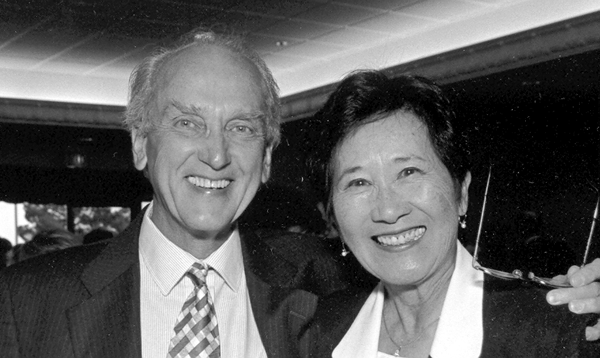
Mike Belton and Anna Don

Michael J.S. Belton was the President of Belton Space Exploration Initiatives, LLC, and an Emeritus Astronomer at the National Optical Astronomy Observatory (NOAO). Born in Bognor Regis, England, he received his Bachelor’s degree at the University of St. Andrews in Scotland, and earned his Ph.D. at the University of California, Berkeley. He joined Kitt Peak National Observatory (the precursor to NOAO) in 1964 and carried out research on nearly all objects that fell under “planetary science.” 

Belton was a member of the Mariner 10 team that flew a space probe by Mercury and Venus. As a member of the Mariner Jupiter/Uranus Science Advisory Committee he helped define what became the Voyager missions to the outer solar system. He was the Leader of the Galileo Mission Imaging Science Team. Galileo studied the Earth’s Moon, made the first close-up observations of an asteroid, Gaspra, and discovered the first moon of an asteroid, Dactyl, as it passed the asteroid Ida on its way to Jupiter. Before arriving, the team observed the impact of the fragments of comet Shoemaker-Levy 9 into the Jupiter atmosphere and later studied the aftermath in detail. At Jupiter, Belton and his team delved into the nature of the Galilean satellites, the population of small satellites, the Jovian ring system, and the planet’s atmosphere.

He was particularly interested in the origin and evolution of planetary systems, the physics of planetary atmospheres, high-resolution ground-based spectroscopy, and had a special affinity for comets. He studied them from ground-based and space-based telescopes and missions. His contributions were focused on understanding the mechanisms of cometary outbursts, determination of rotational states, exploring the interiors of cometary nuclei, how cometary activity can be used to probe the nucleus, and the size-distribution of comets. He was Deputy Principal Investigator of the Deep Impact mission to P/Tempel 1, a Co-investigator on the EPOXI mission to P/Hartley 2, and a Co-Investigator on the Stardust NExT mission that returned to P/Tempel 1. Belton was also a leader of the planetary science community, most notably chairing the first National Research Council Decadal Survey of Solar System Exploration.

For his contributions to the exploration of the solar system, in 1991 an asteroid was designated 3498 Belton by the International Astronomical Union and in 1995 the Division for Planetary Sciences of the American Astronomical Society awarded him the Gerard P. Kuiper Prize.  In 2000, he founded Belton Space Exploration Initiatives, LLC.

Among the young astronomers who worked with him on his many projects Mike Belton was a mentor who unselfishly encouraged their professional growth. He was an engaging, interested and positive colleague. He was an out-of-the box thinker and visionary in the truest sense. He is deeply missed.

Predeceased by his wife, Helyn, Mike Belton leaves behind his daughter, Lise Myra Belton (John Prader), his son, Scott Alexander Belton, and 3 grandchildren:  Emily Prader, John Prader and Elizabeth Rose Prader. For the past 20 years he has been married to Anna Don whose family has embraced him as their father. This family includes Drs. Michael (Sandy) Don, Norman (Tricia) Don and Damon (Kacy) Don. The Don grandchildren he leaves are Lindsay, Kristin, Colin, Abby, Tony and Ben.

A memorial will be held 10:30 AM Saturday, June 30, 2018, at the University of Arizona, Kuiper Space Sciences Building, Room 308. Remembrances are welcome and may be sent to [email protected].

Newsletter 18-22

Issue 18-22, June 16, 2018


+————————————CONTENTS—————————————-+

  1. IN MEMORIAM: MICHAEL J. S. BELTON (1934-2018)
  2. SOFIA CYCLE 7 CALL FOR PROPOSALS RELEASED
  3. SOFTWARE SYSTEMS FOR ASTRONOMY 5 – UPDATE
  4. NASA POSTDOCTORAL FELLOWSHIP APPLICATION DEADLINE JULY 1, 2018
  5. REMINDER – REGISTER FOR CASSINI SCIENCE SYMPOSIUM AND HOTELS
  6. JOBS, POSITIONS, OPPORTUNITIES

+——————————————————————————————–+


1———1———1———1———1———1———1———1———1———1

IN MEMORIAM: MICHAEL J. S. BELTON (1934-2018)


Michael J.S. Belton was the President of Belton Space Exploration Initiatives, LLC,

and an Emeritus Astronomer at the National Optical Astronomy Observatory (NOAO).

Born in Bognor Regis, England, he received his Bachelor’s degree at the University of

St. Andrews in Scotland, and earned his Ph.D. at the University of California, Berkeley.

He joined Kitt Peak National Observatory (the precursor to NOAO) in 1964 and carried

out research on nearly all objects that fell under “planetary science.”  


Belton was a member of the Mariner 10 team that flew a space probe by Mercury and

Venus. As a member of the Mariner Jupiter/Uranus Science Advisory Committee he

helped define what became the Voyager missions to the outer solar system. He was the

Leader of the Galileo Mission Imaging Science Team. Galileo studied the Earth’s Moon,

made the first close-up observations of an asteroid, Gaspra, and discovered the first moon

of an asteroid, Dactyl, as it passed the asteroid Ida on its way to Jupiter. Before arriving,

the team observed the impact of the fragments of comet Shoemaker-Levy 9 into the

Jupiter atmosphere and later studied the aftermath in detail. At Jupiter, Belton and his

team delved into the nature of the Galilean satellites, the population of small satellites,

the Jovian ring system, and the planet’s atmosphere. 


He was particularly interested in the origin and evolution of planetary systems, the

physics of planetary atmospheres, high-resolution ground-based spectroscopy, and

had a special affinity for comets. He studied them from ground-based and space-based

telescopes and missions. His contributions were focused on understanding the

mechanisms of cometary outbursts, determination of rotational states, exploring the

interiors of cometary nuclei, how cometary activity can be used to probe the nucleus,

and the size-distribution of comets. He was Deputy Principal Investigator of the Deep

Impact mission to P/Tempel 1, a Co-investigator on the EPOXI mission to P/Hartley 2,

and a Co-Investigator on the Stardust NExT mission that returned to P/Tempel 1.

Belton was also a leader of the planetary science community, most notably chairing

the first National Research Council Decadal Survey of Solar System Exploration.


For his contributions to the exploration of the solar system, in 1991 an asteroid was

designated 3498 Belton by the International Astronomical Union and in 1995 the

Division for Planetary Sciences of the American Astronomical Society awarded him

the Gerard P. Kuiper Prize. 


In 2000, he founded Belton Space Exploration Initiatives, LLC.


Among the young astronomers who worked with him on his many projects Mike Belton

was a mentor who unselfishly encouraged their professional growth. He was an engaging,

interested and positive colleague. He was an out-of-the box thinker and visionary in the

truest sense. He is deeply missed. 


Predeceased by his wife, Helyn, Mike Belton leaves behind his daughter, Lise Myra Belton

(John Prader), his son, Scott Alexander Belton, and 3 grandchildren:  Emily Prader, John

Prader and Elizabeth Rose Prader. For the past 20 years he has been married to Anna Don

whose family has embraced him as their father. This family includes Drs. Michael (Sandy)

Don, Norman (Tricia) Don and Damon (Kacy) Don. The Don grandchildren he leaves are

Lindsay, Kristin, Colin, Abby, Tony and Ben.


A memorial will be held 10:30 AM Saturday, June 30, 2018, at the University of Arizona,

Kuiper Space Sciences Building, Room 308. Remembrances are welcome and may be sent

to [email protected].


2———2———2———2———2———2———2———2———2———2

SOFIA CYCLE 7 CALL FOR PROPOSALS RELEASED


The SOFIA project has released two calls for proposals (CfP) for observing

time in the Cycle 7 period.


The regular call solicits proposals of any size and combination of instruments.

A total of 400 hours of observing time and approximately $4 million of funding

is available to support these programs. There is a separate call for those affiliated

with German institutions administered by the German SOFIA Institute (Deutsches

SOFIA Institut; DSI) on behalf of the German Aerospace Center (Deutsches

Zentrum für Luft und Raumfahrt; DLR) that will offer an additional approximately

70 hours of observing time.


A complementary call for proposals for “SOFIA Legacy Programs” (SLP) has also

been released, soliciting large coherent programs aimed at high-impact science that

also have a significant promise of valuable archival data sets. Programs up to 100

hours of observing time are solicited in this category. In addition to observing time,

these programs are invited to deliver higher level data products (including supporting

data, software and theory). Nominally, two SLP programs are expected to be selected

per cycle, with observations carried out over two cycles, and a third year included for

completion of the higher-level data processing and analysis. Up to $1 million per

cycle is available for support of the SLPs.


The main parts of the Cycle 7 calendar are:

CfP release: June 1, 2018

CfP update: July 16, 2018

Proposal Deadline: September 7, 2018 (9 p.m. PDT)

Selections announced: November 2018

Cycle 7: April 27, 2019 – April 27, 2020

The Call for Proposals documents can be found at

https://www.sofia.usra.edu/sites/default/files/Other/Documents/SOFIA_Cy7_CfP.pdf

and

https://www.sofia.usra.edu/sites/default/files/Other/Documents/SOFIA_Cy7_SLP_CfP.pdf


Any questions about the Cycle 7 Calls for Proposals can be directed to

[email protected]


3———3———3———3———3———3———3———3———3———3

SOFTWARE SYSTEMS FOR ASTRONOMY 5 – UPDATE


SSfA at UH Hawaii – 4 seats available – This year we so far have 18 students and

therefore plan two sessions for Software Systems for Astronomy 5 on the Big Island

of Hawaii.  This leaves 4 seats still available.


SSfA covers software design and implementation of telescope and instrument

control systems, observation planning tools, and software for analyzing and

archiving astronomical data. SSfA-5 will be offered as a two week intensive

course, 23-Jul to 03-Aug, 2018.
 

Please find special instructions for off-island participants here:

   http://astro.uhh.hawaii.edu/Summer/Summer-2018/ssfa18.php#Special_Summer_Note
 

More information about Software Systems for Astronomy 5 is here:

   http://astro.uhh.hawaii.edu/Summer/Summer-2018/ssfa18.php

More detail about the course is given in the UHH catalog (the course number is 385):

  https://hilo.hawaii.edu/catalog/astr-courses
 

If you have questions, send email to [email protected]


4———4———4———4———4———4———4———4———4———4

NASA POSTDOCTORAL FELLOWSHIP APPLICATION DEADLINE JULY 1, 2018


The NASA Postdoctoral Program offers US and international scientists

the opportunity to advance their research while contributing to NASA’s

scientific goals. The NPP supports fundamental science; explores the

undiscovered; promotes intellectual growth; and encourages scientific

connections.


Selected by a competitive peer-review process, NPP Fellows complete

one- to three-year Fellowship appointments that advance NASA’s missions

in earth science, heliophysics, planetary science, astrophysics, space

bioscience, aeronautics and engineering, human exploration and space

operations, and astrobiology.


Current NPP research opportunities in planetary science can be viewed

here: 


https://npp.usra.edu/opportunities/?filter_keywords=&filter_fields=145


Applicants must have a Ph.D. or equivalent degree in hand before

beginning the fellowship, but may apply while completing the degree

requirements. U.S. citizens, Lawful Permanent Residents, and foreign

nationals eligible for J-1 status as a Research Scholar may apply.


UPDATED! Stipends now start at $60,000 per year, with supplements for

high cost-of-living areas and for certain academic specialties.

Financial assistance is available for relocation and health insurance,

and $10,000 per year is provided for professional travel.


Applications are accepted three times each year: March 1, July 1, and

November 1.


For further information and to apply, visit:


https://npp.usra.edu/


Questions: [email protected]


5———5———5———5———5———5———5———5———5———5

REMINDER – REGISTER FOR CASSINI SCIENCE SYMPOSIUM AND HOTELS


Dear speakers, poster presenters and chairpersons,


As you are scheduled to be at the Cassini Project’s final Cassini Science Symposium,

August 12-17 at the University of Colorado in Boulder, we’d like to remind you to

register and get your hotel room if you haven’t done so already.

  • 29 June:  Early registration deadline – $300 (Students $150)
  • 30 June:  Late registration begins – $400  
  • 3 August:  Cancellation deadline (last day for refunds)


Please go to the website to register, sign up for events, and get hotel information:

http://lasp.colorado.edu/home/2018-cassini-science-symposium

Hotel courtesy rates were offered while space is available, and the Millennium and

Boulderado may already be booked up. See the hotel pages for  more information.


The website includes the revised program, logistics and presentation guidelines.

If you are giving an oral talk, you may email your presentation by July 31 to avoid

coming in early to load it and to help avoid any last minute issues—see guidelines

for details. Posters may be up all week.


The symposium includes a reception Sunday evening before the sessions, a public

talk Tuesday evening, and a banquet on Wednesday for those who are interested.

Invited and contributed talks will include the latest Cassini findings on the Saturn

system, including the interpretation and synthesis of results.  Sessions will cover

the following disciplines:  Rings, Icy Satellites, Titan, Magnetospheres and Saturn.

This Symposium can serve as a springboard for future studies and space missions. 


We hope to see you there.


Larry W. Esposito

Chair, Symposium Organizing Committee


6———6———6———6———6———6———6———6———6———6

JOBS, POSITIONS, OPPORTUNITIES


A) ESA RESEARCH FELLOWSHIP IN PLANETARY SCIENCE


content/esa-research-fellowship-space-science-1


The European Space Agency awards several postdoctoral fellowships each year.

The aim of these fellowships is to provide scientists in their early career,
holding a PhD or the equivalent degree, with the means of performing research
in fields related to the ESA Science Programme.

Areas of research include planetary science, astronomy and
astrophysics, solar and solar-terrestrial science, plasma physics and
fundamental physics. The fellowships have a duration of two years, with the
possible extension to three years, and are tenable at the
European Space Research and Technology Centre (ESTEC) in Noordwijk, Netherlands,
or at the European Space Astronomy Centre (ESAC) in Villafranca del Castillo,
near Madrid, Spain.

Applications are now solicited for fellowships in space science to begin in
the fall of 2019. Preference will be given to applications submitted by
candidates in an early stage of their career. Candidates not holding
a PhD yet are encouraged to apply, but they must provide evidence of
receiving their degree before starting the fellowship.

ESA fellows are enrolled in ESA’s Social Security Scheme, which covers
medical expenses. A monthly deduction covers these short-term and long-term risks.

The deadline for applications is 1 October 2018.

More information on the ESA Research Fellowship programme in Space Science,
on the conditions and eligibility, as well as the application form can retrieved from
http://cosmos.esa.int/fellowship

Questions on the scientific aspects of the
ESA Fellowship in Space Science not answered in the above pages can be sent
by e-mail to the fellowship coordinators, Dr. Oliver Jennrich or Dr. Bruno
Altieri at the address[email protected]

———————————+

Send submissions to:

Anne Verbiscer, DPS Secretary ([email protected]


You are receiving this email because you are a DPS member.

To unsubscribe or update your information, please send your request

to [email protected]. The more general AAS privacy policy is available
online at https://aas.org/about/policies/privacy-policy.

Newsletter 18-21

Issue 18-21, June 10, 2018


+————————————CONTENTS—————————————-+

  1. MESSAGE FROM THE CHAIR: 50TH ANNUAL MEETING OF THE AAS DIVISION FOR PLANETARY SCIENCES FROM OCTOBER 21-26, 2018 IN KNOXVILLE, TENNESSEE
  2. 4TH IPM INTERNATIONAL WORKSHOP
  3. CALL FOR EGU PS MEDAL NOMINATIONS : DEADLINE JUNE 15, 2018
  4. NASA POSTDOCTORAL FELLOWSHIP APPLICATION DEADLINE JULY 1, 2018
  5. MARS EXPLORATION SCIENCE MONTHLY NEWSLETTER FOR JUNE 2018
  6. TESS SCIENCE CONFERENCE I, JULY 29 – AUGUST 2, 2019
  7. JOBS, POSITIONS, OPPORTUNITIES

+——————————————————————————————–+


1———1———1———1———1———1———1———1———1———1

MESSAGE FROM THE CHAIR: 50TH ANNUAL MEETING OF THE AAS DIVISION FOR PLANETARY SCIENCES FROM OCTOBER 21-26, 2018 IN KNOXVILLE, TENNESSEE


Abstract submission for our annual meeting is now open! 

Regular abstracts are due Thursday, July 26, 2018.


Registration will open June 20 and both local and scientific organizing committees

are working with AAS meeting planners to make this meeting a place to share our

recent scientific results and to continue our collaborations with colleagues.


More information, as it becomes available, can be found at the meeting website:

https://aas.org/meetings/dps50


Here are some key dates to be aware of:


30 June 2018 Workshop Proposal Submission Deadline

26 July 2018 Regular Abstract Deadline

31 July 2018 Early Registration Deadline (lowest cost!)


Note that there will be limited and expensive hotel rooms close to the Knoxville

Convention Center in downtown Knoxville on the Saturday night before the meeting

(Oct 20) due to the home football game between Tennessee and Alabama. The LOC

and AAS staff are working to find meeting space so that workshops can be held on

Saturday October 27. There will be meeting space for workshops at the Knoxville

Convention Center on Sunday October 21 (before the meeting), but it will be

extremely difficult for some people to get into Knoxville early that day (particularly

those coming from the west coast).  Another option for workshop attendees would

be to stay at a hotel outside of the downtown area on Saturday night.  Workshop

conveners should consider these constraints and communicate with expected

attendees when deciding on workshop dates and times.


We are planning multiple field trips for the weekend after the meeting. Expected

offerings include a visit to the Oak Ridge National Laboratory, nearby caves, and

hiking in the Smoky Mountains.


We plan to continue offering electronic posters this year. We will also be having a

banquet at the Knoxville Museum of Art and an ice-cream social on Friday afternoon.


We look forward to seeing you in Knoxville in October. And when you see members

of the local or scientific organizing committees, please thank them for their time and efforts.   


Cathy Olkin
DPS Chair


2———2———2———2———2———2———2———2———2———2

4th IPM INTERNATIONAL WORKSHOP

Sep 12-14, 2018- Berlin, Germany


We are very excited to announce that the 4th International Workshop on

 ‘Instrumentation for Planetary Missions’ (IPM – 2018) will be held in 

Berlin, Germany Sep 12-14, 2018. The venue will be the Technical

University (TU) of Berlin. The topics of interest are listed below.


Important dates:

July 1, 2018: Abstracts submission deadline 


The Local organizing committee (LOC) is led by Prof Juergen Oberst of the

Planetary Geodesy and Geoinformation Science Department at TU, Berlin.


The scientific Organizing Committee (SOC) members are:

  • Athena Coustenis (Observatoire de Meudon/LESIA/CNRS), 
  • Juergen Oberst (TU, Planetary Science, Berlin)- Co-chair
  • Sabrina Feldman (JPL) 
  • Stephanie Getty (GSFC)  
  • Elizabeth Turtle (APL) 
  • Shawn Domagal-Goldman (NASA/GSFC)
  • Neil Bowles (Oxford, UK) 
  • Brook Lakew (GSFC)- Co-chair
  • Manuel Grande (Aberystwyth Univ, UK) 
  • Anita Heward (UK)  
  • Christophe Sotin (JPL)
  • David Beaty (JPL)
  • Harald Michaelis (DLR, Institute of Planetary Research, Berlin) 


*Please note that IPM-2018 will take place the week before the European

Planetary Science Congress (EPSC) – the main annual European planetary

science conference (https://www.epsc2018.eu/) – also happening at the

same venue in Berlin. 


As in years past we are looking forward to a successful IPM International Workshop. 


Mark your calendars and prepare your abstracts!


-Brook Lakew

4th IPM Workshop co-chair.   


Suggested topics for the 4th IPM Workshop 


1-    Planetary Science questions to be addressed in the next decade and beyond – 

keynote/invited papers

2-    Instruments on past missions – lessons learned and vision for next generation

instruments – keynote/invited papers

3-    Life detection Instrumentation and related technologies for Ocean Worlds 

4-    Instruments on past and newly selected phase-A missions (Rosetta, Hayabusa 2,

Mangalyaan, TGO, ExoMars, Mars 2020, JUICE, Juno, OSIRIS-Rex, Bepi-Colombo, Lucy, Psyche, Dragonfly, CEASAR, Europa Clipper, Europa Lander,  etc.)

      5- Novel instruments for Lander Missions- including Lunar and Mars landers  

      6- Instruments for Orbiters, Flyby Missions (Sub-mm, Radar, UV, IR spectrometers, imagers)

      7- Instrumentation for descent probes (Saturn, Uranus, Venus, …) 

      8- Mass Spectrometry, Geochronology and Elemental Spectroscopy instruments 

      9- Science Instruments for Deep-Space SmallSats and CubeSats 

    10- Electronics for extreme environments (temperature and radiation) 

    11- Dual-Function Instruments on Human Space Flight missions beyond LEO 

    12- Science Instruments on human space flight missions to the Deep-space Gateway and

          planetary targets beyond LEO (NEO, Mars, Phobos)


3———3———3———3———3———3———3———3———3———3

CALL FOR EGU PS MEDAL NOMINATIONS: DEADLINE JUNE 15, 2018


Dear Colleagues, 


We would like to remind that Awards & Medals nominations for the year

2018 are currently open. The nominations of EGU medalists, as everything

within EGU, is a bottom up process. Please consider  nominations for the

following medals/awards specific to the PS Division: 


Jean Dominique Cassini Medal (http://www.egu.eu/awards-medals/jean-dominique-cassini/)
David Bates / Runcorn-Florensky Medals
(http://www.egu.eu/awards-medals/david-bates/ http://www.egu.eu/awards-medals/runcorn-florensky/

Division Outstanding Young Scientists Award (http://www.egu.eu/awards-medals/division-outstanding-ecs-award/


Please use the Awards & Medals nomination form
to propose a candidate for the year 2018.  

**Submission deadline 15 June 2018**.  

Please read the Proposal & Selection of Candidates
  ,
the relevant Best Practices  
carefully and checklist for submitting nominations
(https://www.egu.eu/awards-medals/checklist-for-submitting-nominations/)  


Stephanie Werner  

EGU Planetary and Solar System Sciences Division

Email: [email protected] http://www.egu.eu/ps/home/ 


4———4———4———4———4———4———4———4———4———4

NASA POSTDOCTORAL FELLOWSHIP APPLICATION DEADLINE JULY 1, 2018


The NASA Postdoctoral Program offers US and international scientists

the opportunity to advance their research while contributing to NASA’s

scientific goals. The NPP supports fundamental science; explores the

undiscovered; promotes intellectual growth; and encourages scientific

connections.


Selected by a competitive peer-review process, NPP Fellows complete

one- to three-year Fellowship appointments that advance NASA’s missions

in earth science, heliophysics, planetary science, astrophysics, space

bioscience, aeronautics and engineering, human exploration and space

operations, and astrobiology.


Current NPP research opportunities in planetary science can be viewed

here: 


https://npp.usra.edu/opportunities/?filter_keywords=&filter_fields=145


Applicants must have a Ph.D. or equivalent degree in hand before

beginning the fellowship, but may apply while completing the degree

requirements. U.S. citizens, Lawful Permanent Residents, and foreign

nationals eligible for J-1 status as a Research Scholar may apply.


UPDATED! Stipends now start at $60,000 per year, with supplements for

high cost-of-living areas and for certain academic specialties.

Financial assistance is available for relocation and health insurance,

and $10,000 per year is provided for professional travel.


Applications are accepted three times each year: March 1, July 1, and

November 1.


For further information and to apply, visit:


https://npp.usra.edu/


Questions: [email protected]


5———5———5———5———5———5———5———5———5———5

MARS EXPLORATION SCIENCE MONTHLY NEWSLETTER FOR JUNE 2018

On behalf of Jeff Johnson (MEPAG Chair), Dave Beaty, Rich Zurek, and
Serina Diniega of the Mars Program Science Office, the June 2018
edition of the Mars Exploration Science Monthly Newsletter can be
found on the web at:

http://mepag.jpl.nasa.gov

Please send your Mars community announcements and calendar items for
inclusion in the newsletter to Barbara at:
[email protected]


6———6———6———6———6———6———6———6———6———6

TESS SCIENCE CONFERENCE I, JULY 29 – AUGUST 2, 2019


The TESS Science Conference I will be the first conference devoted to

results from the NASA TESS Mission. It will focus on discoveries made

with TESS data and their theoretical interpretation, and also on TESS

data analysis and follow-up observations.


The conference will take place on July 29 – August 2, 2019, at the

Kresge Auditorium on MIT campus, Cambridge, MA, USA.


The conference is timed close to the beginning of TESS 2nd year of

operations, when the satellite is scheduled to transition from

surveying the Southern ecliptic hemisphere to the Northern ecliptic

hemisphere. It will be an auspicious time to bring together experts on

all aspects of the mission to discuss the achievements made during the

1st year, as well as highlighting potential improvements and lessons

learned to be implemented in the 2nd year, and possibly also during the

TESS Extended Mission (yet to be funded by NASA).


In the near future, more information about conference will be posted 

at:


http://tess.mit.edu/science/tess-science-conference


We will send out further announcements once we put together the

schedule for registration and abstract submission.


7———7———7———7———7———7———7———7———7———7

JOBS, POSITIONS, OPPORTUNITIES


A) POSTDOCTORAL POSITION IN EXOPLANET ATMOSPHERES,

     LUNAR AND PLANETARY LABORATORY,

     UNIVERSITY OF ARIZONA, TUCSON, AZ


The University of Arizona Department of Planetary Sciences/Lunar and

Planetary Laboratory invites applications for a postdoctoral position to

work with Dr. Tommi Koskinen on the escape and evolution of exoplanet

atmospheres.  The successful candidate will develop models of exoplanet

upper atmospheres to interpret existing observations and motivate searches

for new atmospheric signatures with current and future instruments.  In

addition to working on the interpretation of observations by the Hubble

Space Telescope and ground-based high resolution data, the candidate will

have the opportunity to participate in the preparation for the NASA Colorado

Ultraviolet Transit Experiment (CUTE).


The Lunar and Planetary Laboratory and the University of Arizona offer a

world-class research program in astronomy, physics and planetary sciences,

including research into atmospheres ranging from exoplanets to the planets,

dwarf planets, satellites and comets in the solar system.  The successful

candidate will have the opportunity to interact and foster collaborations with

many talented researchers working at the university. 


Candidates should have a PhD in planetary science, exoplanets or a related

field and experience in numerical modeling.  A background in modeling

atmospheres and/or atmospheric escape is an advantage.  Candidates should

apply to Job Posting P20545 at www.uacareers.com.  Applications should

include a cover letter, CV, a brief statement of research plans and contact

details for two referees.

———————————+

Send submissions to:

Anne Verbiscer, DPS Secretary ([email protected]


You are receiving this email because you are a DPS member.

To unsubscribe or update your information, please send your request

to [email protected]. The more general AAS privacy policy is available
online at https://aas.org/about/policies/privacy-policy

Newsletter 18-20

Issue 18-20, June 2, 2018


+————————————CONTENTS—————————————-+

  1. MESSAGE FROM THE CHAIR: 50TH ANNUAL MEETING OF THE AAS DIVISION FOR PLANETARY SCIENCES FROM OCTOBER 21-26, 2018 IN KNOXVILLE, TENNESSEE
  2. SPICE TRAINING SECOND ANNOUNCEMENT
  3. SBAG STEERING COMMITTEE CANDIDATE SOLICITATION
  4. GEOSCIENCES SPECIAL ISSUE RECENT ADVANCES IN LUNAR STUDIES
  5. SBAG 19 PRELIMINARY AGENDA, JUNE 13-14 2018
  6. THEMATIC SCHOOL – FLUID-ROCK INTERACTIONS IN THE SOLAR SYSTEM
  7. JOBS, POSITIONS, OPPORTUNITIES

+——————————————————————————————–+


1———1———1———1———1———1———1———1———1———1

MESSAGE FROM THE CHAIR: 50TH ANNUAL MEETING OF THE AAS DIVISION FOR PLANETARY SCIENCES FROM OCTOBER 21-26, 2018 IN KNOXVILLE, TENNESSEE


Abstract submission for our annual meeting is now open! 

Regular abstracts are due Thursday, July 26, 2018.


Registration will open June 20 and both local and scientific organizing committees

are working with AAS meeting planners to make this meeting a place to share our

recent scientific results and to continue our collaborations with colleagues.


More information, as it becomes available, can be found at the meeting website:

https://aas.org/meetings/dps50


Here are some key dates to be aware of:


30 June 2018 Workshop Proposal Submission Deadline

26 July 2018 Regular Abstract Deadline

31 July 2018 Early Registration Deadline (lowest cost!)


Note that there will be limited and expensive hotel rooms close to the Knoxville

Convention Center in downtown Knoxville on the Saturday night before the meeting

(Oct 20) due to the home football game between Tennessee and Alabama. The LOC

and AAS staff are working to find meeting space so that workshops can be held on

Saturday October 27. There will be meeting space for workshops at the Knoxville

Convention Center on Sunday October 21 (before the meeting), but it will be

extremely difficult for some people to get into Knoxville early that day (particularly

those coming from the west coast).  Another option for workshop attendees would 

be to stay at a hotel outside of the downtown area on Saturday night.  Workshop 

conveners should consider these constraints and communicate with expected

attendees when deciding on workshop dates and times.


If you’d like to propose a special session, please email the SOC chair, Devon Burr, at

[email protected]. Emails would be appreciated within the next two weeks.


We are planning multiple field trips for the weekend after the meeting. Expected

offerings include a visit to the Oakridge National Laboratory, nearby caves, and

hiking in the Smoky Mountains.


We plan to continue offering electronic posters this year. We will also be having a

banquet at the Knoxville Museum of Art and an ice-cream social on Friday afternoon.


We look forward to seeing you in Knoxville in October. And when you see members

of the local or scientific organizing committees, please thank them for their time and efforts.   


Cathy Olkin
DPS Chair


2———2———2———2———2———2———2———2———2———2

SPICE TRAINING SECOND ANNOUNCEMENT

The ESA SPICE Service (ESS) and the Navigation and Ancillary Information  
Facility (NAIF) will conduct a SPICE observation geometry training 
class on June 19-22, 2018 in Madrid, SPAIN. SPICE at ESA is 
described at:

http://www.cosmos.esa.int/web/spice/home

The class is free and open to all professionals and students involved 
in Solar System exploration. Further information about the class and 
the class registration form are found at: 

https://www.cosmos.esa.int/web/spice/training-class-june-2018

Three grants are available for European students to cover Travel expenses.

Registration is due by June 5, 2018.

3———3———3———3———3———3———3———3———3———3

SBAG STEERING COMMITTEE CANDIDATE SOLICITATION


There are up to three positions open on the Steering Committee of the Small

Bodies Assessment Group (SBAG), starting in August 2018. 

The SBAG Steering Committee organizes SBAG meetings, writes the official 

SBAG findings, and takes a leadership role in other activities where community

input on topics of interest is needed. In selecting members, the Steering Committee’s

goal is to have a committee that is as diverse as the community, in terms of topical

interest, gender, experience, type of employer, and other parameters. In particular,

the Steering Committee will always have members who will serve as the leads

for Human Exploration, Planetary Defense, and Technology, respectively, as

well as an Early Career Secretary who will be selected from individuals with

less than three years’ experience after a terminal degree (PhD, Master’s or

Bachelor’s). Terms are three years except for the Early Career Secretary, whose

term is two years. Any member of the small bodies exploration community is

eligible to apply for a position on the Steering Committee. A two-page CV,

which should include a description of participation in SBAG or other small

bodies community organizations, is requested to apply. In addition, please

include a short (one-page or equivalent) statement of why you are interested.

Previous participation in SBAG is preferred, but not required. 

We are looking for members with expertise in the following areas: 

  •  
  •  
  •  

To indicate your willingness to serve in any of these positions, please email

Tim Swindle ([email protected]) by June 8, 2018, and include a

two-page CV and your statement of interest.

The current Steering Committee will select new members at the 19th Meeting 

of SBAG, June 13-14, 2018.


Tim Swindle, SBAG Steering Committee Chair


4———4———4———4———4———4———4———4———4———4

GEOSCIENCES SPECIAL ISSUE RECENT ADVANCES IN LUNAR STUDIES


Dear Colleagues,


The journal Geosciences is accepting papers for a Special Issue related

to recent advances in studies of the Moon. Since the Apollo era, sample

studies, remote analyses, and dynamical models continue to tease out

details related to the Moon’s formation and evolution. Additionally,

the international lunar science community is eager to continue its

presence on the Moon, as evidenced by recent, upcoming, and future

lunar missions. All of these topics are of great interest to the

broader geoscience community.


The Special Issue welcomes papers that describe studies related to any

of the above topics and will be an outlet for rapid, accessible, and

peer-reviewed publications. The editors especially welcome papers from

young investigators. The deadline for manuscript submissions is 15 June

2018.


Additional details are available at:


http://www.mdpi.com/journal/geosciences/special_issues/lunar_studies


Dr. Nicolle E. B. Zellner (Albion College) Dr. Karen R. S. Cahill (PSI)

Guest Editors


5———5———5———5———5———5———5———5———5———5

SBAG 19 PRELIMINARY AGENDA, JUNE 13-14, 2018


The preliminary agenda for the 19th Small Bodies Assessment Group (SBAG)

meeting is attached. The meeting will be in College Park, Maryland — more

details, including the link for registration, are on the SBAG website at

https://www.lpi.usra.edu/sbag/meetings/ 

If you are presenting at the meeting, we will be in touch with you in the coming 

days with more details. 

I hope to see many of you there. 

Tim Swindle

SBAG Chair


6———6———6———6———6———6———6———6———6———6

THEMATIC SCHOOL – FLUID-ROCK INTERACTIONS IN THE SOLAR SYSTEM


The Laboratoire de Planetologie et Geodynamique organises the second

GeoPlaNet thematic school on Fluid-Rock Interactions in the Solar

System. The event will take place in Nantes (France) from next 

November 12th to 16th.


This school in Planetary Geosciences will present to participants

various techniques for observing, analysing, experimenting and

modelling the compositional and morphological aspects of fluid-rock

interactions in rocky and icy bodies of all sizes of the Solar System.


The school will include lectures and practicals, as well as poster

presentations by attendees. It will be organised along two themes: 

1) Fluid-rock interactions on planetary surfaces: 

   Fluid-related rock deformation, rock weathering, sedimentation,

   hydrothermalism; 

   Spectroscopy of rocks and minerals, field excursion, experimental 

   modelling, laboratory analyses; 

2) Fluid-rock interactions in planetary interiors: 

   Icy ocean worlds, mantle dynamics, volatile cycle, metasomatism, 

   deep magmatic source; 

   Petrology, geochemistry, geophysics, laboratory analyses, 

   experimentation, numerical modelling.


This high-level training program is open to 80 international Master

students, PhD students and young researchers with a background in

geosciences and/or in planetary science.


https://lpg-umr6112.fr/TS-GeoPlaNet


O. Bourgeois, O. Verhoeven et S. Lheritier 

Laboratoire de Planetologie et Geodynamique UMR CNRS 6112 – University

of Nantes


7———7———7———7———7———7———7———7———7———7

JOBS, POSITIONS, OPPORTUNITIES


A) POSTDOCTORAL POSITION AVAILABLE AT INSTITUT D’ASTROPHYSIQUE

     SPATIALE, UNIVERSITE PARIS-SUD


content/postdoctoral-position-available-institut-d’astrophysique-spatiale-université-paris-sud


B) POSTDOCTORAL RESEARCH SCHOLARSHIP IN ASTEROID ENGINEERING


Lulea University of Technology invites applications for a Postdoctoral

Research Scholarship in Asteroid Engineering.


The successful candidate will focus on projects aiming to understand

the mechanisms leading to the disruption of asteroids close to the Sun

by planning, executing, analyzing, and modeling heating experiments on

meteorites and asteroid-analogue materials carried out in the new

Asteroid Engineering Laboratory in Kiruna, Sweden.


A Ph.D. in planetary science, astronomy, geosciences, geoengineering,

space engineering, or a related field is meriting, as well as

experience in numerical modeling and experimental research on

meteorites and/or other geological materials.


Deadline for applications is June 30, 2018.


More information available at:


https://www.ltu.se/ltu/stipendier-priser/postdoc-stipendier?l=en


———————————+

Send submissions to: 

Anne Verbiscer, DPS Secretary ([email protected]


You are receiving this email because you are a DPS member.

To unsubscribe or update your information, please send your request

to [email protected]. The more general AAS privacy policy is available

online at https://aas.org/about/policies/privacy-policy.

Message from The Chair: 50th Annual Meeting of the AAS Division For Planetary Sciences from October 21-26, 2018 in Knoxville, Tennessee

Abstract submission for our annual meeting is now open!  Regular abstracts are due Thursday, July 26, 2018.

Registration will open June 20 and both local and scientific organizing committees are working with AAS meeting planners to make this meeting a place to share our recent scientific results and to continue our collaborations with colleagues.


More information, as it becomes available, can be found at the meeting website:

https://aas.org/meetings/dps50


Here are some key dates to be aware of:


30 June 2018 Workshop Proposal Submission Deadline

26 July 2018 Regular Abstract Deadline

31 July 2018 Early Registration Deadline (lowest cost!)


Note that there will be limited and expensive hotel rooms close to the Knoxville Convention Center in downtown Knoxville on the Saturday night before the meeting (Oct 20) due to the home football game between Tennessee and Alabama. The LOC and AAS staff are working to find meeting space so that workshops can be held on Saturday October 27. There will be meeting space for workshops at the Knoxville Convention Center on Sunday October 21 (before the meeting), but it will be extremely difficult for some people to get into Knoxville early that day (particularly those coming from the west coast).  Another option for workshop attendees would be to stay at a hotel outside of the downtown area on Saturday night.  Workshop conveners should consider these constraints and communicate with expected attendees when deciding on workshop dates and times.


We are planning multiple field trips for the weekend after the meeting. Expected offerings include a visit to the Oakridge National Laboratory, nearby caves, and hiking in the Smoky Mountains.


We plan to continue offering electronic posters this year. We will also be having a banquet at the Knoxville Museum of Art and an ice-cream social on Friday afternoon.


We look forward to seeing you in Knoxville in October. And when you see members of the local or scientific organizing committees, please thank them for their time and efforts.   

Cathy Olkin
DPS Chair

30 May 2018

Newsletter 18-19

Issue 18-19, May 14, 2018


+————————————CONTENTS—————————————-+

  1. AAS DIVISION FOR PLANETARY SCIENCES 2018 PRIZES
  2. EPSC 2018 SESSIONS ON OUTER PLANET SYSTEMS

+——————————————————————————————–+


1———1———1———1———1———1———1———1———1———1

AAS DIVISION FOR PLANETARY SCIENCES 2018 PRIZES


The DPS is pleased to announce its 2018 prize winners.


Gerard P. Kuiper Prize – Julio Ángel Fernández Alves


The DPS awards the 2018 Gerard P. Kuiper Prize for outstanding contributions

to the field of planetary science to Julio Ángel Fernández Alves (Facultad

de Ciencias, Universidad de la República, Montevideo, Uruguay) for his

research focusing on the origin of the solar system and the physical and

dynamical evolution of comets.   Prof. Fernández’s 1980 paper “On the 

Existence of a Comet Belt Beyond Neptune” inspired the search for and

discovery of the Kuiper belt. In the same year he published another seminal

paper showing that Oort cloud comets should come from the Neptune-Uranus

region, having been scattered by those planets’ perturbations; this population

of scattered disk objects has also been found. His third seminal contribution

introduced the fundamental concept behind the present formation models

involving massive migrations of the planets in the early solar system. In

addition to his scientific contributions, Dr. Fernández has been tireless in

inspiring and promoting the interaction and integration of South American

planetary scientists with colleagues around the world.


Harold C. Urey Prize – Francesca E. DeMeo


The DPS awards the 2018 Harold C. Urey Prize for outstanding achievement

in planetary research by a young scientist to Francesca DeMeo (MIT). We

award this in recognition of the broad foundational understanding of the study

of solar system bodies using the modern system of asteroid classification that

bears her name. With reflectance spectra of thousands of asteroids she used

the Bus-DeMeo taxonomy as a tool leading to our modern understanding of

the geologic structure of the asteroid belt. The compositional complexity revealed

by her analysis provides independent, observational evidence fully supporting

dynamical models demonstrating greater mixing of bodies in the early solar

system than previous observations indicated.


Carl Sagan Medal – Bonnie J. Buratti


The DPS awards the 2018 Carl Sagan Medal for excellence in public

communication to Bonnie J. Buratti (Jet Propulsion Laboratory)

for her effective education and public outreach with a measured

and demonstrably, high impact. She is noted for conducting teachers’

workshops, delivering popular public talks, and written work appearing

in encyclopedias, blog posts, and a recently published, popular book,

“Worlds Fantastic, Worlds Familiar.” She brings personal anecdotes

combined with clear explanations of science, accompanied by stunning

images that bring our science to the public for their enlightenment and

enjoyment. Buratti also advocates for others to engage with the public

and initiated the DPS program called “Trick or Treat and Telescopes,”

a program the division hopes will grow.


Harold Masursky Award – Faith Vilas


The DPS awards the 2018 Harold Masursky Award for meritorious service

to planetary science to Faith Vilas (National Science Foundation). During a

time of national duress following the chaos of the 9/11 attack, she insured

the integrity of the Discovery program selection process. As the first Chair

of the NASA Small Bodies Assessment Group, she established its operational

practices and made it the viable entity that continues today. As Chair of the

DPS, Vilas played a key role in establishing the Carl Sagan Medal, which

was the first major statement in support of the importance of communicating

our science with the public. She has mentored and inspired young people who

have become well-known figures in our profession, and others who have taken

an appreciation of our science into other careers. She has served on numerous

Academy and NASA panels. Her service to the field and to society has been

exemplary.


Jonathan Eberhart Planetary Sciences Journalism Award – Alexandra Witze


The DPS presents the 2018 Jonathan Eberhart Planetary Sciences Journalism 

Award for distinguished popular writing to Alexandra Witze for her article 

“Next Stop, Mars” in the January 19, 2017, issue of Nature. After setting the 

high stakes involved in bringing back samples from Mars, Witze describes 

how NASA plans to tackle the daunting task of keeping the samples pristine. 

Witze takes readers on a wonderful journey through the Jet Propulsion Lab, 

where the Mars 2020 rover is being built, and introduces some of the people 

leading the immense project. She beautifully conveys the extreme levels of 

cleanliness essential to detecting life on another planet and the rigorous planning 

that goes on behind the scenes. Witze ends the article by describing the rationale 

behind selecting the landing site for the Mars 2020 rover and looks ahead at 

potential missions that would carry the precious samples back to Earth. 


2———2———2———2———2———2———2———2———2———2

EPSC 2018 SESSIONS ON OUTER PLANET SYSTEMS


Dear colleagues,


We would like to bring to your attention to the following sessions related

to Outer Planet Systems taking place at the upcoming EPSC meeting in Berlin.

Please consider submitting an abstract.


https://www.epsc2018.eu/home.html


Abstract deadline is May 16th.


OPS1

Outer planets systems and Pluto

Conveners: Athena Coustenis, Glenn Orton , Sushil K. Atreya ,

Leigh Fletcher , Nicolas Altobelli         


OPS2

Cassini’s Legacy: One Year Later

Conveners: Scott Edgington, Sushil K. Atreya , Athena Coustenis ,

Norbert Krupp , Linda Spilker         


OPS3

Ocean worlds and Icy Moons

Conveners: Alex Hayes, Jean-Pierre Lebreton , Olivier Witasse ,

Athena Coustenis , Elizabeth Turtle , Federico Tosi         


OPS4

Juno at Jupiter and Supporting Earth-Based Observations

Conveners: Scott Bolton,  Alberto Adriani , Jack Connerney ,

Tristan Guillot , Alessandro Mura 


———————————+

Send submissions to: 

Anne Verbiscer, DPS Secretary ([email protected]


To unsubscribe visit http://aas.org/unsubscribe or email [email protected].

To change your address email [email protected]

AAS Division For Planetary Sciences Announces 2018 Prize Winners

14 May 2018

The Division for Planetary Sciences (DPS) of the American Astronomical Society (AAS) has named its prizewinners for 2018.

Julio Angel Fernandez AlvesThe Gerard P. Kuiper Prize for outstanding contributions to the field of planetary science goes to Julio Ángel Fernández Alves (Facultad de Ciencias, Universidad de la República, Montevideo, Uruguay) for his research focusing on the origin of the solar system and the physical and dynamical evolution of comets. Prof. Fernández’s 1980 paper “On the Existence of a Comet Belt Beyond Neptune” inspired the search for and discovery of the Kuiper belt. In the same year he published another seminal paper showing that Oort cloud comets should come from the Neptune-Uranus region, having been scattered by those planets’ perturbations; this population of scattered disk objects has also been found. His third seminal contribution introduced the fundamental concept behind the present formation models involving massive migrations of the planets in the early solar system. In addition to his scientific contributions, Dr. Fernández has been tireless in inspiring and promoting the interaction and integration of South American planetary scientists with colleagues around the world.


Francesca DeMeoFrancesca DeMeo (MIT) will receive the Harold C. Urey Prize for outstanding achievement in planetary research by a young scientist. The prize recognizes the broad foundational understanding of the study of solar system bodies using the modern system of asteroid classification that bears her name. With reflectance spectra of thousands of asteroids she used the Bus-DeMeo taxonomy as a tool leading to our modern understanding of the geologic structure of the asteroid belt. The compositional complexity revealed by her analysis provides independent, observational evidence fully supporting dynamical models demonstrating greater mixing of bodies in the early solar system than previous observations indicated.


Faith VilasThe 2018 Harold Masursky Award for meritorious service to planetary science goes to Faith Vilas (National Science Foundation). During a time of national duress following the chaos of the 9/11 attack, she insured the integrity of the Discovery program selection process. As the first Chair of the NASA Small Bodies Assessment Group, she established its operational practices and made it the viable entity that continues today. As Chair of the DPS, Vilas played a key role in establishing the Carl Sagan Medal, which was the first major statement in support of the importance of communicating our science with the public. She has mentored and inspired young people who have become well-known figures in our profession, and others who have taken an appreciation of our science into other careers. She has served on numerous Academy and NASA panels. Her service to the field and to society has been exemplary. 


Bonnie BurattiThe Carl Sagan Medal for excellence in public communication is awarded to Bonnie Buratti (Jet Propulsion Laboratory) for her effective education and public outreach with a measured and demonstrably high impact. She is noted for conducting teachers’ workshops, delivering popular public talks, and writing in encyclopedias, blog posts, and a recently published popular book on planetary science “Worlds Fantastic, Worlds Familiar.” She brings personal anecdotes combined with clear explanations of science, accompanied by stunning images that bring planetary science to the public for their enlightenment and enjoyment. Buratti also advocates for others to engage with the public and initiated the DPS program called “Trick or Treat and Telescopes,” a program the Division hopes will grow.


Alexandra WitzeThe Jonathan Eberhart Planetary Sciences Journalism Award for distinguished popular writing is presented to Alexandra Witze for her article “Next Stop, Mars” in the January 19, 2017, issue of Nature. After setting the high stakes involved in bringing back samples from Mars, Witze describes how NASA plans to tackle the daunting task of keeping the samples pristine. Witze takes readers on a wonderful journey through the Jet Propulsion Lab, where the Mars 2020 rover is being built, and introduces some of the people leading the immense project. She beautifully conveys the extreme levels of cleanliness essential to detecting life on another planet and the rigorous planning that goes on behind the scenes. Witze ends the article by describing the rationale behind selecting the landing site for the Mars 2020 rover and looks ahead at potential missions that would carry the precious samples back to Earth.


“The DPS Committee offers their congratulations and thanks to these individuals for their contributions to planetary science and our community,” says DPS Chair Cathy Olkin (Southwest Research Institute). “I look forward to presenting these awards to the winners at the 50th annual meeting of the DPS in Knoxville, Tennessee, in October.”

Contacts:

Shantanu Naidu

DPS Press Officer

+1 (917) 373 8840

[email protected]

Cathy Olkin

DPS Chair

+1 (303) 546 9685

[email protected]

More information about DPS prizes:

prizes

50th annual DPS meeting, Knoxville, Tennessee, 21-26 October 2018:

https://aas.org/meetings/dps50

The Division for Planetary Sciences (DPS), founded in 1968, is the largest special-interest Division of the American Astronomical Society (AAS). Members of the DPS study the bodies of our own solar system, from planets and moons to comets and asteroids, and all other solar-system objects and processes. With the discovery that planets exist around other stars, the DPS has expanded its scope to include the study of extrasolar planetary systems as well.

Newsletter 18-18

Issue 18-18, May 12, 2018


+————————————CONTENTS—————————————-+

  1. DPS ELECTIONS 2018: CANDIDATE SLATE
  2. REQUEST FOR COMMUNITY INPUT TO NASA SCIENTIFIC BALLOON PROGRAM ANALYSIS GROUP
  3. EPSC SESSION: MODELS OF ATMOSPHERES AND EXOSPHERES, SURFACES, AND INTERIORS OF SMALL BODIES
  4. EPSC SESSION: CERES AND VESTA
  5. EPSC SESSION: AEROSOLS AND CLOUDS IN PLANETARY ATMOSPHERES
  6. ASTRONOMY X: MINING THE PAST, MAKING SPACE FOR THE FUTURE
  7. NASA SMD SEEKS VOLUNTEER REVIEWERS
  8. JOBS, POSITIONS, OPPORTUNITIES

+——————————————————————————————–+


1———1———1———1———1———1———1———1———1———1

DPS ELECTIONS 2018: CANDIDATE SLATE


The DPS Nominating Subcommittee has identified the following candidates

for the 2018 DPS elections for Vice Chair and Committee :


Vice-Chair (1 to be elected):

o Matija Cuk, SETI Institute

o Amanda Hendrix, Planetary Science Institute


Committee (2 to be elected):

o Michael Bland

o Will Grundy, Lowell Observatory

o Lucille Le Corre, Planetary Science Institute

o Krista Soderlund, University of Texas, Austin


Additional candidates, supported by a petition of at least 20 DPS members,

may be nominated by May 15th. Please send any nominations to the

DPS Secretary, Anne Verbiscer, at [email protected].


2———2———2———2———2———2———2———2———2———2

REQUEST FOR COMMUNITY INPUT TO NASA SCIENTIFIC BALLOON PROGRAM ANALYSIS GROUP


NASA seeks input from planetary scientists on future directions of scientific
ballooning. Over the next several months, NASA will incorporate input from
the community into a Balloon Roadmap which, in turn, will help inform the
upcoming 2020 Decadal Surveys. NASA’s scientific balloons regularly fly
payloads weighing over 5000-lb to altitudes of 33 – 37 km, above 99% of the
Earth’s atmosphere. NASA is developing super-pressure balloons to support
100-day flight durations at mid-latitudes.

– The NASA/GHAPS/SIDT report discusses some potential uses of stratospheric
balloons for planetary science:


– The full text of the Request-for-Input letter is here:


http://www.phys.hawaii.edu/~gorham/Post/NASA_Roadmap_RFI.pdf

Note that there will be a session on July 19, 2018 at COSPAR in Pasadena with
opportunities to present input, but content must be received by mid-June (via

email: [email protected]).
 

3———3———3———3———3———3———3———3———3———3

EPSC SESSION: MODELS OF ATMOSPHERES AND EXOSPHERES, SURFACES, AND INTERIORS OF SMALL BODIES


Dear colleagues,


This is a reminder for the upcoming abstract submission deadline of the

next EPSC conference (https://www.epsc2018.eu/) that will be held in

Berlin on 16-21 September 2018.


Abstracts submission is now open to  Session SB11/MD7: “Models of

atmospheres and exospheres, surfaces, and interiors of small bodies”

The analysis and interpretation of data from recent and upcoming planetary

missions to solar system small bodies require the development of new

specific models. This session will focus on the description of these new

models and the results of their applications. Abstracts on atmospheric and

exospheric modeling, radiative transfer models and modeling of scattering

properties of surfaces and surface release processes, are welcome as well

as thermophysical evolution models of interiors of small bodies.


To submit you may use the following link:

https://meetingorganizer.copernicus.org/EPSC2018/abstractsubmission/29898

The Abstract submission deadline is  May 16, 2018, 13:00 CEST. 


Best regards,

The conveners

Michelangelo Formisano

Andrea Raponi

Audrey Vorburger


4———4———4———4———4———4———4———4———4———4

EPSC SESSION: CERES AND VESTA


Dear colleagues,


this is a reminder for the upcoming abstract submission deadline of the next

EPSC conference (https://www.epsc2018.eu/) that will be held in Berlin on

16-21 September 2018.


The “Abstract submission deadline” is  May 16, 2018, 13:00 CEST.


We would like to invite you to submit an abstract to the Session: 

SB9 – “Ceres and Vesta “. 


Session summary: September 2017 marked 10 years since the launch of NASA’s

Dawn mission. Dawn has been the first mission to orbit two different targets in

the main asteroid belt: the largest asteroid Vesta and the dwarf planet Ceres.

Dawn’s overall results represent a huge leap in our understanding of these bodies.

Dawn is now in its Second Exteneded Mission Phase. In this session we welcome

contributions that cover: 1) latest results obtained from the Dawn mission on both

Ceres and Vesta, concerning geology, mineralogy, surface composition and/or

geophysics, 2) comparative analysis of Vesta and Ceres in terms of surface

processes, internal structure, thermal evolution and origins. The goal of this session

is to highlight the major achievements of the Dawn mission, and to illustrate recent

discoveries and ongoing work on Vesta and Ceres through direct analysis of Dawn

data, study of analogs and/or theoretical models.


To submit you may use the following link:

 https://meetingorganizer.copernicus.org/EPSC2018/session/29473


Looking forward to see you in Berlin,


The conveners

Francesca Zambon

Eleonora Ammannito

Wladimir Neumann


5———5———5———5———5———5———5———5———5———5

EPSC SESSION: AEROSOLS AND CLOUDS IN PLANETARY ATMOSPHERES


Dear Colleagues,

The abstract submission for the European Planetary Science Congress 2018
organized in Berlin, Germany, on 16–21 September 2018, is open until May 16.

We invite you to submit abstracts to the session
OPS5/TP11  “Aerosols and clouds in planetary atmospheres”!

http://meetingorganizer.copernicus.org/EPSC2018/session/29457

Atmospheric aerosols and cloud particles are found in every atmosphere
of the solar system, as well as, in exoplanets. Depending on their size,
shape, chemical composition, latent heat, and distribution, their effect
on the radiation budget varies drastically and is difficult to predict.
When organic, aerosols also carry a strong prebiotic interest reinforced
by the presence of heavy atoms such as nitrogen, oxygen or sulfur.

The aim of the session is to gather presentations on these complex
objects for both terrestrial and giant planet atmospheres, including the
special case of Titan’s hazy atmosphere. All research aspects from their
production and evolution processes, their observation/detection, to
their fate and atmospheric impact are welcomed, including laboratory
investigations and modeling.

The ambition of the session is a review effort beginning in our solar
system, and which would be valuable to further investigate atmospheric
aerosols in exoplanetary systems.

Spread the word, and see you in Berlin!

With best regards,
Nathalie Carrasco, Panayotis Lavvas and Anni Määttänen


6———6———6———6———6———6———6———6———6———6

.ASTRONOMY X: MINING THE PAST, MAKING SPACE FOR THE FUTURE


Dear colleagues

We are excited to announce our upcoming conference:

“.Astronomy X: Mining the past, making space for the future”
Space Telescope Science Institute, Baltimore, US

24-27 September 2018

The .Astronomy conference (http://www.dotastronomy.com) brings together

an international community of astronomers, science communicators and educators

to discuss new ways in which software and web-based technologies can enable

innovation and accelerate new discoveries in astronomy research that reach

beyond the realm of traditional academia. Through talks, tutorials, unconferences

and a hack day, participants gain new coding or maker skills, hear about the latest

data services and tools, learn how to communicate and collaborate more effectively

using web platforms, and broaden their views on what a career in astronomy can

look like. 

For the 10th edition of .Astronomy we will explore the past/future duality that is

unique to our subject. We push to build, innovate and explore to study at the same

time the history and the future of the Universe. We apply new technologies to data

from past observations to generate new knowledge. As our host institute STScI is

a world-leading centre for space astronomy, we’ll be incorporating the theme of

space into our sessions.

If you are interested in attending .Astronomy X, please visit the  STScI conference

webpage <http://www.stsci.edu/institute/conference/astronomyx> for information

on registration. Please submit your pre-registration forms by Friday, June 8th.

If you have any questions, contact us at [email protected].


Confirmed Invited Speakers
   * Prof. Andy Connolly, University of Washington, US
   * Prof. Jarita Holbrook, University of the Western Cape, South Africa
   * Prof. Sarah Hörst, Johns Hopkins University, US
   * Prof. James Howison, University of Texas at Austin, US

We hope to welcome you in Baltimore!

Kind regards,

The .Astronomy X SOC
Sarah Kendrew (Chair)

Arfon Smith (co-Chair)
Tom Donaldson 

Susan Kassin
Iva Momcheva
Josh Peek
Erik Tollerud


7———7———7———7———7———7———7———7———7———7

NASA SMD SEEKS VOLUNTEER REVIEWERS


Seeking volunteer reviewers in Earth and Space Science


NASA’s Science Mission Directorate (SMD) is seeking subject matter

experts to serve as mail-in and/or panel reviewers of proposals to

ROSES and other SMD solicitations. Just follow the links below to the

volunteer review forms and click the boxes to indicate the topics in

which you consider yourself to be a subject matter expert. If your

skills match our needs for that review, we will contact you to discuss

scheduling. 


We are currently seeking reviewers for:


Heliophysics Programs (Appendix B of ROSES-18)

Emerging Worlds (C.2 of ROSES)

Exobiology (C.5 of ROSES)

Solar System Observations (C.6 of ROSES)

Planetary Data Archiving, Restoration, and Tools (C.7 of ROSES)

MatISSE and DALI (high-TRL planetary instrument programs) C.13 and C.22

 of ROSES

Juno Participating Scientist Program (E.5 of ROSES)

Earth Surface and Interior and Space Geodesy Programs

Astrophysics Data Analysis Program (D.2 of ROSES)

Small Innovative Missions for Planetary Exploration (SIMPLEx PEA J of

 SALMON-3 AO)


The landing page all of these forms may be found at:


http://science.nasa.gov/researchers/volunteer-review-panels/ 


8———8———8———8———8———8———8———8———8———8

JOBS, POSITIONS, OPPORTUNITIES

A) LECTURER POSITION AT THE UNIVERSITY OF TENNESSEE, KNOXVILLE


Lecturer / Laboratory Director position in the Department of Earth and

Planetary Sciences


Further details and instructions for applying are at:


https://webapps.utk.edu/humanresources/utjoblist/


We seek to hire a dynamic educator to teach introductory geoscience

courses (including planetary science), coordinate laboratory sections

and mentor graduate students. This is a 12-month position with a

competitive salary and would be a great fit for those interested in

geoscience education and curriculum development. Although the initial

appointment is for one year, the contract is renewable. The University

of Tennessee, Knoxville has a three-tiered promotional structure for

lecturers, so career advancement and wage increases are expected,

contingent upon performance evaluations. Knoxville has a growing arts

and culture scene, fantastic outdoor recreational opportunities and

provides excellent quality of life. 


B) PHD POSITION AT UNIVERSITY OF IDAHO


The IceCrystal project has an open position for a student seeking a

PhD. The individual will be working with VNIR spectral analysis of lava

flows and will focus on  microcrystal distribution throughout flow

features. The student will participate in field campaigns in rugged and

remote volcanic regions located in Idaho, Iceland, and Alaska. The

student will produce a protocol for the most effective method for

collecting spectral data with the purpose of identifying environmental

conditions experienced by lava flows during emplacement. The work will

be performed in collaboration with NASA Ames Research Center and the

SETI Institute. Starting date for the position is as soon as

August-2018. 


Please contact [email protected] with questions about the position and

instructions on how to apply.


C) THREE-YEAR POSTDOC POSITION AT THE UNIVERSITY OF IDAHO


Position Summary


The IceCrystal project has a post-doctoral fellowship available. The

individual will be expected to perform visible-near infrared

reflectance (VNIR) spectral analysis of terrestrial basaltic lava flows

with particular emphasis on unaltered glassy surfaces. Spectral

measurements will be conducted during field campaigns, which involves

travel to rugged and remote volcanic regions located in Idaho, Iceland,

and Alaska. This individual will then compare spectral signatures of

glassy basalts from different regions and apply these findings to lava

flows on Mars using the CRISM dataset. The work will be performed in

collaboration with NASA Ames Research Center and the SETI Institute.

Starting date for the position is as soon as August-2018.


Please contact [email protected] with questions about the position and

application instructions. 


D) POSTDOCTORAL POSITION IN COMETARY PLASMA PHYSICS AT IRF IN UPPSALA,

SWEDEN


The Swedish Institute of Space Physics is seeking candidates for a

postdoctoral position in space physics to study the complex dynamics of

a cometary ionosphere. Our group is responsible for one of the plasma

instruments on the Rosetta spacecraft to comet 67P, and we collaborate

closely with other Rosetta teams. In this project, there will also be

collaboration with a team doing particle-in-cell plasma simulations.

The work involves both analysis of Rosetta data and theoretical

modeling. Experience in the analysis of space plasma data is expected,

and experience in relevant theoretical modelling is an advantage.


Candidates should have completed a PhD during 2015 or later. Candidates

planning to obtain their PhD degree no later than September 2018 can

also apply.


The position is available at our Uppsala office for 2 years. At IRF

Uppsala some 20 researchers work on the space plasma mainly around

Earth, Saturn, Mars and comet 67P using data from our own instruments

on Rosetta, Cluster, MMS, Swarm and Cassini as well as other data. The

project is financed by the Swedish National Space Board.


More information:


http://www2.irf.se/Topical/Vacancies/?group=P4&vacid=62


Closing date: 15 May 2018


E) POSTDOCTORAL RESEARCH ASSOCIATE IN VENUS OR MARS SCIENCE, WESLEYAN UNIVERSITY


Wesleyan University Department of Earth and Environmental Sciences,

Planetary Sciences Group is seeking a Postdoctoral Research Associate

for one of two potential projects to work under the direction of Prof.

Martha Gilmore. The funds will be available July 1, 2018 for two

years.


Venus Surface Mineralogy – we seek someone with expertise in

geomorphology, remote sensing and mineralogy to undertake analysis of

radar properties of the Venus surface to constrain the origin and

composition of tessera highlands and the lowland plains materials. We

will also examine chemical changes in relevant minerals exposed to

Venus conditions using a number of analytical techniques.


Mars Geochemistry and Spectroscopy – The project is to create a series

of Mars analogue brines and precipitate them under terrestrial and

martian conditions in a Mars chamber. VNIR spectra of the precipitates

will be collected in situ and compared to data collected by CRISM in

Mars orbit.


The Planetary Sciences Group comprises 6 core faculty, 7 affiliated

faculty and postdocs across the sciences and offers both graduate and

undergraduate planetary curricula.


http://www.wesleyan.edu/planetary


Wesleyan University is in Middletown CT, a New England college town

midway between New York and Boston.


To apply:


https://careers.wesleyan.edu/postings/6316


Questions: Prof. Martha Gilmore, [email protected]


Applications will be reviewed as they are received.


———————————+

Send submissions to:

Anne Verbiscer, DPS Secretary ([email protected]


To unsubscribe visit http://aas.org/unsubscribe or email [email protected].

To change your address email [email protected]