Newsletter 19-29

Issue 19-29, July 14, 2019


+————————————CONTENTS—————————————-+

  1. OPAG FINDINGS, REMINDER, AND ANNOUNCEMENT
  2. EPSC-DPS 2019 DPS DEPENDENT CARE GRANTS
  3. HORIZON 2061 SYNTHESIS WORKSHOP
  4. CALL FOR ABSTRACTS: 2019 AGU FALL MEETING
  5. JOBS, POSITIONS, OPPORTUNITIES

+——————————————————————————————–+


1———1———1———1———1———1———1———1———1———1

OPAG FINDINGS, REMINDER, AND ANNOUNCEMENT


OPAG Findings Spring 2019 now posted to OPAG Website, see: 

https://www.lpi.usra.edu/opag/meetings/apr2019/OPAG%20Findings%20Spring%202019.pdf


REMINDER: Upcoming Meetings

The next OPAG Meeting will be held August 20–21, 2019 Boulder, CO, 

the day prior, August 19th will be the Ocean World Access Working Group Workshop.

The meeting will be held at the University of Colorado’s Laboratory for Atmospheric

and Space Physics (LASP), Space Science Building, Room W120 (SPSC) on

East Campus, 3665 Discovery Drive, Boulder, Colorado, 80303

Directions to SPSC can be found at

http://lasp.colorado.edu/home/about/address-directions/spsc/


The Outer Planets Assessment Group (OPAG) will be devoting the bulk of its

August meeting to discussions and preparation for the next Decadal Survey. 

Community members are encouraged to attend and add their voice to this diverse 

discussion.  During the meeting we will arrange panel discussions on various

topics.  Please contact Carrie Chavez ([email protected]) by August 15 if you

would like to lead one of these panel discussions. By the end of the meeting we

expect to produce a list of three key recommendations to develop and eventually

deliver to the Decadal Survey committee for consideration. 


2———2———2———2———2———2———2———2———2———2

EPSC-DPS 2019 DPS DEPENDENT CARE GRANTS


The DPS Susan Niebur Professional Development Fund provides financial assistance

to qualifying members of the DPS in order to facilitate their meeting attendance by

offsetting dependent care costs (such as child care, elder care, spousal care, etc) at

the meeting location, or at home, during the DPS conference week. For 2019, the

DPS Professional Development Subcommittee will accept applications for dependent

care subsidies to assist an eligible DPS member to attend the Joint EPSC-DPS Meeting

in Geneva, Switzerland (September 2019). The deadline for applications is 12 August 2019. 

Please access the grant application form at development#grants .


Mark Gurwell, DPS Professional Development Subcommittee member


3———3———3———3———3———3———3———3———3———3

HORIZON 2061 SYNTHESIS WORKSHOP


The Third Circular of the “Horizon 2061 synthesis workshop” will be

organized by IRAP and OMP in Toulouse from September 11-13, 2019. The

objectives, contents and components of the “Planetary Science, Horizon

2061″ long-term foresight exercise are presented in our conference

website:


https://h2061-tlse.sciencesconf.org/


The main objective of the Horizon 2061 long-term community foresight 

exercise is to progressively build with YOUR inputs and YOUR ideas the 

contours of the four “pillars” of planetary exploration:


– the important science questions that planetary exploration addresses;

– the broad spectrum of space missions that need to be flown to address 

  these science questions;

– the enabling technologies that we will need to master in the coming 

  decades to fly these missions;

– the technical infrastructures and services, space-based and 

  ground-based, that will be needed to support the planetary exploration 

  missions and maximize their science return.


We have chosen to schedule our workshop just before the EPSC-DPS

meeting in Geneva (September 16-20). Travel from Toulouse to Geneva can

be done in one-hour direct flights, which should facilitate

participation in the two events and decrease travel costs.


Register: https://h2061-tlse.sciencesconf.org/registration

(early registration until July 22)


Abstracts: https://h2061-tlse.sciencesconf.org/index/unauthorized 


4———4———4———4———4———4———4———4———4———4

CALL FOR ABSTRACTS: 2019 AGU FALL MEETING


  1. SESSION ED026 – ENGAGEMENT OPPORTUNITIES FOR EVERYONE THROUGH SCIENCE FESTIVALS


Anyone interested in sharing their experiences participating in science festivals as a 

means of engaging audiences is encouraged to submit an abstract to the 2019 AGU 

Fall Meeting session Engagement Opportunities for Everyone through Science Festivals.


Increasing numbers of think pieces and news articles position scientists as experts yet 

still leave people questioning the science. Now, more than ever, it is crucial for scientists 

to be present in conversations around scientific subjects. Enter: science festivals. This 

session will illustrate the power of engaging public audiences with science festivals 

through descriptions of ongoing events, discussions of evaluation methods and results, 

and connecting scientists with resources and experts to help them join current festivals, 

or start their own. For scientists already engaging with public audiences, this session will 

provide next-steps for communicating their science. This session will focus on what science 

festivals are, why engagement is important for scientists, and how scientists can connect 

with this living resource. Abstracts from education/communication professionals and scientists 

are welcome. Topics of interest may include science communication at live events, scientists’ 

engagement and outreach activities, and evaluation.


https://agu.confex.com/agu/fm19/prelim.cgi/Session/82194


2019 Fall AGU abstract submission deadline is July 31, 2019 at 11:59 p.m. EDT. 

Don’t forget: submitting an education abstract won’t count against your first author 

science abstract submissions! At AGU, one first author education abstract is allowable 

in addition to a science abstract.


Questions? Contact Andy Shaner.


  1. SESSION P003 : ATMOSPHERIC PROCESSES, PARTICLES, AND CHEMISTRY


We are pleased to invite you to submit an abstract to a cross-disciplinary session

on Atmospheric Processes, Particles, and Chemistry (P003) at the AGU 2019 Fall

Meeting in San Francisco, CA (December 9-13, 2019).


The goal of this session is to stimulate communication across disciplines and spark

new scientific collaborations between the Earth and Planetary communities (lab,

theory, model, observations). With this in mind, we encourage presenters who have

already made these types of connections, as well as others who have a technique to

offer or a problem in search of a new perspective to submit their abstracts.  (Please

Note: you can find our session by selecting Planetary Science or Cross-listed/Atmospheric Science.)


Abstract submission deadline: 31 July 2019, 11:59 pm EDT


P003 – Atmospheric Processes, Particles, and Chemistry


Many of the chemical and microphysical processes occurring in planetary atmospheres

have direct similarities to those studied in the Earth’s atmosphere. The aim of this

session is to bring together atmospheric expertise from the Earth and planetary

communities to share knowledge and techniques across traditional boundaries. 

We encourage submissions from all areas of atmospheric studies, including but

not limited to experimental and/or theoretical studies of gas phase composition,

chemistry, dynamics, and particle (aerosols and clouds) formation and evolution.

We encourage reports of existing cross-disciplinary efforts as well as abstracts

describing techniques that could be applied to other bodies, and submissions

describing a gap in knowledge that could be addressed collaboratively. We intend

to use the “short talk” format to maximize information exchange and encourage

participants to initiate conversations that could lead to future collaborations and

new research investigations.


Conveners: Laura Iraci (NASA Ames), Ella Sciamma-O’Brien (NASA Ames), 

Alexandria Johnson (Brown University), and Erika Barth (Southwest Research

  •  


  1. SESSION P005: CARBON ACROSS THE SOLAR SYSTEM

    We invite abstracts for the following session at the 2019 AGU Fall
    Meeting in San Francisco, CA, December 9-13, 2019.

    Recent results ranging from the Kuiper Belt, the Pluto system, the
    Saturn system, other locations beyond ~5 AU, all the way to Mercury in
    the inner Solar System, and nearly all points in between, raise
    questions about the state of carbon in the Solar System: how do
    carbonaceous compounds become weathered in response to thermal
    processes and irradiation? How do we recognize carbon compounds and
    their various weathering products? The syntheses of these results
    improve our scientific understanding of the role of carbon in the Solar
    System, how it evolves and how to recognize it. The carbonaceous
    near-Earth asteroids 162173 Ryugu and 101955 Bennu are now being
    visited and sampled; the analyses of these samples will provide context
    for the presence of carbon. In this session, abstracts covering
    observational, laboratory and modeling work related to carbon and
    carbonaceous species on Solar System bodies are welcome.

    The deadline for abstract submissions is Wednesday, 31 July, 23:59 EDT

    Conveners: Faith Vilas (PSI, [email protected]), Amanda R. Hendrix (PSI),
    Yvonne J. Pendleton (NASA ARC)


  1. SESSION P013: FINDING, EXPLORING AND CHARACTERIZING TERRESTRIAL
    EXOPLANETS: THE NEXT FRONTIER

    We are pleased to invite you to submit an abstract for the following
    session at the 2019 AGU Fall Meeting in San Francisco, CA, December
    9-13, 2019.

    This session is a discussion of the potential of new and future
    facilities and modeling efforts designed to detect, image and
    characterize Earth-size and super-Earth terrestrial exoplanets,
    studying their formation, evolution and also the existence of possible
    biospheres. Topics to be covered in this session include instrument
    requirements and technologies to detect these exoplanets; strategies
    for target selection and prioritization; signs of exoplanet
    habitability and global biosignatures that can be sought with upcoming
    instrumentation; impacts of planetary system properties; and future
    ground-based and space telescope architectures.

    For more information, visit:

    https://agu.confex.com/agu/fm19/prelim.cgi/Session/75474

    The submission deadline is Wednesday, July 31, 2019.

    Conveners:
    Franck Marchis (SETI Institute)
    Ramses Ramirez (Tokyo Institute of Technology)
    Douglas A. Caldwell (SETI Institute)


  1. SESSION P038: THE NEW MARS UNDERGROUND 2.0


After last year’s highly successful “The New Mars Underground” Session, we look forward 

to seeing again many abstracts focusing on the Martian subsurface: its properties, processes 

and prospects for life, ancient and modern – across science, enabling technologies and mission concepts.


Summary: The Martian crustal subsurface encompasses a wide range of environments at 

depths from ~centimeters to kilometers. These environments are relatively unexplored but 

are of enormous interest for planetary science. Recent results, e.g., methane fluctuations, 

radar data that are consistent with liquid subsurface water, and ongoing debates on RSL, 

all point to dynamic subsurface environments. We invite contributions that address the nature 

and diversity of Mars crustal subsurface environments (modeling, experiments, observations) 

or develop the tools/missions for exploring them (sounding, access, in situ analysis). We are 

particularly interested in contributions that advance our understanding of how the subsurface 

changes with geographic location and depth, in respect to: volatiles such as brines, ices, clathrates, 

salts, methane and oxidants, the potential for extant life and the preservation of signs of extinct 

life, the redox potential of past and present environments, and the technologies/mission concepts 

that enable such subsurface exploration.


Please direct question to the conveners: Vlada Stamenkovic (JPL, [email protected]), 

Nina Lanza (Los Alamos), Jack Mustard (Brown), Kris Zacny (Honeybee).


Submit here: Abstract submission deadline is coming soon: 31 July 2019, 11:59 pm EDT

https://agu.confex.com/agu/fm19/prelim.cgi/Session/83347


  1. SESSION P039: THE URANUS AND NEPTUNE SYSTEMS, AND THEIR RELATION TO OTHER PLANETS 

    https://agu.confex.com/agu/fm19/prelim.cgi/Session/81002 

    Uranus and Neptune systems are high-priority targets for near-future exploration by orbiter and/or flyby missions that may accompany in-situ probes and landers. We aim to hold a highly interdisciplinary session that advances the state of the art in our understanding of all aspects of ice-giant systems: the magnetospheres, satellites, rings, atmospheres, and interiors of Uranus and Neptune; their formation and evolution; and their relation to other planets in and beyond our solar system. Our session especially welcomes presentations that advance our understanding of the Ice Giant systems in preparation for future remote sensing and in situ explorations. We solicit presentations on observations, modeling, theory and laboratory work, as well as concepts for missions and instruments relevant for future exploration of the Ice Giant Systems. 

    Convenors: Kunio Sayanagi, Krista Soderlund, Zibi Turtle, Xin Cao


  1. SESSION P040: TITAN: THE EXOTIC AND ENIGMATIC MOON


Saturn’s giant moon Titan is one of the most mysterious, and yet strangely familiar,

realms in the solar system. Possessing a dense atmosphere enriched in organic compounds,

its active photochemistry works to produce a panoply of molecules of increasing size and

complexity, running the gamut from ethane to haze particles. This session solicits

presentations on all aspects of Titan research, including on-going Cassini dataset analysis,

Earth-based observations, modeling, laboratory investigations, and comparison with other bodies.
 

Conveners: Conor Nixon (NASA GSFC), Alex Hayes (Cornell University), Kathleen Mandt (Johns Hopkins APL)


Submissions welcome until: 31 July 2019 23:59 EDT/03:59 +1 GMT.


At: https://agu.confex.com/agu/fm19/prelim.cgi/Home/0


5———5———5———5———5———5———5———5———5———5

JOBS, POSITIONS, OPPORTUNITIES


A) ARECIBO OBSERVATORY SCIENCE MANAGER


The Arecibo Observatory Management Team is hiring a Science Manager.

The Science Manager will have overall management responsibility over the

onsite science team at Arecibo. This position is responsible for administratively

managing staff work, making assignments, evaluating performance and

providing guidance and direction. The candidate will work directly with

the scientists in developing performance plans and metrics aligned with

short- and long-term objectives of the facility. Responsible for managing team

budget, hiring and reporting requirements (see link for more details) 


https://jobs.ucf.edu/en-us/job/497580/science-manager-arecibo-observatory 


The Arecibo Observatory, located near the town of Arecibo, Puerto Rico, is a

world-class observational facility allowing for cutting-edge space research and

education. The observatory hosts one of the world’s largest and most powerful

single-dish radio/radar telescopes, and gathers information about planets, moons,

asteroids and comets.  The Arecibo Observatory is currently operated and managed

by University of Central Florida in partnership with Sistema Ana G. Mendez

Universidad Metropolitana (UMET) and Yang Enterprises, Inc under a cooperative

agreement with the National Science Foundation (NSF). To learn more about the

Arecibo Observatory, visit www.naic.edu/ao/


Location: Puerto Rico

Deadline: August 16, 2019 (open until filled)

For details, reach out to Francisco Cordova, 787 878 2612 Ext. 212 —
[email protected]  or Noemi Pinilla-Alonso, 787 878 2612 Ext. 294 — [email protected]


B) FACULTY POSITION AT INSTITUTE FOR PLANETARY MATERIALS


The Institute for Planetary Materials (IPM), Okayama University,

Misasa, Japan, invites applications for an Assistant Professor (tenure

track) position in the area of Astrobiology. IPM consists of three

divisions, the Division for Astrobiology, the Division for Planetary

System Science, and the Division for Basic Planetary Materials Science.

Further information about the faculty, research and facilities of the

Institute can be found at the IPM website:


http://www.misasa.okayama-u.ac.jp


Applications are invited for a tenure-track assistant professor

position in the Division for Astrobiology. 


http://www.misasa.okayama-u.ac.jp/eng/announcement/?eid=01724


We seek a candidate who will be able to develop a novel and independent

research program in one of the research areas in astrobiology, such as

analytical or experimental studies of prebiotic chemistry,

mineral-water-organic interactions related to the origin of life, the

search for signatures of primitive life on the early Earth or in the

Solar System, and also work within a collaborative environment with

other staff to pursue joint researches on Earth and planetary

materials.


———————————+

Send submissions to: 

Anne Verbiscer, DPS Secretary ([email protected]


You are receiving this email because you are a DPS member.

To unsubscribe or update your information, please send your request

to [email protected]. The more general AAS privacy policy is available

online at https://aas.org/about/policies/privacy-policy. Current and back

issues of the DPS Newsletter can be found at newsletters         

Newsletter 19-28

Issue 19-28, July 7, 2019


+————————————CONTENTS—————————————-+

  1. BINARY ASTEROIDS IN THE SOLAR SYSTEM WORKSHOP: FINAL CALL FOR ABSTRACTS
  2. EPSC-DPS 2019 DPS DEPENDENT CARE GRANTS
  3. JWST USER SURVEY ON DATA ANALYSIS TOOLS NOW OPEN!
  4. SOFIA CYCLE 8 CALLS FOR PROPOSALS AND FUNDING OPPORTUNITIES
  5. CALL FOR ABSTRACTS: 2019 AGU FALL MEETING
  6. MEPAG 37 – 2ND INFORMATION CIRCULAR
  7. MARS EXPLORATION SCIENCE MONTHLY NEWSLETTER FOR JULY 2019

+——————————————————————————————–+


1———1———1———1———1———1———1———1———1———1

BINARY ASTEROIDS IN THE SOLAR SYSTEM WORKSHOP: FINAL CALL FOR ABSTRACTS

The deadline for submitting abstracts eligible for oral presentations has been extended

to July 10, 23:59 Mountain Daylight Time. Abstracts submitted from July 11 through

August 15, 2019, will be considered only as poster presentations only.

The workshop is being held in Fort Collins, Colorado, near the Colorado State

University campus, from 2019 September 3-5.

Details are available, including a list of those already registered, at

http://binaryast5.org/

The number of participants is limited to a maximum of 60. We’re about half-way there.

To guarantee being included, you must register before August 1.

The workshop will be characterized by a relaxed atmosphere and free format, with

almost as much time for discussion as for the presentations themselves.

The goal is to bring together various ideas on the detection, characterization, formation,

and implications of binary and multiple objects among the NEO, main-belt, Trojan,

Centaur, TNO populations. We hope to include all of the many modes of observation,

in all of the dynamical populations, as well as theory and numerical modeling of

formation and evolution of these systems. We especially welcome the new topics

of rings of small bodies, and heliocentric orbital pairs of asteroids and their implications.

There is still a small amount of funds funds available for students to waive either

the registration fee or for travel support. Students hoping for a grant should register

soon. No payment will be required at the time. However, registering will reserve a

seat in the meeting room pending review of the request. Proof of student status may

be required.

If you have any questions, please contact

Brian D. Warner (LOC)

[email protected]


2———2———2———2———2———2———2———2———2———2

EPSC-DPS 2019 DPS DEPENDENT CARE GRANTS


The DPS Susan Niebur Professional Development Fund provides financial assistance

to qualifying members of the DPS in order to facilitate their meeting attendance by

offsetting dependent care costs (such as child care, elder care, spousal care, etc) at

the meeting location, or at home, during the DPS conference week. For 2019, the

DPS Professional Development Subcommittee will accept applications for dependent

care subsidies to assist an eligible DPS member to attend the Joint EPSC-DPS Meeting

in Geneva, Switzerland (September 2019). The deadline for applications is 12 August 

2019. Please access the grant application form at development#grants .


Mark Gurwell, DPS Professional Development Subcommittee member


3———3———3———3———3———3———3———3———3———3

JWST USER SURVEY ON DATA ANALYSIS TOOLS NOW OPEN!


The James Webb Space Telescope is anticipated to launch in March 2021, with

the first scientific data becoming available 6 months after launch. STScI would

like to request your input on how we can best serve your needs for analyzing

JWST data. Our goal is to enable the best possible science with JWST, so your

feedback is greatly appreciated. The input you provide will be used to improve

the JWST data analysis software tools and training activities now and through 

Cycle 1.


The survey focuses on your needs in the areas of:

·         JWST data exploration, reduction, and analysis

·         Training activities and workshops

·         Getting ready to make full use of JWST data as soon as they are available 


Please take a few minutes to provide us with your anonymous feedback on these

topics by completing our online survey by August 2, 2019: 


https://www.surveymonkey.com/r/QW2FLZL


4———4———4———4———4———4———4———4———4———4

SOFIA CYCLE 8 CALLS FOR PROPOSALS AND FUNDING OPPORTUNITIES

The SOFIA Observatory, the only aircraft-based facility offering an access to 

the 4-600 µm wavelength range, has recently released calls for proposals for the 

Cycle 8 period, with a deadline of September 6, 2019 (9 p.m. PDT). Anyone in

the astronomy scientific community is welcome to apply for time, and US-based

proposers are also eligible for funding opportunities listed below.


In this observing Cycle, we are offering:

§  up to 300 hours of observations for Regular Proposals and up to 400 hours for 

   Legacy Proposals (1-4 proposals up to 200 h of observations each, spread over 2 

   observing cycles)

§  one Southern Hemisphere deployment to New Zealand with two instruments

§  improved mapping modes on instruments FORCAST (spectral mapping) and 

   HAWC+ (on-the-fly polarimetry mapping)

§  new filters for FIFI-LS improving the sensitivity at the [OIII] 52µm line and for 

   HAWC+ making band B (63µm) available


Also note the following funding opportunities:

§  Up to $3M for Regular Proposals

§  Up to $2M per year for Legacy Proposals 

§  ~ $300k available through our new archival research proposal program

  • for proposals which are central to a PhD thesis, additional funding can be requested 

   through the Thesis-enabling Program (up to two years of graduate student funding)


In addition, the SOFIA Science Center provides specialist support for proposal

preparation and data analysis via email, phone, and otherwise. Please feel free to

contact the Science Center through our HelpDesk: [email protected].

We will also hold a webinar on August 9th to provide support for proposers on

how to design effective observing proposals and use SOFIA proposal tools

(more information to come on the SOFIA website).


The selection results will be announced in December of 2019. Good luck!


5———5———5———5———5———5———5———5———5———5

CALL FOR ABSTRACTS: 2019 AGU FALL MEETING


  1. SESSION ED026 – ENGAGEMENT OPPORTUNITIES FOR EVERYONE THROUGH SCIENCE FESTIVALS


Anyone interested in sharing their experiences participating in science festivals as a 

means of engaging audiences is encouraged to submit an abstract to the 2019 AGU 

Fall Meeting session Engagement Opportunities for Everyone through Science Festivals.


Increasing numbers of think pieces and news articles position scientists as experts 

yet still leave people questioning the science. Now, more than ever, it is crucial for 

scientists to be present in conversations around scientific subjects. Enter: science 

festivals. This session will illustrate the power of engaging public audiences with 

science festivals through descriptions of ongoing events, discussions of evaluation 

methods and results, and connecting scientists with resources and experts to help 

them join current festivals, or start their own. For scientists already engaging with 

public audiences, this session will provide next-steps for communicating their science. 

This session will focus on what science festivals are, why engagement is important 

for scientists, and how scientists can connect with this living resource. Abstracts from 

education/communication professionals and scientists are welcome. Topics of interest 

may include science communication at live events, scientists’ engagement and outreach 

activities, and evaluation.


https://agu.confex.com/agu/fm19/prelim.cgi/Session/82194


2019 Fall AGU abstract submission deadline is July 31, 2019 at 11:59 p.m. EDT. 

Don’t forget: submitting an education abstract won’t count against your first author 

science abstract submissions! At AGU, one first author education abstract is allowable 

in addition to a science abstract.


Questions? Contact Andy Shaner.


  1. SESSION P003 : ATMOSPHERIC PROCESSES, PARTICLES, AND CHEMISTRY


We are pleased to invite you to submit an abstract to a cross-disciplinary session

on Atmospheric Processes, Particles, and Chemistry (P003) at the AGU 2019 Fall

Meeting in San Francisco, CA (December 9-13, 2019).


The goal of this session is to stimulate communication across disciplines and spark

new scientific collaborations between the Earth and Planetary communities (lab,

theory, model, observations). With this in mind, we encourage presenters who have

already made these types of connections, as well as others who have a technique to

offer or a problem in search of a new perspective to submit their abstracts.  (Please

Note: you can find our session by selecting Planetary Science or Cross-listed/Atmospheric Science.)


Abstract submission deadline: 31 July 2019, 11:59 pm EDT


P003 – Atmospheric Processes, Particles, and Chemistry


Many of the chemical and microphysical processes occurring in planetary

atmospheres have direct similarities to those studied in the Earth’s atmosphere.

The aim of this session is to bring together atmospheric expertise from the Earth 

and planetary communities to share knowledge and techniques across traditional

  • We encourage submissions from all areas of atmospheric studies, 

including but not limited to experimental and/or theoretical studies of gas phase 

composition, chemistry, dynamics, and particle (aerosols and clouds) formation

and evolution. We encourage reports of existing cross-disciplinary efforts as well 

as abstracts describing techniques that could be applied to other bodies, and 

  •  describing a gap in knowledge that could be addressed collaboratively. 

We intend to use the “short talk” format to maximize information exchange and 

  • participants to initiate conversations that could lead to future collaborations 
  •  new research investigations.


Conveners: Laura Iraci (NASA Ames), Ella Sciamma-O’Brien (NASA Ames), 

Alexandria Johnson (Brown University), and Erika Barth (Southwest Research

  •  


  1. SESSION P005: CARBON ACROSS THE SOLAR SYSTEM

    We invite abstracts for the following session at the 2019 AGU Fall
    Meeting in San Francisco, CA, December 9-13, 2019.

    Recent results ranging from the Kuiper Belt, the Pluto system, the
    Saturn system, other locations beyond ~5 AU, all the way to Mercury in
    the inner Solar System, and nearly all points in between, raise
    questions about the state of carbon in the Solar System: how do
    carbonaceous compounds become weathered in response to thermal
    processes and irradiation? How do we recognize carbon compounds and
    their various weathering products? The syntheses of these results
    improve our scientific understanding of the role of carbon in the Solar
    System, how it evolves and how to recognize it. The carbonaceous
    near-Earth asteroids 162173 Ryugu and 101955 Bennu are now being
    visited and sampled; the analyses of these samples will provide context
    for the presence of carbon. In this session, abstracts covering
    observational, laboratory and modeling work related to carbon and
    carbonaceous species on Solar System bodies are welcome.

    The deadline for abstract submissions is Wednesday, 31 July, 23:59 EDT

    Conveners: Faith Vilas (PSI, [email protected]), Amanda R. Hendrix (PSI),
    Yvonne J. Pendleton (NASA ARC)


  1. SESSION P013: FINDING, EXPLORING AND CHARACTERIZING TERRESTRIAL
    EXOPLANETS: THE NEXT FRONTIER

    We are pleased to invite you to submit an abstract for the following
    session at the 2019 AGU Fall Meeting in San Francisco, CA, December
    9-13, 2019.

    This session is a discussion of the potential of new and future
    facilities and modeling efforts designed to detect, image and
    characterize Earth-size and super-Earth terrestrial exoplanets,
    studying their formation, evolution and also the existence of possible
    biospheres. Topics to be covered in this session include instrument
    requirements and technologies to detect these exoplanets; strategies
    for target selection and prioritization; signs of exoplanet
    habitability and global biosignatures that can be sought with upcoming
    instrumentation; impacts of planetary system properties; and future
    ground-based and space telescope architectures.

    For more information, visit:

    https://agu.confex.com/agu/fm19/prelim.cgi/Session/75474

    The submission deadline is Wednesday, July 31, 2019.

    Conveners:
    Franck Marchis (SETI Institute)
    Ramses Ramirez (Tokyo Institute of Technology)
    Douglas A. Caldwell (SETI Institute)


  1. SESSION P040: TITAN: THE EXOTIC AND ENIGMATIC MOON


Saturn’s giant moon Titan is one of the most mysterious, and yet strangely familiar,

realms in the solar system. Possessing a dense atmosphere enriched in organic

compounds, its active photochemistry works to produce a panoply of molecules

of increasing size and complexity, running the gamut from ethane to haze particles.

This session solicits presentations on all aspects of Titan research, including on-going

Cassini dataset analysis, Earth-based observations, modeling, laboratory investigations,

and comparison with other bodies.
 

Conveners: Conor Nixon (NASA GSFC), Alex Hayes (Cornell University),

Kathleen Mandt (Johns Hopkins APL)


Submissions welcome until: 31 July 2019 23:59 EDT/03:59 +1 GMT.


At: https://agu.confex.com/agu/fm19/prelim.cgi/Home/0


6———6———6———6———6———6———6———6———6———6

MEPAG 37 – 2ND INFORMATION CIRCULAR

I cordially invite you to participate in the 37th meeting of the Mars 
Exploration Program Analysis Group (MEPAG), scheduled as an ~5-hour 
meeting on July 26th, 2019, 8:15am-1:00pm PDT (15:15-20:00pm UTC). This 
meeting will be hosted at the California Institute of Technology in 
Pasadena, CA on the day after the 9th International Conference on Mars 

https://mepag.jpl.nasa.gov/meetings.cfm?expand=m37

A main focus of this MEPAG meeting will be looking forward to the next 
decadal survey and MEPAG’s role in preparing for it. This will include 
reviewing the highlights of the 9th International Conference on Mars 
which will feed into the upcoming MEPAG Goals update. There will also 
be discussion of White Papers and other next steps for MEPAG and the 
Mars Exploration Community.

This MEPAG meeting will include reports to the Mars community regarding 
recent MEPAG activities, updates from NASA’s Mars Exploration Program 
on its current status, and the next steps for Mars Sample Return (MSR). 
There will also be updates from several Mars missions currently in 
development, and news on the Moon to Mars Initiative.

Sincerely,

Dr. R. Aileen Yingst
MEPAG Chair


7———7———7———7———7———7———7———7———7———7

MARS EXPLORATION SCIENCE MONTHLY NEWSLETTER FOR JULY 2019

To the Mars Community,

On behalf of Aileen Yingst (MEPAG Chair), Dave Beaty, Rich Zurek, and 
Serina Diniega of the Mars Program Science Office, the July 2019 
edition of the Mars Exploration Science Monthly Newsletter can be found 
on the web at: 

http://mepag.jpl.nasa.gov

Please send your Mars community announcements and calendar items for 
inclusion in the newsletter to Barbara at: 

[email protected]


———————————+

Send submissions to: 

Anne Verbiscer, DPS Secretary ([email protected]


You are receiving this email because you are a DPS member.

To unsubscribe or update your information, please send your request

to [email protected]. The more general AAS privacy policy is available

online at https://aas.org/about/policies/privacy-policy. Current and back

issues of the DPS Newsletter can be found at newsletters              
Newsletter 19-27

Issue 19-27, July 4, 2019


+————————————CONTENTS—————————————-+

  1. SPECIAL EDITION: CERN OPEN DAYS VISITOR REGISTRATION DEADLINE

+——————————————————————————————–+


1———1———1———1———1———1———1———1———1———1

SPECIAL EDITION: CERN OPEN DAYS VISITOR REGISTRATION DEADLINE


For those EPSC-DPSC 2019 meeting attendees interested in visiting CERN

prior to the meeting, please note that the registration for CERN Open Days

on 14-15 September CLOSES tomorrow JULY 5!


You can register and get more details at : https://opendays.cern


This registration opportunity OPENS at 8:00 AM CEST and apparently closes very

quickly when all tickets are gone. 


If you are interested in attending the CERN Open Days, plan to be online at the link

above at 8:00 AM CEST on July 5.


———————————+

Send submissions to:

Anne Verbiscer, DPS Secretary ([email protected]


You are receiving this email because you are a DPS member.

To unsubscribe or update your information, please send your request

to [email protected]. The more general AAS privacy policy is available

online at https://aas.org/about/policies/privacy-policy. Current and back

issues of the DPS Newsletter can be found at newsletters              

Newsletter 19-26

Issue 19-26, June 30, 2019


+————————————CONTENTS—————————————-+

  1. UPDATE: NEW COMETARY INSIGHTS FROM THE CLOSE APPROACH OF 46P/WIRTANEN – A SYMPOSIUM IN CELEBRATION OF MIKE A’HEARN
  2. EPSC-DPS 2019 DPS DEPENDENT CARE GRANTS
  3. ROCKY EXOPLANETS IN THE ERA OF JWST: THEORY AND OBSERVATION, NOV 4-8, 2019
  4. INCLUSIVE ASTRONOMY 2 CONFERENCE: ABSTRACT SUBMISSION/PRE-REGISTRATION
  5. CALL FOR ABSTRACTS: 2019 AGU FALL MEETING
  6. GROUND AND SPACE OBSERVATORIES: A JOINT VENTURE TO PLANETARY SCIENCE
  7. THIRD CALL: “MODELING AND SIMULATION OF PLANETARY ATMOSPHERES” SPECIAL ISSUE
  8. JOBS, POSITIONS, OPPORTUNITIES

+——————————————————————————————–+


1———1———1———1———1———1———1———1———1———1

UPDATE: NEW COMETARY INSIGHTS FROM THE CLOSE APPROACH OF
46P/WIRTANEN -A SYMPOSIUM IN CELEBRATION OF MIKE A’HEARN

This is a reminder that registration for the meeting (August 6-8, 2019
on the University of Maryland campus) is currently open. Early
registration ends on July 12, at which time the registration fee
increases from $125 to $135.

We also note that although comet Wirtanen, due to its recent close
approach, was highlighted for the theme of the symposium, we invite
other talks as well, including those about other comets, about
big-picture views of comets, or simply talks presenting memories of
Mike.

Abstracts requesting an oral talk are due on July 12. Submissions after
that date are likely to be assigned poster status.

We have a small amount of funding available to help support student
travel. If you are interested in applying for this support, please send
a 1-page application describing your student status, Institution, who
you are working with, and what you intend to present. Applications are
due by the July 12 registration deadline and can be emailed to
[email protected].

For more information about the meeting and a link to the registration
site, go to:

http://wirtanen.astro.umd.edu/symposium/index.shtml

2———2———2———2———2———2———2———2———2———2

EPSC-DPS 2019 DPS DEPENDENT CARE GRANTS


The DPS Susan Niebur Professional Development Fund provides financial assistance

to qualifying members of the DPS in order to facilitate their meeting attendance by

offsetting dependent care costs (such as child care, elder care, spousal care, etc) at

the meeting location, or at home, during the DPS conference week. For 2019, the

DPS Professional Development Subcommittee will accept applications for dependent

care subsidies to assist an eligible DPS member to attend the Joint EPSC-DPS Meeting

in Geneva, Switzerland (September 2019). The deadline for applications is 12 August 2019. 

Please access the grant application form at development#grants .


Mark Gurwell, DPS Professional Development Subcommittee member


3———3———3———3———3———3———3———3———3———3

ROCKY EXOPLANETS IN THE ERA OF JWST: THEORY AND OBSERVATION, NOV 4-8, 2019


Dear Colleagues,

We’d like to remind you about the 2nd Annual NASA Goddard SEEC

Symposium, titled “Rocky Exoplanets in the Era of JWST: Theory and

Observation”, which will be held November 4 – 8, 2019 here at NASA

Goddard. The Symposium will be hosted by the GSFC Sellers Exoplanet

Environments Collaboration (SEEC) and co-supported by the University

of Maryland Astronomy Department.

The goal of this meeting is to bring together theorists and observers interested

in rocky exoplanets from across the exoplanet and planetary community and

related fields, in order to help us all prepare for the first light of the James

Webb Space Telescope era by framing the key questions about these worlds

and the exciting new observations that will help us characterize them.


The workshop will include invited overview talks combined with short

research presentations, as well as ample time for group discussion and

collaborative work sessions. The Symposium website now has a full list

of sessions topics and the current invited speakers list: https://seec.gsfc.nasa.gov/Symposium.html.


The website for Registration and Abstracts for combined poster+flash talks

will open at the beginning of August.  Attendance will be limited by space

(max of 150 attendees), so please check out the meeting’s webpage and pre-

register now. We will alert pre-registrants first when the full registration and 

abstract submission pages are available.


Best,
Avi Mandell, Eliza Kempton, and the Symposium SOC and LOC


4———4———4———4———4———4———4———4———4———4

INCLUSIVE ASTRONOMY 2 CONFERENCE: ABSTRACT SUBMISSION/PRE-REGISTRATION

The Inclusive Astronomy 2 Conference will be held from October 14-15,
2019, at the Space Telescope Science Institute in Baltimore, MD. Like
the first Inclusive Astronomy conference, IA2 will serve as a venue to
advocate and provide resources for the inclusion in the astronomy
community of people of color; LGBTQIA+ people; people with
disabilities; women; and everyone who holds more than one of these
underrepresented identities. Come take part in a community discussion
to reflect on the state of the profession and envision how to improve
it into the 2020s. Pre-registration and abstract submission for IA2
are now open, and due by Friday, July 19, 2019. To pre-register and
submit an abstract, please fill out the form here:

https://tiny.cc/IA2PreReg

Please note that pre-registration is mandatory for attendance at the
conference. For more information, please visit the website pages about
registration and abstract submission. Direct any questions to
[email protected] – and spread the word!


5———5———5———5———5———5———5———5———5———5

CALL FOR ABSTRACTS: 2019 AGU FALL MEETING


  1. SESSION ED026 – ENGAGEMENT OPPORTUNITIES FOR EVERYONE THROUGH SCIENCE FESTIVALS


Anyone interested in sharing their experiences participating in science festivals as a 

means of engaging audiences is encouraged to submit an abstract to the 2019 AGU 

Fall Meeting session Engagement Opportunities for Everyone through Science Festivals.


Increasing numbers of think pieces and news articles position scientists as experts yet 

still leave people questioning the science. Now, more than ever, it is crucial for scientists 

to be present in conversations around scientific subjects. Enter: science festivals. This 

session will illustrate the power of engaging public audiences with science festivals through 

descriptions of ongoing events, discussions of evaluation methods and results, and connecting 

scientists with resources and experts to help them join current festivals, or start their own. 

For scientists already engaging with public audiences, this session will provide next-steps 

for communicating their science. This session will focus on what science festivals are, why 

engagement is important for scientists, and how scientists can connect with this living resource. 

Abstracts from education/communication professionals and scientists are welcome. Topics of 

interest may include science communication at live events, scientists’ engagement and outreach 

activities, and evaluation.


https://agu.confex.com/agu/fm19/prelim.cgi/Session/82194


2019 Fall AGU abstract submission deadline is July 31, 2019 at 11:59 p.m. EDT. Don’t forget: 

submitting an education abstract won’t count against your first author science abstract submissions! 

At AGU, one first author education abstract is allowable in addition to a science abstract.


Questions? Contact Andy Shaner.


  1. SESSION P005: CARBON ACROSS THE SOLAR SYSTEM

    We invite abstracts for the following session at the 2019 AGU Fall
    Meeting in San Francisco, CA, December 9-13, 2019.

    Recent results ranging from the Kuiper Belt, the Pluto system, the
    Saturn system, other locations beyond ~5 AU, all the way to Mercury in
    the inner Solar System, and nearly all points in between, raise
    questions about the state of carbon in the Solar System: how do
    carbonaceous compounds become weathered in response to thermal
    processes and irradiation? How do we recognize carbon compounds and
    their various weathering products? The syntheses of these results
    improve our scientific understanding of the role of carbon in the Solar
    System, how it evolves and how to recognize it. The carbonaceous
    near-Earth asteroids 162173 Ryugu and 101955 Bennu are now being
    visited and sampled; the analyses of these samples will provide context
    for the presence of carbon. In this session, abstracts covering
    observational, laboratory and modeling work related to carbon and
    carbonaceous species on Solar System bodies are welcome.

    The deadline for abstract submissions is Wednesday, 31 July, 23:59 EDT

    Conveners: Faith Vilas (PSI, [email protected]), Amanda R. Hendrix (PSI),
    Yvonne J. Pendleton (NASA ARC)


  1. SESSION P013: FINDING, EXPLORING AND CHARACTERIZING TERRESTRIAL
    EXOPLANETS: THE NEXT FRONTIER

    We are pleased to invite you to submit an abstract for the following
    session at the 2019 AGU Fall Meeting in San Francisco, CA, December
    9-13, 2019.

    This session is a discussion of the potential of new and future
    facilities and modeling efforts designed to detect, image and
    characterize Earth-size and super-Earth terrestrial exoplanets,
    studying their formation, evolution and also the existence of possible
    biospheres. Topics to be covered in this session include instrument
    requirements and technologies to detect these exoplanets; strategies
    for target selection and prioritization; signs of exoplanet
    habitability and global biosignatures that can be sought with upcoming
    instrumentation; impacts of planetary system properties; and future
    ground-based and space telescope architectures.

    For more information, visit:

    https://agu.confex.com/agu/fm19/prelim.cgi/Session/75474

    The submission deadline is Wednesday, July 31, 2019.

    Conveners:
    Franck Marchis (SETI Institute)
    Ramses Ramirez (Tokyo Institute of Technology)
    Douglas A. Caldwell (SETI Institute)


  1. SESSION P040: TITAN: THE EXOTIC AND ENIGMATIC MOON


Saturn’s giant moon Titan is one of the most mysterious, and yet strangely familiar,

realms in the solar system. Possessing a dense atmosphere enriched in organic compounds,

its active photochemistry works to produce a panoply of molecules of increasing size and

complexity, running the gamut from ethane to haze particles. This session solicits presentations

on all aspects of Titan research, including on-going Cassini dataset analysis, Earth-based

observations, modeling, laboratory investigations, and comparison with other bodies.
 

Conveners: Conor Nixon (NASA GSFC), Alex Hayes (Cornell University), Kathleen Mandt (Johns Hopkins APL)


Submissions welcome until: 31 July 2019 23:59 EDT/03:59 +1 GMT.


At: 


6———6———6———6———6———6———6———6———6———6

GROUND AND SPACE OBSERVATORIES : A JOINT VENTURE TO PLANETARY SCIENCE


Dear all,

I am pleased to announce that pre-registration is now open for an ALMA workshop on:

“Ground and space observatories: a joint venture to planetary sciences”

March 2-6, 2020
Santiago, Chile
https://conference.almaobservatory.org/planets2020/

This is a follow-up to the successful workshop organized in March 2015. 

The goal will be to investigate further the potential synergies between ground

and space-based observatories in the exploration of the Solar System, and to

continue fostering collaborations among planetary scientists through the sharing

of scientific and technical knowledge.

Topics for scientific discussion will be open to all bodies of the Solar system 

(planets, moons, asteroids, TNOs and comets), and will cover the body itself

as well as its atmosphere, and any rings. We also look forward to discussing

results on exoplanets, as comparative planetology investigations relating to

the properties of our Solar System. We intend to organize the sessions in a

way that emphasizes the parallels between the results from ground and space-

based observatories. There will also be the opportunity to display posters with

dedicated sessions for everyone to read and discuss them.

On the last day, we will run a proposal preparation workshop for ALMA and 

JWST. Both observatories will have a proposal deadline soon after March 2020,

such that the timing will be perfect to work on coordinated investigations.

Invited speakers will be announced on our website in the next few weeks as 

soon as they have been confirmed.

The meeting will be held at the ALMA office in Santiago, which is located on 

the ESO campus in Vitacura. Participation will be limited to 100. The registration

fee will be 250 EUR (150 EUR for students). We hope to be able to offer financial

support for a number of students.

The deadline for abstract submission will be mid-November 2019.

Finally, there will be the opportunity for a limited number of participants to fly

to the North of Chile and enjoy a guided tour of the ALMA observing site on

March 7. More details will be given on the website in the next weeks.

We hope to see you next year in Santiago!

Best regards,
Eric Villard


7———7———7———7———7———7———7———7———7———7

THIRD CALL: “MODELING AND SIMULATION OF PLANETARY ATMOSPHERES” SPECIAL ISSUE


This is the third and final call for submissions to the special issue 

“Modeling and Simulation of Planetary Atmospheres” in the open-access

journal Atmosphere. There are on the order of two dozen contributions in every

stage of preparation, and we are excited about the breadth of the response. If

necessary, reasonable time extensions may be negotiated before the 16 August

2019 due date by contacting the Managing Editor, Colin Chen

<[email protected]> or the Guest Editor,

Tim Dowling <[email protected]>.


8———8———8———8———8———8———8———8———8———8

JOBS, POSITIONS, OPPORTUNITIES


A) POSTDOCTORAL POSITION IN PLANETARY SCIENCES

     University of Maryland

     College Park, Maryland


The Small Bodies Group in the Department of Astronomy at the University

of Maryland, College Park invites applications for a Postdoctoral Research

Associate to work with Dr. Tony Farnham and Dr. Jessica Sunshine to develop

and apply models to simulate sublimation processes on solar system bodies, to

explore how they impact the surface features and morphology, and to intercompare

results among different objects. Of particular interest in this study are bodies

with microgravity environments, including the Rosetta target comet 67P/Churyumov-

Gerasimenko.  


The UMD Small Bodies Group specializes in remote sensing observations,

both ground-based and space-based, and theoretical modeling, primarily of

comets, asteroids, and the Moon. Our group has been involved with multiple

spacecraft missions and instrument teams, including Deep Impact, EPOXI,

Dawn, Lucy, Rosetta, Stardust NExT and Chandrayaan. We are also at the

forefront in using current and upcoming facilities to study small bodies,

including JWST, TESS, LSST, DCT and numerous other ground-based

observatories. UMD also operates the Small Bodies Node of NASA’s

Planetary Data System, which maintains all mission data related to small

bodies in the Solar System. 


Candidates for this position should have a Ph.D. in Physics, Astronomy,

Planetary Science or a related field, which must be obtained by the time of

the start date. IDL or similar experience is preferred. We recognize that

strength comes through diversity and actively seek and welcome candidates

with diverse backgrounds, experiences, and identities. We encourage women

and minority candidates to apply. 


Those interested in applying should send a CV, a short statement (no more

than 2 pages) of research goals and their experience with computer simulations

and small body studies, and arrange for three letters of reference to be sent

electronically to: [email protected] and [email protected]. The position

will remain open until filled. 


This appointment will be for two years with a possible third year extension

based on performance and funding availability. Requests for additional

information should be sent to Tony Farnham ([email protected]). 


The University of Maryland, College Park, an equal opportunity/affirmative

action employer, complies with all applicable federal and state laws and

regulations regarding nondiscrimination and affirmative action; all qualified

applicants will receive consideration for employment. The University is

committed to a policy of equal opportunity for all persons and does not

discriminate on the basis of race, color, religion, sex, national origin, physical

or mental disability, protected veteran status, age, gender identity or expression,

sexual orientation, creed, marital status, political affiliation, personal appearance,

or on the basis of rights secured by the First Amendment, in all aspects of

employment, educational programs and activities, and admissions.


B) NASA JOB OPENING: ORBITAL DEBRIS PROGRAM OFFICE MODELING LEAD,
JOHNSON SPACE CENTER
 
Announcement open 6/24-7/15. Apply here:

https://www.usajobs.gov/GetJob/ViewDetails/537515300

Position summary:

Serves as Lead in the ARES Orbital Debris Program Office (ODPO) in the
area of computer model development, providing Agency unique expertise
in measuring, modeling, and providing guidance in mitigating the
orbital debris environment to support NASA missions.

Qualifications:

– Knowledge of orbital mechanics and computer modeling of orbital
debris populations. Specific knowledge of orbital debris software such
as Orbital Debris Engineering Model (ORDEM) and Debris Assessment
Software (DAS).

– Experience performing management of software development projects.

– Ability to effectively communicate scientific results and technical
instructions, orally and in writing, to scientific peers, subordinates,
management, and to the general public.

– Ability to apply originality, creativeness, and ingenuity to solve
orbital debris modeling and data collection related problems.

Education Requirements:

– A bachelor’s degree from an accredited college or university with
major study in engineering, physical science, mathematics, life
sciences, computer science, or other field of science.

– Ph.D. or equivalent experience in computer science, astronomy,
physics or engineering and five or more years in computer modeling,
particularly orbital debris modeling is highly desired.


C) JOB ANOUNCEMENT: ASTROMATERIALS ACQUISITION AND CURATION OFFICE
CARBONACEOUS ASTEROID SCIENTIST, JOHNSON SPACE CENTER

Announcement open 7/3-7/24. Apply here:

http://www.usajobs.gov/GetJob/ViewDetails/537404200

Position summary:

Serves as a Space Scientist in the Astromaterials Acquisition and
Curation Office, studies the origin, composition, structure and
evolution of the bodies of the solar system; plans and conducts mission
operations; and serves as a Curator of an astromaterial sample
collection.

Qualifications:

– Knowledge of the chemical and physical properties of the primitive
materials that may be returned from the carbonaceous asteroids targeted
by robotic or human exploration (i.e., Carbonaceous Chondrites and/or
Interstellar Dust Particles).

– Experience with state-of-the-art techniques used to analyze
carbonaceous chondrites and other primitive solar system samples.

– Ability to make connections between meteorite and asteroid samples to
inform Curation (lab management, protocols and techniques) of the
asteroid samples and determine appropriate sample requests.

– Demonstrated ability to publish peer-reviewed science on primitive
Solar System samples.

Education Requirements:

– A bachelor’s degree from an accredited college or university with
major study in engineering, physical science, mathematics, life
sciences, computer science, or other field of science.

– Ph.D. in Planetary Science or similar field is highly desired.


———————————+

Send submissions to: 

Anne Verbiscer, DPS Secretary ([email protected]


You are receiving this email because you are a DPS member.

To unsubscribe or update your information, please send your request

to [email protected]. The more general AAS privacy policy is available

online at https://aas.org/about/policies/privacy-policy. Current and back

issues of the DPS Newsletter can be found at newsletters              

DPS 2019 Elections

DPS ELECTIONS 2019 : PROCEDURE AND HOW TO VOTE


The 2019 election for DPS Vice-Chair and Committee is now open, and will close on July 31st 2019.

To vote you will receive an email asking you to cast your ballot. Each email contains a link with a unique code that will bring you to the ballot site. There is no need to enter your AAS login information this year. You will be able to review the candidate statements and cast your vote.

You should vote for one of the two candidates for Vice-Chair:

  • Amy Mainzer
  • Matt Tiscareno

The Vice-Chair will become the DPS Chair in October 2020.

You should vote for two of the four candidates for DPS Committee:

  • Dana Hurley
  • Franck Marchis
  • Jay Pasachoff
  • Noemi Pinilla-Alonso

The successful candidates will serve on the Committee for three years.

The detailed vitae and position statements for each of the candidates follow.  This information will also appear on the election page when you click on the link in your email sent from the AAS.


CANDIDATE BIOS AND STATEMENTS


Candidate biographical notes and statements follow in alphabetical order.


CANDIDATES FOR VICE-CHAIR (Vote for 1)


A) AMY MAINZER: VICE-CHAIR


Education:

Ph.D. in Astronomy, UCLA, 2003

M.S. in Astronomy, Caltech, 2001

B.S. in Physics, Stanford, 1995


Career:

Professor of Planetary Science, University of Arizona, 2019

Senior Research Scientist, JPL, 2015 – 2019

Principal Scientist, JPL, 2012 – 2015

Research Scientist, JPL, 2003 – 2012

Senior Systems Engineer, Lockheed Martin Advanced Technology Center, 1995 – 2003


Principal Investigator, NEOWISE mission, 2011 – present

Principal Investigator, NEOCam, 2005 – present

Deputy Project Scientist, WISE, 2003 – 2011

Lead Engineer for Spitzer Pointing Calibration & Reference Sensor, 1995 – 2003

Graduate work on SOFIA instrument, 2001 – 2003


Community Service:

Vice Chair, NASA Planetary Advisory Committee, 2018 – present

Board Member, Astronomical Society of the Pacific, 2019

LSST Science Advisory Committee, 2015 – present

NASA Planetary Science Subcommittee, 2014 – 2017

JPL Senior Research Scientist Council, 2017 – present

JPL Senior Research Scientist Council Diversity Subcommittee, 2018 – present

Reviewer for ROSES, Senior Reviews, journals, and various telescope time allocation committees

NASA Small Bodies Assessment Group Steering Committee, 2011 – 2013


Education & Outreach:

Curriculum advisor, host, executive producer for PBS Kids TV series Ready Jet Go!, 2012 – present (274 million views; airing in 176 countries around the world)

Co-hosted 2017 solar eclipse at Homestead National Monument with Bill Nye (~20,000 visitors, ~650,000 livestream viewers)

Interviews for History Channel, Nat Geo, Discovery, BBC, etc.

Mentor for Sally Ride Science Festival, 2007, 2009

Advisor to 5 postdoctoral fellows

Mentor or co-mentor to ~2 dozen high school students, undergraduates, grad students


Thank you for considering me for DPS Chair. My background is in building and using visible and infrared systems for use in astronomical applications; over the last decade I’ve been using them to study our solar system’s minor planets. I’ve learned about the importance of leadership and teamwork from working on the Spitzer Space Telescope, the SOFIA airborne observatory, and from my experience as the principal investigator of both the NEOWISE mission and the Near-Earth Object Camera (NEOCam) proposal to find, track, and characterize potentially hazardous asteroids and comets. Professional societies like DPS play an incredibly important role in advocating for science, and I am motivated to run because I want to do my part to ensure a welcoming and equitable environment for planetary scientists from all walks of life. Public outreach has been as important to me as writing papers because I remember all too well what it was like to be a kid who loved science but had no idea of how to go about becoming a professional scientist.


I am passionate about helping to improve the futures of our earliest career scientists. As someone who has walked between industry, a national lab, and now a new job in academia, I’ve learned that excellent science can be done in a wide variety of arenas. I spent eight years at Lockheed Martin as an engineer leading the development and delivery of the fine guidance sensor for the Spitzer Space Telescope; during five of these years I worked part time on Spitzer while in graduate school. I’ve worked for 16 years as a staff scientist at JPL and am now beginning a new position at LPL as a professor. Working with the PBS Kids network on a science show for children ages 3-8 and on other TV shows and outreach events has also further cemented my commitment to helping others find their way into science, regardless of background. Helping early career researchers learn how to enter the field and make an impact – through industry, national labs, or education – is a priority.


By organizing workshops focusing on non-academic career paths, proposal writing, and project management skill development, I’d like to expand the work of the DPS professional development subcommittee to help early career folks find the many opportunities where they can shine and thrive. From mentoring students, I’ve observed that many do not know how education in science is financed and are consequently afraid to even apply to graduate school. The burden of educational debt is discouraging many fine students. Finding ways for DPS to offer counseling for our earliest career students on the “business” aspects of how to obtain an education in planetary science without accruing punishing debt is also a high priority.


Finally, doing science requires an environment that fully supports everyone regardless of their background, and one that is free from all types of harassment, professional or otherwise. My top priority is to review the DPS policies with regards to harassment and diversity/inclusion to ensure that they are equitable for all. The DPS is an organization devoted to promoting the health of our profession, and it can play a big role in setting a standard of excellence for our home institutions for fairness and equality. I want to ensure that our policies with regards to meetings, publications, and outreach reflect our values so that others feel inspired to advocate for their adoption elsewhere. The DPS professional culture climate subcommittee has laid the groundwork, and I’d like to ensure that their recommendations are given full consideration. My goal is to help remove some of the barriers that prevent talented and deserving people from achieving their dreams of working in planetary science.


B) MATT TISCARENO: VICE-CHAIR


Education:

Ph.D. in Planetary Science, University of Arizona: 2004

B.S. in Planetary Science, Caltech: 1998


Career:

Senior Research Scientist, SETI Institute: 2015–present

Senior Research Associate, Cornell University: 2011–15

Research Associate, Cornell University: 2004–11


Team Memberships and Associations:

Planetary Data System (PDS) Ring-Moon Systems Node, Team Member: 2015–present

Cassini Participating Scientist: 2013–19

Cassini Imaging Team Associate: 2004–19


Selected Honors and Awards:

NASA Group Achievement Award (Cassini Imaging Team): 2009, 2018

Certificate of Excellence in Reviewing, Icarus: 2013

NASA Early Career Fellowship: 2011


Selected Service to the Community:

AAS Division for Planetary Sciences (DPS): 

– DPS Professional Culture and Climate Subcommittee member: 2016–present

– DPS Meeting LOC member: 2008

– DPS Meeting SOC member: 2011, 2014

AAS Division on Dynamical Astronomy (DDA): 

– DDA Committee member: 2014–16

– DDA LOC Co-Chair: 2018

– DDA SOC member: 2016, 2017

Director, SETI Institute site, NSF Research Experience for Undergraduates (REU): 2017–present

Member, NASA Planetary Data System (PDS) Roadmap Study Team: 201617


Statement:

I am honored to have been asked to run for DPS Vice Chair.  The DPS is our community, as planetary scientists, and there is much we can do to strengthen the institution and to steer it in the direction we want our community to go.


Our annual meetings have been steadily growing in size, and thanks to the dedication of volunteer organizers and AAS staff, have been consistently successful both financially and as community gatherings.  We must continue to balance cost with convenience while improving accessibility. 


We must continue to faithfully discharge our role as the voice of the planetary science community, particularly in the U.S.  We must consistently and resolutely make our priorities clear to stakeholders in the administration and Congress, including a sensible mix of missions and research with sufficient funding, the integration of excellence with work-life balance for researchers, and attention to the diversity and well-being of the next generation of our workforce.  We must also speak directly to the public, not only as individuals but also occasionally the DPS as an institution, to share our passion for our work and to advocate for sound scientific thinking in public life.


The Planetary Science Decadal Survey will soon go into full swing, and we must ensure that the process is structured to encourage the expression of diverse viewpoints and to fairly weigh the community’s consensus.  The breadth of our scientific interests is among our strengths, and the priorities set by the Decadal Survey should prioritize robust continuation of excellent work in all corners of our community.


I believe we should strive for a community that is not only diverse but also equitable and inclusive, a community in which everyone is equipped with what they need to flourish.  The DPS as an institution should avoid political partisanship in order to maximize the readiness of all segments of society to value our work and leadership as scientists.  However, we cannot close our eyes to the needs of our own members, especially those who are subject to unjust marginalization.  We have made progress in promoting inclusive institutions and in fighting harassment that may occur during our meetings, thanks in part to the leadership of the DPS Professional Culture and Climate Subcommittee, but much remains to be done. Tasks for the future include 1) posting online a report on the meeting venue’s accessibility, at least several months in advance, so that prospective attendees with specific needs can make informed decisions; 2) developing a method of collecting voluntary demographic information that is both secure and sensitive to the needs of marginalized communities, to enable an informed response to implicit bias; and 3) codifying recent advances, when it seems sensible, so that they become the default for future years.


More important than any specific policy or initiative is to maintain our bonds of community and mutual respect.  Like any community, our members hold divergent viewpoints, and everybody’s perspective is important.  One thing I pledge is to always be ready to listen, and to engage in good-faith dialogue. 


The DPS has been a home for me since I first attended the 2000 meeting as a starry-eyed graduate student.  I have attended every meeting since, except one.  I am also active in another AAS division (the DDA), where I gained experience as a division committee member.  I have served on various committees and have been generally active in community governance discussions.  I would be honored to serve in this capacity. 


CANDIDATES FOR COMMITTTEE (Vote for two)


A) DANA HURLEY


Principal Professional Staff at the Johns Hopkins University Applied Physics Laboratory


Research Focus:

Inventory and evolution of volatiles at planets: Moon, Mars, Mercury, asteroids

Ambient and transient processes in sparse atmospheres: Moon, Enceladus, Mercury

Solar wind interaction with planetary bodies: Mars, Moon, Venus, comets, asteroids


Education:

Ph.D.   Space Physics and Astronomy, Rice University, Houston, TX, 1999

M.S.   Space Physics and Astronomy, Rice University, Houston, TX, 1996

B.A.   Physics, The Johns Hopkins University, Baltimore, MD, 1993


Career:

Principal Professional Staff, JHU Applied Physics Laboratory, 2016-present

Assistant Group Supervisor, JHU Applied Physics Laboratory, 2016-present

Senior Professional Staff, JHU Applied Physics Laboratory, 2008-2016

Assistant Research Professor, The Catholic University of America, 2001-2008

NRC Resident Research Associate, NASA Goddard Space Flight Center, 1999-2001


Mission Experience:

Mars Global Surveyor, Magnetometer/Electron Reflectometer Team        

Lunar Reconnaissance Orbiter, Lyman Alpha Mapping Project Co-I        

Lunar Atmosphere and Dust Environment Explorer, Guest Investigator; Science Definition Team


Selected Service to the Community:

NASA Planetary science Advisory Committee, 2018-present

Friends of Lunar/NEO Volatiles Focus Group Chair, 2012-2018

Lunar Exploration Analysis Group (LEAG) Executive Committee, 2015-2018

Diversity Advisory Team, JHUAPL Space Exploration Sector, 2012-present

Icarus Guest Editor: Lunar Volatiles (2015); Solar Wind Interaction with Mars (2009)


Statement:

Throughout my career, I have had the privilege to work on exciting science enabled by robust spacecraft missions with highly capable and inspiring colleagues. I believe that it is both my responsibility and an honor to give back to the planetary science community through service. On the DPS Committee, I would work to ensure that the planetary science community remains strong and vibrant.


To be a strong community, we should promote and share our exciting results with the world, including the general public, the funding agencies, and elected officials. On the DPS Committee, I would help the DPS to provide input to the stakeholders that is needed for them to make informed decisions regarding future funding and changes in NASA programs. For example, as the planetary science community ramps up to the next US Planetary Science Decadal Survey, we have a short window of time to organize the community to provide inputs. I would work to use the excellent venue for collaborating that is provided by DPS meetings to build consensus for decadal survey white papers.


To be a vibrant community, we should foster an environment and culture in which all scientists can collaborate and contribute. Our science is inherently interdisciplinary; thus we benefit from the diversity of thought that comes with inclusion of researchers of different backgrounds. On the DPS Committee, I would leverage my experience implementing diversity initiatives at JHUAPL to further the work of DPS and AAS in diversity and inclusion. Of immediate need is to ensure that meetings are environments that are safe from harassment and bullying. In addition, we should highlight the work and contributions of the full spectrum of researchers in our field through invited talks, awards, and appointed positions. 


B) FRANCK MARCHIS


Education and Career:

  • Jun 2017 –                 Co-founder and Chief Scientific Officer at Unistellar
  • Nov 2012 –               Senior Research and Science Outreach Manager at SETI Institute
  • Mar 2014 – Jan 2017            Senior AO Application scientist at Iris AO Inc.
  • Jul 2007 – Nov 2012             Research Scientist at the SETI Institute
  • Jun 2003 – Jun 2011 Assistant Research Astronomer at UC Berkeley 
  • Nov 2000 – May 2003         Postdoctoral Fellow at UC Berkeley Department of Astronomy 
  • October 2000                        Ph.D., Université P. Sabatier, Toulouse, France
  • Nov 1998 – Sep 2000           Ph.D. Student at the European Southern Observatory
  • Jun 1997 – Oct 1998            French National Service at the European Southern Observatory
  • Jul 1996 – Jan 1997  Research Assistant at UNAM, Mexico         
  • June 1996                 Master in Planetary Science, Université P. Sabatier, Toulouse, France                    


Research:

  • Planetary astronomer with twenty years of experience in academic, international, and non-profit scientific institutions. Conducted multiple research projects in a wide range of areas.
  • Instrumentation for ground-based telescopes with emphasis on adaptive optics (AO) systems
  • Data-processing and analysis of astronomical and fluorescence microscopy images by deconvolution
  • Research studies including Io volcanic activity, Titan, Uranus, and Neptune, search for moons around asteroids and planets around other stars using a wide variety of instruments, leading to 134 publications in major journals including NatureScienceIcarus, and Astrophysical Journal.


Community service and outreach: 

  • Instructed numerous students, organized and taught academic and professional development courses, gave professional and public conference presentations
  • Consultant and interviewee for several science movies and documentaries (e.g. Incoming!Disaster Playground) for the Science channel, BBC, ARTE and news media in English, French, and Spanish.
  • Peer reviewer for scientific journals and panelist for NASA grants
  • Currently advising two Ph.D. students and have advised more than 20 undergraduate and master students
  • Served at the ESO OPC committee
  • Member of the Thirty-Meter Telescope International Science Definition Team for Solar System since Oct. 2013
  • Member of several ground-based instrumentation science teams, including ERIS, ESO next generation AO system (since 2011), NGAO the Keck next generation AO (since 2006), Gemini Planet Imager (since 2003), GNAO (since March 2019)
  • Organized sessions about asteroid research and exoplanet studies at the AGU Fall meeting since 2009, and at the Astrobiology Conferences since 2014


Statement: 

The Division for Planetary Sciences, which is now 51 years old, is the largest special interest division within the AAS. I have been a member since 2000 and share the energy and excitement that make our community so vibrant, and that have made possible our enormous achievements in fields as varied as missions to explore the solar system, to the deployment of space and ground-based telescopes, to our work on outreach, education, and inclusion. This is truly the golden age of astronomy, especially planetary astronomy. Our hard work and innovation have also made this a golden age for the AAS.


I would be honored to serve on the DPS committee. If elected, I plan to direct my efforts to modernizing the DPS by embracing new tools and ideas to foster communication between and among members, and to initiate new collaborations and conversations during our annual meeting and in our publication portfolio. I want to make sure that the DPS remains a welcoming place for all planetary astronomers, respects their differences, and gives voice to underrepresented groups in all their diversity, including from the LGBTQ community and from scientists with families. It’s important to keep in mind that an institution that reflects the diversity and modernity of our world can produce better results by attracting dynamic people from all backgrounds.


If elected, I will also give a voice to planetary astronomers who, like me, have chosen to fund their research through soft money and/or through public-private partnerships by founding or joining a private company. It’s unrealistic to expect agencies like NASA and science-funding institutions like the NSF in the U.S., and their equivalents in other countries, to fund all planetary research. DPS should encourage and promote new and alternative funding sources by increasing the spirit of entrepreneurship in planetary science. 


My research has focused on the development and use of adaptive optics to study solar system bodies from asteroids to Io and the icy giants, and more recently to the direct imaging of exoplanets. I am involved in numerous concept studies for instruments such as the 8-10m class telescopes (Gemini, VLT), the coming extremely large telescopes (TMT), and the next generation of space telescopes (HabEx, Project Blue). For the reasons described above, I believe that I could well represent the DPS community in its diversity if I am elected.


C) JAY PASACHOFF


Solar-system research involvement

Mercury: transit studies 1999 (spacecraft), 2003, 2006, 2016, 2019 (planned)

Venus: transit studies 2004/2012 and historical; use as exoplanet-transit analogue

Earth: infrared volcanic-flame spectra; effect of solar eclipses on terrestrial atmosphere (2001, 2009, 2017)

Jupiter: Hubble observations, 14 orbits, ToV from Jupiter; exoplanet-related publication

Saturn: Cassini VIMS data to detect a transit of Venus

Uranus: occultation ring observations

Neptune: occultation ring-search observations; Triton occultation observations

Pluto: extensive occultation studies, as part of MIT-Williams group; NASA grants

Ultima Thule: part of a NASA/SwRI occultation expedition to Argentina in 2017

Small bodies: historical; art-historical

Sun: 70 solar eclipses (34 totals); coronal studies; other chromospheric/photospheric research

Moon: Baily’s beads eclipse observations with LRO 3D map for eclipse prediction and the implications for solar size; historical and art-historical studies

comets: art-historical studies

exoplanets: testing MCMC method for exoplanet spots on our HST Jupiter observations

SETI: suggested and tested neutrino communication idea


Fun-fact

Comment from the floor at 2006 IAU responsible for omitting Charon as a dwarf planet


Education

Bronx High School of Science

Harvard College A.B.; Harvard grad school in astronomy, A.M., Ph.D.

Postdocs: Harvard College Observatory; Caltech and Mt. Wilson and Palomar Observatories


Long-term position

Williams College, Williamstown, Mass., now Field Memorial Professor of Astronomy and Director of the Hopkins Observatory


Sabbaticals/academic-leaves

Institute for Astronomy, U. Hawaii; Institut d’Astrophysique, Paris; Institute for Advanced Study, Princeton; Harvard-Smithsonian Center for Astrophysics; Caltech Department of Planetary Science; (currently) Carnegie Observatories


Officer and committee member:

Former President, Commission 46 (Astronomy Education and Development) of the International Astronomical Union; U.S. National Liaison to the Commission (now C.C1 Astronomy Education and Development) and its predecessor, The Teaching of Astronomy;

Chair, Working Group on Solar Eclipses of the International Astronomical Union, Division C Education, Outreach and Heritage and Division E Sun and Heliosphere:

Member, Johannes Kepler Working Group, IAU Commission 41 (now C.C3) on the History of Astronomy

Member, IAU Division C Commission C1 (C.C1) Working Group, Theory and Methods in Astronomy Education

Member, IAU Division C Commission C1 (C.C1) Working Group, Network for Astronomy School Education

Past Chair, Historical Astronomy Division of the American Astronomical Society (2015-17); Chair (2013-2015)

Organizing Committee, International Astronomical Union C.C3 on the History of Astronomy (2015-2018)

IAU Working Group on Star Names (2016–), Division C Education, Outreach and Heritage,https://www.iau.org/science/scientific_bodies/working_groups/280/

American Association for the Advancement of Science, Section D—Astronomy, twice Chair


Prizes:

2003 Education Prize of the American Astronomical Society

  https://aas.org/grants-and-prizes/education-prize

2012 Prix-Jules-Janssen of the Société Astronomique de France

 https://en.wikipedia.org/wiki/Prix_Jules_Janssen

2017 Richtmyer Memorial Lecture Award, American Association of Physics Teachers

2019 Klumpke-Roberts Award from the Astronomical Society of the Pacific


Honors:

Sigma Xi Distinguished Lecturer

Honorary Membership (foreign citizen): Royal Astronomical Society of Canada (2003–)

 (one of only 15: https://www.rasc.ca/honorary-members)

Fellow: Committee for Skeptical Inquiry (2010–)

Terzian Lecturer, Cornell University, 2013


Asteroid: (5100) Pasachoff, named 1993 by E. Bowell, discoverer (1985 GW)


Photograph: Image (of the Great Barrier Reef from the air) on Voyagers, Golden Record (1977)


Past funding: NSF (eclipse-related; Atmospheric and Geospace Sciences Division); NASA (solar-system stellar occultations; Planetary Science Division); National Geographic (eclipses; transit; Triton occultation; Hawaiian volcano spectroscopy)


Current funding: NSF (Solar Terrestrial Program, Atmospheric and Geospace Sciences Division)


Recent diversity-related funding: 

NSF grant supplements for minority alumni to participate in eclipse expeditions


Statement

I am honored to be considered for this position to help the Division of Planetary Sciences with its programming and its direction.  I am interested in various types of relevant diversity—diversity in solar-system topics, diversity in research vs. outreach, and diversity in membership, for example, and would work to foster such emphases within the DPS.


I have long been interested in working with students on a wide variety of solar-system topics.  I am particularly proud of the alumni/ae who have done senior undergraduate theses with me and who are now major researchers on their own.  I will be particularly interested in education and outreach within and without DPS.


I have also been interested in writing for students and for the general public.  My survey textbook, now in its 17th version (the fifth edition of Pasachoff and Filippenko, The Cosmos: Astronomy in the New Millennium, published in May 2019), addresses a variety of topics relevant to the Division of Planetary Sciences, and I have long kept up-to-date on a wide variety of solar-system studies through my attendance at the yearly DPS meetings.


Since the year of Halley’s Comet, I have been working with an art-historian on matters related to the overlap of art and astronomy.  With twin grants from the Getty Grant Fund, we wrote a book on Fire in the Sky: Comets and Meteors, the Decisive Centuries, in British art and Science, and our magnum opus Cosmos: The Art and Science of the Universe has recently been published (May 2019).


I inherited my Peterson Field Guide to the Stars and Planets from my freshman and post-doc mentor, have rewritten it, and keep the planetary predictions and descriptions up-to-date.


I have long been interested in working with students of diverse backgrounds, and Williams College, with its own emphasis on diversity, has been a good place to sponsor a talented group such students, some of whom have gone on to careers in astronomy and others to careers in other fields.  From the point of view of diversity, I am proud of the female and black Ph.D. alumni, and have included them in expeditions.


Over the years, I have found the DPS meetings to be interesting places to interact with colleagues, now including former students, and as a member of the DPS committee I would be particularly interested in fostering personal interchanges in both formal and informal settings.  I am also interested in international outreach, through the IAU, through eclipse expeditions, and otherwise.  And I would emphasize a full range of solar-system studies for DPS meetings.


In recent years, I have sponsored and organized sessions at DPS meetings jointly with the Historical Astronomy Division, of which I am past chair, and I look forward to fostering continued interchanges with HAD and other AAS Divisions.


I hope I am given a chance through this election to help DPS maintain its wide range of solar-system topics and to help with the continued enhancement of the diversity of its membership.


D) NOEMI PINILLA-ALONSO


EDUCATION


2009 Ph.D. in Physical Science Cum Laude (A++) University of La Laguna, Spain.

2003 M.S. in Physics of the Cosmos (Astronomy & Astrophysics) Excellent (A) University of La Laguna, Spain. 

1997 B.S. in Physical Science, major in Astrophysics, University of La Laguna, Spain.


CAREER


Science manager at the Arecibo Observatory, FSI/UCF, Nov 2018 to present

Deputy Principal Scientist at the Arecibo Observatory, FSI/UCF, Apr 2018 to present

Research Associate in Planetary Science at the Florida Space Institute, University of Central Florida, Orlando, FL, USA, Oct 2016 – Oct 2018

Visiting Associate Scientist at the Florida Space Institute, University of Central Florida, Orlando, FL, USA, Oct 2015 – Oct 2016

Postdoctoral Research Associate at the Department of Earth and Planetary Sciences, University of Tennessee, Knoxville, USA, Aug 2012 – July 2015

Postdoctoral Researcher at the Instituto de Astrofísica de Andalucía, Granada, Spain. Programe of excellence “Juan de la Cierva”, Dec 2011 – Aug 2012

Guest Researcher at Instituto Astrofísico de Canarias, IAC, Tenerife, Spain, Aug 2011 – December 2011

Specialist Guest Researcher at Observatorio do Valongo, Río de Janeiro. INCT-A Postdoctoral Fellowship, May 2011 – Aug 2011

NASA Postdoctoral Fellowship, NASA Ames Research Center, Moffet Field, CA, USA, Apr 2009 – Apr 2011

Telescope operator at Telescopio Nazionale Galileo, Observatorio del Roque de los Muchachos, La Plama, Spain, Sep 2002 – Nov 2008

Co-Investigator and on-site operator of passive optics instrumentation for  site testing campaigns at the Observatorio del Roque de los Muchachos, Feb 2000 – Sep 2002

Research Assistant with the group of Massive Blue Stars at the Instituto de Astrofísica de Canarias, La Laguna, Spain, Sep 1997 – Sep 1998


SELECTED HONORS AND AWARDS


Asturiana del mes (Asturian of the month: May 2018) honor given by the newspaper La Nueva España, lead of the newspapers in the Principality of Asturias, Spain (2 million inhabitants), 2018

Asteroid 10689 Pinillaalonso named after me by the International Astronomical Union (IAU), 2017

Severo Ochoa Excellence Visiting Professor at the Instituto Astrofísico de La Laguna, Oct – Dec 2016. 

Campus Atlántico Tricontinental – Visiting Professorship to the Instituto de Astrofísica de Canarias (IAC) in La Laguna, Tenerife, funded by the University of La Laguna, 2015

Short Visit Grant at the Instituto de Astrofísica de Canarias, funded by the European Science Foundation (ESF) within the framework: “Gaia Research for European Astronomy Training”, 2013

Juan de la Cierva Fellowship, funded by the Spanish Science Ministry, 2011 – 2013

Fellowship for Specialist Guest Researcher at Observatorio do Valongo, Río de Janeiro, 2011

NASA Postdoctoral Fellowship at the Ames Research Center – USA, 2009 – 2011


SELECTED SERVICE TO THE COMMUNITY


Chair of the SOC and LOC of the workshop “Pathways to the Future of the Arecibo Observatory”, 2019

Member of the TAC of the CAHA observatory, Almería, Spain, 2018 to present

Thesis Committee of Anicia Arredondo, graduate student, Physics Department, UCF, USA, 2018 to present

SOC of FM: “A Century of Asteroid Families” at the 2018 General Assembly of the IAU. 2018

Judge of the EUReCA (Exhibition of Undergraduate Research and Creative Achievement), University of Tennessee, Knoxville, USA, 2013

SOC of the Workshop: “Organic Material in Planetary Science: nurture or nature?”, Observatoire du Paris, 2010

Referee for international scientific publications and proposals such as Icarus, A&A and NASA/ROSES 2008 to present

Elected member of the Graduate Student Council for the Astronomy & Astrophysics phD program 2001 – 2003

Elected member of the Student Government at the undergraduate level, 1996 – 1997


STATEMENT


I am grateful to be nominated for the DPS committee election. The DPS is a community of scientist with a passion for expanding the knowledge of how planetary systems work, and to explore our Solar System seeking for answers about its origin and evolution. It is a small community when compared with the American Astronomical Society, but its discoveries have a strong impact on how society perceives science advances, generally speaking. If elected, my efforts in making the DPS stronger would be focused on facilitating the communication with the broad planetary science community, towards the Planetary Science Decadal Survey 2023-2032; supporting the next generation of planetary scientists and opening new avenues for collaborations with the European and Latin American communities. In the last two years, I have been sharing my time on science with management duties at the FSI/UCF and at the Arecibo Observatory (AO). I feel lucky for the opportunity that the partnership between UCF and AO has given to me, to explore a new set of skills and I want to use those in serving at the DPS committee.

My first DPS meeting was Louisville, in 2004. As a Ph. D student, I felt amazed to share the podium with PIs of promising projects, such as Deep Impact, Cassini or the Spitzer Telescope. This made the DPS, then and forever, my favorite conference. At the DPS committee, I want to be sure that others enjoy the same opportunities. I would work to be sure that graduate students and research assistants, feel welcome and heard, and that their science is given the best space in the agenda, side by side with that presented by career scientists.

In the second stage of my career, after I finished my Ph.D in Spain, I moved to the USA and I have been mostly here for the last ten years. My career has been a continuous effort in developing an independent career while maintaining collaborations with my colleagues in the USA, Europe, and Latin-America. Nowadays, when we see a trend of self-centered communities turning their backs on influences from “outsiders”, planetary science is an example on how a group, if diverse, is always stronger than each of its single members (e.g. ISS, Rosetta, JWST, JUICE, Orion) and the DPS plays a critical role in this. While a DPS committee member, I will take an active part in enhancing and extending the actual collaborations between the DPS, the EPSC, and the Latin-American community of planetary scientists. I would like to explore the possibility of establishing an award, together with the EPS, for international groups or networks that have reached excellence in planetary science and exploration. That award would be used to fund a short visit of a graduate student or postdoc (on each side of the Atlantic) to a hosting institution in the net of collaborators across the ocean.


Finally, at these very same moments, the whole community of planetary scientists is already taking positions for the upcoming Decadal Survey. When I participated in the first one, I just wanted to get to know what that was all about. Now, 10 years after, I really know how influential the white papers can be, and the big impact that the final report will make in our individual and global success in the next decade. Yes, we are a small community, but with a broad scope of research, from dust behavior to giant planets, from laboratory work to observers, from ultraviolet to radar observations, from theoretical models to exploration missions. The DPS can help in facilitating that all the diversity that conforms us, is reflected in this decadal survey by facilitating community-based conversations and workshops, and open discussions.

Newsletter 19-25

Issue 19-25, June 24, 2019


+————————————CONTENTS—————————————-+

  1. DPS ELECTIONS 2019: PROCEDURE AND HOW TO VOTE
  2. CANDIDATE BIOS AND STATEMENTS

+——————————————————————————————–+


1———1———1———1———1———1———1———1———1———1

DPS ELECTIONS 2019 : PROCEDURE AND HOW TO VOTE


The 2019 election for DPS Vice-Chair and Committee is now open, and

will close on July 31st 2019.


To vote you will receive an email asking you to cast your ballot. Each email

contains a link with a unique code that will bring you to the ballot site. There

is no need to enter your AAS login information this year. You will be able to

review the candidate statements and cast your vote. 


You should vote for one of the two candidates for Vice-Chair:


Amy Mainzer or Matt Tiscareno


The Vice-Chair will become the DPS Chair in October 2020.


You should vote for two of the four candidates for DPS Committee: 


Dana Hurley, Franck Marchis, Jay Pasachoff, and Noemi Pinilla-Alonso


The successful candidates will serve on the Committee for three years.


The detailed vitae and position statements for each of the candidates follow.  

This information will also appear on the election page when you click on the

link in your email sent from the AAS.


2———2———2———2———2———2———2———2———2———2

CANDIDATE BIOS AND STATEMENTS


Candidate biographical notes and statements follow in alphabetical order.


CANDIDATES FOR VICE-CHAIR (Vote for 1)


A) AMY MAINZER: VICE-CHAIR


Education:

Ph.D. in Astronomy, UCLA, 2003

M.S. in Astronomy, Caltech, 2001

B.S. in Physics, Stanford, 1995


Career:

Professor of Planetary Science, University of Arizona, 2019

Senior Research Scientist, JPL, 2015 – 2019

Principal Scientist, JPL, 2012 – 2015

Research Scientist, JPL, 2003 – 2012

Senior Systems Engineer, Lockheed Martin Advanced Technology Center, 1995 – 2003


Principal Investigator, NEOWISE mission, 2011 – present

Principal Investigator, NEOCam, 2005 – present

Deputy Project Scientist, WISE, 2003 – 2011

Lead Engineer for Spitzer Pointing Calibration & Reference Sensor, 1995 – 2003

Graduate work on SOFIA instrument, 2001 – 2003


Community Service:

Vice Chair, NASA Planetary Advisory Committee, 2018 – present

Board Member, Astronomical Society of the Pacific, 2019

LSST Science Advisory Committee, 2015 – present

NASA Planetary Science Subcommittee, 2014 – 2017

JPL Senior Research Scientist Council, 2017 – present

JPL Senior Research Scientist Council Diversity Subcommittee, 2018 – present

Reviewer for ROSES, Senior Reviews, journals, and various telescope time allocation committees

NASA Small Bodies Assessment Group Steering Committee, 2011 – 2013


Education & Outreach:

Curriculum advisor, host, executive producer for PBS Kids TV series Ready Jet Go!, 2012 – present (274 million views; airing in 176 countries around the world)

Co-hosted 2017 solar eclipse at Homestead National Monument with Bill Nye (~20,000 visitors, ~650,000 livestream viewers)

Interviews for History Channel, Nat Geo, Discovery, BBC, etc.

Mentor for Sally Ride Science Festival, 2007, 2009

Advisor to 5 postdoctoral fellows

Mentor or co-mentor to ~2 dozen high school students, undergraduates, grad students


Thank you for considering me for DPS Chair. My background is in building and using visible and infrared systems for use in astronomical applications; over the last decade I’ve been using them to study our solar system’s minor planets. I’ve learned about the importance of leadership and teamwork from working on the Spitzer Space Telescope, the SOFIA airborne observatory, and from my experience as the principal investigator of both the NEOWISE mission and the Near-Earth Object Camera (NEOCam) proposal to find, track, and characterize potentially hazardous asteroids and comets. Professional societies like DPS play an incredibly important role in advocating for science, and I am motivated to run because I want to do my part to ensure a welcoming and equitable environment for planetary scientists from all walks of life. Public outreach has been as important to me as writing papers because I remember all too well what it was like to be a kid who loved science but had no idea of how to go about becoming a professional scientist.


I am passionate about helping to improve the futures of our earliest career scientists. As someone who has walked between industry, a national lab, and now a new job in academia, I’ve learned that excellent science can be done in a wide variety of arenas. I spent eight years at Lockheed Martin as an engineer leading the development and delivery of the fine guidance sensor for the Spitzer Space Telescope; during five of these years I worked part time on Spitzer while in graduate school. I’ve worked for 16 years as a staff scientist at JPL and am now beginning a new position at LPL as a professor. Working with the PBS Kids network on a science show for children ages 3-8 and on other TV shows and outreach events has also further cemented my commitment to helping others find their way into science, regardless of background. Helping early career researchers learn how to enter the field and make an impact – through industry, national labs, or education – is a priority.


By organizing workshops focusing on non-academic career paths, proposal writing, and project management skill development, I’d like to expand the work of the DPS professional development subcommittee to help early career folks find the many opportunities where they can shine and thrive. From mentoring students, I’ve observed that many do not know how education in science is financed and are consequently afraid to even apply to graduate school. The burden of educational debt is discouraging many fine students. Finding ways for DPS to offer counseling for our earliest career students on the “business” aspects of how to obtain an education in planetary science without accruing punishing debt is also a high priority.


Finally, doing science requires an environment that fully supports everyone regardless of their background, and one that is free from all types of harassment, professional or otherwise. My top priority is to review the DPS policies with regards to harassment and diversity/inclusion to ensure that they are equitable for all. The DPS is an organization devoted to promoting the health of our profession, and it can play a big role in setting a standard of excellence for our home institutions for fairness and equality. I want to ensure that our policies with regards to meetings, publications, and outreach reflect our values so that others feel inspired to advocate for their adoption elsewhere. The DPS professional culture climate subcommittee has laid the groundwork, and I’d like to ensure that their recommendations are given full consideration. My goal is to help remove some of the barriers that prevent talented and deserving people from achieving their dreams of working in planetary science.


B) MATT TISCARENO: VICE-CHAIR


Education:

Ph.D. in Planetary Science, University of Arizona: 2004

B.S. in Planetary Science, Caltech: 1998


Career:

Senior Research Scientist, SETI Institute: 2015–present

Senior Research Associate, Cornell University: 2011–15

Research Associate, Cornell University: 2004–11


Team Memberships and Associations:

Planetary Data System (PDS) Ring-Moon Systems Node, Team Member: 2015–present

Cassini Participating Scientist: 2013–19

Cassini Imaging Team Associate: 2004–19


Selected Honors and Awards:

NASA Group Achievement Award (Cassini Imaging Team): 2009, 2018

Certificate of Excellence in Reviewing, Icarus: 2013

NASA Early Career Fellowship: 2011


Selected Service to the Community:

AAS Division for Planetary Sciences (DPS): 

– DPS Professional Culture and Climate Subcommittee member: 2016–present

– DPS Meeting LOC member: 2008

– DPS Meeting SOC member: 2011, 2014

AAS Division on Dynamical Astronomy (DDA): 

– DDA Committee member: 2014–16

– DDA LOC Co-Chair: 2018

– DDA SOC member: 2016, 2017

Director, SETI Institute site, NSF Research Experience for Undergraduates (REU): 2017–present

Member, NASA Planetary Data System (PDS) Roadmap Study Team: 201617


Statement:

I am honored to have been asked to run for DPS Vice Chair.  The DPS is our community, as planetary scientists, and there is much we can do to strengthen the institution and to steer it in the direction we want our community to go.


Our annual meetings have been steadily growing in size, and thanks to the dedication of volunteer organizers and AAS staff, have been consistently successful both financially and as community gatherings.  We must continue to balance cost with convenience while improving accessibility. 


We must continue to faithfully discharge our role as the voice of the planetary science community, particularly in the U.S.  We must consistently and resolutely make our priorities clear to stakeholders in the administration and Congress, including a sensible mix of missions and research with sufficient funding, the integration of excellence with work-life balance for researchers, and attention to the diversity and well-being of the next generation of our workforce.  We must also speak directly to the public, not only as individuals but also occasionally the DPS as an institution, to share our passion for our work and to advocate for sound scientific thinking in public life.


The Planetary Science Decadal Survey will soon go into full swing, and we must ensure that the process is structured to encourage the expression of diverse viewpoints and to fairly weigh the community’s consensus.  The breadth of our scientific interests is among our strengths, and the priorities set by the Decadal Survey should prioritize robust continuation of excellent work in all corners of our community.


I believe we should strive for a community that is not only diverse but also equitable and inclusive, a community in which everyone is equipped with what they need to flourish.  The DPS as an institution should avoid political partisanship in order to maximize the readiness of all segments of society to value our work and leadership as scientists.  However, we cannot close our eyes to the needs of our own members, especially those who are subject to unjust marginalization.  We have made progress in promoting inclusive institutions and in fighting harassment that may occur during our meetings, thanks in part to the leadership of the DPS Professional Culture and Climate Subcommittee, but much remains to be done. Tasks for the future include 1) posting online a report on the meeting venue’s accessibility, at least several months in advance, so that prospective attendees with specific needs can make informed decisions; 2) developing a method of collecting voluntary demographic information that is both secure and sensitive to the needs of marginalized communities, to enable an informed response to implicit bias; and 3) codifying recent advances, when it seems sensible, so that they become the default for future years.


More important than any specific policy or initiative is to maintain our bonds of community and mutual respect.  Like any community, our members hold divergent viewpoints, and everybody’s perspective is important.  One thing I pledge is to always be ready to listen, and to engage in good-faith dialogue. 


The DPS has been a home for me since I first attended the 2000 meeting as a starry-eyed graduate student.  I have attended every meeting since, except one.  I am also active in another AAS division (the DDA), where I gained experience as a division committee member.  I have served on various committees and have been generally active in community governance discussions.  I would be honored to serve in this capacity. 


CANDIDATES FOR COMMITTTEE (Vote for two)


A) DANA HURLEY


Principal Professional Staff at the Johns Hopkins University Applied Physics Laboratory


Research Focus:

Inventory and evolution of volatiles at planets: Moon, Mars, Mercury, asteroids

Ambient and transient processes in sparse atmospheres: Moon, Enceladus, Mercury

Solar wind interaction with planetary bodies: Mars, Moon, Venus, comets, asteroids


Education:

Ph.D.   Space Physics and Astronomy, Rice University, Houston, TX, 1999

M.S.   Space Physics and Astronomy, Rice University, Houston, TX, 1996

B.A.   Physics, The Johns Hopkins University, Baltimore, MD, 1993


Career:

Principal Professional Staff, JHU Applied Physics Laboratory, 2016-present

Assistant Group Supervisor, JHU Applied Physics Laboratory, 2016-present

Senior Professional Staff, JHU Applied Physics Laboratory, 2008-2016

Assistant Research Professor, The Catholic University of America, 2001-2008

NRC Resident Research Associate, NASA Goddard Space Flight Center, 1999-2001


Mission Experience:

Mars Global Surveyor, Magnetometer/Electron Reflectometer Team        

Lunar Reconnaissance Orbiter, Lyman Alpha Mapping Project Co-I        

Lunar Atmosphere and Dust Environment Explorer, Guest Investigator; Science Definition Team


Selected Service to the Community:

NASA Planetary science Advisory Committee, 2018-present

Friends of Lunar/NEO Volatiles Focus Group Chair, 2012-2018

Lunar Exploration Analysis Group (LEAG) Executive Committee, 2015-2018

Diversity Advisory Team, JHUAPL Space Exploration Sector, 2012-present

Icarus Guest Editor: Lunar Volatiles (2015); Solar Wind Interaction with Mars (2009)


Statement:

Throughout my career, I have had the privilege to work on exciting science enabled by robust spacecraft missions with highly capable and inspiring colleagues. I believe that it is both my responsibility and an honor to give back to the planetary science community through service. On the DPS Committee, I would work to ensure that the planetary science community remains strong and vibrant.


To be a strong community, we should promote and share our exciting results with the world, including the general public, the funding agencies, and elected officials. On the DPS Committee, I would help the DPS to provide input to the stakeholders that is needed for them to make informed decisions regarding future funding and changes in NASA programs. For example, as the planetary science community ramps up to the next US Planetary Science Decadal Survey, we have a short window of time to organize the community to provide inputs. I would work to use the excellent venue for collaborating that is provided by DPS meetings to build consensus for decadal survey white papers.


To be a vibrant community, we should foster an environment and culture in which all scientists can collaborate and contribute. Our science is inherently interdisciplinary; thus we benefit from the diversity of thought that comes with inclusion of researchers of different backgrounds. On the DPS Committee, I would leverage my experience implementing diversity initiatives at JHUAPL to further the work of DPS and AAS in diversity and inclusion. Of immediate need is to ensure that meetings are environments that are safe from harassment and bullying. In addition, we should highlight the work and contributions of the full spectrum of researchers in our field through invited talks, awards, and appointed positions. 


B) FRANCK MARCHIS


Education and Career:

  • Jun 2017 –                 Co-founder and Chief Scientific Officer at Unistellar
  • Nov 2012 –               Senior Research and Science Outreach Manager at SETI Institute
  • Mar 2014 – Jan 2017            Senior AO Application scientist at Iris AO Inc.
  • Jul 2007 – Nov 2012             Research Scientist at the SETI Institute
  • Jun 2003 – Jun 2011 Assistant Research Astronomer at UC Berkeley 
  • Nov 2000 – May 2003         Postdoctoral Fellow at UC Berkeley Department of Astronomy 
  • October 2000                        Ph.D., Université P. Sabatier, Toulouse, France
  • Nov 1998 – Sep 2000           Ph.D. Student at the European Southern Observatory
  • Jun 1997 – Oct 1998            French National Service at the European Southern Observatory
  • Jul 1996 – Jan 1997  Research Assistant at UNAM, Mexico         
  • June 1996                 Master in Planetary Science, Université P. Sabatier, Toulouse, France                    


Research:

·  Planetary astronomer with twenty years of experience in academic, international, and non-profit scientific institutions. Conducted multiple research projects in a wide range of areas.

·  Instrumentation for ground-based telescopes with emphasis on adaptive optics (AO) systems

·  Data-processing and analysis of astronomical and fluorescence microscopy images by deconvolution

·  Research studies including Io volcanic activity, Titan, Uranus, and Neptune, search for moons around asteroids and planets around other stars using a wide variety of instruments, leading to 134 publications in major journals including NatureScienceIcarus, and Astrophysical Journal.


Community service and outreach: 

  • Instructed numerous students, organized and taught academic and professional development courses, gave professional and public conference presentations

·      Consultant and interviewee for several science movies and documentaries (e.g. Incoming!Disaster Playground) for the Science channel, BBC, ARTE and news media in English, French, and Spanish.

·      Peer reviewer for scientific journals and panelist for NASA grants

·      Currently advising two Ph.D. students and have advised more than 20 undergraduate and master students

·      Served at the ESO OPC committee

·      Member of the Thirty-Meter Telescope International Science Definition Team for Solar System since Oct. 2013

·      Member of several ground-based instrumentation science teams, including ERIS, ESO next generation AO system (since 2011), NGAO the Keck next generation AO (since 2006), Gemini Planet Imager (since 2003), GNAO (since March 2019)

·      Organized sessions about asteroid research and exoplanet studies at the AGU Fall meeting since 2009, and at the Astrobiology Conferences since 2014


Statement: 

The Division for Planetary Sciences, which is now 51 years old, is the largest special interest division within the AAS. I have been a member since 2000 and share the energy and excitement that make our community so vibrant, and that have made possible our enormous achievements in fields as varied as missions to explore the solar system, to the deployment of space and ground-based telescopes, to our work on outreach, education, and inclusion. This is truly the golden age of astronomy, especially planetary astronomy. Our hard work and innovation have also made this a golden age for the AAS.


I would be honored to serve on the DPS committee. If elected, I plan to direct my efforts to modernizing the DPS by embracing new tools and ideas to foster communication between and among members, and to initiate new collaborations and conversations during our annual meeting and in our publication portfolio. I want to make sure that the DPS remains a welcoming place for all planetary astronomers, respects their differences, and gives voice to underrepresented groups in all their diversity, including from the LGBTQ community and from scientists with families. It’s important to keep in mind that an institution that reflects the diversity and modernity of our world can produce better results by attracting dynamic people from all backgrounds.


If elected, I will also give a voice to planetary astronomers who, like me, have chosen to fund their research through soft money and/or through public-private partnerships by founding or joining a private company. It’s unrealistic to expect agencies like NASA and science-funding institutions like the NSF in the U.S., and their equivalents in other countries, to fund all planetary research. DPS should encourage and promote new and alternative funding sources by increasing the spirit of entrepreneurship in planetary science. 


My research has focused on the development and use of adaptive optics to study solar system bodies from asteroids to Io and the icy giants, and more recently to the direct imaging of exoplanets. I am involved in numerous concept studies for instruments such as the 8-10m class telescopes (Gemini, VLT), the coming extremely large telescopes (TMT), and the next generation of space telescopes (HabEx, Project Blue). For the reasons described above, I believe that I could well represent the DPS community in its diversity if I am elected.


C) JAY PASACHOFF


Solar-system research involvement

Mercury: transit studies 1999 (spacecraft), 2003, 2006, 2016, 2019 (planned)

Venus: transit studies 2004/2012 and historical; use as exoplanet-transit analogue

Earth: infrared volcanic-flame spectra; effect of solar eclipses on terrestrial atmosphere (2001, 2009, 2017)

Jupiter: Hubble observations, 14 orbits, ToV from Jupiter; exoplanet-related publication

Saturn: Cassini VIMS data to detect a transit of Venus

Uranus: occultation ring observations

Neptune: occultation ring-search observations; Triton occultation observations

Pluto: extensive occultation studies, as part of MIT-Williams group; NASA grants

Ultima Thule: part of a NASA/SwRI occultation expedition to Argentina in 2017

Small bodies: historical; art-historical

Sun: 70 solar eclipses (34 totals); coronal studies; other chromospheric/photospheric research

Moon: Baily’s beads eclipse observations with LRO 3D map for eclipse prediction and the implications for solar size; historical and art-historical studies

comets: art-historical studies

exoplanets: testing MCMC method for exoplanet spots on our HST Jupiter observations

SETI: suggested and tested neutrino communication idea


Fun-fact

Comment from the floor at 2006 IAU responsible for omitting Charon as a dwarf planet


Education

Bronx High School of Science

Harvard College A.B.; Harvard grad school in astronomy, A.M., Ph.D.

Postdocs: Harvard College Observatory; Caltech and Mt. Wilson and Palomar Observatories


Long-term position

Williams College, Williamstown, Mass., now Field Memorial Professor of Astronomy and Director of the Hopkins Observatory


Sabbaticals/academic-leaves

Institute for Astronomy, U. Hawaii; Institut d’Astrophysique, Paris; Institute for Advanced Study, Princeton; Harvard-Smithsonian Center for Astrophysics; Caltech Department of Planetary Science; (currently) Carnegie Observatories


Officer and committee member:

Former President, Commission 46 (Astronomy Education and Development) of the International Astronomical Union; U.S. National Liaison to the Commission (now C.C1 Astronomy Education and Development) and its predecessor, The Teaching of Astronomy;

Chair, Working Group on Solar Eclipses of the International Astronomical Union, Division C Education, Outreach and Heritage and Division E Sun and Heliosphere:

Member, Johannes Kepler Working Group, IAU Commission 41 (now C.C3) on the History of Astronomy

Member, IAU Division C Commission C1 (C.C1) Working Group, Theory and Methods in Astronomy Education

Member, IAU Division C Commission C1 (C.C1) Working Group, Network for Astronomy School Education

Past Chair, Historical Astronomy Division of the American Astronomical Society (2015-17); Chair (2013-2015)

Organizing Committee, International Astronomical Union C.C3 on the History of Astronomy (2015-2018)

IAU Working Group on Star Names (2016–), Division C Education, Outreach and Heritage,https://www.iau.org/science/scientific_bodies/working_groups/280/

American Association for the Advancement of Science, Section D—Astronomy, twice Chair


Prizes

2003 Education Prize of the American Astronomical Society

  https://aas.org/grants-and-prizes/education-prize

2012 Prix-Jules-Janssen of the Société Astronomique de France

 https://en.wikipedia.org/wiki/Prix_Jules_Janssen

2017 Richtmyer Memorial Lecture Award, American Association of Physics Teachers

2019 Klumpke-Roberts Award from the Astronomical Society of the Pacific


Honors:

Sigma Xi Distinguished Lecturer

Honorary Membership (foreign citizen): Royal Astronomical Society of Canada (2003–)

 (one of only 15: https://www.rasc.ca/honorary-members)

Fellow: Committee for Skeptical Inquiry (2010–)

Terzian Lecturer, Cornell University, 2013


Asteroid: (5100) Pasachoff, named 1993 by E. Bowell, discoverer (1985 GW)


Photograph: Image (of the Great Barrier Reef from the air) on Voyagers, Golden Record (1977)


Past funding: NSF (eclipse-related; Atmospheric and Geospace Sciences Division); NASA (solar-system stellar occultations; Planetary Science Division); National Geographic (eclipses; transit; Triton occultation; Hawaiian volcano spectroscopy)


Current funding: NSF (Solar Terrestrial Program, Atmospheric and Geospace Sciences Division)


Recent diversity-related funding: 

NSF grant supplements for minority alumni to participate in eclipse expeditions


Statement

I am honored to be considered for this position to help the Division of Planetary Sciences with its programming and its direction.  I am interested in various types of relevant diversity—diversity in solar-system topics, diversity in research vs. outreach, and diversity in membership, for example, and would work to foster such emphases within the DPS.


I have long been interested in working with students on a wide variety of solar-system topics.  I am particularly proud of the alumni/ae who have done senior undergraduate theses with me and who are now major researchers on their own.  I will be particularly interested in education and outreach within and without DPS.


I have also been interested in writing for students and for the general public.  My survey textbook, now in its 17th version (the fifth edition of Pasachoff and Filippenko, The Cosmos: Astronomy in the New Millennium, published in May 2019), addresses a variety of topics relevant to the Division of Planetary Sciences, and I have long kept up-to-date on a wide variety of solar-system studies through my attendance at the yearly DPS meetings.


Since the year of Halley’s Comet, I have been working with an art-historian on matters related to the overlap of art and astronomy.  With twin grants from the Getty Grant Fund, we wrote a book on Fire in the Sky: Comets and Meteors, the Decisive Centuries, in British art and Science, and our magnum opus Cosmos: The Art and Science of the Universe has recently been published (May 2019).


I inherited my Peterson Field Guide to the Stars and Planets from my freshman and post-doc mentor, have rewritten it, and keep the planetary predictions and descriptions up-to-date.


I have long been interested in working with students of diverse backgrounds, and Williams College, with its own emphasis on diversity, has been a good place to sponsor a talented group such students, some of whom have gone on to careers in astronomy and others to careers in other fields.  From the point of view of diversity, I am proud of the female and black Ph.D. alumni, and have included them in expeditions.


Over the years, I have found the DPS meetings to be interesting places to interact with colleagues, now including former students, and as a member of the DPS committee I would be particularly interested in fostering personal interchanges in both formal and informal settings.  I am also interested in international outreach, through the IAU, through eclipse expeditions, and otherwise.  And I would emphasize a full range of solar-system studies for DPS meetings.


In recent years, I have sponsored and organized sessions at DPS meetings jointly with the Historical Astronomy Division, of which I am past chair, and I look forward to fostering continued interchanges with HAD and other AAS Divisions.


I hope I am given a chance through this election to help DPS maintain its wide range of solar-system topics and to help with the continued enhancement of the diversity of its membership.


D) NOEMI PINILLA-ALONSO


EDUCATION


2009 Ph.D. in Physical Science Cum Laude (A++) University of La Laguna, Spain.

2003 M.S. in Physics of the Cosmos (Astronomy & Astrophysics) Excellent (A) University of La Laguna, Spain. 

1997 B.S. in Physical Science, major in Astrophysics, University of La Laguna, Spain.


CAREER


Science manager at the Arecibo Observatory, FSI/UCF, Nov 2018 to present

Deputy Principal Scientist at the Arecibo Observatory, FSI/UCF, Apr 2018 to present

Research Associate in Planetary Science at the Florida Space Institute, University of Central Florida, Orlando, FL, USA, Oct 2016 – Oct 2018

Visiting Associate Scientist at the Florida Space Institute, University of Central Florida, Orlando, FL, USA, Oct 2015 – Oct 2016

Postdoctoral Research Associate at the Department of Earth and Planetary Sciences, University of Tennessee, Knoxville, USA, Aug 2012 – July 2015

Postdoctoral Researcher at the Instituto de Astrofísica de Andalucía, Granada, Spain. Programe of excellence “Juan de la Cierva”, Dec 2011 – Aug 2012

Guest Researcher at Instituto Astrofísico de Canarias, IAC, Tenerife, Spain, Aug 2011 – December 2011

Specialist Guest Researcher at Observatorio do Valongo, Río de Janeiro. INCT-A Postdoctoral Fellowship, May 2011 – Aug 2011

NASA Postdoctoral Fellowship, NASA Ames Research Center, Moffet Field, CA, USA, Apr 2009 – Apr 2011

Telescope operator at Telescopio Nazionale Galileo, Observatorio del Roque de los Muchachos, La Plama, Spain, Sep 2002 – Nov 2008

Co-Investigator and on-site operator of passive optics instrumentation for  site testing campaigns at the Observatorio del Roque de los Muchachos, Feb 2000 – Sep 2002

Research Assistant with the group of Massive Blue Stars at the Instituto de Astrofísica de Canarias, La Laguna, Spain, Sep 1997 – Sep 1998


SELECTED HONORS AND AWARDS


Asturiana del mes (Asturian of the month: May 2018) honor given by the newspaper La Nueva España, lead of the newspapers in the Principality of Asturias, Spain (2 million inhabitants), 2018

Asteroid 10689 Pinillaalonso named after me by the International Astronomical Union (IAU), 2017

Severo Ochoa Excellence Visiting Professor at the Instituto Astrofísico de La Laguna, Oct – Dec 2016. 

Campus Atlántico Tricontinental – Visiting Professorship to the Instituto de Astrofísica de Canarias (IAC) in La Laguna, Tenerife, funded by the University of La Laguna, 2015

Short Visit Grant at the Instituto de Astrofísica de Canarias, funded by the European Science Foundation (ESF) within the framework: “Gaia Research for European Astronomy Training”, 2013

Juan de la Cierva Fellowship, funded by the Spanish Science Ministry, 2011 – 2013

Fellowship for Specialist Guest Researcher at Observatorio do Valongo, Río de Janeiro, 2011

NASA Postdoctoral Fellowship at the Ames Research Center – USA, 2009 – 2011


SELECTED SERVICE TO THE COMMUNITY


Chair of the SOC and LOC of the workshop “Pathways to the Future of the Arecibo Observatory”, 2019

Member of the TAC of the CAHA observatory, Almería, Spain, 2018 to present

Thesis Committee of Anicia Arredondo, graduate student, Physics Department, UCF, USA, 2018 to present

SOC of FM: “A Century of Asteroid Families” at the 2018 General Assembly of the IAU. 2018

Judge of the EUReCA (Exhibition of Undergraduate Research and Creative Achievement), University of Tennessee, Knoxville, USA, 2013

SOC of the Workshop: “Organic Material in Planetary Science: nurture or nature?”, Observatoire du Paris, 2010

Referee for international scientific publications and proposals such as Icarus, A&A and NASA/ROSES 2008 to present

Elected member of the Graduate Student Council for the Astronomy & Astrophysics phD program 2001 – 2003

Elected member of the Student Government at the undergraduate level, 1996 – 1997


STATEMENT


I am grateful to be nominated for the DPS committee election. The DPS is a community of scientist with a passion for expanding the knowledge of how planetary systems work, and to explore our Solar System seeking for answers about its origin and evolution. It is a small community when compared with the American Astronomical Society, but its discoveries have a strong impact on how society perceives science advances, generally speaking. If elected, my efforts in making the DPS stronger would be focused on facilitating the communication with the broad planetary science community, towards the Planetary Science Decadal Survey 2023-2032; supporting the next generation of planetary scientists and opening new avenues for collaborations with the European and Latin American communities. In the last two years, I have been sharing my time on science with management duties at the FSI/UCF and at the Arecibo Observatory (AO). I feel lucky for the opportunity that the partnership between UCF and AO has given to me, to explore a new set of skills and I want to use those in serving at the DPS committee.

My first DPS meeting was Louisville, in 2004. As a Ph. D student, I felt amazed to share the podium with PIs of promising projects, such as Deep Impact, Cassini or the Spitzer Telescope. This made the DPS, then and forever, my favorite conference. At the DPS committee, I want to be sure that others enjoy the same opportunities. I would work to be sure that graduate students and research assistants, feel welcome and heard, and that their science is given the best space in the agenda, side by side with that presented by career scientists.

In the second stage of my career, after I finished my Ph.D in Spain, I moved to the USA and I have been mostly here for the last ten years. My career has been a continuous effort in developing an independent career while maintaining collaborations with my colleagues in the USA, Europe, and Latin-America. Nowadays, when we see a trend of self-centered communities turning their backs on influences from “outsiders”, planetary science is an example on how a group, if diverse, is always stronger than each of its single members (e.g. ISS, Rosetta, JWST, JUICE, Orion) and the DPS plays a critical role in this. While a DPS committee member, I will take an active part in enhancing and extending the actual collaborations between the DPS, the EPSC, and the Latin-American community of planetary scientists. I would like to explore the possibility of establishing an award, together with the EPS, for international groups or networks that have reached excellence in planetary science and exploration. That award would be used to fund a short visit of a graduate student or postdoc (on each side of the Atlantic) to a hosting institution in the net of collaborators across the ocean.


Finally, at these very same moments, the whole community of planetary scientists is already taking positions for the upcoming Decadal Survey. When I participated in the first one, I just wanted to get to know what that was all about. Now, 10 years after, I really know how influential the white papers can be, and the big impact that the final report will make in our individual and global success in the next decade. Yes, we are a small community, but with a broad scope of research, from dust behavior to giant planets, from laboratory work to observers, from ultraviolet to radar observations, from theoretical models to exploration missions. The DPS can help in facilitating that all the diversity that conforms us, is reflected in this decadal survey by facilitating community-based conversations and workshops, and open discussions.


———————————+ 

Send submissions to: 

Anne Verbiscer, DPS Secretary ([email protected]


You are receiving this email because you are a DPS member.

To unsubscribe or update your information, please send your request

to [email protected]. The more general AAS privacy policy is available

online at https://aas.org/about/policies/privacy-policy. Current and back

issues of the DPS Newsletter can be found at newsletters

Newsletter 19-24

Issue 19-24, June 21, 2019


+————————————CONTENTS—————————————-+

  1. LUNAR AND SMALL BODIES GRADUATE CONFERENCE 2019 ANNOUNCEMENT 
  2. EPSC-DPS 2019 DPS DEPENDENT CARE GRANTS
  3. ICE GIANT SYSTEMS 2020 CONFERENCE: REGISTRATION AND ABSTRACT SUBMISSION NOW OPEN
  4. CALL FOR ABSTRACTS: 2019 AGU FALL MEETING
  5. NASA SEEKING VOLUNTEER REVIEWERS IN PLANETARY SCIENCE AND HELIOPHYSICS

+——————————————————————————————–+


1———1———1———1———1———1———1———1———1———1

LUNAR AND SMALL BODIES GRADUATE CONFERENCE 2019 ANNOUNCEMENT


ABSTRACT SUBMISSION DEADLINE: June 21, 2019


Registration is now open for the 9th Annual Lunar and Small Bodies Graduate Conference (LunGradCon 

2019) to be held on Monday, July 22, 2019 at the NASA Ames Research Center, preceding the NASA 

Exploration Science Forum (ESF, July 23-25). With the expanded interests of the Solar System Exploration 

Research Virtual Institute (SSERVI), the scope of LunGradCon includes both lunar and small body science. 

LunGradCon provides an opportunity for grad students and early-career postdocs to present their research 

on lunar and small body science in a low-stress, friendly environment, being critiqued only by their peers. 

In addition to oral presentations, the conference presents opportunities for professional development and 

networking with fellow grad students and postdocs, as well as senior members of SSERVI. A limited amount 

of funding will be provided for travel and lodging costs. The deadline for LunGradCon registration and abstract 

submission is June 21, 2019, 11:59 PM PDT. The ESF abstract deadline is April 23rd. LunGradCon attendees 

are highly encouraged to also submit abstracts to the ESF.


For more details, please visit:

http://impact.colorado.edu/lungradcon/2019/

or email any questions to: [email protected]


2———2———2———2———2———2———2———2———2———2

EPSC-DPS 2019 DPS DEPENDENT CARE GRANTS


The DPS Susan Niebur Professional Development Fund provides financial assistance

to qualifying members of the DPS in order to facilitate their meeting attendance by

offsetting dependent care costs (such as child care, elder care, spousal care, etc) at

the meeting location, or at home, during the DPS conference week. For 2019, the

DPS Professional Development Subcommittee will accept applications for dependent

care subsidies to assist an eligible DPS member to attend the Joint EPSC-DPS Meeting

in Geneva, Switzerland (September 2019). The deadline for applications is 12 August 2019. 

Please access the grant application form at development#grants .


Mark Gurwell, DPS Professional Development Subcommittee member


3———3———3———3———3———3———3———3———3———3

ICE GIANT SYSTEMS 2020 CONFERENCE: REGISTRATION AND ABSTRACT SUBMISSION NOW OPEN


Dear Colleagues,


Registration and abstract submission for the Ice Giant Systems 2020 conference,

hosted by London’s prestigious Royal Society, are now open.  The workshop spans

Ice Giant formation, interiors, atmospheres, magnetospheres, rings and satellites, as

well as mission/technology requirements and strategies for international collaboration

in the coming decade.


The meeting will consist of plenary lectures (Jan 20th-21st), posters (Jan 20th), and

three parallel splinter workshops (Jan 22nd).  The 2-day plenary meeting will be

hosted at the Royal Society’s Carlton House Terrace, overlooking the Mall in central London.  

The latter splinter meetings will be held in three of the Learned Societies

of Burlington House, just off Piccadilly – the Royal Astronomical Society, the Royal

Geological Society, and the Linnean Society.  Both the plenary lectures and splinter

contributions will be summarised in a special edition of the Philosophical Transactions

of the Royal Society A.  


Registration for the limited spaces is via a three-step process, open until December 10th 2019.  

Full details are available on our website https://ice-giants.github.io.


     1. Plenaries: Register for the free, two-day plenary meeting on January 20th-21st at the Royal Society via:  https://royalsociety.org/science-events-and-lectures/2020/01/ice-giants/ – note that registration is mandatory for attendance.  Optional lunches can be purchased at the time of registration.

      2.  Splinter Meetings: Register for the one-day splinter meetings on January 22nd at Burlington House (a £55 fee will be charged to cover venue hire and catering) via: https://shop.le.ac.uk/product-catalogue/events-at-leicester/department-of-physics-and-astronomy/ice-giant-systems-2020-splinter-meeting-registration

      3.  Abstract Submission:  Submit a poster and/or splinter meeting abstract by following the instructions on this form (https://github.com/ice-giants/papers/raw/master/IG2020_abstractform.docx) and sending it to [email protected] before 12:00 GMT on Tuesday December 10th 2019.  This is your opportunity to showcase new, cutting-edge Ice Giant science to the whole community.


Please spread the word, and we look forward to welcoming you to London!


Best Wishes,

The #IceGiants2020 Science Organising Committee


Ice Giant Systems 2020

Royal Society, London

January 20-22, 2020

Social Media:  #IceGiants2020

Website: http://ice-giants.github.io

Email:  [email protected]


NB:  Your email address will be used solely for the purposes of coordination of

Ice Giant meetings and mission-related announcements.  You can

subscribe/unsubscribe at any time by sending an email with the subject

“Subscribe” or “Unsubscribe” to  [email protected].


4———4———4———4———4———4———4———4———4———4

CALL FOR ABSTRACTS: 2019 AGU FALL MEETING


  1. SESSION ED026 – ENGAGEMENT OPPORTUNITIES FOR EVERYONE THROUGH SCIENCE FESTIVALS


Anyone interested in sharing their experiences participating in science festivals as a means of engaging audiences is encouraged to submit an abstract to the 2019 AGU Fall Meeting session Engagement Opportunities for Everyone through Science Festivals.


Increasing numbers of think pieces and news articles position scientists as experts yet still leave people questioning the science. Now, more than ever, it is crucial for scientists to be present in conversations around scientific subjects. Enter: science festivals. This session will illustrate the power of engaging public audiences with science festivals through descriptions of ongoing events, discussions of evaluation methods and results, and connecting scientists with resources and experts to help them join current festivals, or start their own. For scientists already engaging with public audiences, this session will provide next-steps for communicating their science. This session will focus on what science festivals are, why engagement is important for scientists, and how scientists can connect with this living resource. Abstracts from education/communication professionals and scientists are welcome. Topics of interest may include science communication at live events, scientists’ engagement and outreach activities, and evaluation.


https://agu.confex.com/agu/fm19/prelim.cgi/Session/82194


2019 Fall AGU abstract submission deadline is July 31, 2019 at 11:59 p.m. EDT. Don’t forget: submitting an education abstract won’t count against your first author science abstract submissions! At AGU, one first author education abstract is allowable in addition to a science abstract.


Questions? Contact Andy Shaner.


  1. SESSION P040: TITAN: THE EXOTIC AND ENIGMATIC MOON


Saturn’s giant moon Titan is one of the most mysterious, and yet strangely familiar, realms in the solar system. Possessing a dense atmosphere enriched in organic compounds, its active photochemistry works to produce a panoply of molecules of increasing size and complexity, running the gamut from ethane to haze particles. This session solicits presentations on all aspects of Titan research, including on-going Cassini dataset analysis, Earth-based observations, modeling, laboratory investigations, and comparison with other bodies.
 

Conveners: Conor Nixon (NASA GSFC), Alex Hayes (Cornell University), Kathleen Mandt (Johns Hopkins APL)


Submissions welcome until: 31 July 2019 23:59 EDT/03:59 +1 GMT.


At: https://agu.confex.com/agu/fm19/prelim.cgi/Home/0


5———5———5———5———5———5———5———5———5———5

NASA SEEKING VOLUNTEER REVIEWERS IN PLANETARY SCIENCE AND HELIOPHYSICS


NASA’s Science Mission Directorate is seeking subject matter experts to serve as mail-in and/or panel reviewers of proposals to ROSES. Just follow the links below to the volunteer review forms and click the boxes to indicate the topics in which you consider yourself to be a subject matter expert. If your skills match our needs for that review and there are not too many organizational conflicts of interest, we will contact you to discuss scheduling. 

The following new volunteer reviewer forms have been (re)posted recently:

·        The New Frontiers Data Analysis Program (ROSES C.7)

·        Heliophysics Supporting Research and Guest Investigators Programs

·        Exobiology (ROSES C.5)

·        Solar System Observations (ROSES C.6)

·        Planetary Data Archiving, Restoration, and Tools (ROSES C.7)

·        Cassini Data Analysis Program (ROSES C.10)

In addition to some older forms that persist from last time like  ROSES C.4 Habitable Worlds and Heliophysics Phase I DRIVE Science Centers

———————————+

Send submissions to: 

Anne Verbiscer, DPS Secretary ([email protected]


You are receiving this email because you are a DPS member.

To unsubscribe or update your information, please send your request

to [email protected]. The more general AAS privacy policy is available

online at https://aas.org/about/policies/privacy-policy. Current and back

issues of the DPS Newsletter can be found at newsletters              

Newsletter 19-23

Issue 19-23, June 16, 2019


+————————————CONTENTS—————————————-+

  1. SMALL BODIES ASSESSMENT GROUP STEERING COMMITTEE CANDIDATE SOLICITATION
  2. VENERA-D LANDING SITES AND CLOUD HABITABILITY WORKSHOP
  3. ICARUS NEWS: TRANSITIONING TO ARTICLE NUMBERS
  4. NASA POSTDOCTORAL FELLOWSHIP – APPLICATION DEADLINE JULY 1, 2019
  5. 5TH BEIJING EARTH AND PLANETARY INTERIORS SYMPOSIUM
  6. CALL FOR ABSTRACTS – THE FIRST BILLION YEARS: HABITABILITY
  7. LLOYD V. BERKNER SPACE POLICY INTERNSHIPS AUTUMN 2019

+——————————————————————————————–+


1———1———1———1———1———1———1———1———1———1

SMALL BODIES ASSESSMENT GROUP STEERING COMMITTEE CANDIDATE SOLICITATION


There are up to four positions open on the Steering Committee of the Small

Bodies Assessment Group (SBAG), starting in August 2019. 

The SBAG Steering Committee organizes SBAG meetings, writes the official 

SBAG findings, and takes a leadership role in other activities where community

input on topics of interest is needed. The Steering Committee members should

be as diverse as the community, in terms of topical interest (asteroids, comets,

meteoroids, TNOs, KBOs, observational, experimental, computational, sample

handling, etc.), demographics, experience, type of employer (commercial, small

business, academia, government), and other parameters.


We are looking for members with expertise in the following areas:

·        SBAG Planetary Defense Lead – We desire an individual who is actively 

involved in studying Planetary Defense and is aware of the current challenges

and progress in this field, to lead SBAG activities relating to Planetary Defense.

·        Early Career Secretary – We try to encourage the participation of scientists

and engineers early in their careers. The Early Career Secretary will assist with

meeting and website logistics, as well as serve as a full member of the Steering

Committee. We invite graduate students, postdocs, and other early career scientists

or engineers (within 3 years of PhD/MS/BS) to apply.

·        At-large members (1 or 2) – Any member of the small bodies community is 

welcome to apply.


Terms are for three years, except for the Early Career Secretary, which is a two

and one-half year term.


Application for Steering Committee Membership requires a) a two-page CV,

which should include a description of participation in SBAG or other small

bodies community organizations, and b) a short (one-page or equivalent)

statement of interest. Previous participation in SBAG is preferred, but not required.


To indicate your willingness to serve in any of these positions, please email

Tim Swindle ([email protected]) by June 17, 2019, and include a two-page

CV and your statement of interest. The current Steering Committee will select new

members at the 21st Meeting of SBAG, June 24-25, 2019.


A more complete description of the responsibilities and eligibility requirements

for SBAG Steering Committee membership is on the SBAG website at

https://www.lpi.usra.edu/sbag/committee


Tim Swindle, SBAG Steering Committee Chair


2———2———2———2———2———2———2———2———2———2

VENERA-D LANDING SITES AND CLOUD HABITABILITY WORKSHOP 


The Venera-D Landing Sites and Cloud Habitability Workshop, to be held

October 2–5, 2019 at the Space Research Institute (IKI) in Moscow, Russia.

The purpose of this workshop is to gather community input on a) the criteria

for scientifically desirable landing sites at Venus for the Venera-D lander, and

b) the best measurements and measurement methods that can advance our

understanding of Venus’ habitability present and past.


Abstracts related to these four categories are solicited:  i) landing sites target 

priorities, ii) habitability and bio species survival (current research and theory),

iii) surface/atmosphere/bio species instrumentation and sampling systems, and

iv) laboratory studies.


The abstract deadline is August 10, 2019. Notifications

of interest must be sent by June 21 to facilitate visa processing

Some travel support is available for US-based scientists. Please email notifications

of interest by to [email protected], subject: JSDT 2019 Workshop (category 

of interest). Please include in the body of your email message: the abstract title, 

requests for travel support (if needed), and your availability to volunteer as a 

meeting scribe. Requests for travel support will be provided on a case by case

basis, pending abstract acceptance. 


https://www.hou.usra.edu/meetings/venera-d2019/


3———3———3———3———3———3———3———3———3———3

ICARUS NEWS: TRANSITIONING TO ARTICLE NUMBERS


Within the publishing industry, unique article numbers are emerging as an easy

and efficient way to cite journal articles. Article numbering has already been

successfully rolled out to Elsevier’s multidisciplinary open access journal

Heliyon and has been well received by the academic community. Based on

that positive feedback, Elsevier is now introducing article numbering for a

number of journals, including Icarus.


Unique article numbers are an abbreviated form of the article’s DOI – digital

object identifier. Citing an article with an article number is very simple: the

article number is used instead of the page range in the citation. Below are

answers to common questions:


Will the Impact Factor be affected?

No. Each time a journal adopts article numbering, we notify Clarivate Analytics

(Thomson Reuters). This ensures all citations by article number are included in

future Impact Factor calculations.


Why the change?

While journal volumes and issue numbers will remain in place, the introduction

of article numbers makes page numbers redundant, opening up a number of

benefits for the journal and readers.

Faster publication: With article numbers, the version of record of the article is

online and citable as soon as the proof corrections have been incorporated,

ensuring readers have access to the latest research faster.

More flexibility: PDFs can now be generated in any font size and articles can

be any length.  This allows online platforms to tailor the content, for example

resize it based on the device used to access it.

Increased content options:  In collections (e.g. online Special Issues), articles

can now be placed in any order.

We believe the introduction of article numbering will encourage readers to

browse and help them quickly identify the papers most relevant to their research

interests.


Rosaly Lopes

Icarus Editor-in-Chief


4———4———4———4———4———4———4———4———4———4

NASA POSTDOCTORAL FELLOWSHIP – APPLICATION DEADLINE JULY 1, 2019


The NASA Postdoctoral Program offers US and international scientists the

opportunity to advance their research while contributing to NASA’s scientific

goals.  The NPP supports fundamental science; explores the undiscovered;

promotes intellectual growth; and encourages scientific connections.


Selected by a competitive peer-review process, NPP Fellows complete one-

to three-year Fellowship appointments that advance NASA’s missions in earth

science, heliophysics, planetary science, astrophysics, space bioscience,

aeronautics and engineering, human exploration and space operations, and

astrobiology.


Current NPP research opportunities in planetary science can be viewed here:

NPP Planetary Sciences Research Opportunities.


Applicants must have a Ph.D. or equivalent degree in hand before beginning

the fellowship, but may apply while completing the degree requirements. U.S.

citizens, Lawful Permanent Residents, and foreign nationals eligible for J-1

status as a Research Scholar may apply.


Stipends start at $60,000 per year, with supplements for high cost-of-living

areas and for certain academic specialties. Financial assistance is available

for relocation and health insurance, and $10,000 per year is provided for

professional travel.


Applications are accepted three times each year: March 1, July 1, and November 1.


For further information and to apply, visit: https://npp.usra.edu/


Questions: [email protected]


5———5———5———5———5———5———5———5———5———5

5TH BEIJING EARTH AND PLANETARY INTERIORS SYMPOSIUM

The 5th Beijing Earth and Planetary Interiors Symposium (BEPIS) will be 
held on 24-27 August 2019 at the Institute of Geology and Geophysics, 
Chinese Academy of Sciences, Beijing, China.

BEPIS focuses on observations and theoretical advances in palaeo-, 
geo-, bio-, and rock magnetism, geodynamo theories and models, as well 
as planetary magnetism, with a primary aim of further understanding of 
the origin, structure, and variations of Earth’s magnetic fields.

Registration and abstract submission: 

http://bepis2019.csp.escience.cn

Deadline for registration and abstract submission: June 30, 2019.

If you have questions please do not hesitate to contact Yongxin Pan 
([email protected]).

We cordially invite friends old and new to participate in the 
BEPIS2019!

All the best,

Rixiang Zhu, Keke Zhang

Chairs of BEPIS


6———6———6———6———6———6———6———6———6———6

CALL FOR ABSTRACTS – THE FIRST BILLION YEARS: HABITABILITY


The First Billion Years: Habitability conference will be held in Big Sky, Montana

from September 8 – 12.  The conference focuses on habitability, producing

conditions conducive to life, the emergence of life on Earth, the potential for

the emergence of life on other solar system bodies, and extensions to extrasolar

systems. The conference format is intended to foster multi- and interdisciplinary

discussion on the processes and physical conditions that affected the development

of potentially habitable environments during the first billion years, how such 

environments evolved over time, and how such ideas may be tested with

current and future laboratory measurements, field studies, astronomical observations, 

and spacecraft missions.

A one-day excursion to Yellowstone National Park is planned to explore the 

biologic potential of hydrothermal systems in volcanic settings and to discuss

a similar potential in impact-generated hydrothermal systems that may have

existed during the dawn of life nearly 4 billion years ago.

The abstract deadline is July 3 at 5pm CDT. To learn more, please visit:

https://www.hou.usra.edu/meetings/habitability2019/ 


7———7———7———7———7———7———7———7———7———7

LLOYD V. BERKNER SPACE POLICY INTERNSHIPS AUTUMN 2019


The goal of the Lloyd V. Berkner Space Policy Internship is to provide promising

undergraduate and graduate students with the opportunity to work in the area of

civil space research policy in the nation’s capital, under the aegis of the National

Academies of Sciences, Engineering, and Medicine’s Space Science Board. The

deadline for applications has been extended to July 1. Candidates selected will be

contacted no later than August 1. Additional information about the program,

including application procedures, can be found at 

http://sites.nationalacademies.org/SSB/SSB_052239.

Enquiries should be direct to [email protected].


———————————+

Send submissions to: 

Anne Verbiscer, DPS Secretary ([email protected]


You are receiving this email because you are a DPS member.

To unsubscribe or update your information, please send your request

to [email protected]. The more general AAS privacy policy is available

online at https://aas.org/about/policies/privacy-policy. Current and back

issues of the DPS Newsletter can be found at newsletters              

AAS Division For Planetary Sciences Announces 2019 Prize Winners

30 May 2019

The Division for Planetary Sciences (DPS) of the American Astronomical Society (AAS) has named its prize winners for 2019.

Maria ZuberThe Gerard P. Kuiper Prize for outstanding contributions to the field of planetary science goes to Dr. Maria Zuber (Massachusetts Institute of Technology) for her contributions to advancements in geophysics, planetary gravity mapping, and laser altimetry. One example of her seminal contributions includes her paper in Science in 2000 combining Mars Global Surveyor laser altimetry data and gravity data to determine the crustal and upper mantle structure of Mars. Another example is her leadership as principal investigator of the GRAIL mission to construct a model of the Moon’s gravitational field to spherical harmonic degree 1,800, which exceeds the baseline requirement of the mission by an order of magnitude. Dr. Zuber has turned her attention to many different solid bodies in the solar system including Mercury, Venus, Eros, Vesta, and Ceres. Over the years she has advised a number of students and postdocs, and one reports that she strikes the perfect balance of being demanding, supportive, encouraging, and open minded.
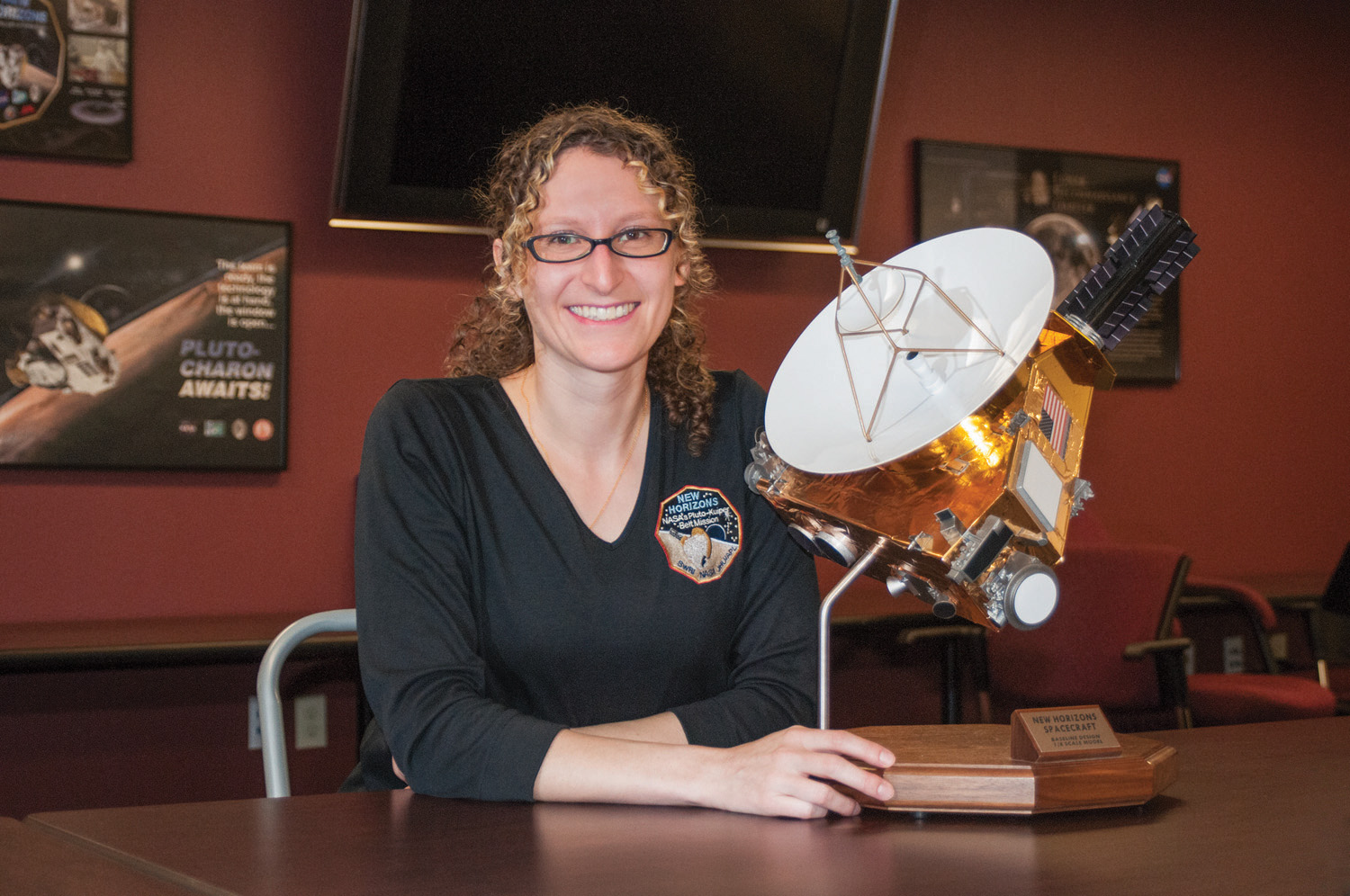
Kelsi SingerThe 2019 Harold C. Urey Prize for outstanding achievement in planetary research by a young scientist is awarded to Dr. Kelsi Singer (Southwest Research Institute) in recognition of her work in impact cratering and in the geology and geophysics of icy worlds. In one paper, she used Cassini observations of Iapetus to create a catalog of landslide data and tested theories of long-runout landslides. Dr. Singer also used secondary craters on Europa and Ganymede to produce size-frequency and size-velocity distributions for icy blocks that revealed fundamental scaling relationships. In recent work, she used the cratering record on Pluto and Charon to determine that there is a deficit of small objects in the Kuiper Belt, with implications for the collisional history of the Kuiper belt and planetesimal formation. Dr Singer’s work is meticulous, rigorous, and insightful. In the best tradition of scientific brilliance, she examines data with an open mind, considers multiple theories, follows those theories to their logical conclusions, quantifies her uncertainties, and applies healthy skepticism toward her results.  Photo credit: Rayna Tedford
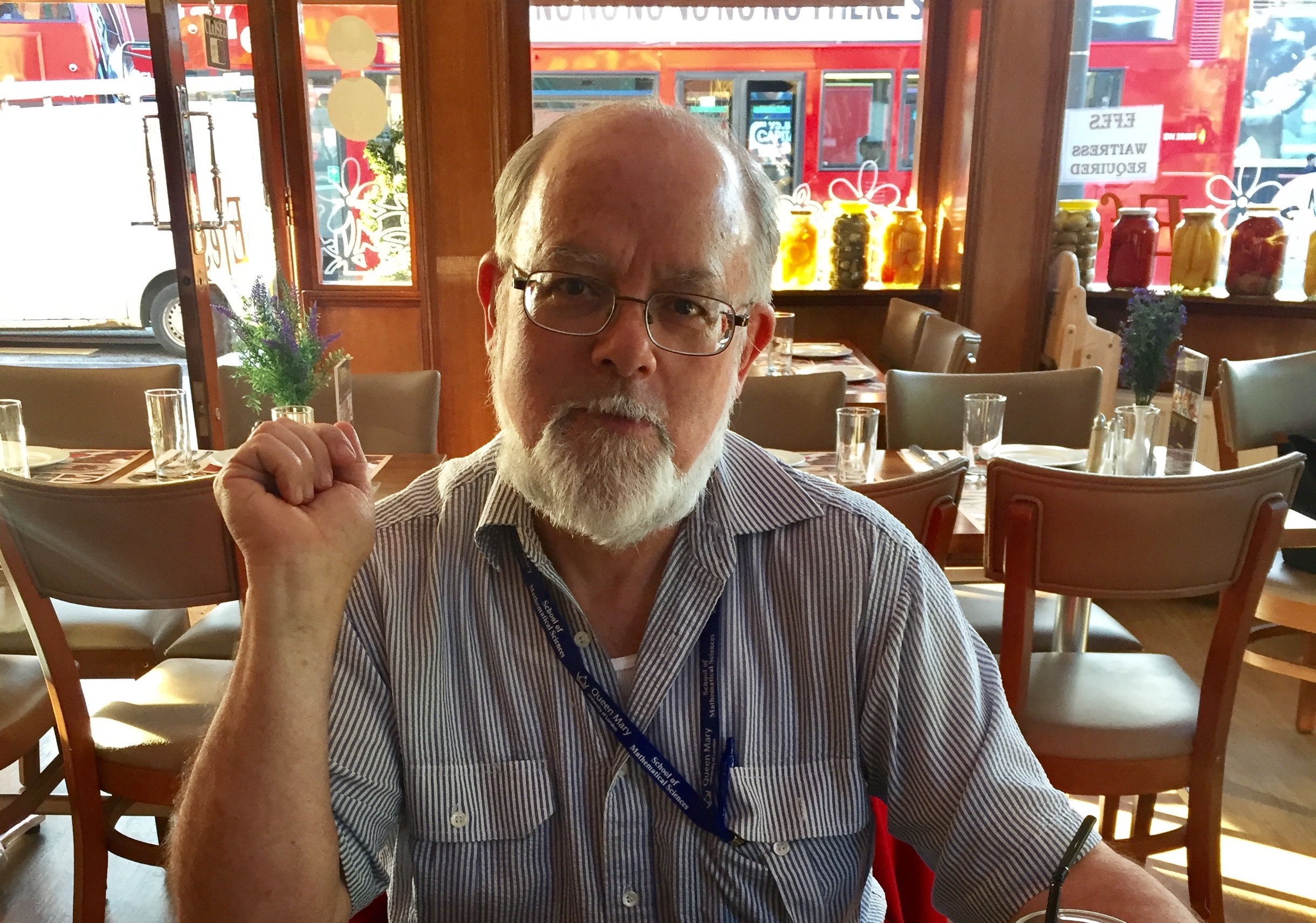
Phil NicholsonThe 2019 Harold Masursky Award for meritorious service to planetary science goes to Dr. Phil Nicholson (Cornell University). A highlight of his service to the community has been his role as Editor in Chief of Icarus for 20 years. During his tenure he improved the experience for authors, reduced time to publication, and increased access. Dr. Nicholson was dedicated to the integrity of the peer review process; he gave everyone the chance to have their voice heard. His work as Editor in Chief, in addition to his full load of teaching and research duties — as well as his volunteer efforts on numerous committees and review panels — makes him an icon of service to the planetary science community.
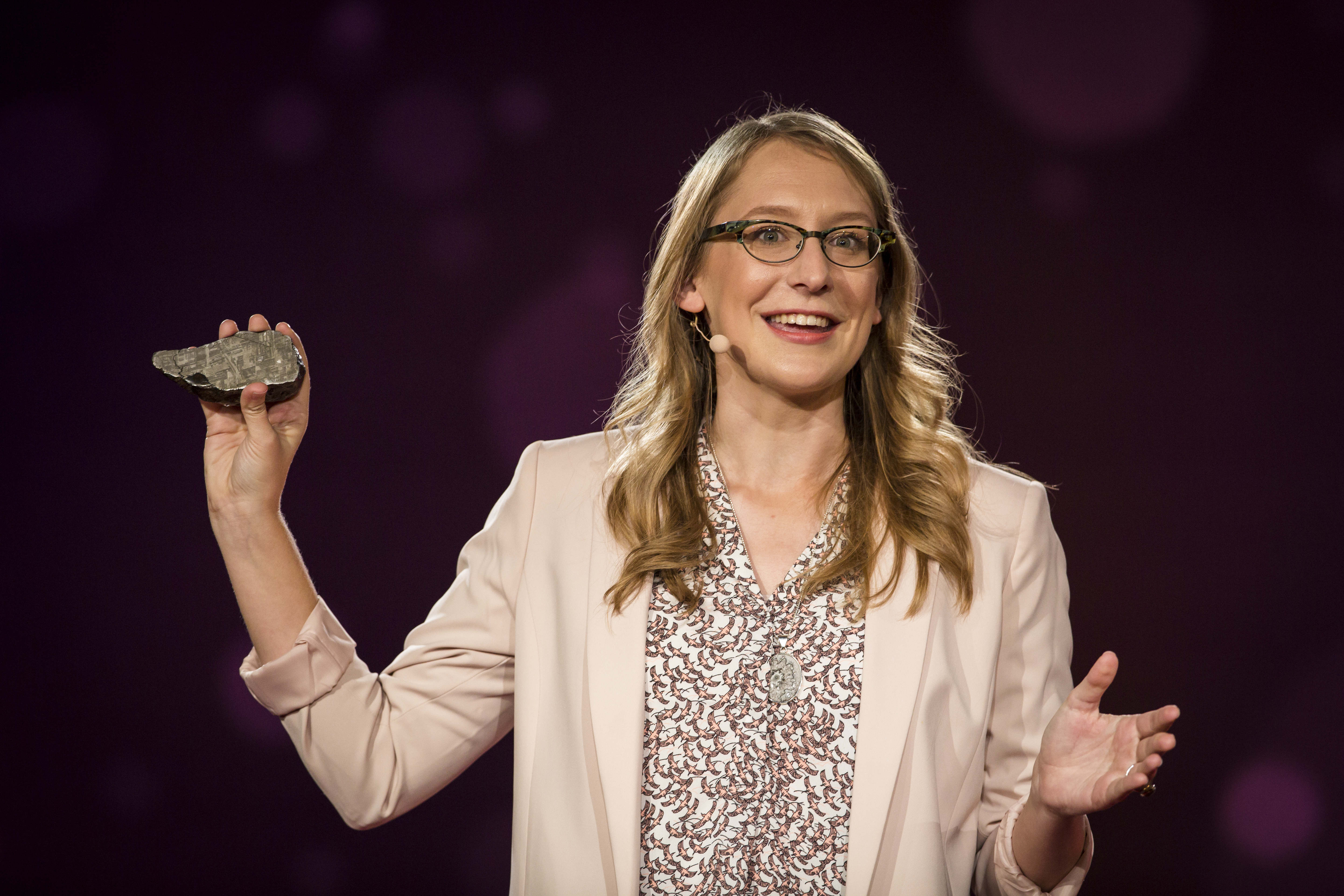
Carrie NugentThe 2019 Carl Sagan Medal for excellence in public communication goes to Dr. Carrie Nugent (Olin College) for her compelling and effective outreach to a worldwide audience. In her highly rated Spacepod podcast, Dr. Nugent interviews other scientists about their work, providing the public with a wide and deep view of planetary science research. Through Spacepod, she has enabled hundreds of members of our community to share their science with the public. Dr. Nugent is an engaging speaker with more than 1.3 million views of her TED talk on asteroid hunting. She uses clear, evocative language to make solar system discoveries accessible to people of all ages and backgrounds.
Rebecca BoyleThe 2019 Jonathan Eberhart Planetary Science Journalism Award for distinguished popular writing goes to Rebecca Boyle for her article “Pictures of Worlds to Come” in the December 6, 2018, issue of Nature. In this eloquently written feature, Rebecca explores the rapidly evolving field of planet formation, which lies at the intersection of planetary science and other branches of astronomy. She brings to light the giant strides being made in imaging protoplanetary disks by vividly describing the extremely detailed images taken by the Atacama Large Millimeter/submillimeter Array and other facilities. She addresses the challenges presented by such observations to theories about planet formation and how researchers are working on reconciling those. Rebecca beautifully wraps together historical insights, the latest science, and potential paths forward to paint a vibrant picture of this exciting field.

“It’s a pleasure to honor such deserving people with DPS prizes,” says DPS Chair Dr. Linda Spilker (Jet Propulsion Laboratory). “I’m proud that our organization recognizes excellence in so many areas of endeavor, including scientific research at different career stages, service to our community, and outreach through direct interaction with — and inspiring writing for — an enthusiastic public.”

The 2019 DPS prizes will be presented at the joint 51st meeting of the Division for Planetary Sciences and 14th European Planetary Science Congress (EPSC) in Geneva, Switzerland, 15-20 September 2019.

Contacts:

Dr. Shantanu Naidu

DPS Press Officer

+1 (917) 373-8840

[email protected]

Dr. Linda Spilker

DPS Chair

+1 (818) 354-1647

[email protected]

More information about DPS prizes:

prizes

EPSC-DPS Joint Meeting 2019, Geneva, 15-20 September 2019:

https://www.epsc-dps2019.eu/home.html

The Division for Planetary Sciences (DPS), founded in 1968, is the largest special-interest Division of the American Astronomical Society (AAS). Members of the DPS study the bodies of our own solar system, from planets and moons to comets and asteroids, and all other solar-system objects and processes. With the discovery that planets exist around other stars, the DPS has expanded its scope to include the study of extrasolar planetary systems as well.

Newsletter 19-22

Issue 19-22, May 30, 2019


+————————————CONTENTS—————————————-+

  1. AAS DIVISION FOR PLANETARY SCIENCES 2019 PRIZES
  2. TITAN AFTER CASSINI-HUYGENS WORKSHOP: JUNE 9TH ABSTRACT AND REGISTRATION DEADLINE
  3. WORKSHOP ON SMALL SOLAR SYSTEM BODIES
  4. PLANETARY CRATER CONSORTIUM MEETING
  5. SBAG 21 MEETING REGISTRATION
  6. SECOND ANNOUNCEMENT: ICARUS SPECIAL ISSUE ON THE PLUTO SYSTEM, KUIPER BELT & KUIPER BELT OBJECTS SPECIAL ISSUE— DEADLINE 15 SEPTEMBER 2019 
  7. SOFTWARE SYSTEMS FOR ASTRONOMY – REGISTRATION OPEN

+——————————————————————————————–+


1———1———1———1———1———1———1———1———1———1

AAS DIVISION FOR PLANETARY SCIENCES 2019 PRIZES


The DPS is pleased to announce its 2019 prize winners.


Gerard P. Kuiper Prize – Maria Zuber

DPS awards the 2019 Gerard P. Kuiper Prize for outstanding contributions to the field of planetary science to Maria Zuber (MIT) for her contributions to advancements in geophysics, planetary gravity mapping, and laser altimetry. One example of her seminal contributions includes her paper in Science in 2000 combining Mars Global Surveyor laser altimetry data and gravity data to determine the crustal and upper mantle structure of Mars. Another example is her leadership as principal investigator of the GRAIL mission to construct a model of the Moon’s gravitational field to spherical harmonic degree 1,800, which exceeds the baseline requirement of the mission by an order of magnitude. Dr. Zuber has turned her attention to many different solid bodies in the solar system including Mercury, Venus, Eros, Vesta, and Ceres. Over the years she has advised a number of students and postdocs, and one reports that she strikes the perfect balance of being demanding, supportive, encouraging, and open minded.

Harold C. Urey Prize – Kelsi Singer

DPS awards the 2019 Harold C. Urey Prize for outstanding achievement in planetary research by a young scientist to Kelsi Singer (SwRI). We award this prize in recognition of Dr. Singer’s work in impact cratering and in the geology and geophysics of icy worlds. In one paper, she used Cassini observations of Iapetus to create a catalog of landslide data and tested theories of long-runout landslides. Dr. Singer also used secondary craters on Europa and Ganymede to produce size-frequency and size-velocity distributions for icy blocks that revealed fundamental scaling relationships. In recent work, she used the cratering record on Pluto and Charon to determine that there is a deficit of small objects in the Kuiper Belt, with implications for the collisional history of the Kuiper belt and planetesimal formation. Dr Singer’s work is meticulous, rigorous, and insightful. In the best tradition of scientific brilliance, she examines data with an open mind, considers multiple theories, follows those theories to their logical conclusions, quantifies her uncertainties, and applies healthy skepticism toward her results.

Harold Masursky Award – Phil Nicholson

DPS awards the 2019 Harold Masursky Award for meritorious service to planetary science to Phil Nicholson (Cornell University). A highlight of his service to the community has been his role as Editor in Chief of Icarus for 20 years. During his tenure he improved the experience for authors, reduced time to publication, and increased access. Dr. Nicholson was dedicated to the integrity of the peer review process; he gave everyone the chance to have their voice heard. His work as Editor in Chief, in addition to his full load of teaching and research duties — as well as his volunteer efforts on numerous committees and review panels — makes him an icon of service to the planetary science community.

Carl Sagan Medal – Carrie Nugent

DPS awards the 2019 Carl Sagan Medal for excellence in public communication to Carrie Nugent (Olin College) for her compelling and effective outreach to a worldwide audience. In her highly rated Spacepod podcast, Dr. Nugent interviews other scientists about their work, providing the public with a wide and deep view of planetary science research. Through Spacepod, she has enabled hundreds of members of our community to share their science with the public. Dr. Nugent is an engaging speaker with more than 1.3 million views of her TED talk on asteroid hunting. She uses clear, evocative language to make solar system discoveries accessible to people of all ages and backgrounds.

Jonathan Eberhart Planetary Science Journalism Award – Rebecca Boyle

The Jonathan Eberhart Planetary Science Journalism Award for distinguished popular writing goes to Rebecca Boyle for her article “Pictures of Worlds to Come” in the December 6, 2018, issue of Nature. In this eloquently written feature, Rebecca explores the rapidly evolving field of planet formation, which lies at the intersection of planetary science and other branches of astronomy. She brings to light the giant strides being made in imaging protoplanetary disks by vividly describing the extremely detailed images taken by the Atacama Large Millimeter/submillimeter Array and other facilities. She addresses the challenges presented by such observations to theories about planet formation and how researchers are working on reconciling those. Rebecca beautifully wraps together historical insights, the latest science, and potential paths forward to paint a vibrant picture of this exciting field.

2———2———2———2———2———2———2———2———2———2

TITAN AFTER CASSINI-HUYGENS WORKSHOP: JUNE 9TH ABSTRACT AND REGISTRATION DEADLINE


This is a reminder of the ‘Titan after Cassini-Huygens’ 3-day workshop to be 

held at the European Space Agency (ESA –European Space Astronomy Centre) 

in Madrid on 23-25 September 2019.


The registration (free) and the abstract submission are open until June 9th. The

registration tool and abstract submission page in addition to further information 

regarding the workshop can be found here: 

https://www.cosmos.esa.int/web/titan-after-cassini-huygens/home 


The workshop will include past and new science focusing on the fields and studies

of magnetospheric & atmospheric science, geology, geophysics, astrobiology,

Earth-based observations, future missions and more. 

Given the cancellation of the APL Cassini meeting, the organizing committee has 

decided to welcome papers that were intended to be presented at the APL meeting

for which (pending participation) we will dedicate an afternoon session focused on

other aspects of the Saturnian system.


We look forward to see you all in Madrid! 


The organizing committee:

Anezina Solomonidou (local)

Nicolas Altobelli (local)

Thomas Cornet (local)

Japheth Yates (local)

Rosaly Lopes (JPL)

Athena Coustenis (Obs. Paris)

Conor Nixon (Goddard) 

Alice Le Gall (LATMOS)

Steve Vance (JPL)


3———3———3———3———3———3———3———3———3———3

WORKSHOP ON SMALL SOLAR SYSTEM BODIES


Dear Colleagues, 


We would like to advert attention to a workshop devoted to the research on

small Solar system bodies which will take place in Akdeniz University, Antalya,

Turkey, on September 4-6, 2019. 


The workshop aim is to shorten the gap for astronomers in understanding the

contemporary problems in dynamics and physics and the requirements set up

to observations. We plan to discuss the synergy of dynamics and physics of these

bodies, giving the possibility for analysis of their observations and the corresponding

follow-up programs. 


The workshop website is opened: www.asteroid2019.space  


Topics:

– Small Solar System bodies and natural satellites

– Analysis of their observations (astrometry, photometry, polarimetry, spectroscopy, occultations)
– Gaia catalog and Large Synoptic Survey Telescope

– Follow up programs 


Keynote speakers abstract submission: July 1

Abstract on-line submission: August 4 


The poster is also available https://asteroid2019.space/wp-content/uploads/2019/05/poster_A2_good.pdf  

We kindly ask you to distribute this info to all possibly interested colleagues. 


Sincerely, Dr. Anatoliy Ivantsov (Akdeniz University, SOC chair)

Dr. Daniel Hestroffer (Paris Observatory, SOC co-chair) 


4———4———4———4———4———4———4———4———4———4

PLANETARY CRATER CONSORTIUM MEETING


The 10th Planetary Crater Consortium meeting will be held August 7-9, 2019,

 at the US Geological Survey in Flagstaff, AZ. The Planetary Crater Consortium

is open to all planetary scientists interested in any aspect of impact cratering on

solar system bodies (including Earth!), incorporating observational, theoretical,

experimental, field, and/or numerical studies. The meeting is a combination of

contributed talks, posters, and open discussion and is designed to encourage and

provide adequate time for in-depth discussion of crater-related issues and topics

to enhance research collaborations. Abstract deadline is Monday, June 24, 2019.

An optional field trip around the rim of Meteor Crater will be arranged for

Saturday, August 10, 2019, if there is sufficient interest expressed by meeting

participants by June 15, 2019.


For more information, see www.planetarycraterconsortium.nau.edu/

or contact Nadine Barlow ([email protected]).


5———5———5———5———5———5———5———5———5———5

SBAG 21 MEETING REGISTRATION


Hello SBAG Community,


Registration and hotel block booking information is now live for SBAG 21

to be held June 24-25, 2019 in College Park, MD:

http://www.cvent.com/events/21st-nasa-small-bodies-assessment-group-meeting/event-summary-ae650c2597d94c3a8ce14538c06d3631.aspx


The Adobe Connect information will be available closer to the meeting.


Hannah Susorney

SBAG Early Career Secretary 


6———6———6———6———6———6———6———6———6———6

SECOND ANNOUNCEMENT: ICARUS SPECIAL ISSUE ON THE PLUTO SYSTEM, KUIPER BELT & KUIPER BELT OBJECTS SPECIAL ISSUE— DEADLINE 15 SEPTEMBER 2019 


Icarus is sponsoring a special issue on results related to the exploration of the

Pluto system, the Kuiper Belt, and Kuiper Belt Objects, particularly by New

Horizons, groundbased techniques, and NASA NFDAP projects. Papers are

solicited from authors across the planetary science community. The deadline

for this special issue is 15 September 2019. 


Alan Stern Principal Investigator, New Horizons 

Rosaly Lopes Editor, Icarus


7———7———7———7———7———7———7———7———7———7

SOFTWARE SYSTEMS FOR ASTRONOMY – REGISTRATION OPEN


Please note that registration is now open for the summer school in Software Systems 

for Astronomy (SSfA-6).  The course will take place 15-Jul to 26-Jul, 2019, on the 

Big Island of Hawaii.  The course covers software design and implementation of 

telescope and instrument control systems, observation planning tools, and software

for analyzing and archiving astronomical data. 


If you are not a UHH student, use this link to register:


  https://hilo.hawaii.edu/depts/summer/SummerAdmissions.php


If you are a UHH student, use this link to register:


   https://hilo.hawaii.edu/depts/summer/SummerCourseRegistration.php


More information can be found here:  
 

http://astro.uhh.hawaii.edu/Summer/Summer-2019/ssfa19.php


Direct questions to [email protected]


———————————+

Send submissions to: 

Anne Verbiscer, DPS Secretary ([email protected]


You are receiving this email because you are a DPS member.

To unsubscribe or update your information, please send your request

to [email protected]. The more general AAS privacy policy is available

online at https://aas.org/about/policies/privacy-policy. Current and back

issues of the DPS Newsletter can be found at newsletters